Showing posts with label Italy. Show all posts

Monday, October 26, 2026

Photographs: Operation Baytown, Invasion of Italy, 1943 (1)

Invasion of Mainland Italy, September 3, 1943 and Landings

at Charlie Beach, by Canadian 80th Flotilla Landing Crafts

NA 6149 - Original wartime caption: A picture which shows the complete
accord with which Allied soldiers have been received by the people of Sicily.
This Sgt. Major of the Highland Division held no terrors for this charming
Sicilian who greeted him with grapes, and a ready welcome to Messina.
Credit - Photographer Chetwyn, Leonard Production date - 1943-08-30
Imperial War Museum (IWM)

Introduction:

According to news reports of the time the Canadian Navy was represented in the Mediterranean in 1943 (serving in Operation HUSKY, the invasion of Sicily beginning July 10, and Operation BAYTOWN and AVALANCHE, the invasion of Italy beginning September 3 at the toe of the boot and September 9 at Salerno on the shin) by 400 Canadian sailors, many in RCNVR and Combined Operations. The Imperial War Museum (IWM), London, England, claims to possess over 11,000,000 WWII photographs and I was very happy to locate a good handful related to Operation BAYTOWN taken by productive photographers, a few of whom will already be familiar to readers who have found good collections of pictures shared on this site re Operation TORCH and HUSKY already. 

Lt. L. Chetwyn (link to his collection - Chetwyn, Leonard) provides the first and last two photographs in the series in this post and Sgt. Palmer, also a member of No. 2 Army Film and Photo Section, Army Film and Photographic Unit, provides the rest. More photographs will be shared from this series in a second post.

Based on the first two photographs the series looks like 'all sweets and goodness' but that's before the bombardment of the toe of the boot began in the early morning of September 3rd.

"(We) attacked Italy at Reggio di Calabria across Messina Straits... there was no resistance. The air force had done a complete job and there wasn’t a whole building standing and the railroad yards were ripped to shreds. How long we worked across the straits I cannot really recall, but perhaps into October." (From "Dad, Well Done" Navy memoirs by Doug Harrison, RCNVR/Combined Operations, page 35)

And now for one last look at the "sweets" before the bombardment. All photographs are found at the Imperial War Museum (IWM):

Heading - SICILY : "SWEETS" FOR THE SERGEANT MAJOR

NA 6150 - A picture which shows the complete accord with which the
Allied soldiers have been received by the people of Sicily. This Sgt. Major
of the Highland Division held no terrors for this charming Sicilian who
greeted him with grapes, and a ready welcome to Messina. 
Photo - L. Chetwyn, No. 2 AFPU (IWM)


Heading - FIRST PICTURES OF THE INVASION OF THE ITALIAN MAINLAND

NA 6151 - From Messina, Sicily, medium guns of the Scottish Horse
bombard the Italian mainland prior to the initial landings. Photographer -
Imperial War Museum (IWM)


About 'the Scottish Horse' as mentioned above on side B of photo NA 6151. At Wikipedia we can glean some details re so-named artillery regiment:

"The Scottish Horse was a Yeomanry regiment of the British Army's Territorial Army raised in 1900 for service in the Second Boer War. It saw heavy fighting in both the First World War, as the 13th Battalion, Black Watch, and in the Second World War, as part of the Royal Artillery." (More details @ Wikipedia)

Howitzers of the 79th (The Scottish Horse) Medium Regiment during a
training exercise, Banffshire, Scotland (May 1941) Credit - Wikipedia

Please click here to read more from the Regimental Scottish Horse Archives.

Heading - THE ALLIED LANDINGS IN ITALY, SEPTEMBER 1943: REGGIO, TARANTO AND SALERNO

NA 6152 - Reggio, 3 September 1943 (Operation Baytown): British
artillery bombards the Italian mainland from Messina in Sicily prior to
the initial landings at Reggio. Photo - Sgt. Palmer No. 2 AFPU. IWM


Heading - FIRST PICTURES OF THE INVASION OF THE ITALIAN MAINLAND

NA 6153 - From Messina, Sicily, medium guns of the Scottish Horse
bombard the Italian mainland prior to the initial landings.
Photo - Sgt. Palmer No. 2 AFPU. IWM


NA 6154 - Seated on a wall overlooking the harbour (at Messina)
troops watch the Invasion craft leaving for Italy.
Photo - Sgt. Palmer No. 2 AFPU. IWM


About the invasion craft leaving for Italy, one sailor manning a landing craft mechanised (LCM) as a member of the 80th Flotilla of Canadian LCMs writes: 

 It was no different touching down on the Italian beach at Reggio di Calabria at around midnight, September 3, 1943 than on previous invasions.

Naturally we felt our way slowly to our landing place. Everything was strangely quiet and we Canadian sailors were quite tense, expecting to be fired upon, but we touched down safely, discharged our cargo and left as orderly and quietly as possible.

In the morning light on our second trip to Italy across seven miles of the Messina Straits
(7 miles equals a round trip? GH Editor) we saw how the Allied artillery barrage across the straits had levelled every conceivable thing; not a thing moved, the devastation was unbelievable and from day one we had no problems; it was easy come, easy go from Sicily to Italy. (From "Dad, Well Done" by Doug Harrison, page 114)

NA 6155 - The scene as amphibious "Ducks" enter the water at Messina,
loaded with men and equipment. Photo - Sgt. Palmer No. 2 AFPU. IWM


NA 6156 - The scene as amphibious "Ducks" enter the water at Messina,
loaded with men and equipment. Photo - Sgt. Palmer No. 2 AFPU. IWM


Please note the large stone or cement blocks at the lower left corner of the above photo. There were such blocks in a photo re WWII and landing crafts in the Allied Invasion of Sicily WWII Museum in Catania when my son and I visited Sicily in 2023:

The landing craft above seem to be going in the same direction as those
in Sgt. Palmer's photos. Same day (Sept. 3, 1943)? More details needed. 

Below are my own photographs taken from the beach at Mili Marina, south of the city of Messina, Sept. 2023, 80 years later:

Was this spot in Mili Marina used by Allied forces to embark to Italy's
mainland on Sept. 3, 1943? It's very possible. (Or a spot close by).

Compare the coastline and background hills of Italy at Reggio di Calabria (straight across the strait) in the following photos and that of the children with the best (stone) seats in town:

I am opposite Reggio di Calabria in late September, 2023. GH

Photo Credit GH

Pictures taken by Sgt. Palmer continue:

Heading - THE ALLIED LANDINGS IN ITALY, SEPTEMBER 1943: REGGIO, TARANTO AND SALERNO

NA 6157 - Reggio, 3 September 1943 (Operation Baytown): Amphibious
DUKWs loaded with men and equipment, enter the water at Messina in Sicily
to cross to the Italian mainland. Photo - Palmer, Roy H. No. 2 AFPU. IWM


NA 6158 - The scene as amphibious "Ducks" enter the water at Messina,
loaded with men and equipment. Sgt. Palmer No. 2 AFPU. IWM


NA 6159 - The scene as amphibious "Ducks" enter the water at Messina,
loaded with men and equipment. Sgt. Palmer No. 2 AFPU. IWM


Heading - THE BRITISH ARMY IN NORTH AFRICA, SICILY, ITALY, THE BALKANS AND AUSTRIA 1942-1946

NA 6160 - Infantry marching through the streets of Messina to embark
on Invasion craft. Photo - Leonard Chetwyn, No. 2 AFPU. IWM


NA 6161 - Infantry marching through the streets of Messina to embark
on Invasion craft. Photo - Chetwyn, Leonard, No. 2 AFPU. IWM


My son and I marched "through the streets of Messina" as well! It is a city that demands a return visit.


Literally from "the streets of Messina." GH

More photographs will follow in the near future.

Unattributed Photos GH

Friday, March 13, 2020

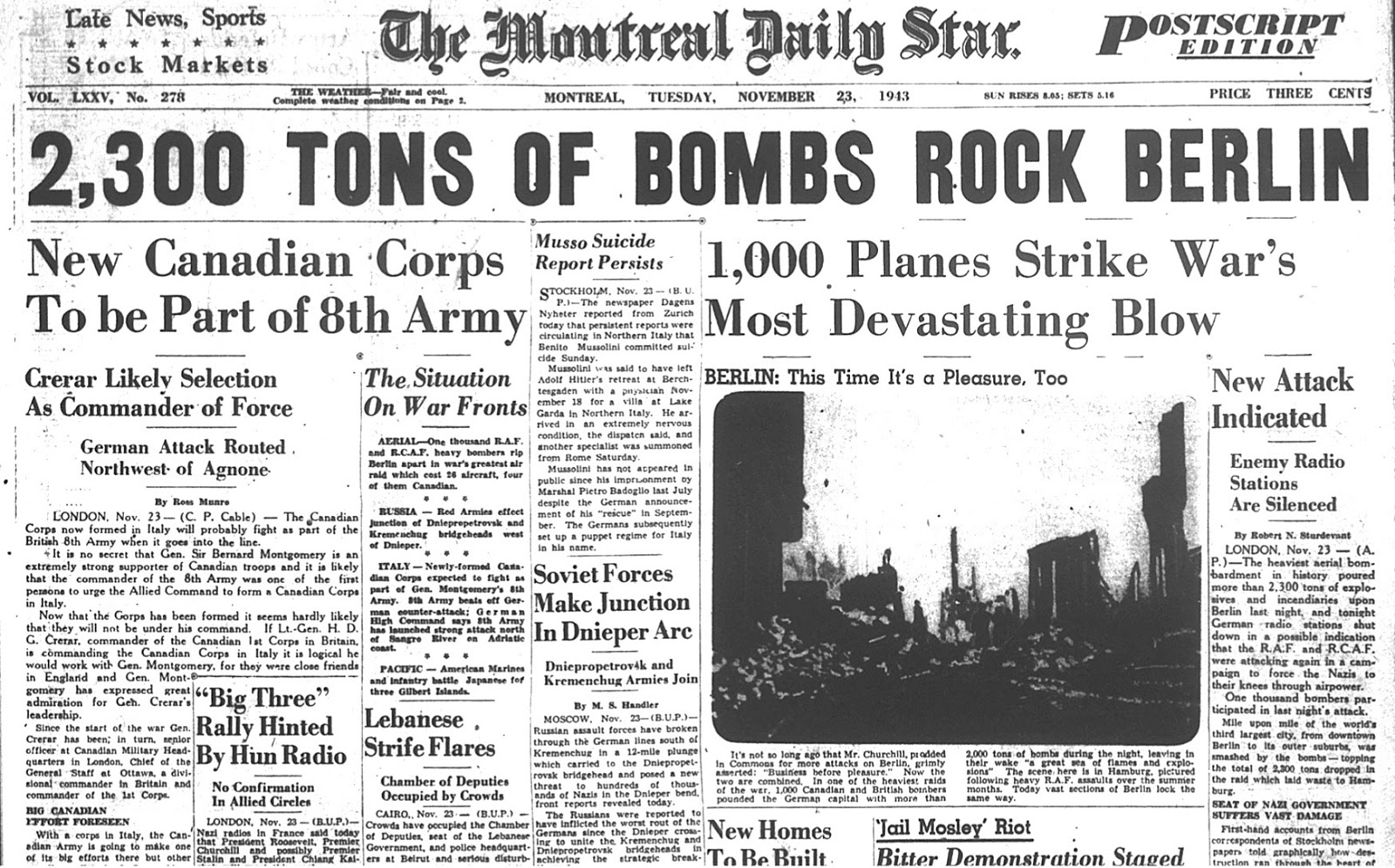
Editor's Research: Invasion of Italy (29) - Montreal Star (Nov. 23-25, '43)

The Slog Continues and Berlin is Getting Blasted 

'Bomber' Harris is getting his wish. "Blast 'em, Boys. Let's end the war." 

Introduction:

I tip my hat to The Montreal Star, its war correspondents (including Sholto Watt, he really gets around), and large team, for getting out a newspaper on a steady basis filled to the brim with a variety of updates from various war fronts.

As well, there is a stream of other news that helps provide a context for the Canadians in Combined Operations who are finished their role in Italy and have steamed back to ports in North Africa aboard their flotilla of landing crafts. By this time in November, 1943, the members of RCNVR and Combined Operations may already be in the United Kingdom, e.g., at HMS Folliot, and making plans for what they would do on their upcoming extended leave, which included for many a trip back to Canada with a fat pay packet.

In the stream of news that follows, one will find information about "the war's greatest air raid", and read that "Old Blood and Guts Patton" actually made an apology. We also learn that more Canadians are heading overseas, men and women, ably reported by 29-year-old Douglas Amaron, a CP war correspondent from Quebec City.

The following news clippings, editorial features and cartoons, artistic ads, etc. are all from the November 23 - 25, 1943, issues of The Montreal Star, available on microfilm at the University of Western Ontario.

Any questions or concerns can be directed to me at gordh7700@gmail.com: I will make every effort to reply promptly.


I clip just about every item from the desk or typewriter of Ross Munro, a very active and well-informed war correspondent with Canadian Press. In the report that follows, Mr. Munro includes details provided by Sholto Watt of The Star:


I don't think I have clipped many items from American writers but I will keep my eyes open for more from Gladwin Hill, for certain:


Regular readers of this site will likely know that I am all in favour of columns like the one below. Yes, it is by a Canadian writer. And, while reading we are introduced to many Canadians by name and address, basic details that may lead readers to a close or relative involved in WWII:


Patton was and is admired by many. But not all he did deserves praise:


Heavily damaged in September, the Tirpitz, Germany's largest battleship, is being moved for repairs. Would it arrive safely? Would it be repaired and return to service?


The following related information is listed on an online source:

On 12 November 1944, British Lancaster bombers equipped with 12,000-pound (5,400 kg) "Tallboy" bombs scored two direct hits and a near miss which caused the ship to capsize rapidly. A deck fire spread to the ammunition magazine for one of the main battery turrets, which caused a large explosion. Figures for the number of men killed in the attack range from 950 to 1,204. Between 1948 and 1957, the wreck was broken up by a joint Norwegian and German salvage operation. Wikipedia

I don't think I have seen anything in The Star about the November 12 attack but will keep my eyes peeled.

I include the following article because of its link to Dieppe and Sicilian battles, both events in which Canadians in Combined Operations (C.Ops.) were active, and at Dieppe many Canadians were taken prisoner, including a few members of C.Ops.

As well, besides the useful fact it contains many names and home addresses of troops, one member of C.Ops. who went to the U.K. in the first draft of Canadians in C. Ops., got married to a Scottish woman in Glasgow... and I have their wedding photo:


Eight Canadians from the first draft of RCNVR volunteers for C. Ops.
Location - HMS Northney (camp) on Hayling Island. Spring 1942
L-R: Al Adlington, Joe Spencer, Chuck Rose, Doug Harrison,
Art Bradfield, Don Linder, Joe Watson, Jake Jacobs.

Wedding Day. L-R: C. Rose, Al Adlington, Mary Adlington, Mary's sister
Mary came to Canada aboard the Isle de France (She told me so!)


Thousands upon thousands of landing craft - of all sizes, for troops, and trucks and tanks, etc. - were needed by Allied forces during WWII. Some used at Dieppe were made of plywood (e.g., some Higgins' boats) and couldn't stop a bullet, but still proved useful in many circumstances:


More news now follows, some about surprises. E.g., "What did Goering say?" And, "Who is that knocking on my door?"


How could you beat this surprise?


The Canadian Navy was growing stronger and contributing in many ways to ultimate Allied victory:


I include this next story because it reminds me of a young Al Kirby of Woodstock, who in late 1941, volunteered for Combined Operations while at HMCS Stadacona in Halifax. Al may have influenced several others to do so, including my father, because he had become enthusiastically interested in small, fast motor-torpedo boats (MTBs) while taking an RCNVR course.  

About my father's entry into Combined Operations at the same time and place, I read the following in his Navy memoirs:

     Time passed quickly at Stadacona in Halifax and by this time (i.e., late 1941) nearly everyone had paired off in threes, as buddies, or in naval language, as ‘oppo.’

     One day we heard a mess deck buzz or rumour that the navy was looking for volunteers for special duties overseas, with nine days leave thrown in. Many from the Effingham Division, including myself, once again volunteered. (Will I ever quit volunteering?) The buzz turned out to be true and we came home on leave, which involved three days coming home on a train, three days at home and three days on the train going back.


Page 8, "Dad, Well Done"

The buzz or rumour may have started with young Kirby. About that same time he writes the following:

     In December of 1941, I was finishing my Seaman Torpedo Course at the Torpedo School in Halifax Dockyard, when I saw on the bulletin board, a notice asking for volunteers to go to England to train with the Royal Navy for hazardous duties on small craft.

     I immediately thought, "MTBs". Now that sounded very exciting to a 17 year old RCN Boy Seaman, so I reported to the RPO and applied. The only qualification was that you be single and warm.

Page 9, The Yardarm, Vol 5. Number 1 

Once in the United Kingdom, e.g., at HMS Northney (camp), the first volunteers for Combined Operations learned they would be training aboard landing crafts, not MTBs. Had Al Kirby waited a couple of years, he might have got his wish.


Please note: In the 4th paragraph above, under the sub-heading 'Aided in Sicily', we read that "two complete Canadian landing craft flotillas helped land the British 8th Army in Sicily."

According to stories, records and maps in "Combined Operations" by Londoner Clayton Marks, there were in fact 4 Canadian Flotillas of Landing Craft at work in Sicily, i.e., the 55th and 61st Flotillas of Assault Landing Craft (ALCs, troops carriers), and the 80th and 81st Flotillas of Landing Craft, Mechanised (LCMs, larger than ALCs, used to transport troops and much of the material of war) 

Map found in Combined Operations. Dad worked aboard
 LCMs for a period of about 30 days in Sicily, near Avola


As the sick and wounded were returned to Canada, out came the stories re their survival and some of the indignities suffered...


The Red Cross provided invaluable services. In Ticket to Hell via Dieppe (From A Prisoner's Wartime Log, 1942 - 1945 by A. Robert Prouse) one reads that many parcels did not make it to the POWs. The Germans ate the food.

Readers can find significant passages from Prouse's detailed book by linking to Passages: Ticket to Hell.


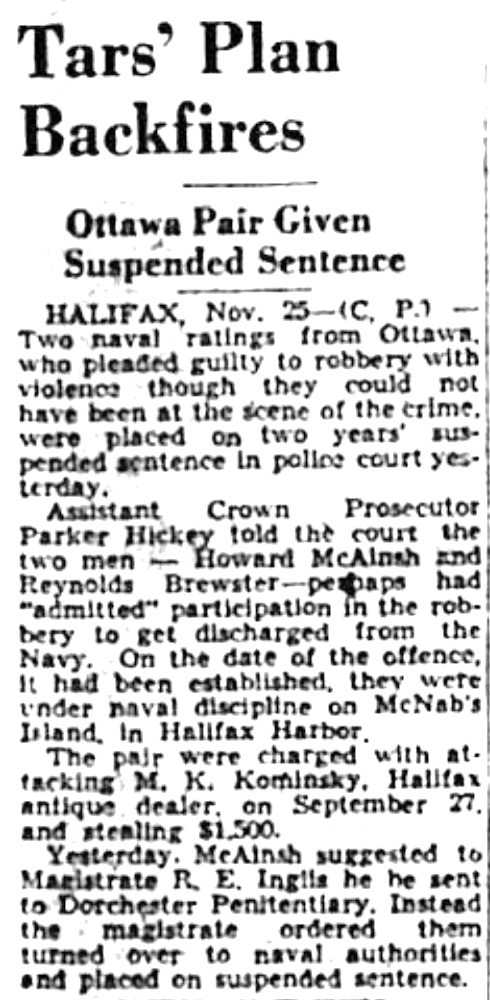
I guess the lesson learned by the troubled tars is... if you want out of the Navy then do not volunteer in the first place. 

More from November and December will follow.

Please link to Editor's Research: Invasion of Italy (28) - Montreal Star (Nov. 18-22, '43)

Unattributed Photos GH