Monday, May 30, 2016

Photographs: "The Spit" at Comox, Vancouver Island, BC

HMCS Givenchy III, The Spit: From the 1930s to 2016

Aerial shot of The Spit from 1930s. Photo credit - Comox Library

I visited HMCS Quadra recently, the Canadian Navy base formerly known as HMCS Givenchy III (as well as 'The Spit' and 'Cowards Cove' in my father's naval memoirs). It was a Combined Operations training ground during WW2, and while I was there I hoped to gain a better understanding of the context and setting of some of my father's photos from 1944 - 45.

I walked twice around as well as onto The Spit (I ignored a few of many DND "No Trespassing" signs) and talked with a local woman familiar with the location of the 1940s baseball diamond where the Navy Number 1 team practised their batting and ball-handling skills, at the time not far from government oyster beds and wood booms.

I came home with the knowledge there would have been several reasons why my father thought the area was like heaven on earth.

 My plane looks toward The Spit. Comox is to the right, Courtenay beyond it.

 Buildings (some WW2 era) used by HMCS Quadra (Sea Cadets) dot The Spit

 Three mates (D. Harrison, centre) relax, 1944. Town of Comox in background.

I relax on The Spit, similar location, i.e., opposite Comox, 72 years later

 My father, centre, enjoys time off near the end of The Spit

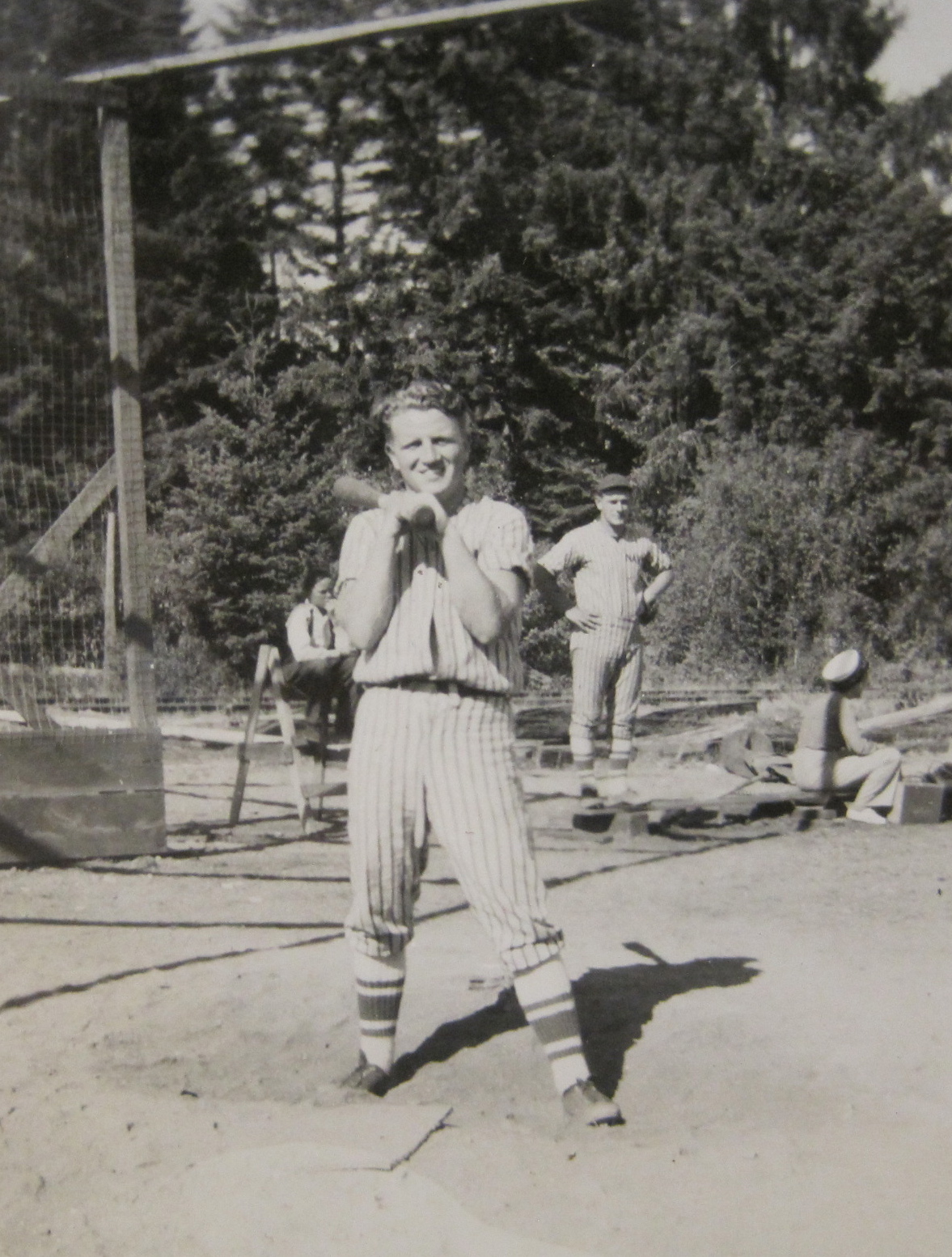
"Batter up!" Practice field with ball screen, rudimentary benches - on the Spit.
Bill Grycan stands behind Dad. Railroad tracks appear in background

 Navy No. 1 Team, likely at Lewis Park, Courtenay

No date on card. Credit - Ian Douglas, Vancouver Island Postcards

Please view photographs related to Canadians in Combined Ops on the East Coast, i.e., Halifax, NS. Link - Presentation: Photo Gallery (1)

Unattributed Photos by GH

Wednesday, May 11, 2016

Presentation: Dad's Navy Days Part 4 (2)

Dad's Navy Days, 1941 - 1945

By G. A. Harrison

D. Harrison on sentry duty, HMS Northney. Circa January 1942

Introduction: The following post will be part of a Nov. 2016 presentation regarding my father's WW2 service with the RCNVR and Combined Operations organization.

MY DAD'S NAVY DAYS

Part 4 - Combined Operations Training in the UK

I - Initial Combined Ops Training in Southern England

How long the new Canadian recruits stayed at HMCS Niobe on the Clyde River is not known at this time but it sounds like for only a few days. Then they were sent packing to various Combined Ops training camps on Hayling Island on the southern coast of England.

My father Doug Harrison writes:

We spent little time at Niobe but entrained for Havant (editor - adjacent to Hayling Island) in southern England, to H.M.S. Northney 1, a barracks (formerly a summer resort) with a large building for eating and then cabins with four bedrooms. This was December, 1941 or January, 1942 and there was no heat at all in the brick cabins. The toilets all froze and split. But we made out. Our eating quarters were heated. ("DAD, WELL DONE", page 11)


Canadians (from SW Ontario) in Comb. Ops at HMS Northney, Hants, England
Circa January 1942.  From L - R: Allan Adlington (London), Joe Spencer (Toronto),
Chuck Rose (Chippawa), Doug Harrison (Norwich), Art Bradfield (Simcoe),
Don Linder (Kitchener), Joe Watson (Simcoe), J. Jacobs (unknown)
Photo - Credit - From the collection of Joe Spencer 

Lloyd Evans, another Canadian volunteer, writes:

After a few days at the Greenock base we were posted to HMS Northney III on Hayling Island near Portsmouth on the south coast of England. The purpose was training and it was there that we discovered we had 'volunteered' to operate Landing Craft for future raids and landings under the auspices of Combined Ops (Operations). (My Naval Chronicle, page 9)

The young sailors would soon learn that they would spend a good deal of time over the next two years travelling (often by train) to a cluster of Combined Operations establishments spread along the coastlines of SE England and NW Scotland. They would spend a few weeks or months here, another few weeks or months there, and in between training sessions they would participate in raids, e.g., Dieppe, and invasions, e.g., North Africa, Sicily, Italy.

45 locations are listed, 4 or 5 very familiar to Canadians in Comb. Ops

No. 29 - HMS Northney I, II, III, IV. Repair based Combined Ops
Pilotage Parties (C.O.P.P.) Depot. Combined Operations, page 7

Harrison and Evans briefly refer to duties performed while at their first camp. Unfortunately, no mention is made of landing craft exercises. But both do recall lonely nights on sentry duties.

Evans writes:

Some nights I stood guard duty at the end of a long pier as lookout for German raiding parties. In the lonely darkness of the night this inexperienced 18 year old discovered the power of the imagination! It seemed that the end of the watch would never come; I was gaining a sense of the terrible nature of modern warfare as I realized in my imaginings how easily they could be turned into brutal and bloody reality. (Ibid)

Harrison says:

I had the misfortune to break the toe next to my big toe on my left foot. I went to sick bay and someone applied mercurochrome, told me to carry out my usual duties and sent me away. Running, guard duty, anything, I toughed it out.... We were issued brooms for guard duty in some cases at Northney, sometimes a rifle with no ammunition, and they were expecting a German invasion. Rounds were made every night outside by officers to see if we were alert and we would holler like Hell, “Who goes there? Advance and be recognized.” When you hollered loud enough you woke everyone in camp, so sentry duty was not so lonesome for a few minutes. (Ibid)

I'm pretty sure my father was trying out a bit of a joke on the last line. My family calls it 'Harrison humour' and it takes some listeners a while to get the hang of it. Good luck.

Though my father goes on to say "there was no training here (at Hayling Island)", I have found a few lines elsewhere that suggest otherwise, from a young Canadian officer, Kendall 'Happy' Kidder. His story - Small Landing Craft Training - is available online thanks to work done by Geoff Slee, creator of 'Combined Operations Command' (website, Scotland), and various contributors, including the officer's wife, Jill Kidder.

I read:

Training bases for 'small' landing craft were set up at Hayling Island on the south coast of England and at Inveraray in Scotland. The first Canadian flotillas joined the RN in January of 1942. Kendall was posted to HMCS Niobe in Scotland on March 1, 1942. It was the main manning and pay depot for the Canadian Navy in the UK.... a gloomy brick building which had been a mental hospital and was locally known as the 'loony bin.'

As well I read:

The initial drafts from Canada arrived in Scotland and soon were shipped to Hayling Island east of Portsmouth for initial training in the smaller 'landing craft assault', LCA's, for about three weeks. Hayling Island had somewhat the same shape as Portsmouth so on occasions lights in the fields were dimly lit to appear much like Portsmouth to the German bomber pilots. This ruse gave Portsmouth some relief from the daily bombing the civilians suffered. Didn't please the farmers of Hayling Island much to become the target. [contributor Bob Crothers, RCNVR, Combined Ops].

Whether the Canadians participated in duties ("running, guard duty, anything," said my father) or small landing craft training, most agree that after a few weeks they heard an "all aboard" and north to Scotland they did go.

My father writes:

This was to be one of the more memorable camps, with our first actual work and introduction to landing barges.

More to follow.

More information about early training at Hayling Island can be found at an earlier post on this website - Training re Combined Operations, "Havant and Hayling Island"

As well, please link to Presentation: Dad's Navy Days Part 4 (1)

Unattributed Photo - G. Harrison

Tuesday, May 10, 2016

Presentation: Dad's Navy Days Part 4 (1)

Dad's Navy Days, 1941 - 1945

By G. A. Harrison

HMCS Niobe, a Canadian base in Scotland during WW2, was named after
the above ship*. Photo credit - Silver Hawk author

Introduction: The following post will be part of a Nov. 2016 presentation regarding my father's WW2 service with the RCNVR and Combined Operations organization.

MY DAD'S NAVY DAYS

Part 4 - Combined Operations Training in the UK

In January, 1942 the first Canadians to volunteer for Combined Operations once again left Canada, this time aboard the Dutch liner Volendam - in a blizzard of blinding snow, not in resounding cheers - to eventually arrive at barracks called HMCS Niobe in Scotland. 

Al Kirby (RCNVR and Combined Ops) writes:

"It was late in January that we re-embarked (aboard Volendam) to arrive in Scotland and learn that we were destined to join Combined Operations, driving landing craft." (Early Days in Combined Ops)

It appears that although lessons aboard landing craft would begin shortly after their arrival, the first drafts of Canadians learned valuable lessons while being transported across the Atlantic Ocean as well.

The Atlantic Crossing and Safe Landing in Scotland

About what my father describes as "an eventful trip", he writes the following:

The convoy consisted of a destroyer H.M.S. Firedrake, armed merchant ship Jervis Bay (sister ship of the famed Burgess Bay who held off a large German man o’ war until the remainder of its convoy could escape, costing her her life and all aboard) and an American four-stacker loaned by the USA to England. 

The Dutch captain lined us all up and assured us we would arrive safely because the Volendam had already taken three torpedoes and lived to sail. This was very heartening news for those of us who had never been to sea except for a few hours in Halifax upon a mine-sweeper. Our first meal was sausage with lots of grease. Naturally, many were sick as it was very rough. 
            
Late at night I was on watch at our stern and saw a red plume of an explosion on our starboard quarter. In the morning the four-stacker was not to be seen. The next evening I heard cries for help, presumably from a life-raft or life-boat. Although I informed the officer of the watch, we were unable to stop and place ourselves in jeopardy as we only had the Firedrake with ASDIC (sonar) to get us through safely.

After some days we spotted a light on our port stern quarter one night. It was the light of the conning tower of a German submarine. How she failed to detect us, or the Firedrake detect it, I will never know. I was gun layer and nearly fell off the gun (4.7 gauge). I informed the Bridge and the Captain said, “Don’t shoot. Don’t shoot. It could be one of ours.” But as it quickly submerged we did fire one round to buck up our courage.

Some days later we spotted a friendly flying Sunderland and shortly after sailed up the Firth of Clyde to disembark at the Canadian barracks called Niobe. Before we disembarked, however, we took up a good-sized collection for the crew of the Firedrake for bringing us through. It was soon confirmed that the American four-stacker had taken a fish (torpedo). (from "DAD, WELL DONE", pages 8 - 9)

HMS Firedrake. Photo Credit - Firedrake Assoc.

So, before even setting foot in a classroom or on a beach to practice handling a landing craft, the Canadian sailors learned much concerning the dangers of going to sea during wartime, for example, not everyone would survive, and cries for help would not immediately be answered. 

Lloyd Evans, another early member of RCNVR and Combined Operations adds this to the story re the trip across the Atlantic:

That evening, while on lookout duty on the bridge, I was surprised to see one of the destroyers, HMS Belmont, go full speed ahead followed shortly by two huge explosions. She had been hit by two torpedoes..... For obvious reasons we didn’t slow down to look for survivors but, since we were only a short distance from Halifax, a rescue ship came out to look for them....

The rest of the trip was reasonably quiet with the remaining destroyer (HMS Firedrake) doing double duty. In effect she proceeded at high speed most of the time to cover all the distance normally undertaken by two ships. In appreciation of their great efforts we passed the hat around for the benefit of the crew. About ten days later we sailed up the River Clyde to Gourock in Scotland. The final stage of our journey was by bus to the Canadian Base HMCS Niobe a few miles away in Greenock.
(Memoirs, Lloyd Evans).

About HMCS Niobe one can find the following at The Memory Project:

During the Second World War, HMCS Niobe was a shore establishment near Greenock, Scotland that served as the Royal Canadian Navy’s overseas headquarters and a transit point for personnel for their overseas appointments. (Robert Sutherland

According to my reading material, the men disembarked safely at HMCS Niobe, likely filled with anticipation about what would happen next, but had little time to even look around before they were given orders to board a train destined to take them from the southern shores of the River Clyde to the southern coast of England.

All aboard!

More to follow concerning the Combined Ops training in England and Scotland.

*HMCS Niobe ca. 1898 - 1915, Royal Canadian Navy. HMS Niobe was a ship of the Diadem-class of protected cruiser in the Royal Navy. She served in the Boer War and was then given to Canada as the first ship of the then newly created Royal Canadian Navy as HMCS Niobe. After patrol duties at the beginning of the First World War, she became a depot ship in Halifax. Damaged in the 1917 Halifax Explosion, she was scrapped in the 1920s. Two of HMCS Niobe's 6-inch guns are preserved in the City of Saint John, New Brunswick. (RCN Photo, as found at Silver Hawk author)

Monday, May 9, 2016

Audio: Lysle Sweeting, Coxswain on an LCM

Lysle Sweeting, Coxswain on an LCM

Lysle Sweeting, front and centre. Photo credit - The Memory Project

Introduction: One will find hundreds of audio files related to the experiences of men and women associated with many branches of Canadian Armed Forces and Canadian organizations (e.g., Red Cross, CWAC, etc.) at The Memory Project. Most audio files are accompanied by authentic WW2 photos and a written transcript.

Please link to the audio file at The Memory Project related to the activities of Lysle Sweeting, a likely member of the Royal Canadian Navy Volunteer Reserve and Combined Operations. His story touches on his experiences on landing crafts during the invasion of North Africa (at Arzew) in 1942 and Sicily in 1943.

A landing craft at an undisclosed location in Africa, 1942. 
Photo credit Lysle Sweeting at The Memory Project

A short segment of Lysle Sweeting's transcript follows:

I was a coxswain on the LCM which is a Landing Craft Mechanized. You would take tanks and trucks. And then there was the LCAs, which was Landing Craft [Assault], just small ones. And the actual first troops that hit the beach would have been on them and for bigger ships, it was the LCTs, Landing Craft Tanks, to put the big tanks on and whatnot; they could take 10 or 12 of those on a landing craft. There was two ships that we were on, on merchant ships; they put the boats over the side and then they put the contents in. There was supposed to have been an officer on my ship and one on the other one, but the other boat was ready before I was, so they took off with, Lieutenant Barclay was the officer in charge, which left me with just… I was in charge by myself. And on the way in, there was a lot of shooting and what it was was the French Foreign Legion, they pretty well owned Algiers [Algeria]. And we were about 20 miles east of Algiers City, at Arzew, was where we landed. But we were being shot at, at the time. I had, I had one shot where a bullet came down. I was in this square box, as the coxswain steering the ship and we had pads on the outside, anti-shrapnel pads and had one bullet land right in, about that far from me, that’s the closest I ever came to what could have been death.

Please link to Audio: George McLean - RCNVR, Combined Operations

Saturday, May 7, 2016

Audio: George McLean - RCNVR, Combined Operations

George McLean - RCN, Combined Operations

George H.F. McLean enlisted in the Canadian Navy in 1941 and
was placed on Naval reserve. This photo was taken in May, 1942, when
he was called up for active duty. Photo credit - The Memory Project 

Introduction: One will find hundreds of audio files related to the experiences of men and women associated with many branches of Canadian Armed Forces and Canadian organizations (e.g., Red Cross, CWAC, etc.) at The Memory Project. Most audio files are accompanied by authentic WW2 photos and a written transcript.

Please link to the first of two audio files at The Memory Project, page 89 related to the activities of George McLean, a member of the Royal Canadian Navy Reserve and Combined Operations. His story touches on the invasion of Sicily and Salerno, Italy in 1943.

Troops training on Navy landing crafts in preparation for the D-Day
landings at the Isle of Wight. April 1944. At The Memory Project

A small portion of the first audio's transcript follows:

I served with the Navy – V34075. I joined the Navy in early 1941. I served on the male reserve until May of '42, and then I signed up with the Royal Navy to go on Combined Operations. We left Norfolk in February of 1943. Proceeded to our base in North Africa, and from there, we trained all the different regiments that were in Africa. About the 1st of July, our whole flotilla of invasion craft proceeded to Malta. We sat there until I guess about July 10th, when we picked up the 8th British Army and took them into Sicily. After the invasion of Sicily, we moved back to Africa, and numerous times we were heavily bombed.

Please link to the second of two audio files at The Memory Project.

A small portion of the second audio's transcript follows:

When I joined up, I was 16. I went to HMCS Discovery, which is in Stanley Park [in Vancouver]. After about three weeks of basic training, they shipped us over to Esquimalt [British Columbia]. It was HMCS Naden. And they were on a course there and it was a day like today, the sun was shining and we were in a classroom learning all about engines. It was rather dull. And this commander walked into our classroom and said that they needed five volunteers to go with the British Navy in the Mediterranean [Sea] to work on combined operations, which is sort of a commando unit. So I put my hand up and next thing I know, I’m in Toronto on a course.

Pictured here is the only Canadian L.C.I to land on Omaha Beach,
Normandy, France. George McLean and the ship's crew transported the U.S
field hospital from England to France, 1944. Photo Credit - G. McLean

Please link to Audio: W. K. Newell, Canadian Beach Commando Unit

Friday, May 6, 2016

Audio: W. K. Newell, Canadian Beach Commando Unit

W. K. Newell, Canadian Beach Commando Unit

Canadian Navy commandos at Scottish training course in April 1944.
The "death slide" was maneuvered by a rope toggle or "trolley" rigged by
the commando himself. Photo credit - R.C.N. Lieut. G. Milne. GM 1611.

Introduction: One will find hundreds of audio files related to the experiences of men and women associated with many branches of Canadian Armed Forces and Canadian organizations (e.g., Red Cross, CWAC, etc.) at The Memory Project. Most audio files are accompanied by authentic WW2 photos and a written transcript.

Please link to audio files at The Memory Project (Page 91) related to the activities of W. K. Newell, a member of the Royal Canadian Navy Beach Commando Unit. His story touches on the purpose and responsibilities of the Beach Commandos under Lord Louis Mountbatten and the tough training program in Scotland.

Combined Commando Operations Dress Patch for the Canadian
Naval Uniform. Photo credit - The Memory Project

A small part of Mr. Newell's transcript follows:

The Beach Commando Unit, we were identified alphabetically, whereas the Marine and Army Commando Units were identified numerically. We had 3 units in our Commando of 28 men each. And we trained purposely for Operation Overlord which was the Normandy invasion. The three units worked independently but in coordination with each other. The Beach Commandos were part of combined operations commanded by Lord Louis Mountbatten. The basic responsibility of a Beach Commando was to go into a landing site, under cover of darkness, ahead of the assault troops, for purposes of securing the beach area and signalling out to sea to inform the landing craft and the other landing troops of the conditions for landing various elements of the assault....

Wednesday, May 4, 2016

Video: The Invasion of Sicily

The Invasion of Sicily, July 1943

Planning and Preparations January - July 1943: View of the dockside of
Sousse Harbour, Tunisia. Landing craft are loaded with vehicles and equipped
in preparation for the invasion. Photo credit - Histomil History

Introduction: Thanks to YouTube and other sources there are many videos and still images of various theatres of war, and many concern significant events during WW2 in which Canadians in Combined Operations were involved. Here I provide links to two videos related to the 1943 invasion of Sicily.

Please note: The above photo and the videos presented may not be concerned with the same troops at the same location.

Link to 'The Invasion of Sicily' (8:38 minutes)


(Campaign in Sicily: Invasion of Sicily by the 15th Army Group, consisting of the American 7th Army and the British 8th Army.Published 1948)