Showing posts with label Remembrance Day. Show all posts

Saturday, November 12, 2022

Remembrance Day: 80th Anniversary, Allied Invasion of North Africa (2)

Canadians Sailors Remember Operation TORCH, November 1942

Operation TORCH Attacked 'Soft Underbelly of Nazi Germany'

Seven Canadian sailors (RCNVR) who likely were all involved in the
invasion of N. Africa (Operation TORCH) beginning Nov. 8, 1942
Back row, L - R: Unknown, P. Bowers, Lloyd Evans*, Don Westbrook
Front L - R: Don Linder, Unknown, Doug Harrison w a smoke
[*From the collection of Lloyd Evans]

Introduction:

On Remembrance Day 2022 I am sharing information about Operation TORCH, the Allied invasion of North Africa, which involved the formation of largest armada of ships in history (to that date) upon the  Mediterranean Sea, with landings taking place in three locations (see map in Part 1), most taking place on November 8th and 11th at or near Casablanca, Oran and Algiers. 

Approximately 100 - 200 Canadian sailors, members of RCNVR and the Combined Operations organization, were sprinkled among crews of chiefly British flotillas of landing crafts at or near Oran and Algiers, my father and mates (as seen above) included.

It was my good fortune to meet Lloyd when he lived in Markham, Ontario, about two hours by car from my home in London. We exchanged printed copies of memoirs (his and my father's, both well written in my opinion) and WWII photographs in our possession (his outnumbered mine). A few paragraphs re my father's time in North Africa appear in Part 1 with more to follow, and two pages from Lloyd Evans' memoirs appear below:

North Africa - Algiers

Around November 1942, we went aboard the RFA Derwentdale, an oil tanker anchored off Gourock on the Clyde. With purpose built gantries, she could carry a dozen or more MLCs loaded with heavy equipment and launch them at a speed of about ten knots. My craft carried a large American Army truck and two American soldiers. We spent a day or more loading thousands of 5-gallon cans of high-octane aviation fuel into one of the ship's holds. This was hard, gruelling, smelly and monotonous work. We secured a rope around the cans, lowered them into the hold, removed the rope and stored the cans away. We could only spend a short time in the hold, because of the fumes. Surprisingly, feelings of nausea struck only when we climbed back onto the deck. The fresh air often made us throw up. When we reached our destination, the aviation fuel was to be transferred into the landing craft and taken ashore. It was to last until a port was captured with proper unloading facilities.

After inspection by several high-ranking officers, we set sail with a large convoy. The accommodation on board was totally inadequate, as the ship was not designed to handle all the landing craft crews and the American soldiers. All services were hard pressed to handle the extra people and, near the end of the trip, only half of the bread was useable after the blue mould was cut off! We always ate better during an invasion, as we took all the food ashore and made up for earlier deprivations. The two American truck drivers and I slept in their truck. At night the cold north Atlantic wind nearly froze us to death, even with all our clothes on and blankets on top. To confuse the enemy, we often sailed south at night and north during the day to waste time.

A few times we helped the merchant crew refuel some of our destroyer escorts at sea. The procedure was both dangerous and complex, especially in heavy seas. The crew of the destroyer shot a fine rope line over to our ship by means of a special rifle. We secured it to a much heaver line and this was pulled on board the destroyer by their crew. Finally the fuelling line itself was attached to the heavy duty rope, which, once again, the destroyer's crew pulled to their ship. The whole operation was much more impressive in the doing than in the telling.

One evening, the merchant crew held a little party for us in their mess. There was plenty of black humour around. One Scottish wit said, optimistically, that it wouldn’t be so crowded on the return trip and an old hand almost had us convinced that his duties included the watering of wreaths that were to be thrown over the side in memory of the dead!
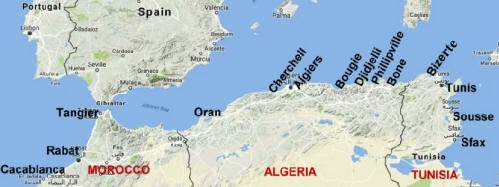

One bright sunny day, around noon, we left the Atlantic Ocean and passed through the Straits of Gibraltar. Another large fast convey of troopships, battleships, cruisers, destroyers and motor launches split up around us and passed by at full speed. What a glorious sight it was. Our convoy then picked up to full speed and that night we anchored off the beach of the little town of Arzew in Algeria. This was on the eastern flank for the attack on Oran. We lowered the landing craft over the side, lined up in formation and headed for the beach. Unfortunately we couldn’t find the two American truck drivers when it was our turn to leave the ship. I had never driven a car, let alone a big army truck, but it looked as though I'd have to learn real quick, since there was nobody else!. I sure as hell hoped there wasn’t going to be too much enemy fire. Fortunately, we landed with no trouble and one of the beach party was able to drive the truck ashore after I managed to get it started. I wasn’t keen on hanging around a moment longer than was absolutely necessary, so made a quick turnaround!

It was reasonably quiet during the couple of weeks we were there - we were only strafed once by a Spitfire the French had captured. To the west of us, in Oran, there was more activity, where a large French battleship sunk a small American ship that had approached to invite its surrender. The battleship could have sunk almost the whole landing fleet but a RN battle cruiser was standing by for just such a possibility - a few broadsides could have put the French battleship guns out of action in seconds. No one had wanted this to happen but there was no alternative.

We spent the next week or so unloading troop ships, cargo ships and ammunition ships that had just come from the USA. Other than the RN and RCN naval personnel, this was strictly an American operation. It was strange for us to see the jeeps and trucks we took ashore loaded with cigarettes, gum and chocolate bars. One night, we had to make an emergency trip ashore with a load of Tommy gun ammo for an American group, who were almost surrounded by the French Foreign Legion and fast running out of ammo.

On our last night there, we pulled our craft alongside an R.N. Tank Landing Craft and went aboard for a visit. They had liberated wine casks from the thousands on the beach waiting to be shipped to France. The Americans had got into this stuff pretty heavy, so they put it under guard to stop any more drinking but a couple of the RN sailors had other ideas! They threw a hand grenade nearby and, when the American army guards went to see what was up, they rolled one of the casks on to the TLC and pulled away. In the dark, they fumbled around in a vain attempt to open the cask, so they just blew a hole in it with a .45. With the wine flowing freely, we used our tin helmets and drank our farewell to North Africa.

We sailed next morning for the return to Scotland aboard the troopship Reno del Pacifico (sic), an ex P&O liner. Not having fully recovered from the previous night's festivities, I was grateful to find it was calm. We stopped at Gibraltar to set up a convoy and to pick up a few R.N. men. Some of us chose to sleep on deck because of the risk of being torpedoed in the Atlantic approaches to the Straits of Gibraltar. I was bitching the next morning, because the RN boys paced the deck all night but calmed down when told that they had recently been torpedoed twice in the same night. Our convoy made it back without any trouble. On our return to the river Clyde, we were given leave ,which I spent in Glasgow and Edinburgh. The next few months were spent in training in the following ships and camps in England and Scotland; HMS Westcliff, Drake, Foliot,, Glengyle, Keren, Ulster Monarch and Rosneath.

My Naval Chronicle by Lloyd Evans

Interested readers can find all of Lloyd's memoirs at the following link to Combined Operations Command by Scotsman Geoff Slee. Mr. Slee did much typing and organizing of Lloyd's emails that contained his stories (leading to a self-published book, i.e., My Naval Chronicle), and it was through him I was able to make contact with Lloyd during the last two years of his life.

Both Lloyd and my father rose through the ranks, from Ordinary Seamen (OS), to Able-Bodied (AB), to Leading Seamen (LS) and Coxswain (aka "Cox'n") but I think their greatest accomplishment - apart from serving Canada steadfastly for four years during WWII - was to take time to write things down. After about two weeks in N. Africa they returned to the U.K. aboard the Reina Del Pacifico, and likely crossed paths a few more times before their next operation, i.e., HUSKY, the invasion of Sicily beginning in early July, 1943.

In closing, I share below a story my father wrote about the Reina Del Pacifico, first published in his hometown weekly newspaper (The Norwich Gazette) in the early 1990s:

REINA DEL PACIFICO SERVED WELL IN WAR YEARS

This is the story of a large passenger liner converted to a troop ship called the Reina Del Pacifico which carried 200 Canadian sailors and other personnel back to Liverpool, England after the invasion of North Africa, which started November 8th, 1942.

Buryl McIntyre and I were among the 200 sailors who had worked on our landing craft ferrying army supplies ashore night and day for about a week at a little town south of Oran named Arzew.

Doug Harrison (left) and Buryl McIntyre, RNCVR, from Norwich, Ont.
Outside Wellington barracks, at HMCS Stadacona, Halifax, N.S. 1941

During the invasion, the Reina Del had acted as a hospital ship which we Canadian sailors could go aboard when tired. We were given excellent food, excellent rum, help to tumble into a hammock where we remained horizontal for many hours. The Reina Del served as a passenger liner again for many years after the war but unfortunately burned about 1970.

Canadians in Combined Ops (dark uniforms) man landing crafts as U.S.
troops unload supplies. Arzew, N. Africa. Nov. 8, 1942. Photo - IWM

Approximately Nov. 14th, 1942 the dark green, two funnel Reina Del lay at anchor at Arzew, and those two funnels were active enough to indicate steam was being brewed in the engine rooms, and she was as anxious as the sailors to head for home. Our landing craft, one by one, manoeuvered to the gang-plank on the port side of the Reina Del and Canadian sailors waiting for the proper swell of the wave jumped to the gang-plank and hurried up the steps and went aboard through the large cargo door. Each one was checked off by name by a Canadian officer standing inside the cargo door, complete with clip-board. The landing craft were now manned by English sailors returning at a later date.

As my turn came to jump aboard the gang-plank, my eye spotted a large unexploded shell imbedded in the side of the ship not far from the officer’s head. I was very tired but not that tired, and inquired of the officer about the unexploded shell and he replied that the Captain had the shell examined and it was a dud. “I sure hope he is right because my mother will miss me, Mr. Wedd,” I said. (Canadian Navy Officer Andrew Wedd)

Mr. Wedd was dog-tired too and in no mood for an argument. “Your mother will miss you a lot more if you’re not aboard on the next swell, Harrison, because we are leaving. Do you hear me?” He added a bit more which couldn’t be printed and his ultimatum enabled me to time the swell of the next wave perfectly and I jumped to the gang-planks, and though tired, I found new energy at the cargo door and was soon amidships. The shell never exploded but it was sand-bagged and roped off.

It wasn’t long before the clank of the anchor cable could be heard in the hawse pipe. The anchors stowed, the gang-plank came on board and we were underway and in a few hours steaming at 27 knots (about 33 mph) we were safely inside the submarine nets at Gibraltar. In those few hours we organized bridge and crib tournaments.

The scene at Gibraltar was one of carnage, war at its worst. Nearby were destroyers which had been mauled by bomb and torpedoes, with gaping holes in their sides and deck plating, and some of the large guns were bent and pointed at bizarre angles.

H.M.C.S.: One Photographer's Impressions, WWII... Page 64
Photo Credit - Royal Canadian Navy Photographer Gilbert A. Milne

Doug Harrison's story from The Norwich Gazette continues:

Miraculously they floated with pride and here and there steam came from the odd funnel. We thought of what the crews had been through and the fire and heat that had buckled the plates, how anyone could have survived. But Malta had to be fed.

Aboard the Reina Del at Gibraltar the Captain advised us to sleep up top under cover at night and those Canadian sailors who were not taking part in the tournaments became look-outs as we sailed west into the Atlantic alone.

Naval tradition prevailed aboard the ship and at 11 o’clock each morning we were given a tot of navy rum which we didn’t have to drink under the watchful eye of some Chief Petty Officer. Buryl McIntyre and I were partners at bridge; we received good cards and placed second in the tournament; there being no main prize it was agreed that whichever team won the rubber of bridge also won their opponents’ tot of rum. Buryl and I slept quite well most nights, but with one eye open and one arm through our Mae West life jackets. Each ship has its own peculiar quirks and sounds; it is the unusual sound that brings sailors awake.

The Captain wished to miss the Bay of Biscay and as we skirted the western edge heading north we ran into a severe electrical storm. Standing well inboard under cover we witnessed the worst electrical display of our lives. Also, it seemed to rain so hard it pounded the sea flat. The ship retained good speed throughout and reached Liverpool safely in about four days.

Liverpool, such a friendly city, has welcomed sailors for centuries and we went ashore soon after our arrival to a seaman’s home, a large, warm, clean barrack-like building with good food, showers, and cots with white sheets and pillow cases. Heaven! Soon mail arrived and I can still see myself and my friends discarding our boots and stretching out on the cots to read the latest from home. Everything went quiet until someone shouted, “Hey guys, get a load of this!”

“Pipe down!” The old familiar phrase. “Read it to us later!”

We shared our parcels with anyone who may have missed out and showed new photos all around. Although we had shore leave, many chose to stay where we were, get some rest, and write some letters home.

We did not see the Reina Del Pacifico again. One evening she slipped quietly away, but I for one have never forgotten her, our home for a few short days.

"Dad, Well Done" Pages 89 - 91

Reina Del Pacifico, 'Underway'. Photo by J. Hall, Gourock, Scotland
As found at Imperial War Museum, FL18191

Interested readers can read Doug Harrison's memoirs here.

Please click here to view more about Operation TORCH, the invasion of North Africa, at Remembrance Day: 80th Anniversary, Allied Invasion of North Africa (1)

Interested readers can also link to all of the information (i.e., photographs, news articles, etc.) I have compiled thus far on "1,000 Men, 1,000 Stories" related to the Allies in North Africa here.

Lest We Forget

Unattributed Photos GH

Tuesday, November 8, 2022

Remembrance Day: 80th Anniversary, Allied Invasion of North Africa (1)

Operation Torch: N. Africa Invaded Beginning November 8, 1942 

Canadian Sailors Landed U.K. and U.S. Troops in Landing Crafts

American troops landing on the beach at Arzeu, near Oran, from a landing
craft assault (LCA 426), some of them are carrying boxes of supplies. 
RN Photographer Lt. F.A. Hudson, A12649 Imperial War Museum (IWM)

Introduction:

Remembrance Day 2022 approaches quickly. And during WWII, also in the month of November, Allied forces combined to land thousands of troops in three general areas along the shores of North Africa, beginning November 8, 1942, eighty years ago from this date.

Canadian sailors (RCNVR) were members of the Center and Eastern Task Forces
More information, incl. above map, re Operation Torch, link to Wikipedia here

As we remember all those who served amongst Allied Forces during WWII, I would like to shine a light on the significant role of a relatively small number of Canadian sailors who not only volunteered for the RCNVR in the summer of 1941, but, shortly thereafter, also for Combined Operations (aka Combined Ops, a British organization).

Under the command of Combined Ops they accepted "dangerous duties overseas" and helped fill the need to man small, swift landing craft, to transport troops and all the materials of war to foreign beaches, from Dieppe (Operation JUBILEE, August 19, 1942) to Normandy, France (Operation NEPTUNE, beginning June 6, 1944).

Below I will share a few details related to Operation TORCH, my father's first serious action. He was one of the 50 - 60 members of the Effingham Division - RCNVR, HMCS Stadacona, Halifax - and amongst the first draft of Canadian sailors to join Combined Operations in November, 1941. Though they all trained for the Dieppe raid a few months after arriving in the U.K. in January, 1942, some were put on leave on that fateful day, my father included.

The Effingham Division, "almost to the man", volunteered for Combined Ops
The sailors left for the U.K. for training aboard landing crafts in Jan. 1942
Photo - from the collection of Doug Harrison, taken December, 1941

That being said, over the course of the remainder of WWII, a total of about 950 - 1,000 other members of RCNVR (about one per cent of the 95 - 100,000 Canadians who joined the Canadian Navy during WWII), were eye witnesses (front row seats!) to most of the major Allied operations, including Operation TORCH (beginning Nov. 8, 1942), HUSKY (the invasion of Sicily beginning July 10, 1943; about which a sailor on my father's landing craft, after getting attacked by the German Luftwaffe every two hours during the first three days, proclaimed while hiding under a winch, "Dieppe was never like this!"), BAYTOWN (the invasion of Italy, on 'the toe of the boot', beginning Sept. 3, 1943), AVALANCHE (the invasion of Italy at Salerno, on the shin of the boot, beginning Sept. 9, 1943), and finally NEPTUNE (Neptune was the Navy's role in Operation OVERLORD, the invasion of France, beginning June 6, 1944).

I would say the 1,000 sailors who are the chief subject of '1,000 Men, 1,000 Stories' kept busy. 

And now, about TORCH:

In the book Assault Landing Craft: Design, Construction and Operations by Brian Lavery, we read the following about the invasion of North Africa:

As the Vichy forces finally surrendered on Madagascar on 5 November, several huge convoys were approaching the coast of North Africa, for the Americans were about to land near Casablanca and at Safi, and the British inside the Mediterranean at Algiers and Oran. It was the largest operation mounted so far and the training camps had been emptied as partly trained crews were embarked in LSIs (Landing Ships, Infantry).

The Combined Operations Organisation was under considerable strain as the demands increased. Fifteen LSIs had been originally requested  for the operation, twenty-five eventually sailed. The planners had asked for 91 LCAs (Landing Craft, Assault) with their crews, but now they needed 140. Page 102

My father, heading toward Arzeu in a troopship - with landing crafts hanging from davits - just east of Oran (one of the Central Task Force's destinations) writes the following in memoirs:

After Dieppe we regrouped and went back to H.M.S. Quebec for further training, this time on LCMs or Landing Craft Mobile or Mechanized. H.M.S. Quebec was in Scotland on Loch Fyne... My group went through much more training at H.M.S. Quebec and then we entrained for Liverpool. Prominent pub was The Crown in Wallasey. We left Greenock in October, 1942 with our LCMs (Landing Craft, Mechanized) aboard a ship called Derwentdale, sister ship to Ennerdale. She was an oil tanker and the food was short and the mess decks where we ate were full of eighteen inch oil pipes. The 80th and 81st flotillas, as we are now called, were split between the Derwentdale and Ennerdale in convoy, and little did we know we were bound for North Africa.

RFA Derwentdale, 'At Anchor'. Photo by J. Hall, Gourock, Scotland
As found at Imperial War Museum FL 11110

We had American soldiers aboard and an Italian in our mess who had been a cook before the war. He drew our daily rations and prepared the meal (dinner) and had it cooked in the ship’s galley. He had the ability to make a little food go a long way and saved us from starvation. Supper I can’t remember, but I know the bread was moldy and if the ship’s crew hadn’t handed us out bread we would have been worse off.

We used to semaphore with flags to the Ennerdale to see how they were eating; they were eating steak. One of the crew cheered us up and said, “Never mind, boys. There will be more food going back. There won’t be as many of us left after the invasion.” Cheerful fellow. However, we returned aboard another ship to England, the Reina Del Pacifico, a passenger liner, and we nicknamed the Derwentdale the H.M.S. Starvation.

In the convoy close to us was a converted merchant ship which was now an air craft carrier. They had a relatively short deck for taking off, and one day when they were practicing taking off and landing a Swordfish aircraft failed to get up enough speed and rolled off the stern and, along with the pilot, disappeared immediately. No effort was made to search, we just kept on.

One November morning the huge convoy, perhaps 500 ships, entered the Mediterranean Sea through the Strait of Gibraltar. It was a nice sun-shiny day... what a sight to behold. "Dad, Well Done". Pages 23 - 24

Related Photos:

In the distance a destroyer is laying a smoke screen round one of the transports
off Oran. Two landing craft assault and one landing craft personnel (ramped) can
be seen in the foreground they are LCA 85, LCA 394 and LCP (R) 838.
 Photo Credit - RN Photographer Lt. J.E. Russell. A12633 (IWM)

A destroyer laying a smoke screen round one of the transports off Oran.
Photo - RN Photogr. Lt. J.E. Russell. A12634 Imperial War Museum

An Auxiliary aircraft carrier escorting the convoy.
RN Photographer Lt. L. Pelman A12711 (IWM)

HMS ARGUS operating off the North African coast during combined operations
for the 'Torch' landings. RN Photographer Lt. R.G.G. Coote. A12882 IWM

Excerpt from Brian Lavery's Assault Landing Craft continues:

The lack of training showed and several of the LCA flotillas got into difficulties. Off Algiers there was a westerly current that caused many landing ships and craft to arrive in the wrong place. Fortunately there was little resistance from the Vichy French. The three landings in the Oran area had similar difficulties. West of the town, Queen Emma's and Princess Beatrix's ten LCAs formed only a small part of the total of thirty-nine craft, which were mostly LCP and LCMs...

The troops from Monarch of Bermuda were embarked via ladders (Editor: see photograph below), the rungs of which turned out to be too far apart. This caused delay so that the LCAs from her and Glengyle landed sixteen minutes late*, and the LCMs grounded on undiscovered sandbars offshore**.

American troops manning their landing craft assault from a doorway in the side
of the liner REINA DEL PACIFICO. Two of the landing craft are numbered LCA
428 and LCA 447. Photo - RN Lt. F.A. Hudson, A12647 Imperial War Museum

The third landing, east of Oran, was much larger and involved 29,000 troops, 2400 vehicles and eight LSIs plus the LCM carrier Derwentdale***. It deployed eighty-five landing craft, of which sixty-eight were LCAs and three were LCSs. The first flight of assault craft heading for Z Green beach lost cohesion despite being led in by a motor launch - the first of its craft landed twelve minutes before H-hour, the last landed ten minutes after...

Pages 102 - 104

*sixteen minutes late - that's not bad compared to my father's tale (below)

**undiscovered sandbars - my father actually discovered one!

***LCM carrier Derwentdale - my father came from England aboard this ship, but he liked Reina Del Pacifico better, I bet. Supporting details to follow.

About the landings east of the town of Oran, near Arzeu, and during the same time period, my father writes:

On November 11, 1942 the Derwentdale dropped anchor off Arzew (sic) in North Africa and different ships were distributed at different intervals along the vast coast. My LCM (landing craft, mechanised) had the leading officer aboard, another seaman besides me, along with a stoker and Coxswain. 

At around midnight over the sides went the LCMs, ours with a bulldozer and heavy mesh wire, and about 500 feet from shore we ran aground. When morning came we were still there, as big as life and all alone, while everyone else was working like bees.

There was little or no resistance, only snipers, and I kept behind the bulldozer blade when they opened up at us. We were towed off eventually and landed in another spot, and once the bulldozer was unloaded the shuttle service began. For ‘ship to shore’ service we were loaded with five gallon jerry cans of gasoline. I worked 92 hours straight and I ate nothing except for some grapefruit juice I stole.

Doug Harrison (centre) watches as troops and ammunition come ashore
on LCAs at Arzeu in Algeria during Operation 'Torch', November 1942.
Photo credit - RN Photographer Lt. F. A. Hudson A12671 (IWM)

Our Coxswain was L/S Jack Dean of Toronto and our officer was Lt. McDonald, RNVR. After the 92 hours my officer said, “Well done. An excellent job, Harrison. Go to Reina Del Pacifico and rest.” 

But first the Americans brought in a half track (they found out snipers were in a train station) and shelled the building to the ground level. No more snipers. "Dad, Well Done" Page 25

Brian Lavery's last line about North Africa in his book Assault Landing Craft reveals that two men in the same harbour (i.e., at Arzeu), perhaps on different days or a mile apart - can have radically different experiences:

"Again there was no opposition (re three LCAs "making for Arzou (sic) harbour"), which was fortunate. Oran surrendered fifty-nine hours after the invasion began." Page 105

My father mentions snipers, and hiding behind a "bulldozer blade when they opened up at us."

But 'all's well that ends well.' After about four straight days of 'ship to shore' - surviving on stolen grapefruit juice - he was given leave to visit the Reina Del:

I then had to climb hand over hand up a large hawser (braided rope) to reach the hand rail of Reina Del Pacifico and here my weakness showed itself.

I got to the hand rail completely exhausted and couldn’t let one hand go to grab the rail or I would have fallen forty feet into an LCM bobbing below. I managed to nod my head at a cook in a Petty Officer’s uniform and he hauled me in. My throat was so dry I only managed to say, “Thanks, you saved my life.”

The Reina was a ship purposely for fellows like me who were tired out, and I was fed everything good, given a big tot of rum and placed in a hammock. I slept the clock around twice - 24 hours - then went back to work.

In seven days I went back aboard the Reina Del and headed for Gibraltar to regroup for the trip back to England. During the trip I noticed the ship carried an unexploded three inch shell in her side all the way back to England. "Dad, Well Done" Pages 25 - 26

In memoirs, my father thanked his Maker for getting him home safely from operations, in this case Operation TORCH, November 1942, 80 years ago this week. And his time of service in North Africa ('ship to shore,' 11 days) was not the first or the last time he expressed his gratitude or sang a hymn of thankfulness that his mother Alice had taught him as a child. 

The damage to MV LLANGIBBY CASTLE from an 8" shell. North Africa
Photo Credit: Royal Navy Official Photographer - Russell, J E (Lt)
© Imperial War Museum (IWM) A12646

I think he and his 1,000 Canadian mates (approx.) in RCNVR and Combined Operations had good cause to be thankful many times over their four years of transporting troops and all the materials of war in small crafts, 'ship to shore' (from Dieppe, North Africa, Sicily, Italy and more, to D-Day Normandy), often under heavy, merciless fire.

Lest We Forget

More information, in Part 2, will follow.

Please click here to view earlier posts about Operation TORCH.

Unattributed Photos GH

Thursday, November 12, 2020

Remembrance Day 2020

Let Us Remember Them Together

"We Remember One, We Remember All"

Doug Harrison, from Norwich ONT, served in RCNVR and 
Combined Operations from June 1941 - September 1945. RIP

Introduction:

I remember my father often, and well. His hand-written navy memoirs are still an inspiration to me as this small online site slowly grows over the years.

Remembrance Day 2020 is a time to reflect on his personal sacrifices during World War II, and that his efforts were just those of one man among tens, hundreds of thousands throughout the world at that time. Today I will attempt to remember the experiences of one man, as well as the thousands, and reflect upon how world wars affect us to this very day.

I present below a few items - the first, from my mother - that will prompt many of my thoughts and recollections today. 

TOGETHER

They went to war together
so our country would be free.
They fought together
on land, in air, on sea.
They died together
in muddy fields
in blazing skies
in deep, cold seas.

Let us remember them,
together.

(By Edith J. Harrison, Norwich Ontario)

Doug Harrison remembered his mates in his memoirs:

One Officer Died at 0347 Hours, August 19th

For about fifty-five officers and ratings
the moment of truth drew near when they would be
put to the test, untried, but with a high esprit de corps
and ready to live or die by Canadian Navy traditions,
and die some did.
Seventy-one men of CO (Combined Operations),
RCNVR took part in the Dieppe raid, 19 August, 1942.
One officer died at 0347 hours, August 19th in the Channel,
killed in a fiery exchange with a small German convoy.
During the long, suffering day two Canadian seamen
were killed and one severely wounded.
The commanding officer of the flotilla and a wounded stoker were captured.
The stoker was repatriated in an exchange of prisoners but
the officer remained captive for the duration.
At least two Canadian officers and the wounded stoker were awarded medals.
A Canadian seaman and officers were mentioned in Dispatches for the Dieppe raid.

"Dad, Well Done" page 73

1989 Reunion of two shipmates at Dieppe, i.e., Stoker R.W. Brown (“severely
wounded”, left) and Lt. McRae (“remained captive," back right), with D. Harrison
(middle, with cap) and Art Bailey (right). Photo - St. Nazaire to Singapore, Vol. 1 

A poet from Sicily remembers the Canadian troops who past through her town:

Boys of freedom

Snow came suddenly
Covering fields in white in the twinkling of an eye,
it woke up the boys of freedom, those coming from afar,
who left their lives at twenty or little more,
who left their lives in a moment
staring at a sunset which was burning by that time.
Air is sparkling in silver.
Wind gathered crumbs of light,
thousands of snow butterflies smile remembering
the colour of a flower and the enchantment of a balcony.
Like shadows in the snow dance
the boys of freedom came back
to play on the white field,
to run, to snowball,
as they used to do at home
before the war came.
Air is darkening,
it's getting cold, wind is icy,
and the boys of freedom disappear among the white butterflies;
they go back to their underground sleep,
rocked by the memory of their country
far away, where they never went back.

By Rosalia Fantoni, Villanova, February 2012

As found at Canadians in the Italian campaign in World War II (online source).


Photo Credit - As posted by Mufasa Quinto on Facebook October 2020

A poem follows by Eric Curwain, a.k.a. Bill Simpson, written June 6, 1979, "thirty-five years to the day after D-Day. Eric was the brains behind the recruitment of most of the Staff and the agents who would be trained at Camp-X (Oshawa-Whitby area) and go on to their most dangerous missions behind enemy lines." 

Canada on D-Day

The older sons of Canada
look down on Juno Beach:
They see the grieving men in prayer
and read the heart of each.

On Juno Beach they see the men
who landed at their side,
but were not called upon to sink
in sand or sullen tide.

And to the east there stands the stone
that marks the Vimy field,
where men had fought a thousand days
and never thought to yield.

Those Vimy heroes see their sons
in Normandy today
and all three bands - pere, fils et frere - 
have common cause to pray.
For they can sense a mood of change,
of purpose unfulfilled:
they wonder if the future holds
what they had fought to build.

The men and wives from many lands
did weave our Tapestry -
let none contrive to make of it
a faded travesty.

O Canada! O Canada!
Thy patriot sons are we,
enfants de la Patrie.

Poem as found in Inside Camp-X, page 259 by L. P. Hodgson

Our bold Canadian flag is adorned with a red maple leaf. As a symbol it is directly linked to the efforts and sacrifices of a body of men and women who are remembered often, and deeply each year in November. Surely, the original red maple leaf started out as a green one.

A WWII navy hammock stored at ECFB Esquimalt Naval Military Museum.
My father's landing craft flotilla displayed green maple leaves prominently.

My father (his name appears on the Sicily-bound hammock) writes that the maple leaf was painted on the side of landing crafts destined for the invasion of Sicily - but I haven't seen any photographs to confirm his sightings, as of yet. But I found the following picture a few years ago: 

Photo Credit - Canada At War, Reader's Digest

Let Us Remember Them, Together

Doug Harrison (right) carries an anchor-shaped wreath. 
Date and location not known. Photo - Doug Harrison

Addendum -

The Maple Leaf continues to be a proud, iconic Canadian symbol. 

And about a week after Remembrance Day 2020, while enjoying my daily walk - which almost always carries me past HMCS Prevost near 'The Fork of the Thames' River in downtown London - a young pup crossed my path (on a leash) and rolled over on the ground at my feet. How could I refuse to say hello!?

The pup's 'Master of the Day' (compare with Officer of the Day) and I chatted and I learned the pup's name was Maple. 

Bold, very Canadian, I thought. And Maple is 55.555% of Maple Leaf.

I recalled the above Remembrance Day entry, wanted a cheery photo, but had no camera in my pocket.

Between then and yesterday (Jan. 4, 2021) I have spotted 'Master of the Day' and Maple a few times but I was either without a camera or the time wasn't right to impose for a photograph (e.g., we were all quickly going in different directions or we were too far away from one another for a quick snap...).

But yesterday, Maple, 'Master of the Day' and I crossed paths beside HMCS Prevost at an opportune time:

I asked for a photo, Maple settled right down, and was still for two seconds!

HMCS Prevost is home to a WWII mounted gun compartment, one that has recently been repainted. It is from HMCS Fraser, has appeared on this site earlier, with another (original?) paint job, and has its own interesting WWII history.

Photo of earlier paint job re HMCS Fraser - It Strikes Me Funny by G. Harrison

A video reveals the gun finding its place at HMCS Prevost in London, ONT. 

Please link to Remembrance Day 2016 for more tributes and photographs.

Unattributed Photos GH

Friday, November 11, 2016

Remembrance Day 2016.

Photographs New and Old.


I walked to the parade marshalling area this morning and was happy to see flashes of red in the first uniformed group I encountered. And when I left the London Cenotaph at Wellington and Dufferin after the service I felt I wanted one last photograph - even the light was red.


Before the parade began I spoke to the gentleman seen in the front row (first on left) concerning his medals, and my father's. He encouraged me to mount them and put them on display in the house, and I will be thinking about that, perhaps even get it done, before the year comes to a close.


As the marching men approached the Cenotaph I snapped one last photo of the older gentleman's designated group. I noticed a moment ago that several carried a shadow of another soldier on their backs.

Today's Favourite Photo:

We Will Remember Them


Photos of Canadians in Combined Operations (from the collection of Joe Spencer, RCNVR, Combined Ops)

 ALC 269 returning to Southampton from Newhaven, August 21, 1942
C. Sheeler, Joe Spencer. Two days after the Dieppe Raid

Art Warrick, Verne Smart (in an LCM) on the Ennerdale in Algiers.
Editor - circa mid-November, 1942, re invasion of N. Africa 

 Charley Sellick, Jim Ivison. in Sicily.
Editor - circa July 1943, related to Operation HUSKY

"Possibly at HMS Quebec", likely near time of Dieppe Raid
Editor - Canadians in Combined Ops, 1942 but no names attached;
Don Linder, Kitchener, ONT - middle row, far right

Please link to Remembrance Day 2015

Photos GH

Tuesday, November 10, 2015

Remembrance Day 2015

Lloyd Campbell, V17138


Lloyd Campbell of London, Ontario, Canada was a member of the Royal Canadian Navy Volunteer Reserve and of Combined Operations in WW2 and was grievously wounded during the Dieppe Raid (also known as Operation Jubilee) and subsequently died of his injuries. It is very unlikely the story associated with Mr. Campbell's death has ever seen the light of day in modern times for a variety of reasons, not to be fully discussed here. But let it be said, though he was but one volunteer member of, in general, two oft lightly-regarded wartime organizations, with names that do not often leap to mind during the retelling of World War II history, Lloyd Campbell's actions on August 19, 1942 should not be forgotten.

"Mr. Campbell's name appears on the list entitled 
'Combined Operations Personnel' Dieppe


"Notes from an out-of-print (currently) book re Combined Ops organization"

Concerning the Dieppe Raid, the following excerpt is found in Combined Operations, a book written and compiled by another Londoner, Clayton Marks. A significant reference to Lloyd Campbell is made within it. The book is very hard to find (try Canada's War Museum), another good reason Mr. Campbell's story is not well known.

DIEPPE August, 19, 1942 

It was deemed a failure right from the original plan of operation. The original code word for this landing was "Rutter". It was accepted by Combined Operations and the Home Forces Staffs on April 25, 1942 and the landing was to commence by the 8th of July, 1942. On July 7th the German Air Force flew over Yarmouth Roads and sank landing ships.

This, and the bad weather, convinced Mountbatten to cancel the complete operation.

Mountbatten and Churchill had a plan to remount "Rutter" on August 19, 1942 under the code word "Jubilee" with all the same participating forces. The Chiefs-of-Staff were on the wane and Dieppe was desperately needed to restore Combined Operations quickly growing ambitions. Bomber Command could not and would not supply heavy, accurate air bombardment, but could guarantee only limited indiscriminate bombing. The Naval Sea Lord could not supply sea power in the form of battleships due to the recent loss of the battleships "Prince of Wales" and the "Revenge" at Singapore in December of 1941. This left only destroyer sea power of 4 inch guns that could not damage the wall of defense along the French coast. At 2130 on the night of August 18th the landing ships slipped their moorings and headed out to sea on a cloudless and warm evening. The fleet consisted of 237 ships of all sizes from large Infantry landing ships to the 74 LCP's unarmed and unarmoured carrying 6,100 of all ranks.

Many stories and acts of heroism have been told and will be retold over and over again. Officers and men of the British Army, Commandos, Royal Marines, American Rangers, Canadian Essex Scottish, Canadian Engineers, Queen's Own Cameron Highlanders, Hamilton Light Infantry, Fusiliers Mont Royal and the Royal Regiment of Canada, Black Watch, were all involved in this raid.

The perilous honour of the raid fell mainly to the Canadian Army and the Royal Navy, but members of the Naval team from Canada had a share. Training was not sufficiently advanced for the Canadians to operate as separate Flotillas when the Dieppe expedition sailed from Portsmouth, Shoreham and Newhaven on the night of August 18th, but among the British Landing Craft fifteen Canadian Officers and fifty-five Ratings were distributed.


 Above three photos from Six Years of War, Ch. XI, Raid on Dieppe

Sub-Lieutenant C.D. Wallace was the first Canadian casualty. He was killed in the dark hours of the morning, when the Flotillas on the extreme left flank of the assault made the fatal encounter with a German convoy. Lt. J. E. Koyl, a Canadian who was to figure in many happier landings, was boat Officer of a Flotilla which included thirty-three Canadians. It left its parent ship, "Duke of Wellington", at 0334. As the craft neared the beach shortly after five, they came under heavy fire from shore. They managed to land their three platoons of the Canadian Black Watch near Puys; but as they were withdrawing the British Flotilla Officer was seriously wounded and Lt. Koyl took charge. Continuing seaward, he transferred the wounded Officer to a British destroyer, and about 1200 when the evacuation of the beach was ordered, led his craft in again through heavy fire from shore and attack from the air. Before he could beach, however, he was ordered to turn back. German batteries were laying down a curtain of steel that made evacuation an impossibility.

Meanwhile, Sub-Lieutenants A. A. Wedd and J. E. Boak, each in command of one of the landing craft (Personnel) which had sailed directly from England, came into shore with their Flotilla a little east of Dieppe harbour. Passing through smoke and into the fire from the German weapons of all calibres, they landed their troops and withdrew. They were sent in an hour or so later to Dieppe harbour itself, but were recalled almost immediately and re-routed to one of the beaches near Puys. As they reached the inner fringe of the smoke shrouding the beach, they came upon a group of Canadian soldiers crouching on a capsized landing craft just off shore, and pinned down by fire. Although the soldiers waved and shouted at them to steer away, the craft ran close alongside, heaved ropes across and managed to rescue three of the men. Then, as the fire from shore blazed up to new intensity, the Flotilla was ordered to turn back from the beach. It was not to go in again. Like all of the other Flotillas, it was to have the memory, most poignant for the Canadians, of having left behind many of the soldiers it had brought ashore.

Unhappy as the immediate results of Dieppe were, the performance of the Canadians in the landing craft had been worthy of their brothers in the Army; and some of them remained with the soldiers as prisoners.

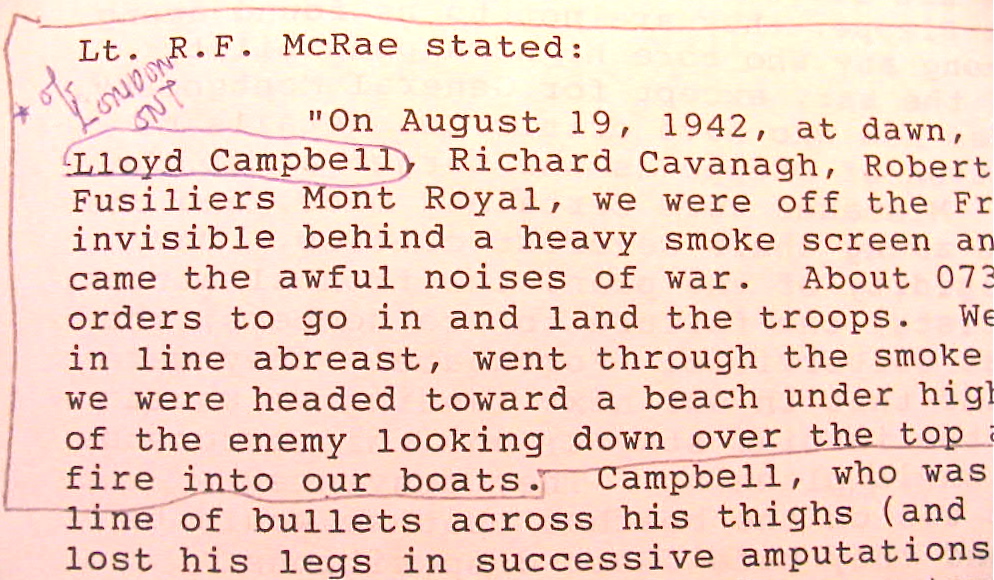
Lt. R. F. McRae stated:

     "On August 19, 1942, at dawn, in our R-Boat, with Lloyd Campbell,
     Richard Cavanagh, Robert Brown and a unit the Fusiliers Mont Royal,
     we were off the French coast which was invisible behind a heavy
     smoke screen and from which there came the awful noises of war.
     About 0730 the Flotilla got orders to go in and land the troops. We
     quickly formed up in line abreast, went through the smoke screen
     and saw that we were headed toward a beach under high cliffs with
     the heads of the enemy looking down over the top and pouring machine-
     gun fire into our boats. Campbell, who was at the wheel, took a line
     of bullets across his thighs (and later, as a P.O.W. lost his legs in
     successive amputations and died before Christmas from gangrene).
     Cavanagh, who was standing next to him, got it in the chest and died
     an hour later when his lungs had filled up. Brown, though hit in the
     stomach, took over the wheel from Campbell. I was the lucky one and
     received only a piece of shrapnel in the ankle.

     In the meantime, the engine had been blown up and was on fire and
     the plywood hull of the boat was well perforated, but we had enough
     weigh on to make it to the beach. The troops scrambled ashore except
     for their Captain who had been standing up forward with us and was
     badly wounded, and I believe, dying. Some of the troops never made
     it across the beach which was strewn with their bodies, and those who
     did were easy targets for grenades lobbed down from above. There was
     no life in the boats on either side of us, and it was, I think, because they
     could see that I was busy with the wounded and that we were unarmed
     so that the Germans on the top of the cliffs gave up trying to finish us off. 

     Some hours later, it was evident that a surrender had taken place when
     I saw a few German soldiers walking along the beach with a medical
     orderly. I jumped out of the boat to fetch the orderly for the wounded
     but our discussion was rudely interrupted by a Corporal with a machine-
     gun directing me, in no uncertain terms to a crevice in the cliff face,
     down which a rope had been lowered. A few surviving troops and myself
     were ordered to hoist ourselves up the rope, hand over hand. I did not
     see my crew again.

     I spent the first year as a P.O.W. in handcuffs in a British Army Officers
     camp and then was shifted to a British Naval Officers camp for the
     remainder of the war. The last two weeks were spent with a long
     straggling column of P.O.W.'s being marched up to the Baltic and
     regularly being strafed by our own fighter aircraft.

     The loss of Campbell and Cavanagh and later Brown, as you can see,
     was a complete waste and unnecessary." 

A German photograph from A Watery Maze

Though there are still some who dispute the value of what was learned at Dieppe, they are not to be found among informed persons or among any who bore high responsibility in the later stages of the war, except for General Montgomery. There are others besides him who have criticized details of the raid, or the retention of Dieppe as the target after the original postponement. Mistakes were certainly made, and the Germans themselves were among their severest critics. They found fault with the rigidity of the plan, the frontal attack, the absence of parachutists, the failure to use bombers, the failure to land tanks at Quiberville. Fortunately they were confirmed in their belief that in our next landing we would go for a large port in the initial stages? and this erroneous conviction colored all their planning. They convinced themselves also that it was on the beaches that we would be most easily defeated, and they made their dispositions accordingly.

In fact we had learned that a frontal attack on a defended port was impracticable, and we never tried it again. A British General is on record as saying, not long afterwards, "Well, if we can't capture a port, we will have to take one with us". The Prime Minister had already and separately had the same idea.

In order that this grim experience should not be for nothing, a full and detailed report, with the lessons learned clearly deduced and codified, was compiled in C.O.H.Q., printed, and given a wide circulation. No time was wasted in chewing the cud; it saw the light and was being closely studied in a very short space of time.

Pages 26 - 29

* * * * * * * 

The book Combined Operations went on to inspire the compilation of two more volumes of stories by Canadians, veterans of both RCNVR and Combined Operations. The books are entitled St. Nazaire to Singapore: The Canadian Amphibious War 1941 - 1945, Volumes 1 and 2 and are seldom found in North American used book stores. However, in Volume 1 I find a second presentation of events at Dieppe by Lt. R. F. McRae, and Lloyd Campbell is mentioned more fully:

     And now they (German gunners) began to pour machine-gun fire down
     into the boats. In our craft, Campbell, who was at the wheel, received
     a line of bullets across his thighs (later as a POW he his legs to amput-
     ations and died before Christmas from gangrene)... As it was my place
     to stand behind the man at the wheel, Campbell had stopped the machine
     -gun bullets I might otherwise have received....

Page 62


The final sentence above tells an important fact. But for Campbell acting as a human shield, history would likely never have heard of Lt. McRae's story of Dieppe, his time as a POW, and much much more related to his long life. 

And on Page 66 of the same volume of stories, a note about Dieppe appears by Lt. R. F. (Bob) McRae, similar in length and in almost every other way to the first entry above under his name, except for the addition of the following few lines near the end:

     I was reluctant to write this note about Dieppe but I knew that I owed it
     to Lloyd Campbell, Richard Cavanagh and Bob Brown. I have visited Cavan-
     agh's grave a couple of times in the War Cemetery in Dieppe. I do not know
     where Campbell is buried. It will be somewhere in Germany. Brown, I saw
     last January when he came with old shipmates to have lunch here...

Page 66


Above three photos are from St. Nazaire to Singapore, Vol. 1

As one can see above, the date of Lloyd Campbell's death is not listed in a short list compiled by Doug Harrison, a member of RCNVR and Combined Ops (WW2) who, according to his memoirs, missed Dieppe by one day while on leave. And though he did miss it, he wrote an article about it later in life (he was opposed to it, saw no good in it) and also penned two words under Lt. Bob McRae's note in the volume to which I have referred, i.e., "survival guilt."

Though there may remain questions about exactly when and where Canadian Lloyd Campbell died, there is no doubt that his role during WW2 was significant, and should not be forgotten.

Lest we forget, think of Lloyd Campbell on Remembrance Day. Perhaps, one day, someone will discover where this brave Canadian rests.

For more about Dieppe, link to Articles re Combined Operations - Why Dieppe?

Unattributed photos by GH