Showing posts with label books re Combined Operations. Show all posts

Tuesday, April 21, 2026

Books re Combined Operations: The Far Distant Ships (3)

First Canadian Draft to Combined Ops Trains for Upcoming Raids

Unbeknownst to Our Sailors the Port at Dieppe was on Their Menu

British prisoners of war* taken at Dieppe marching through the country-
side en route to a prison camp. (Keystone Press Agency LTD, London)
(Photo as found in Dieppe: August 19 by Eric Maguire)

Please click here to learn more about the book Dieppe: August 19 

*re the POWs - most were Canadian soldiers

Introduction:

In the first few months of 1942 after arriving in the United Kingdom in late January, my father's division (Effingham, RCNVR) plus one other Canadian division (name unknown) - totalling about 100 new or raw volunteers for Combined Operations - trained in several locations for upcoming raids, underlined in yellow on map below). They visited HMS Tormentor (#31 on map below) near Southampton, HMS Northney I - IV (#29) on Hayling Island, HMS Quebec (#4) near Inveraray, RAF Dundonald  (#13) near Irvine (sailors were right next door at Camp Auchengate), and other camps for short stints, e.g., Chamois near HMS Quebec and another camp on Loch Long (perhaps #1) likely related to Commando training. 

Map as found at combinedops.com

Canadian RCNVR/Combined Ops officers always knew more than they were telling about the purpose of the training and where/when/why specific operations were taking place. For example, Able-Bodied Seaman Al Kirby (in photo below), in Navy memoirs re the Dieppe Raid, writes that he only learned he was on the way to Dieppe when part way across the English Channel in the very early morning on August 19, 1942. He was told by the soldiers he was transporting in his landing craft. 

"Al Kirby meets with other WW2 Combined Ops veterans"

Please click here to read Al Kirby's "very, very rare" 25-page report concerning the Dieppe Raid

Significant details about the months leading up to the Dieppe Raid are found in The Far Distant Ships by Joseph Schull (published in Ottawa in 1950) and some of them are shared here.

On page 145 we read the following:

Already the combined operations force, now being built up under Lord Louis Mountbatten, was a colourful body. Methods of training were, of necessity, as fluid and unconventional as the situations with which the men would have to deal. Each cross-channel raid - and there were many of them - brought new experience and demands for the revision of tactics, equipment and technique. "Haven't you heard? - it's all been changed" - the most familiar greeting in the force - had become a byword and a slogan tacked up in its headquarters even by the time the first Canadian draft arrived.*

*the first Canadian draft arrived after an eventful journey across the Atlantic Ocean. Please click below for more details from sailors' memoirs:

From the Queen of Bermuda to the Volendam by Doug Harrison (RCNVR, Combined Ops) of Norwich, Ontario

Queen of Bermuda versus Chebucto Head  by Al Kirby (RCNVR/Combined Ops) of Woodstock Ontario

Schull continues:

However unconventional, the standard of discipline and the requirements as to fitness and adaptability were very high. The first Canadian draft, and the drafts which succeeded it, soon began to take on the character of the parent organization. Canadians took part with British commando forces in some of the small, nameless raids, each of which provided its lurid adventures, brought back its quota of information and is now forgotten. There were some of our men in the important raids on Bruneval and St. Nazaire; but even by the time of the Dieppe raid in August 1942 the Canadian naval contribution to combined operations was small. Page 145

In two books entitled St. Nazaire to Singapore: The Canadian Amphibious War, Volumes 1 and 2 (stories written and compiled by Canadian members of Combined Operations, most from RCNVR), one will find a few references to the raid on St. Nazaire that took place on March 28, 1942. The first mention is made by John K. Burgess, Naval Historian, found in Volume 1, page 34:


In the same volume two photographs follow with informative captions, pages 35 - 36:


An excerpt from a two-page report by (Lieut.) John O'Rourke*, RCNVR, re his experiences during the raid on St. Nazaire follows:


There is another page-and-a-half to the report. Please click here to gain access to all of St. Nazaire to Singapore: The Canadian Amphibious War, Volume 1  and go to pages 37 - 38.

Shared below is a fitting conclusion to O'Rourke's report by an editor and contributor to the two volumes of Canadian Navy/Combined Ops stories:

By David J. Lewis

More details from The Far Distant Ships will soon follow.

Questions or comments can be addressed to gordh7700@gmail.com


Unattributed Photos GH


Friday, March 6, 2026

Books re Combined Operations: The Far Distant Ships (2)

"The Newly Arriving Canadians..." Landed at Greenock, Scotland

"They entered upon their first training at H.M.S. Tormentor"

Original caption: "Chuck Rose, Grenock central station, Glasgow 1942"
Photo used with permission from Joe Spencer's family, Ontario
From Greenock to HMCS Niobe, then to Hayling Island

Introduction:

For me, the book entitled The Far Distant Ships by Joseph Schull is a fine Canadian Navy history book as well as a powerful flashlight. Related to the Royal Canadian Navy (RCN) and Royal Canadian Navy Volunteer Reserve (RCNVR) and their significant role during WWII, this book is a prime source of information published in 1950, five years after the war's end. Also, it shines a light on many important details and activities that involved approximately 1,000 members of the RCNVR who started volunteering for a British organization called Combined Operations beginning in December, 1941, including my father, a 21-year-old sailor from the wee village of Norwich, Ontario.

He signed up for duty in Hamilton (at Hamilton Division 1, later renamed HMCS Star) and later, in June of 1941 along with most members of the Effingham Division (out of HMCS Stadacona, Halifax NS) volunteered for Combined Operations.

They were the first draft or division of Canadian sailors to do so, and were soon shipped off to the UK for initial training about - and later aboard - landing crafts.

The Effingham Division at HMCS Stadacona, 1941. Property of
Doug Harrison (bottom 3rd left; died February 6, 2003, age 83)
and son Gord H. age 76 in London, Ontario, Canada


Joseph Schull writes:

From Chapter 7 "Operation Torch", page 145

That there were "some already in England" (see above) may be interpreted to mean 'very few.' There is a book of Canadian Navy veterans' stories entitled St. Nazaire to Singapore: The Canadian Amphibious War 1941 - 1945 (edited by David Lewis, Len Birkenes, Kit Lewis, mid-1990s) that shares some (3 pages) about the early entrants to Combined Operations and I found 4 verifiable names mentioned.


On page iii of the Forward of Volume 1 above I read the following:

     Another end (i.e., re collecting and sharing veterans' stories concerning Combined Operations, WWII) was to gain an historical perspective, a task which we tried to set ourselves but which was not or incompletely accomplished. We would like to have followed up all those of the ranks and ratings who left Canada for training in the RN, many to earn commissions. Could we have learned about the Canadians in the series of pin-prick raids of ''Winston's Murder Gangs" as they were termed by (renowned author) Evelyn Waugh who was for some while tolerated by the Commandos as one of their members? 

Several Canadians (meaning four up to that date?), particularly John O'Rourke and perhaps others, were active in the dangerous but remarkably effective attack on Saint Nazaire which occurred in early 1942, an historical achievement in itself. These brave men are mentioned further on.

'Further on' could mean pages 37 - 39 in Volume I of the two book series that David Lewis helped compile and publish. John O'Rourke and 3 others - Surgeon-Lieut. W. J. Winthrop of Saskatoon (posthumous Mention in Despatches), Lt. G. McN. Baker, RCNVR from Toronto (posthumous Mention in Despaptches), and Lt. D. L. Davies of Montreal (casualty and Prisoner of War) - are mentioned in an account re the St. Nazaire raid and an excerpt from a volume of Salty Dips (4).

The first paragraph of the account follows:

Please click here to link to Volume 1 of St. Nazaire to Singapore Vol. 1
and go to pages 37 - 39 to read more about the raid and Canada's role

St. Nazaire is listed on a stone memorial found on the original site of HMS Quebec (Combined Operations Number 1 Training Camp) just south of Inveraray, Scotland:

Photo by G. Harrison while visiting HMS Quebec, 2012, with Geoff Slee
and Jim Jepson and their wives during a trip overseas from Canada

(Questions or comments about the above can be sent to gordh7700@gmail.com)

I will try to find more information about the four earliest Canadian entrants to Combined Operations, names mentioned above in the Salty Dips. 

Schull mentioned "They (i.e., "the newly-arriving Canadians") entered upon their first training at HMS Tormentor, the combined operations (camp? base?) which was now established at Northney east of Southampton." In my father's memoirs and stories from another sailor HMS Tormentor (#31 on the map below) is not mentioned but they both mention HMS Northney (#29), located on Hayling Island, south of the city of Havant.

Map - found in Combined Operations by Londoner Clayton Marks

Another map of the location of training camps can be found here.

By way of reading memoirs of two young Canadian sailors, members of the first and second drafts to Combined Operations, we can learn a wee bit about their first lessons re landing crafts:

Please click here to view some of the details that I have compiled about training on Hayling Island. And, please click here to view Arts of War: Drawings of Landing Crafts, and D-Day 1944 which depicts the first landing crafts Canadians saw - in drawings - at HMS Northney (I - V) in early 1942.

About Northney I my father writes the following in memoirs:

We spent little time at Niobe but entrained for Havant in southern England, to H.M.S. Northney 1, a barracks (formerly a summer resort, is also again today) with a large building for eating and then cabins with four bedrooms. This was January, 1942 and there was no heat at all in the brick cabins. The toilets all froze and split. But we made out. Our eating quarters were heated.

I had the misfortune to break the toe next to my big toe on my left foot. I went to sick bay and someone applied mercurochrome, told me to carry out my usual duties and sent me away. Running, guard duty, anything, I toughed it out and was told many months later by a Scottish doctor it had healed perfectly - and so it had.


Doug on guard duty at Northney with “a rifle with no ammunition”

We were issued brooms for guard duty in some cases at Northney, sometimes a rifle with no ammunition, and they were expecting a German invasion. Rounds were made every night outside by officers to see if we were alert and we would holler like Hell, “Who goes there? Advance and be recognized.” When you hollered loud enough you woke everyone in camp, so sentry duty was not so lonesome for a few minutes.

There was no training here (at Northney), so, as the navy goes, we went back to Niobe on March 21, 1942. I recall just now we were welcomed to Niobe by Lord Hee Haw (a turncoat) from Germany via the wireless radio.

Thence to H.M.S. Quebec barracks in Ayrshire, Scotland on Loch Fyne. (
"Dad, Well Done", pages 11 - 12)

About H.M.S. Northney another Canadian sailor writes:

After a few days at the Greenock base, we were posted to HMS Northney III on Hayling Island near Portsmouth on the south coast of England. The purpose was training and it was there that we discovered we had 'volunteered' to operate Landing Craft for future raids and landings under the auspices of Combined Operations. While there, Portsmouth and Southampton came under heavy bombing raids, courtesy of the Luftwaffe. What an unforgettable sight it was with ack ack fire arcing upwards and bombs dropping. Large piles of timber, located in uninhabited places around the cities, were set alight during bombing raids. This was to confuse German bombers into thinking that the fires were part of the cities marked by their Pathfinders and to have them release their bombs where they would do little or no damage.

Some nights I stood guard duty at the end of a long pier, as lookout for German raiding parties. In the lonely darkness of the night, this inexperienced 18 year old discovered the power of the imagination! It seemed that the end of the watch would never come.... I was gaining a sense of the terrible nature of modern warfare, as I realised in my imaginings how easily they could be turned into brutal and bloody reality.

At the end of the training period, around February or March 1942, we returned to HMCS Niobe for a few weeks until our next training base was ready for us. In peacetime the building was an old insane asylum and a hospital. While there, I worked in the pantry, so I was able to 'procure' the odd half-pound of butter for my friends in Renfrew. Glasgow was a popular hangout for the Canadian Navy. It was then a big dirty seaport but we always felt quite welcome. The Lacarno Dance Hall was a favourite haunt, where we were sure to find out what Canadian ships were in port. Surprisingly, the Lacarno was a 'dry' dance hall but one of the best for dancing, the main part of the floor being built on springs. The 'no alcohol' rule was enforced at the door too. A hostess, in a fancy tux, stood guard with a cane, which she used to tap pockets for concealed bottles. One night she tapped my jacket as usual and thought she had found a bottle. When she discovered it was a .45 Smith & Wesson, she immediately checked it for me until I left.

Lloyd Evans at home in Ottawa (before or after 1942?)

Atop their landing craft (in England?), Canadians in Combined Ops
Lloyd Evans (back row, 2nd from right), Doug Harrison (front right)

Lloyd auditions for the house band at Lacarno Dance Hall?
Photos from the Lloyd Evan's Collection, with permission

In April '42, we returned to the familiar surroundings of Hayling Island, only this time to HMS Northney I a few miles from the first base we'd used. This one had previously been a summer holiday camp of chalets with two bedrooms, a small sink in each room and no heating. In the winter months, there was usually an icicle hanging from the tap when we arose in the mornings! I used my navy mattress at night in an often vain attempt to keep warm. Meals were served in a large central dining room, which was a welcome relief from the cold. The RN types couldn’t imagine why we complained about the cold, since we came from the land of ice and snow - not appreciating that our Canadian homes were, out of absolute necessity, well insulated and properly heated.

Like the proverbial yo-yo, we returned to Scotland but this time to HMS Quebec situated on the shores of Loch Fyne near Inveraray.
(My Naval Chronicle by Lloyd Evans, page 9, with a big assist from Geoff Slee, Scotland)

My father does not write about holding over as did Lloyd at HMCS Niobe, a Canadian land establishment (likely a transit depot) in Scotland, or the return trip to Northney for a second round of training. Later, when in Scotland, my father writes extensively about training aboard landing crafts in Irvine - and Lloyd does not. Were they assigned to different flotillas with a different schedule at times? I can only guess. Questions or comments are welcome here - gordh7700@gmail.com 

Schull writes that the small first draft of Canadian officers and ratings next went on to HMS Quebec for more advanced training "at Inveraray in Scotland." Many accounts have been written and many photographs have been taken to inform us about the Number 1 Training Camp for Combined Operations.

 
SS Ettrick, used for Combined Ops. training, at Inveraray, Scotland
Link to Geoff Slee's website about Combined Ops training there.

After his time at HMS Northney (perhaps even HMS Tormentor both relatively close together on England's south coast) my father moved north to at least 5 camps related to Combined Operations in north-west Scotland. (He recalls time at HMS Quebec (near Inveraray), Camp Auchengate (near Irvine), Chamois (just south of HMS Quebec), Roseneath and another camp on Loch Long, possibly related to training with commandos.

He was moved about so often he had trouble with setting clear timelines for where he was and when. I do know that he  did not complain about the hard work related to the training he went through aboard landing crafts. 

He writes about leaving HMS Northney (south) to go north:

Thence to H.M.S. Quebec barracks in Ayrshire, Scotland on Loch Fyne. We were all in good shape and this was to be one of the more memorable camps, with our first actual work and introduction to landing barges. We trained on ALCs (assault landing crafts) which carried approximately 37 soldiers and a crew of four, i.e., Coxswain, two seamen and stoker. Some carried an officer.

Troops train on landing craft at Loch Fyne, south of Inveraray
Scotland, 1942. Photo credit - Imperial War Museum (IWM)

Boy, but was it dark up there amongst the heather and the hills. As well, gambling in any form was not allowed in the navy for fear the losers might steal, but a friendly game of craps with pennies was going on one night when rounds were being made. O/S Bradfield of Simcoe, the winner, couldn’t sweep the pennies under his hat fast enough and was caught and severely punished.

We did much running up on beaches so soldiers could disembark and re-embark, always watching the tide if it was flowing in or going out. You could be easily left high and dry, or broach too, if you weren’t constantly alert. We took long trips at night in close single formation, like ducks closed up close, because all you could see was the florescent waters churned up by propellors of an ALC or LCM (landing craft mechanized) ahead.

ALCs carried soldiers and LCMs carried soldiers or a truck, a Bren gun carrier, supplies, land mines, gasoline, etc. ALCs were made of 3/16th inch plating, thick enough to stop a .303. LCMs wouldn’t stop a bullet. ALCs sat three rows of soldiers including two outside rows under 3/16th inch cowling, but the center row was completely exposed.

We clambered up scrambling nets and Jacob’s ladders and became very proficient because we learned to just use our hands. We did this training on a liner called the Ettrick, which we will hear more about later on. Her free board was high, i.e., the distance between the water line and hand rails, and we got so it took about three seconds to drop 25 - 30 feet on scrambling nets. ("Dad, Well Done", pages 12 - 13)

Please click on the following links to read more details concerning Doug Harrison's training (and other activities, e.g., while on leave) connected to Inveraray, Irvine, etc.
 
Memoirs re Combined Operations "DAD, WELL DONE" Navy Memoirs (3)

Memoirs re Combined Operations "DAD, WELL DONE" Navy Memoirs (4)

Memoirs re Combined Operations: "DAD, WELL DONE" Navy Memoirs (6)

While on leave Doug Harrison would travel to 'Dragon' (his spelling) with the son of the Cricksmere family (see above links) for "last call." In my opinion, after checking with a friendly gent at my favourite pub in Irvine (when on my trip to Scotland in 2012) - about the Scottish pronunciation of the village near Irvine seen in the postcard below - my father did not travel to 'Dragon' at all!

"So, how do you pronounce the name of this village down the road?" I asked.
(i.e., 'Dreghorn' on postcard above!) "Drraaygun!" he says.

More information and WWII Combined Ops History will follow from The Far Distant Ships by J. Schull, as time permits : )

Please click here to view Books re Combined Operations: The Far Distant Ships (1)

Unattributed Photos GH

Thursday, December 18, 2025

Books re Combined Operations: The Far Distant Ships (1)

The Far Distant Ships, by Joseph Schull, Published in 1950

Many Stories Related to Canadian Sailors in Combined Ops

Canadian Landing Crafts. Photo - Canada's War At Sea, 1944

Introduction:

The Far Distant Ships by Joseph Schull was published by 'Authority of the Minister of National Defence' in Ottawa (the King's Printer), 1950, the year after I was born and 5 years after my father was discharged from the Royal Canadian Navy Volunteer Reserve and ended his volunteer service to the Combined Operations organization (U.K.).

Wood or lino cut from  The Far Distant Ships. No artist credit given

I will be sharing selected passages from the book because it is 'an official account of Canadian Naval Operations in the Second World War' and includes some informative, significant and musty stories/details concerning the approximately 1,000 Canadian sailors, including my father, who had been part of the landing craft crews active in raids and operations well-known to most readers, i.e., the raid at St. Nazaire and Dieppe, and subsequent operations in North Africa (Torch), Sicily (Husky), Italy (Baytown and Avalanche), and France (Neptune).

An Official Title Page

The first excerpts are from Chapter 7 and in part touch on the Dieppe Raid and Operation Torch. There were about 40 - 50 Canadian sailors operating landing crafts during the Dieppe Raid; the rest of the first two drafts to leave Canada for foreign shores, including my father, were not utilized but suffered some of the consequences of battle nonetheless, i.e., the first losses from their tight-knit group of mates, and subsequent 'survivor guilt', for starters. Please click here to read, from navy memoirs, some of my father's recollections re the Dieppe Raid.

Below is a short note from one of my father's officers:

From page 66, St. Nazaire to Singapore: The Canadian
Amphibious War 1941 - 1945, Volume 1

Please click here to read LT Bob McRae's full account of his experiences re the Dieppe Raid in St. Nazaire, Volume 1, @ University of Alberta

My father wrote "survival guilt" (in blue ink) at the bottom of McRae's brief but significant comment and I asked the question "where (exactly) is Lloyd Campbell buried?" I later went on to find out 'exactly' - from Lloyd's Navy records - and created an entry or two (or four!) about my search and discoveries. Please click here to learn more about Canadian Seaman Lloyd George Campbell of London, Ontario.

And now, on to Ch. 7 from The Far Distant Ships:

Paragraph 1 from page 144

Joseph Schull continues:

Even while the threat of invasion still hung heavy over Britain, the earliest moves had begun. They were at first hardly discernible from necessary measures of defence. Light British ships had occasionally shelled the French coast, or attempted to break up the Channel or Biscay convoys which supplied German garrisons. Small British commando parties* had descended by night on German-held ports to take prisoners, gain information and do what damage they could. 

*Combined Operations, book related to "small British commando parties"
Please click here to learn more about the above book

Schull continues:

By the end of 1941 these first efforts had lost some of their sporadic quality. Seamen and soldiers had begun to work out specialized landing techniques together, and were assembling into the nucleus of what would eventually become an amphibious raiding force.

"Specialized landing techniques" are explored in Combined Operations: The Official Story of the Commandos by Hilary St. George Saunders. Please click here for more information about this book.


As one can see, the book by Joseph Schull can itself be supported by some pretty significant books about Combined Operations, some which predate The Far Distant Ships. That being said, Schull's book focusses upon the overall role of the RCN, RCNVR and - as does this blog/website - the (approx.) 1,000 Canadian sailors who volunteered for the Combined Ops organization, were therefore "on loan to the Royal Navy" as some would say and served aboard landing crafts, trained other young recruits in the related skills (e.g., at Canada's only Combined Operations School on Vancouver Island), and ended the war with many first-hand stories to tell. And as Schull's stories unfold so will a few from our Canadian sailors in Combined Ops. (You've therefore been warned! I do tend to 'go on').

The Far Distant Ships, page 144 continues:

This nucleus (of "an amphibious raiding force") was at first entirely British; but it soon began to absorb a few of the first Canadians trained in England. Early in 1942, the Canadian contribution was substantially increased. Fifty officers and three hundred ratings who had volunteered for "specially hazardous duty" sailed from Halifax in January.* They were shepherded to the United Kingdom by the versatile K. S. Maclachlan who, as a Lieutenant-Colonel in the army, had held the position of Deputy Minister for the Naval Service. Now "dipped" at his own urgent request to the rank of Lieutenant-Commander in the navy, Maclachlan was to have the work of ironing out administrative problems for his charges and was to serve on British combined operations staffs in several theatres.

*"Fifty officers and three hundred ratings" raises some confusion. I know that Doug Harrison (my father) was in the first draft of approx. 50 sailors, the Effingham Division, that "almost to the man" volunteered for Combined Operations (after hearing about "hazardous duties overseas, small craft, with nine days leave thrown in**" - with Christmas coming - while at HMCS Stadacona in Halifax). As well, I know that Lloyd Evans of Ottawa, along with most of his division, approx. 50 - 60 sailors, volunteered for the second draft. Together these two drafts sailed to Scotland aboard the SS Volendam in January, 1942, after the first ship they boarded ran aground while not far away from Halifax Harbour.

Volendam - Dutch Steam passenger ship

One of LC Maclachlan's first administrative problems may have been to organize not only the arrangements related to finding a ship going to the UK with room for 100 sailors and all their gear but arrangements re what to do with 100 boisterous sailors who were stuck in Halifax for awhile. Lloyd Evans mentions getting a bit more leave. My Dad does not.

**"nine days leave thrown in" would have been quite the enticement back in the day, especially as Christmas drew near. Nine days would get an Ontario sailor home in three, well fed for three, then back to Halifax in three. Not a bad deal, especially if the sailors had girlfriends waiting at the station.

Please click here to read three accounts from young, Canadian sailors (Doug Harrison, Lloyd Evans, Al Kirby) who recalled the difficulties associated with getting from Halifax to Scotland. And is it possible that 2 or 3 or 4 other divisions of approx. 50 - 60 sailors also volunteered for Combined Operations around the same time as Doug Harrison, Lloyd Evans and Al Kirby, all from Ontario? Of course, it's possible, and I just haven't read any accounts of it yet.

In another book, The Watery Maze: The Story of Combined Operations by Bernard Fergusson, copyright 1961, we also about those early entries from Canada into Combined Operations, i.e., "of 50 officers and 300 ratings." Click here to read a few more details from The Watery Maze.

Will details emerge eventually concerning when, where, and how many Canadian sailors volunteered for hazardous duties with, at least to most of the volunteers, a hitherto before unknown organization? 

Oh, it's possible, but not very darn likely.

What is likely is that more details from The Far Distant Ships by Joseph Schull will follow, related to Canadian sailors in Combined Operations.

Please click here to view more about a Canadian who volunteered for Combined Operations and was involved in Allied landings on foreign shores. Photographs from the Lloyd Evans' Collection

Unattributed Photographs GH

Tuesday, September 12, 2023

Books: A Blue Water Navy, 1943 - 45 (1)

Very Good Book re Canadians in Combined Operations

It's Online, Downloadable - a Full Chapter of "Latest News"

"I could have bought this in hard cover a few years ago, but..."

Introduction:

When I first saw a hard cover copy at Attic Books in London, Ontario (a couple of years ago), I said to myself, "Ive already got a couple of good (used) books under my arm, so I'll get it another time." I regretted my decision a few times since, because, while reading or posting about the Dieppe Raid, I would recall a line about Canada's first casualty at approx. 0345hrs on August 19, 1942, in A Blue Water Navy and wanted the direct quote.

Well, now I have it, in an online, free, downloadable PDF version. [On the Government's home page, just click on "Continue to Publication." Then thank the Government of Canada, not me.] Published in 2007 in St. Catherines, Ontario, the book is of great length about the Canadian Navy - 665 pages - and is the second of two related texts. 

[Click here for a look at the first volume of the series: No Higher Purpose, (click on the line 'Electronic document') by the same group of authors, i.e., Douglas, Sarty, Whitby, Caldwell, Johnston, and Rawling.]

Besides being "free, (and easily) downloadable," I was delighted to find a full chapter about the Canadians in Combined Operations (including my father) who served in Europe for two years from 1942 - 1943, including 'three months in the Mediterranean' related to Operations Husky (Sicily) and Baytown (Italy), 80 years ago this summer. 

Dozens of recognizable names and references to seminal
Canadian books are a pleasure to see!! 

Chapter 14 begins on page 107 of the text (or 111 when scrolling the left-hand margin thumbprints) and it didn't take long for me to feel at home. Familiar history is mentioned alongside new material that will expand the knowledge of any reader familiar already with some information about the role of Canadians in RCNVR and Combined Operations. A few excerpts are provided below 'for interest's sake':

As found on 'inside book cover, front'

Photo as found on page 106; from the collection of Library
and Archives Canada (LAC), Ottawa

Above, page 107. Below, the first Canadian draft volunteered in December, 1941,
most from Effingham Division, HMCS Stadacona, Halifax, Nova Scotia. (They were
shipped to HMCS NIOBE, near Greenock, Scotland, then to their first Comb. Ops
training camp at HMS Northney, Hayling Island, southern coast of England

Effingham Division, 1941. From the collection of Doug Harrison (X), front row
Email GH at gordh7700@gmail.com for complete list of names, row by row

"Almost to the man" the Effingham Division volunteered for Combined Operations, knowing it was re "dangerous duties overseas, on small craft, but with 9 days leave thrown in," says my father. 

He adds the following re Northney in his Navy memoirs:

We spent little time at Niobe but entrained for Havant in southern England, to H.M.S. Northney 1, a barracks (formerly a summer resort) with a large building for eating and then cabins with four bedrooms. This was December, 1941 or January, 1942 and there was no heat at all in the brick cabins. The toilets all froze and split. But we made out. Our eating quarters were heated.

I had the misfortune to break the toe next to my big toe on my left foot. I went to sick bay and someone applied mercurochrome, told me to carry out my usual duties and sent me away. Running, guard duty, anything, I toughed it out and was told many months later by a Scottish doctor it had healed perfectly - and so it had.

Doug on guard duty outside a brick cabin at Northney, 
early 1942, with “a rifle with no ammunition”

We were issued brooms for guard duty in some cases at Northney, sometimes a rifle with no ammunition, and they were expecting a German invasion. Rounds were made every night outside by officers to see if we were alert and we would holler like Hell, “Who goes there? Advance and be recognized.” When you hollered loud enough you woke everyone in camp, so sentry duty was not so lonesome for a few minutes.

There was no training here (i.e., aboard landing crafts at Northney), so, as the navy goes, we went back to Niobe on March 21, 1942. I recall just now we were welcomed to Niobe by Lord Hee Haw (a turncoat) from Germany via the wireless radio.
("Dad, Well Done, pages 11 - 12)

Though he later trained aboard landing crafts at HMS Quebec (Inveraray, Scotland) with his mates for their first operation - the Dieppe raid - he was on leave the day his landing craft and oppos set sail for the french coast from Newhaven, destination unknown to the ratings. He lost his first mates that day, including Robert Cavanaugh, sitting almost directly behind him in the above photo re Effingham Division. [Cavanaugh is second row from front, 2nd from left].

An excerpt from A Blue Water Navy goes on to say:

Above, page 111. Though Dad missed the raid, he did not escape particular
consequences. He suffered from depression and 'survivor guilt' later in life

Above, page 111. Authors of A Blue Water Navy were able to locate
excellent resources, e.g.,  Combined Operations, a compilation of Navy
veterans' stories by Clayton Marks, of London, Ontario. 

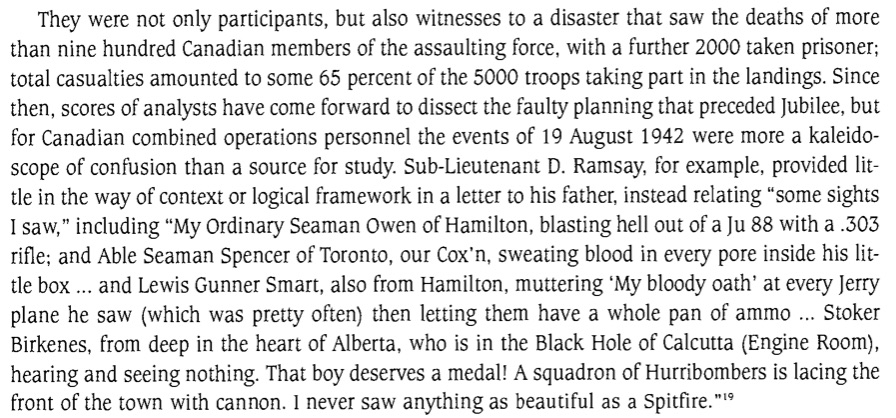
Two sailors of the four mentioned (above) in Sub. Lt. Ramsay's letter, i.e., OS Owen, AB Spencer, AB Smart, Stoker Birkenes, can be spotted in the photo below, also taken at HMCS Stadacona, 1941.

Outside Wellington Barracks, aka Nelson's Barracks, 1941. Joe Spencer is 
in back row, first on left. Vern Smart is in middle row, 4th from the left.
Photo from collection of Doug Harrison, not in photo.
Email GH at gordh7700@gmail.com for more information

Another excerpt from A Blue Water Navy mentions the name of Canada's first casualties related to the Dieppe raid:


The creators of A Blue Water Navy did well to locate the two-volume set of Canadian WWII veterans' stories compiled by Sub. Lt. David Lewis, put together well after the war, after Lewis had been inspired to do so by reading Combined Operations by Londoner Clayton Marks. Many of Mr. Marks' entries are now entries on this website, with the permission of his surviving family members. (E.g., please link to an excellent 25-page account, broken into several sections, written by Al Kirby (RCNVR/Comb.Ops, Woodstock, Ontario) of his experiences re the Dieppe Raid).

Nicely, the authors of A Blue Water Navy give Kirby his due : )


David Lewis' two-volume set, with assists to Catherine (Kit) Lewis and Len Birkenes (RCNVR/ Combined Ops), is entitled St. Nazaire to Singapore, The Canadian Amphibious War 1941 - 1945 and can be found online courtesy of the University of Alberta. Please click on the links below:

St. Nazaire to Singapore Volume 1 (re early training, Dieppe, North Africa, Sicily, Italy and more) 

St. Nazaire to Singapore Volume 2 (re Normandy, individual reports and more)

Photo as found on page113, A Blue Water Navy, LAC Ottawa

Another early excerpt from A Blue Water Navy mentions (partially) the inevitable 'Butcher's Bill':


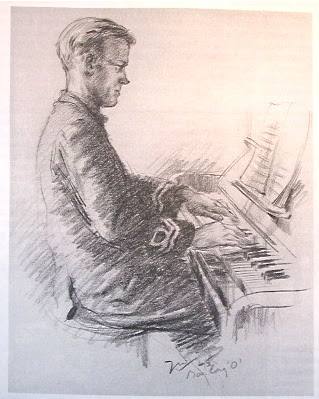
'Prisoners of War' are tallied as well, with significant mention of one of the most-gifted writers among them, Sub. Lt. Robert McRae. (Please see pages 115 - 116, A Blue Water Navy). His prose has been oft-shared on "1,000 Men, 1,000 Stories," along with a lovely pencil sketch of McRae at the piano, while POW:

Photo of the sketch, as found on page 64, St. Nazaire to Singapore Vol. 1

I was certainly delighted to catch wind of A Blue Water Navy with the help of my younger son who did a bit of research re Canadians in Combined Ops prior to out trip to Sicily, re the 80th anniversary of the invasions of Sicily and Italy. More about the book as it relates to 'three months in the Mediterranean' will soon follow.

I will certainly try to connect to one or more of the authors, and try to provide them with a copy of the latest edition of Combined Operations by Londoner C. Marks. And I'll point out that Clayton's last name is not 'Markers' (!) as it appears in footnotes and bibliography.

Photo as found in Combined Operations by LS C. Marks

Please click here to learn more about another book related to WWII, and/or Combined Operations (directly or indirectly) - Books: The Miracle of Dunkirk by Walter Lord

Unattributed Photos GH

Wednesday, April 19, 2023

Books: The Miracle of Dunkirk by Walter Lord

The Miracle of Dunkirk by Walter Lord

First Published in 1982 by The Viking Press

British troops under attack by enemy aircraft on the beach at Dunkirk,
20 June 1940. One fires back with his rifle. Photo - IWM, HU93157*

Introduction:

Though the evacuation of British and French troops in late May and early June, 1940, was an operation (i.e., Operation Dynamo) that involved the coordinated efforts of the army, navy and airforce in order to work successfully, it was not a 'combined operation,' nor were Canadians involved as far as I know. However, it was a pivotal, mainly amphibious operation that involved many small crafts (and medium, and large). And if the Brits could have had 100s of various landing crafts and their crews ready at the time they would have been ideally suited for evacuating troops from Dunkirk. 

If the Canadians in Combined Operations (C. Ops) had been available in May-June 1940 it would have been a miracle as well. My father was in the first draft of 50 - 60 Canadians to volunteer for C. Ops but they did so beginning in November, 1941. I thought of their significant role often as I read the book by Walter Lord.

Please find below a few of the book's highlights, and more:

Jacket painting, "The Little Ships at Dunkirk June 1940," by Norman
Wilkinson, courtesy Trustees of the Imperial War Museum, London

Inside front book cover, a map reveals the setting of the evacuation

The Table of Contents reveals some of the highlights of the book:


The Foreword gives 'the jist' of the story, briefly:


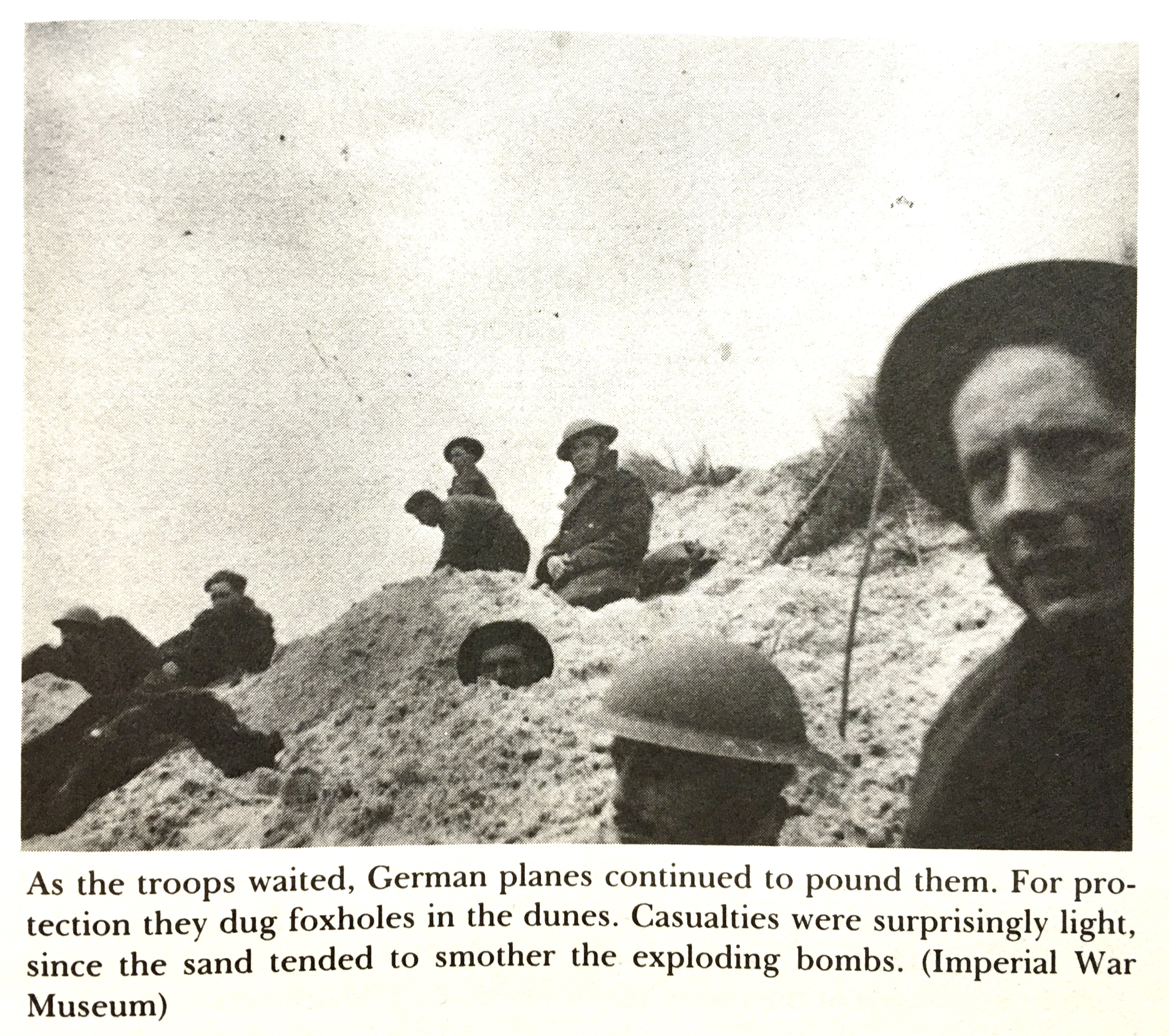
A few of the several photographs shared in the book (following page 154) reveal the extent of Operation Dynamo:


Using a few headings and numbers in the Search Line at the Imperial War Museum I was able to find companion photos for the one above (same location, same foxholes, same men wearing the same helmets) but they had to be purchased. That being said, others re Dunkirk could be found and will appear in a separate post following this entry. ASAP.

Picking up troops direct from the beach seemed to take forever - "loading
ships by the spoonful" was the way one embarkation officer described it.
Above, a trawler and a coaster take aboard men wading out from the shore.


In Chapter 9, entitled 'The Little Ships,' a scene in the English Channel is described by Lt. Ian Cox while upon the destroyer Malcolm. He thought he was seeing dots before his eyes, countless dots, as his ship brought its third load of troops back home to Dover. The dots were going in the opposite direction, i.e., toward the busy beaches of Dunkirk, on the 30th of May.

Walter Lord writes:


Lord then adds a lovely line or two about what the Lieutenant experienced in his mind and heart:


"Showers of Cigarettes, Cakes, Candy, and Affection"


The struggles related to the evacuation of over 300,000 British and French troops varied from day to day, as did the ability of German forces to harass and destroy their enemy. For example, each day a motley crew of British officers and organizers were faced with stiff challenges related to getting ships to the right place on time and in one piece. Some days it was easy, other days were hell. Some days were productive for the German air force (Luftwaffe), on others the weather turned sour and planes sat on the ground. "Such is war," my father said about his own ups and downs as a Canadian in Combined Ops.

About changing tides and circumstances Mr. Lord writes the following:

May 28 promised to be an even more productive day for the Luftwaffe. The Begian surrender, the crumbling French defenses, the capture of Calais - all released additional planes. But the weather turned sour; Fliegerkorkorps VIII, responsible for Dunkirk, remained on the ground...

May 29 dawned even worse. A steady drizzle and ceiling only 300 feet. Fliegerkorps VIII steeled itself for another barrage of calls from Goring (who had assured Hitler "that the Luftwaffe could win the battle alone"). But around noon it began to clear up. At 2:00 p.m. Richthofen (Commanding Officer of Fliegerkorps VIII, and "distant cousin of the famous Red Baron") gave the long-delayed orders to attack...

It was no ordinary raid... some 400 aircraft headed for Dunkirk, led by 180 Stukas.    

(From earlier in May 1940): "Plunging down from the sky, a German Stuka
dive-bombs an Allied tank as Hitler strikes west... the Stuka symbolized a
new kind of lightning war - the Blitzkrieg. Photo - Bundesarchiv Bestand
 
Lord continues:

By 3:00 p.m. they were there. No sign of the RAF. Circling so as to come in from the sea, Corporal Hans Mahnert, a gunner-radio operator flying with Stuka Wing No. 3, looked down on a remarkable sight. Ships were crowded together everywhere. It reminded him, oddly enough, of an old print he had once seen of the English fleet gathered at Trafalgar.

Other more practiced eyes were also scanning the sea. They may have missed the eastern mole (pier, where the Brits loaded many a ship with soldiers) before, but not today. The smoke was blowing inland now, and there - directly below - was a sight no one could overlook. Clustered alongside the mole were a dozen ships. It was hard to imagine a better target...

Lt. Bill's Sketch, as found on page 136

Walter Lord's next two paragraphs reveal which direction the wind is blowing for the next few pages of his book:


The book is filled with many fine, poignant details related to the unforgettable 'days at Dunkirk' (or Dunkerque). I found the following summative lines in the Foreword:


"To Americans, it has come to mean Mrs. Miniver, little ships, The Snow Goose, escape by sea. To the French, it suggests bitter defeat; to the Germans, opportunity forever lost." (page ix) 

Back of book jacket. Painting by Norman Wilkinson

For those who have a full bookshelf...


In my opinion The Miracle of Dunkirk is an exciting, informative, detailed book and I recommend it to others. I was given my clean, hardcover copy for free by a neighbour with a Little Free Library on her front lawn. Excellent!

Please click here to read a short review re another book related (directly and/or indirectly) to Combined Operations. Books: Dieppe: August 19 by Eric Maguire

*re IWM (Imperial War Museum), HU93157, found under the photograph at the top of the page. The photo was taken by an Associated Press photographer or Press Agency photographer (the difference is ?) but no name is provided at IWM.

Unattributed Photos GH