Showing posts with label Editor's Column. Show all posts

Saturday, March 22, 2025

Editor's Column: FAINT FOOTSTEPS, World War II (16A)

Soon Amidships, Soon in Gibraltar

(Stories of "Dad's Navy Days" Continues)

My father wrote, "...Riena (sic) Del Pacifico served (us) well..."
Norwich Gazette, circa 1992 - 1993

Introduction:

"Dad's Navy Days" began in June, 1941, when he enlisted with the Canadian Navy's Volunteer Reserve (RCNVR) in Hamilton, Ontario. They ended on September 5, 1945, when he was officially discharged in the same city one day before his 25th birthday. 

Note the last line in the photo of his Navy records below:

"Discharged, Demobilized to date 5 Sept. 1945" aka "I'm outta here!"
A few weeks later he was back at work at the Norwich Co-op

Doug H. 'holding up his truck' (loaded with fence posts) at the main
intersection in Norwich, Ontario (circa 1940s)

I continue to share his Canadian Navy and Combined Operations memoirs in short bursts, as seen below, this burst coming to you from amidships, off the coast of North Africa, 1942.

Soon Amidships, Soon in Gibraltar

“The clank of the anchor cable... in the hawse pipe” meant the anchor of the Reina Del Pacifico was being stowed deep inside the ship (to many sailors the sound also meant "we're on our way home!"), and the gang plank soon followed, with all sailors on board safe and dry. Such things my father recalled both in Navy memoirs, scribbly hand-written notes put down in the early- to mid-1970s (at the age of 50 - 55 years old), and in weekly, nicely typed newspaper columns for the Norwich Gazette in the early- to mid-1990s, when 20 years older, about the age that I am now. 

Excerpt from the Norwich Gazette, circa 1993

While hearing the distinctive sounds in his mind of anchor cable and gangplanks being moved about, and while sitting safely at a table inside his home in Norwich, Ontario - pen in hand, poised to write - he relived the scene of his first sustained Navy and wartime action during WWII, that is, Operation Torch.

Torch, the Allied invasion of North Africa, took place in the early days of November, 1942, when my father was a 22-year-old, and only ten months removed from his arrival in the United Kingdom to begin training in 'special duties' related to handling various types of landing craft. 'Special duties' that he and his close-knit mates in the Effingham Division (from HMCS Stadacona, Halifax) had only first learned about in theory - with just the use of discussion and diagrams - at HMS Northney on Hayling Island (southern England). Early class lessons were eventually followed by 'hands on' experience and the repeated, practical use of landing crafts in Irvine and Inveraray, Scotland, beginning (according to his records) in April of '42, six to seven months before the actual invasion.

The Effingham Division at HMCS Stadacona,  Halifax, N.S., 1941

A wartime photograph of a drawing of a 'landing craft, assault' or LCA, two views
mounted on card. One of a series of photographic reproductions of D. Moira
Cruickshank's landing craft. Photo Credit - The D-Day Story, Portsmouth

And though in just a matter of a few hours he and his mates were safe and sound “inside the submarine nets at Gibraltar” with "organized bridge and crib tournaments” on his agenda (the winners, Dad included, got to lay claim to "their opponents' tot of rum"), his mind turned to the many long hours and days and nights of training (aboard LCAs and LCMs) he'd undergone for Operation Torch (for the Dieppe Raid as well as), and the main 'lessons learned' related to his role as a Canadian sailor who had, for eleven long and tiring days and nights, transported soldiers and all materials of war to assigned beaches in sturdy landing crafts.

He writes: 

The job of the seaman on an ALC or LCM (Landing Craft, Mechanised) is to let the bow door down and wind it up by means of a winch situated in the stern of the barge. This winch is divided so you can drop a kedge (anchor) possibly about 100 or so feet from shore depending on the tide. If it is going out you can unload and then put motors full astern, wind in the kedge and pull yourself off of breach. 

"Pull yourself off of breach?" Did he mean "the beach?" No. Breach (and broach), when related to a landing craft, means it is turned at a bad angle related to the tide, and is getting into a position where it could be flipped over by strong tidal or wave action. In the photo below, from the invasion of North Africa, November 10, 1942, we see a sailor (far left, looks like my father!) who is handling a rope (an anti-broaching line) to keep the LCA in the direction of the tide, whether going in or out. He may have called for another line - a soldier seems to be bringing it to him. 

Caption: American troops landing on the beach at Arzeu, near Oran, from a
landing craft assault (LCA 426), some of them are carrying boxes of supplies. 
Photo Credit: RN photographer Lt. F.A. Hudson, A12649, IWM

Here is a definition I located that is useful: Anti-broaching lines are ropes rigged to a landing boat to prevent or correct a "broach," which is when a boat's bow or stern swings uncontrollably sideways, potentially leading to capsizing. 

Dad is perhaps recalling that he learned how to control the position of a landing craft by using only the motor and anchor cable. And he likely saw this safety measure in action as well as in training. And if the sailor holding the anti-broaching line is not my father, it is surely him who is sitting on 'what looks like a barrel' on the landing craft! A front row seat, I say.

He also uses the word 'breach' again below:

The tide is very important and constantly watched. If it is going out (on the ebb) and you are slow, you can be left high and dry, and if so, you stay with the barge. If the tide is on the make (flowing in) you use the kedge to keep you from swinging sideways on breach. In this case your kedge would be out only a short ways. After much practice, however, the kedge can be forgotten and everything done by engines and helm. Each barge has two engines.

I think Dad included these two paragraphs about his training because all of his practice paid off during his time near Arzeu in North Africa. No landing craft got flipped over. No officer chewed him out for slowing down the transport of troops and all of their supplies. In fact, he may have been thinking back and realizing he did a pretty fine job when needed, even though he didn't get fed for the first four days.

Another reason the two paragraphs stand out as somewhat special - at least in my humble opinion - is because his 'lessons learned' are very similar to those addressed in The Green Beret: The Story of the Commandos 1940 - 45 by Hilary St. George Saunders.

To be continued. 

More stories related to Dad's Navy Days will follow.

Please click here to read Editor's Column: FAINT FOOTSTEPS, World War II (15)

Unattributed Photos GH

Thursday, November 28, 2024

Editor's Column: FAINT FOOTSTEPS, World War II (15)

Really? Half the Fun is Getting There?

Canadians in Combined Ops served at Z Beach, Arzeu, east of Oran in 
N. Africa during Operation TORCH starting November 8, 1942

Introduction:

Perhaps 100 - 200 members of RCNVR/Combined Operations, some in their first action since undergoing initial training re the handling of landing crafts (e.g., at HMS Northney I - IV on Hayling Island, south coast of England), toiled on the shores of North Africa for about one-and-a-half weeks in mid-November, 1942. The work was exhausting (see previous entry here). On about November 20th, however, members of the Royal Navy took over their duties and - rejoice, rejoice! - the Canadians prepared to sail home.

Clean Beds Back in Liverpool are a Hop, Skip and Jump Away

After about one-and-a-half weeks completing 'ship to shore' duties at Z Beach east of Oran (in North Africa, during November, 1942), the Canadians in Combined Operations including my father Doug Harrison of Norwich, Ontario received a positive sign - a smoke signal of sorts - followed by word that their work was done and they would soon be returning to England's welcoming shores. Be still my beating heart!

Doug, oft-looking fondly at the Reina Del Pacifico resting at anchor a mile or two off shore from Arzeu amongst large supply ships, maybe the occasional destroyer and likely a bevy of spritely landing crafts, caught wind of something (as in 'something's up') near the end of the third week of November. The ship (a favourite to some), having served as a recovery centre for hungry and exhausted sailors for 10 - 11 days, was giving off a hint it was going to soon serve them in another way.

My father writes, "the dark green, two funnel Reina Del lay at anchor... and those two funnels were active enough to indicate steam was being brewed in the engine rooms." He mused (correctly), "She was as anxious as the sailors to head for home."

To get onto the ship, once official word was given, were the young sailors expected to climb up a thick hawser (braided rope) to reach the upper deck, that is, "hand over hand" (as Doug had done the first time he was sent to rest and recuperate onboard the ship)? No, not this time. Not much climbing really. More like a 'hop, skip and jump' according to my father's notes.

If not already on an LCA or LCM (landing craft, assault or landing craft, mechanised) the sailors hopped aboard a long and eager line-up of landing craft (now manned by members of the Royal Navy) heading off the beaches toward Reina Del Pacifico. These small craft (surely buoyed by good cheer) then skipped over the waves and joined others carrying Canadian sailors waiting their turn to enter the open hatch(es) of the waiting supply ship. 

Here we see U.S troops exiting Reina Del Pacifico to assault beaches in
the far distance. Now imagine the Canadians jumping from moving landing
crafts up to the cargo doors... to go home! Photo - Imperial War Museum

"Our landing craft, one by one, manoeuvred to the gangplank on the port side of the Reina Del," my father writes.

And under the well-worn heading 'Getting There is Half the Fun' the Canadian sailors, 'one by one' as well, while surely feeling some pressure from the tricky situation they faced, had to time a perilous jump from a bobbing and weaving landing craft onto a narrow moving target. The sailors, loaded with some odds and ends of personal gear, waited "for the proper swell of the wave" before setting sail across an ever-changing gap of space onto a waiting gangplank.

You'd only get one go at this I'm thinking. Maybe wear a Mae West? Maybe two?

"Mae West" Life Belts, HMCS St. Laurent. Wearing a life belt, Chief
Ordnance Artificer Les Gill (foreground) stands near the torpedo tubes
of the destroyer HMCS St. Laurent. Photo - Canadian War Museum

When Dad's turn came he spotted something that he felt he needed to ask about, i.e., "a large unexploded shell imbedded in the side of the ship not far from the officer's head (Sub. Lt. Andrew Wedd)."

I can hear my father ask, "Isn't that shell going to be a problem?"

Wedd replied, "The Captain had the shell examined and it's a dud."

To that my father said (I think trying in his own way to show a bit of his sense of humour), "I sure hope he is right because my mother will miss me, Mr. Wedd."

"Your mother will miss you a lot more if you're not on board on the next swell, Harrison, because we are leaving," snapped the Sub. Lt. "Do you hear me?" (He added a bit more which couldn't be printed.)

Wedd's ultimatum focussed my father's mind (Okay, I guess it's no time for jokes!) and he timed the next swell perfectly.

"I jumped to the gangplank, and though tired, I found new energy at the cargo door and was soon amidship." He also added that the shell never exploded "but it was sand-bagged and roped off."

As for Dad's mates, if they landed safely (and no notes were shared about any fellows falling into the Mediterranean Sea) they rushed up the exterior steps and boarded via the same cargo door. 

"Each one was checked off by name by another Canadian officer standing inside... complete with clip-board." 

The Reina Del's anchor was soon clanking "in the hawse pipe, the gangplank was soon stowed" and in a few hours the friendly ship was "steaming at 27 knots (about 33 mph)" toward the submarine nets at Gibraltar.   

An anti-submarine net used during World War II in Nova Scotia, Canada

More FAINT FOOTSTEPS, World War II will soon follow.

Please click here to view Editor's Column: FAINT FOOTSTEPS, World War II (14)

Unattributed Photos GH

Tuesday, November 5, 2024

Editor's Column: FAINT FOOTSTEPS, World War II (14)

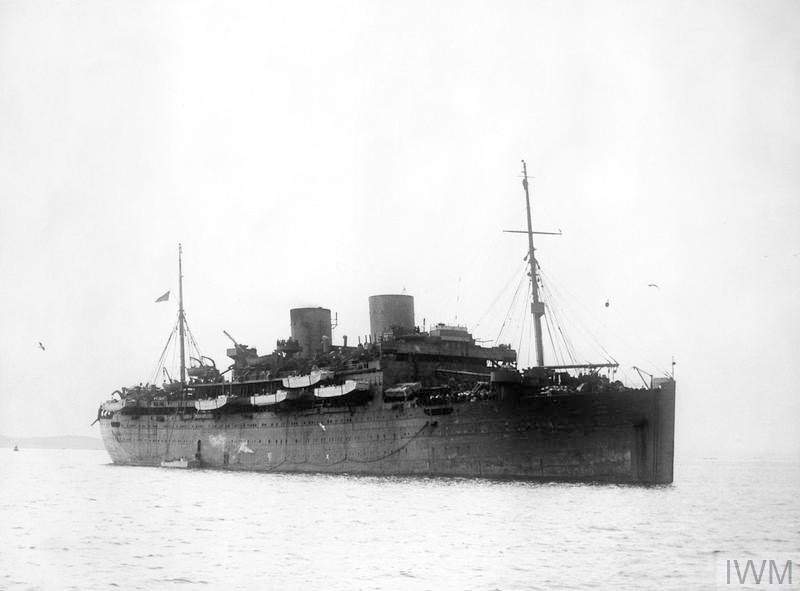
The 'Queen of the Pacific', HMS Reina Del Pacifico

Favourite Ship of Many Tired Sailors During WWII

'HMS Reina Del Pacifico' transported U.S. troops to North Africa, 1942.
Four landing craft can be seen hanging from davits. Another is in the water
near the stern of the ship, alongside an open door - for exitting troops. Photo
by J. Hall at Gourock, Scotland. FL18191, Imperial War Museum (IWM)

Introduction:

In July, 2018, I received news that my columns would no longer be needed by The Norwich Gazette, my father's hometown weekly newspaper. It was closing its doors. I was very disappointed, I didn't think my columns were that bad!!

Now it is common knowledge that small- to medium-sized newspapers across the land are under threat from other forms of news media and that problem is not all my fault. So, I'm going to continue my series of short stories related to my father's Navy memoirs and the several submissions he made to The Gazette and a few other interested parties.

Questions, comments and related information re the 900 - 1,000 Canadian sailors that volunteered for Combined Operations (many manned landing crafts during the Dieppe Raid and Operations Torch, Husky, Baytown, Avalanche, and D-Day France) can be sent to Gord H. @ gordh7700@gmail.com

North Africa PT 3: A Big Tot of Rum on the 'Reina Del Pacifico'

("Getting There was Half the Fun")

American troops manning their landing craft assault from a doorway in the side of
HMS Reina Del Pacifico during Operation 'Torch', the Allied landings in N. Africa,
November 1942. Two of the landing craft are numbered LCA 428 and LCA 447.
Photo Credit: RN Photographer Lt. F. A. Hudson, A12647, Imperial War Museum

*I believe that my father is helping get his LCA (Landing Craft, Assault) into position to take on U.S. troops. It was work, work, and more work for the first four days (without rest) during his 11 days serving near Z Beach and Arzew.

* * * * *

"TORCH was a compromise operation that met the British objective of securing victory in North Africa while allowing American armed forces the opportunity to begin their fight against Nazi Germany and Fascist Italy on a limited scale." Operation Torch, Wikipedia

* * * * *

"The six Flotillas of Canadian Landing Craft included in the forces which made the landings at Oran and Arzew (sic) had an easier time than expected; and their heaviest casualties occurred after all resistance was over, when the ships returning to England were torpedoed... The Canadian Landing Craft ferried in American and British troops almost without incident, although they were occasionally under sporadic fire from French ships and shore batteries. After the nervous initial stage was over, the men were inclined to make a picnic of the work. Nevertheless, at the conclusion of the landings it was reported that it had actually been difficult to get the men out of their craft to be relieved." Combined Operations by Clayton Marks, London, Canada. Page 69

* * * * *

My father, Doug Harrison, unloaded U.S. troops and their supplies at
Arzew, Z Beach, upper right. Map - Combined Operations, pg. 66

Arzeu and Z Beach are in the upper right side of the above map as well.
As found in The Campaign for North Africa by Jack Coggins

"Getting There was Half the Fun"

My father, Doug Harrison, writes about some of the difficulties associated with getting "the men out of their craft to be relieved" in his Navy memoirs (excerpts below from ("Dad, Well Done", pages 25 - 26):

"I worked 92 hours straight and I ate nothing except for some grapefruit juice I stole..." 

After the 92 hours my officer said, "Well done. An excellent job, Harrison. Go to Reina Del Pacifico and rest."

Such kind-hearted words must have been greatly appreciated, but before my father could gratefully comply a few "snipers in a train station" had to be eliminated. It was recorded that American gunners in a half-track flattened the station "to the ground level." Shortly thereafter (perhaps with the smell of fresh cordite still hanging in the air above Beach Z), my father made his way by landing craft - likely with all aboard feeling somewhat safer and more secure - to the side of the Reina Del. It was a very popular liner as far as some very tired Canadian sailors were concerned, and was stationed about a mile or two off shore. 

Once the small landing craft was positioned beside the resting hulk of the liner my father reached for a single fat rope dangling from far up over his head.

"I then had to climb hand over hand up a large hawser (braided rope) to reach the hand rail of Reina Del Pacifico and here my weakness showed itself. I got to the hand rail completely exhausted and couldn't let one hand go to grab the rail or I would have fallen forty feet into an LCM (Landing Craft, Mechanised) bobbing below."

Braided rope, aka hawser, found in front window of a lovely
building (below) at a Canadian Navy base. Photo GH

"Lovely building" on the grounds of CFB Esquimalt, British Columbia
Various types of braided ropes are still made inside. Photo GH

Are these called "fenders for large ships?" Made inside that
same building at Esquimalt, BC. Photo GH

Photographs found in England's Imperial War Museum reveal that U.S. troops exitted the Reina Del through an open door - with help from a rope ladder - situated no more than 8 - 9 feet  above a waiting LCA. No such short cut to the upper deck was available to Doug, but fortunately, an angel smiled in his direction when he reached the end of his rope. 

He writes, "I managed to nod my head at a cook in a Petty Officer's uniform and he hauled me in. My throat was so dry I only managed to say, Thanks, you saved my life."

Under the heading "getting there was half the fun," the better half of the fun associated with my father's journey to a ship he long-remembered* was about to begin. Though the Reina Del served in general as a troop ship from 1939 until 1946 as well as the floating HQ for a Senior Naval Officer of Landings in Sicily - less than a year after my father's visit (i.e., during Operation HUSKY beginning July, 1943) - it served up the best of hospitality for a particular worn-out young sailor.

Also in memoirs (written in the comfort of his own home during the early 1970's) my father recalls the following:

"The Reina was a ship purposely for fellows like me who were tired out, and I was fed everything good, given a big tot of rum and placed in a hammock. I slept the clock around twice - 24 hours - then went back to work."

(And after his work was completed...) "In seven days I went back aboard the Reina Del and headed for Gibraltar to regroup for the trip back to England." 

With a mind full of good memories about the Reina Del (good food, good rum, good hammocks) I bet my father was one the first to climb aboard whether by the side door or hawser.

More stories based on my father's 'Faint Footsteps' will soon follow.

*"long-remembered": Please click here to read a final article my father wrote in the 1990s - for his hometown newspaper - re Reina Del Pacifico, undoubtedly one of his favourite ships.

Please click here to read FAINT FOOTSTEPS, World War II, Part 13

Unattributed Photos GH

Tuesday, May 18, 2021

Editor's Column: As Published in The Norwich Gazette (Parts 1 - 13)

We Follow Faint Footsteps that War Veterans Left Behind

The Norwich Gazette is Shuttered But Stories Live On

Canadians in Combined Operations, including my father, man landing crafts
at Arzeu for US troops; Operation Torch, beginning November 8, 1942. 
Photo - RN photographer Lt. F. Hudson, Imperial War Museum (IWM)

Introduction:

My father Doug Harrison (RCNVR, Combined Operations) appears in the above photograph found at IWM. He is either the sailor (far left) stabilizing the landing craft (Landing Craft Assault, LCA) with an anti-broaching line or the fellow (2nd left on the LCA) taking a break - sitting atop an object so he can get a good view. 

"How can I be sure?" is a very fair question.

My father's Navy memoirs share the same information as read in the caption re who, why, when and where, and besides, it just looks like him even from where I'm sitting, almost 80 years after the event.

By using my father's memoirs and newsy articles for his hometown newspaper I assembled a few columns of my own with the goal of producing 24 in all - to tell some of the story re his WWII adventures. I produced 13 before the Norwich Gazette was closed down in 2018. And I may produce more in the future about my father and other Canadians in Combined Ops who participated in the Dieppe raid and invasion of North Africa in 1942, the invasions of Sicily and Italy in 1943, and trained others at a Combined Operations School (C.O.S.) on Vancouver Island from 1944 - 45.

Some who had been overseas in 1942 - 43 served (and played some baseball)
at a C.O.S. on Vancouver Island. Photo - Collection of D. Harrison (far right)
 
Links to the collection of Gazette columns:

Column 1 - Following My Father’s Trail from 1941-45

Column 2 - Canadian Sailors Volunteer for the Unknown, 1941

Column 3 - A Hole in One Ship, Torpedoes in Another

Column 4 - Dark and Lonely Nights

Column 5 - Lovely Scenery and Good Training in Scotland

Column 6 - Sailors Work Hard, Play Hard in Scotland

950 - 1,000 members of RCNVR also volunteered for Combined
Ops beginning in Dec. 1941 while at HMCS Stadacona, Halifax

Column 7 - An Important Training Exercise Goes Awry

Column 8 - Baptism of Fire on the Ennerdale

Column 9 - Dieppe Raid Pt. 1: Norwich Boy Cool Under Pressure

Column 10 - Dieppe Raid Pt. 2: Norwich Boy Deals with Aftermath

Column 11 - Dieppe Raid Pt. 3: Buried With Full Military Honours

Column 12 - North Africa PT 1: Trip to ‘The Med’ for Operation Torch

Column 13 - North Africa PT 2: The Landings and 11 Days Hard Labour

A navy hammock that made its way around Africa in 1943, pre-Operation Husky
Photo sent to me from CFB Esquimalt, Vancouver Island

Please click here to read a story by Doug Harrison - A Voyage Around Africa to the Invasion of Sicily, Operation HUSKY

Unattributed Photos GH

Sunday, July 1, 2018

Editor's Column: As Published in Norwich Gazette (13).

FAINT FOOTSTEPS, World War II.

[Photo Caption: A12689. US Troops putting off for shore in landing craft.
Credit - RN photographer Lt. J.E. Russell, Imperial War Museum]

Introduction:

The following article is as published in the Norwich Gazette (Norwich Ontario). After it was submitted I received news that the Gazette is being shut down, closed, soon to be out of business (mid-July). My father and mother would have been saddened by such news. Both were lifelong residents of Norwich and frequent contributors to the pages of their hometown weekly.

Perhaps the paper will survive for a period of time online. But whatever the case, these columns about my father's days in the Canadian Navy are coming to an end somewhat prematurely. If another door opens, then the story will continue.

North Africa PT 2: The Landings and 11 Days Hard Labour 

In the book entitled Assault Landing Craft (B. Lavery) is an informative, two-page photograph captioned ‘Unloading ammunition at Arzeu during the North Africa landings.’ Significantly, U.S. troops - as full-fledged allies - are disembarking from a British landing craft during Operation Torch, beginning November 8, 1942. It’s a big deal.

Patriotic U.S. citizens might claim, “We landed first!”

Caption: A12671. Troops and ammunition for light guns being brought ashore
from a landing craft assault (ramped) (LCA 428) on Arzeau beach, Algeria,
North Africa, whilst another LCA (LCA 287) approaches the beach.
Lt. F.A. Hudson, RN photographer, IWM. 

Not so fast, I say. Canadian Doug Harrison, Norwich (sailor centre of photo) dropped the barge’s ramp, jumped into the water and won the day. (Slight exaggeration).

Because the knee-deep water is calm and safe for unloading the troops and supplies, my father would likely have said, “Good landing, fellas.” Though a later news interview limited his experiences to three sentences (saying ‘it was “quite easy”’; ‘his point of invasion was at Arzeu’; and ‘it was his first operation after a year of training’ - Brantford Expositor, 1944), his memoirs and Norwich Gazette columns written 30 - 50 years later reveal more.

A12649. American troops landing on the beach at Arzeu, near Oran, from a
landing craft assault (LCA 26)*, some of them are carrying boxes of supplies.
Photo Credit - Lt. F.A. Hudson, IWM.

(* This editor believes the landing craft is numbered 426, a partner to LCA 428 (in earlier photo) and the sailor (far left) handling the anti-broaching lines is Canadian Doug Harrison).

Admittedly, there were several good, easy days during the landings. My father once transported U.S. troops to a beach within sight of an outdoor cafe. “Good reconnaissance,” he said. But a few days were harder, even dangerous. It seems planners expected some fiery resistance at Arzeu - home to “two coastal batteries and a French garrison” says an online source - and got it.

My father recalls sniper fire two times. First, while his landing craft was grounded on a sandbar not far offshore. He says, “I kept behind the bulldozer blade when they opened up at us.” Second, before taking a rest break, he recalls that “the Americans... found out snipers were in a train station - and shelled the building to the ground level. No more snipers.”

Apart from these incidents, the landings (from the point-of-view of some Canadians in Combined Ops) were chiefly characterized by non-stop work.

Jack Dean of Toronto, pilot of my father’s Landing Craft Mechanized (LCM) writes, “We worked steadily for 11 days. It was a 24-hour-a-day job and we would catch a couple of hours sleep at night if the sea was calm... our landing craft carried American troops ashore and then ferried in (their) supplies: bulldozers, ammunition and tons of light equipment until the merchant ships were empty.” (St. Nazaire to Singapore)

Canadian sailors - about 200 strong now - had to unload their LCMs quickly, on schedule, at the right location, with anxious officers wanting fully-supplied troops before moving inland confidently from the beaches. And it is known that U.S. forces brought a lot of gear, with inherent advantages and disadvantages.

A12690. US Troops disembarking with the aid of nets. Lt. J.E. Russell, IWM.

A12704. LCP's leaving the troop ship for shore. Lt. L. Pelman, IWM.

At Arzeu, an American Commander “insisted on sending so much gear ashore with his men that the landings from the LCM Flotilla were delayed by nearly two hours and the whole program fell more and more behind the clock. The troops went ashore greatly overloaded and... any opposition would have been disastrous.” (P. 68, Combined Operations)

Fortunately, resistance remained light during the initial assault landings (Nov. 8 - 11), and one U.S. soldier has Doug Harrison to thank for not being so ‘greatly overloaded.’

About those four days Dad says, “For ‘ship to shore’ service (after initial troops were landed) we were loaded with five gallon cans of gasoline. I worked 92 hours straight and I ate nothing except for some grapefruit juice I stole.”

He also records that before his next full week of work began (“during which reinforcements and supplies had to be ferried ashore”) he was given a much-needed break.

“Well done. An excellent job, Harrison,” his Royal Navy officer said. “Go to Reina Del Pacifico (Queen of the Pacific) and rest.”

Getting there was half the fun.

Please link to  Editor's Column: As Published in Norwich Gazette (12).

Unattributed Photos GH

Monday, June 25, 2018

Editor's Column: As Published in Norwich Gazette (12).

FAINT FOOTSTEPS, World War II.

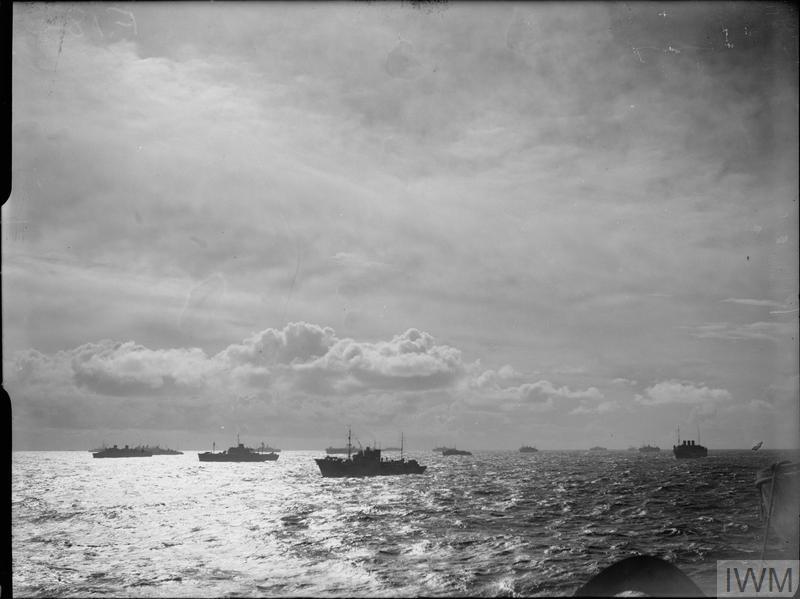
[Photo: A12654. General view of the convoy en route for Gibraltar bathed
in sunlight and stretching into the distance. Photo Credit - RN photographer
Lt. F.A. Hudson, Imperial War Museum (IWM)]

Introduction:

The following article is as published in the Norwich Gazette, my father's hometown newspaper. During the early 1990s, Doug Harrison wrote many weekly columns related to his Second World War experiences. I refer to his columns often as I write my own series (24 columns) about him and his mates, Canadians who volunteered for RCNVR and the Combined Operations organization and who were eventually involved in handling landing crafts at the Dieppe raid and invasions of North Africa, Sicily, Italy and France, from 1942 - 45.

Below is the first of a few columns about preparations for and activities related to Operation Torch, which began on D-Day November 8, 1942:

North Africa PT 1: Trip to ‘The Med’ for Operation Torch

Most Canadians who manned and operated landing crafts during the Dieppe raid survived. They reunited with their anxious mates (including my father) in southern England ports, and were soon aboard waiting trains and troop ships.

My father says, “We regrouped and went back to H.M.S. Quebec (Combined Operations establishment in Scotland) for further training... this time on Landing Craft, Mechanized (LCMs: larger than assault landing crafts and called ‘D-Day workhorses’ ).” For more practice, he worked with LCM flotillas at Southend-on-Sea, east of London, before the next call to action - Operation Torch, the Allied invasion of North Africa.

A29897. Part of the training pool reserve at QUEBEC.
Photo - Lt. E.A. Zimmerman, Imperial War Museum.

[Link to more photographs of landing crafts at H.M.S. Quebec - Photographs: Training on Landing Crafts (12).]

“We left Greenock (Scotland) in October, 1942 with our LCMs aboard a ship called Derwentdale... an oil tanker. The food was short and the mess decks were full of 18-inch oil pipes. Little did we know we were bound for Africa,” he says.

The destination and purpose of Torch were unknown to my father as he travelled toward the Mediterranean Sea in early November. He likely learned ‘the where’ quickly on November 8, the first morning he disembarked troops onto beaches in Africa. He likely discovered ‘the why’ gradually (i.e., to secure bases in Morocco, Algeria, and Tunisia from which British forces in the Western Desert, commanded by Field Marshal Montgomery, could receive assistance in ongoing battles with Axis forces), in the weeks, months, even years after the invasion.

Whatever the case, I find no words of disagreement concerning the invasion’s overall purpose that compare in any way with his angry opinions about Dieppe. My guess is, because of Dad’s British ancestry (he often visited with a few close relatives in London, England while on leave), he supported the war effort, in general, with some sense of pride and patriotism.

His most vocal complaint about his trip to ‘The Med’ seems to be about the food! Though he took tests during the voyage (“I became an A/B or Able-Bodied Seaman on this trip and passed my exams classed very good”), he writes more about bad and ‘short’ food.

“The food aboard was porridge and kippers for breakfast, portioned out with a scale,” he says. “We would plead for just one more kipper from the English Chief Petty Officer, and when he gave it to us we chucked it all over the side because the kippers were unfit to eat.”

He writes that meals aboard ship - amongst high numbers of hungry American troops - did improve somewhat, with help from an Italian cook who “had the ability to make a little food go a long way.” Still, the Canadian sailors soon “nicknamed the Derwentdale H.M.S. Starvation.”

In memoirs he recalls only one mishap during the approach to Gibraltar: In the convoy close to us was a converted merchant ship which was now an air craft carrier. They had a relatively short deck for taking off, and one day when they were practicing taking off and landing a Swordfish aircraft failed to get up enough speed and rolled off the stern and, along with the pilot, disappeared immediately. No effort was made to search, we just kept on. (Page 24, “Dad, Well Done”)

HMS ARGUS operating off the N. African coast during combined operations
for the 'Torch' landings. Credit A12882. - RN Photogr. R.G.G. Coote, IWM.

Fortunately, the tragic scene did not serve as an ill omen for what lay ahead. Soon The Rock appeared. And surely, the Canadians in Combined Ops hugged the rails to see Gibraltar and catch their first glimpse of the Mediterranean.

A12795. HMS ARGONAUT approaching Gibraltar; "The Rock", during
the transport of men to the North African coast. Lt. C.H. Parnall, IWM.

Not long on description, Dad recalls the moment: One November morning the huge convoy... entered the sea through the Strait of Gibraltar. What a sight to behold. I can still see the turquoise colours.

Four days later Torch unfolded.

Please link to Editor's Column: As Published in Norwich Gazette (11).

Unattributed Photos GH

Tuesday, June 12, 2018

Editor's Column: As Published in Norwich Gazette (11).

FAINT FOOTSTEPS, World War II (11)

Lloyd Campbell died in Germany on October 21, 1942

Introduction: My father knew Lloyd Campbell of London, included some details about Lloyd related to an incident (June, 1942) aboard the Ennerdale while they voyaged to an embarking site for the first running of the raid upon Dieppe (Operation Rutter, cancelled on the day it was scheduled, July 7, 1942).

The Ennerdale at Greenock, Scotland with landing crafts hoisted, port side
Photo credit - Joe Spencer, RCNVR, Combined Operations 

My father knew Lloyd had died while in captivity as a POW but did not know the date, as evidenced in the top illustration (a published submission to St. Nazaire to Singapore, Volume 1). Berlin is the correct place of burial ("Well done, Dad," I say), and I have since located the exact site.

The following is the 11th column in a series of 24 I have submitted to my father's hometown newspaper, the Norwich Gazette, to inform readers of work done by Canadians in Combined Operations during the Second World War.

Dieppe Raid Pt. 3: Buried With Full Military Honours

If Dad was sitting beside me right now I’d ask him if he’d like to learn more details about the death of his mate Lloyd Campbell (wounded and captured during the Dieppe Raid), and where he is buried. And if Dad was agreeable, I’d hand him the news clipping I found one week ago.

He’d likely recall first that he believed Lloyd was buried in Berlin. He said as much in memoirs. He’d recall his commanding officer (Lt. Robert McRae, also taken POW) had written at length - once repatriated (1945) - about what happened to his crew on August 19, 1942.

McRae wrote: “We found we were fatally headed toward the beach under the steep cliffs. They began to pour machine-gun fire down into the boats. In our craft, Campbell, who was at the wheel, received a line of bullets across his thighs (later as a POW he lost his legs to amputation and died before Christmas from gangrene). As it was my place to stand behind the man at the wheel, Campbell had stopped the bullets I might otherwise have received”. (St. Nazaire to Singapore)

“The clipping shares a wee bit more,” I’d say.

Navy Casualty. OTTAWA, Nov.18 - The Royal Canadian Navy reported today, in its 130th casualty list of the war, that Able Seaman Lloyd George Campbell, whose sister, Mrs. Madeline Rollands, lives at London, Ont., died Oct. 21 while a prisoner of war in Germany. AB Campbell had undergone amputation of his right leg while in Camp 9-C in Germany. (Winnipeg Tribune, Nov. 18, 1942)

News clipping as found in the Winnipeg Tribune

‘A wee bit more’ sounds right, yes? Or, short and sweet. Because even in scant details (i.e., sister’s name, Oct. 31, Camp 9-C, etc.) a key to an important door is occasionally provided. Within 24 hours, with help from phonebooks and Google, I possessed Lloyd Campbell’s Service Record, significant family letters, and several official documents.

From his Attestation Form: Lloyd joined the Navy (London Division) three months before his 19th birthday. Occupation - knitter at Holeproof Hosiery.

From his Active Service Sheet: He served aboard corvette HMCS Eyebright doing escort duty in the Atlantic before travelling to Scotland for landing craft training at the same Combined Ops camps as my father.

As well, eight days after Lloyd was severely wounded at Dieppe, Madeline Rollands was sent the following letter from Secretary, Naval Board:

It is with deepest regret that I must... inform you that your brother... has been reported missing on active service. It is not possible to say definitely whether your brother was taken prisoner or whether he lost his life... (once) further information is received you will be informed.

POW Lloyd Campbell sent his last message home two weeks after the raid: “This isn’t my handwriting, because my arm isn’t well yet. I am in a hospital in Germany looked after by British Doctors and orderlies.... I have had to have my right leg off, below the knee due to bullet holes, but it might have been worse and I hope to be about soon.” 

Lloyd Campbell's last communication his sister Madeline Rollins, London
As found at collectionscanada.gc.ca

The message (above) reached Canadian Postal Censorship, Ottawa, on Oct. 24, 1942. It therefore reached Lloyd’s sister Madeline and mother Mary* in London shortly after Lloyd’s death due to medical complications.

If Dad was sitting beside me, I’d read, “After his last operation he suffered the minimum of pain and his last hours were very peaceful. Lloyd was buried... with full military honours... the coffin was, as is usual, draped with the Union Jack.’ (Letter from ‘Senior British Medical Officer’)

And when I locate surviving members of Lloyd’s family I’ll provide these details and more, including the exact location of Lloyd’s gravesite in Berlin.

*I have since learned that Lloyd's mother Mary (and father Thomas) had passed away a few years earlier. And I have since found surviving family members and passed along all details I have discovered.

Please link to Editor's Column: As Published in Norwich Gazette (10).

Unattributed Photos GH

Thursday, May 31, 2018

Editor's Column: As Published in Norwich Gazette (10).

FAINT FOOTSTEPS, World War II.

[Photo: "I lost my first comrades at Dieppe. Others were wounded." D. Harrison]

Dieppe Raid Pt. 2: Norwich Boy Deals with Aftermath 

My father trained for the Dieppe Raid for several months. He sailed to, and assembled at, the operation’s embarking point on two occasions. But he did not participate in it. He says he missed the action by one day. And I say, thank goodness for that.

Close comrades, however, were killed. His commanding officer and stoker were captured as POWs. So, though he missed the actual action, he did not entirely miss its aftermath. I feel he may have passed the next 61 years of his life dealing with - at times - deeply-felt losses and associated anger, unanswered questions and doubts about the raid’s validity, and more, related to the event.

In memoirs, penned in 1975, he says, “I wasn’t there, I was on leave (with about 35 other sailors). But I came back early because I knew there was a raid coming, though I didn’t know where, and was in position to see the troopship Duke of Wellington carrying barges, my oppo (i.e., my opposite, or closest regular workmate) and other buddies to Dieppe and certain death for the soldiers.”

He saw troops and mates leave, perhaps with a sense of dread, and was then on hand for the return of survivors.

The Brantford Expositor (1944) reports that my father “returned to duty just as the Dieppe casualty lists were coming in” and it was likely then he discovered, officially, that “seven of his Combined Operations colleagues failed to come back from that cross-Channel venture.”

And how did he handle the news that comrades had been wounded, taken prisoner or killed?

He says, “I was asked to go and clean up Assault Landing Crafts as they struggled back from Dieppe. I absolutely refused. I was so incensed I also refused to go to church there. I went to the door but never went inside.”

His sense of loss, anger and doubt were evident from that day forward.

Thirty years after the war ended he started writing memoirs, and when he mentioned Dieppe his first words were, “The next (raid) on August 19, 1942 should have been aborted too,” soon followed by, “it was a senseless waste of blood. The Germans were ready because we ran into a German convoy in the channel... I will remember it as a complete, useless waste of good Canadian blood and no one - even those who say we learned a valuable lesson there - will ever change my mind.”

Fifty-four years after Dieppe his feelings appear only slightly softened. He writes, “So much has been written and televised (e.g., captured films), with many reasons given for the raid. Possibly much was learned but I am convinced more was lost.”

In part he was referring to Lloyd “Let me at ‘em” Campbell (London; mentioned in an earlier column), Joe McKenna (PEI), Richard Cavanaugh (Ottawa), all manning landing crafts and lost to him on August 19.

Fortunately, my father’s commanding officer and stoker (POWs) returned to Canada after the war and he had important opportunities to visit them both.

Stoker R. Brown (left), D. Harrison, (Lt.) R. McRae (back), Gash Bailey.
Combined Ops veterans reunite at a Navy gathering, circa 1980.

Better still, in the mid-1990s he often visited certain other veterans, and together they reached out to fellow survivors in order to compile their stories about the RCNVR and Combined Operations - the WW2 training, raids and operations, gains and losses, chaos and carnage, even humorous times on leave.

Dozens of vets responded, and the books produced were then and are now very important works, in my opinion.

Those that were lost at Dieppe and other operations are remembered well. And the survivors, including my father, surely gained some rewarding, helpful (even therapeutic) insights from the many stories. For example, they were not alone in suffering deep loss, associated anger or survival guilt.

More columns to follow.


Photos GH, as found in St. Nazaire to Singapore: The Canadian Amphibious War Volume 1*

* There are two volumes of veterans' stories related to their WW2 experiences as members of RCNVR and Combined Operations. Several stories from the books are presented on this website. See 'short stories re Combined Ops' in 'click on Headinds' in right hand margin.

Tuesday, May 15, 2018

Editor's Column: As Published in Norwich Gazette (9).

FAINT FOOTSTEPS, World War II.


Dieppe Raid Pt. 1: Norwich Boy Cool Under Pressure 

Norwich resident Buryl McIntyre drove a landing craft on August 19, 1942 during the Dieppe Raid and said the following to a news reporter once back in Canada in early 1944:

“It was a dark night in August when we crossed the Channel toward Dieppe. Just at dawn we could discern the coast of France. Out of the dark sky and into the light outlining the coast came a (British) plane diving on gun positions on shore, the guns in his wings and cannon in the nose twinkling much like a ‘Hallowe’en sparkler’. Then, just as he reached treetop height, so it seemed, he pulled out and let his bombs go. He zoomed up and set off for home, ‘a job well done’.” (The London Free Press, February 5, 1944)

Newspaper headlines from February 5, 1944

The phrases “a job well done” and “like a Hallowe’en sparkler” are positive and apt descriptions of the action of one plane Buryl witnessed that truly memorable morning above France’s coastal waters. He may not have seen, however, a sea fight between Canadian and German boats that took place 2 - 3 hours earlier.

And unfortunately, that event had devastating consequences.

One, Sub-Lieut. C.D. Wallace became Canada’s first casualty of the day (at about 0345 hours) when flotillas of landing craft on the extreme left flank of the assault made a fatal encounter with a well-armed German convoy in the English Channel.

Two, any hopes for a surprise landing - high on the list of priorities for the 6,100 Allied troops involved - were dashed.

Al Kirby of Woodstock, who manned another landing craft in the same waters (and who learned his destination was “Deepy” from a Canadian soldier on board) says the following: “Shortly before 0400, the sky ahead of us suddenly lit up with a myriad of tracers knifing into the heavens. We all realized that we were getting close to our target... (and) now it appeared that the enemy was awake and at action stations. (Page 52, Combined Operations by Londoner Clayton Marks)

So, shortly after the “job well done” described by Buryl McIntyre, came the formidable, bristling German response that ultimately resulted in the death, wounding or capture of over 3,600 troops, the vast majority from Canada.

“I saw my lieutenant, the flotilla officer, ‘get it’ because he did not know the meaning of fear,” Buryl says. “I saw ship’s gunners being strafed and standing to their guns. I can remember a Bren gunner standing in plain view of wicked cross fire, pouring all he had into the Jerries to cover his mates’ landing.” 

What passing-bells for these who died as cattle?
Only the monstrous anger of the guns.
Only the stuttering rifles' rapid rattle
Can patter out their hasty orisons.
Dieppe, Dieppe, B. Greenhous

       "Perhaps the most famous of all Dieppe photographs; but captions rarely
       mention that the body second from the bottom of the picture is that of a 
       U.S. Army Ranger, judging by his American-style gaiters."
       As found in Dieppe, Dieppe by B. Greenhous
       Photo Credit - ECP Armees

In spite of the hellfire coming from several directions, Buryl stayed at the controls of his barge, and when his lieutenant was shot (almost as soon as they touched the beach) Buryl took command. He landed the troops, then reversed direction in search of “the nearest destroyer to get help for his officer.”

Buryl skillfully maneuvered through a heavy stream of speeding boats, all hoping to escape fire from German planes. At one time a barge drew alongside to offer assistance and its tie rope wrapped itself around Buryl’s propellor. His engine stopped, but without hesitation “Buryl dropped into the water (and) swam around to the stern of the tossing barge.” He eventually unwound the rope and continued his search for help.

Finally McIntyre was able to safely deposit his stricken officer aboard a destroyer, and after standing by for nine hours, “a senior officer commanded him to take his barge home to an English port” 70 miles away.

The fate of the unnamed officer is unknown, but when Dieppe honours were released Buryl McIntyre was mentioned - “for coolness and courage in emergencies.” 

Buryl McIntyre (left), Doug Harrison; two Norwich boys.

More to follow.

Please link to Editor's Column: As Published in Norwich Gazette (8)

Unattributed Photos GH

Thursday, April 26, 2018

Editor's Column: As Published in Norwich Gazette (8).

FAINT FOOTSTEPS, World War II.

Canadians (RCNVR, Combined Ops) with landing crafts at Portsmouth
Doug Harrison (centre) peeks out from behind his mates. circa 1942

Baptism of Fire on the Ennerdale.

In May, 1942 my father received a baptism of water. He was stranded offshore Irvine, Scotland - in cold, black waters - while his landing craft (British troops, Dad’s mates and Lieutenant Koyl aboard) participated in assault exercises under King George’s watchful eye. 

A few weeks later, the Canadians received a baptism of fire. En route to their first official action - Operation Rutter, a raid on Dieppe set for July 7 - they were attacked by German bombers hiding in the sky.

Rutter may be a relatively unknown entity today. The name was not even known to Canadian officers or sailors at the time. Lt. Koyl writes, “The first operational call received was in early June when we sailed away from our base to take part in some operation.” (As found in Combined Operations)

Though cancelled, and over-shadowed five weeks later by Operation Jubilee (the ‘battle of Dieppe’), events related to Operation Rutter - especially the bombings, sudden and frightening - were well-remembered.

The Canadians and well-worn landing barges left Scotland aboard the oil tanker Ennerdale in early June and sailed past Wales and Land’s End on their way to the Isle of Wight. Though one of the ship’s crew warned my father of what might come - “We got a bloody basinful last time!” - Dad recalls that early on “all was serene.”

The Ennerdale headed toward The Solent, the strait near Isle of Wight

Then on June 22, 1942 (“my mother’s birthday,” says Dad), after a bit of “reminiscing on deck... feeling a little homesick,” and after two Spitfires “waggled their wings and headed home,” my father and mates hit their hammocks.

They were barely settled in when chaos erupted - in a mad rush. 

“Eight German Junker JU 88s came from the east, took position in the sun and attacked us from the stern,” says my father.

The Ennerdale’s klaxon horn quickly blared out ‘action stations.’

“Everybody tried to dress and hit the deck,” Doug adds. “Being the largest ship, we knew we were in for it. I got my socks on, put my sweater on backwards and got suspenders on my pants caught on the oil valves. I was hurrying like hell and nearly strangled myself - scared to death. The bombs came, and close. They really bounced us around.”

Extra gunners were needed and Lloyd Campbell of London, Ontario was heard to say, “Let me at ‘em.” The gun crew on the Ennerdale’s forecastle was knocked clear off the gun by the concussion. The men fell hard but were only bruised. 

“The attack was short and sweet but it seemed an eternity,” says Doug. “A near miss had buckled our plates and we lost all our drinking water. I ventured out on deck (when skies were clear) and picked up bomb shrapnel as big as your fist for a souvenir.” 

The sturdy Ennerdale, its plates buckled and decks covered with mud from the sea bottom, arrived at Isle of Wight the next day “with everyone happy to be alive and still shaking.”

Though Lt. Koyl later reported that Operation Rutter “was cancelled and all were ordered to return to base,” sailors saw some details related to the operation before leaving England’s southern coast.

Lloyd Evans recalls a confusing scene. “A large flotilla of Landing Craft, loaded with soldiers and Commandos, set sail one evening - and we remained in port. The mystery deepened,” he says, “they returned a few hours later... they found out the Germans were waiting for them.” (My Naval Chronicles)

Perhaps that same evening my father saw “terrific activity. Motor launches by the dozen went to see what was going on, and it turned out to be the aborted attempt on Dieppe.” 

In his opinion, “The next one should have been aborted too.”

More columns to follow.

Please link to Editor's Column: As Published in Norwich Gazette (7).

Unattributed Photos GH