Louis V. Hunter (V for Victory?) Hits Porches in Hamilton ONT
News from the First Week of Operation HUSKY, Sicily 1943

A featured article follows below by Louis V. Hunter (circled) as
found in the July 14, 1943 issue of the Hamilton Spectator
Photo Credit - The Winnipeg Tribune, July 28, 1943
Link to more details about Canadian correspondents

Introduction:
Four days after beginning of the Allied invasion of Sicily (July 10, 1943), known as Operation HUSKY, more news of its progress arrived on Canadian shores written by a Canadian war correspondent, this time by Louis V. Hunter.
Four days after beginning of the Allied invasion of Sicily (July 10, 1943), known as Operation HUSKY, more news of its progress arrived on Canadian shores written by a Canadian war correspondent, this time by Louis V. Hunter.
The following news article, which mentions the Canadians in Combined Operations that manned landing crafts in four flotillas, was found online as published in the Hamilton Spectator:


It is indeed rare to see a number affixed to the presence of the Canadian Navy members in actions planned by Combined Operations Head Quarters (COHQ). Rarer still to see numbers attached to Canadian landing craft flotillas, e.g., in North Africa (Operation TORCH) or Sicily, and two months later in Italy.
That being said we can attach numbers to how many Canadian flotillas of LCAs and LCMs served in Operation HUSKY, July 1943. E.g., the "two RCN flotillas which have returned to port" (e.g., ports in North Africa, without injury) were the 55th and 61st Canadian LCA (Landing Craft Assault) Flotillas, as seen in the map below:

Map as found in the book "Combined Operations" by Clayton Marks, from
London ONT, a member of RCNVR and Combined Operations Page 76
Hunter writes that "other flotillas have not returned." The 80th and 81st Canadian LCM (Landing Craft Mechanised) Flotillas stayed in the region near Avola (see lower right, east coast of Sicily) until near the end of the first week of August, as they unloaded all materials of war (vehicles, guns, ammunition, fuel, food... then more fuel... then more food and bullets, etc.) for Montgomery's Eighth Army as it marched north to Messina.

My father, also a member of RCNVR and Combined Ops, spent three
months in the Mediterranean, incl. 30 days near Messina in September

Combined Operations by C. Marks has been reprinted.
Email gordh7700@gmail.com for details
Mr. Hunter continues:


The first members of RCNVR to volunteer for duties with the Combined Op organization (i.e., Combined Operations Command) did so at HMCS Stadacona, Halifax, in November 1941. They were shipped to Greenock, Scotland in January 1942, sent by train a couple of days later to their first training camp re landing crafts, i.e., HMS Northney I-IV on Hayling Island, southern England and shortly thereafter to Inveraray, and Irvine, Scotland. Their first major training exercises, e.g., Exercise Schuyt I and II were in preparation for the Dieppe raid, August 19, 1942 (unbeknownst to the Canadian sailors). Training for the invasion of North Africa (Operation TORCH, beginning November 8, 1942) followed quickly on the heels of the tragedy at Dieppe.

Personnel of the Royal Canadian Army Medical Corps treating "casualties"
during the final rehearsal for Operation JUBILEE, the raid on Dieppe. England,
August, 1942. Left is a landing craft personnel (LCP), right is a landing craft
assault (LCA). Library and Archives Canada Photo, MIKAN No. 3194481
Lt. Cmdr Bartlett posted several news articles (a few have been shared in various posts scattered throughout this blog).
That being said, readers may find some interest in an article from The Winnipeg Tribune about officer Bartlett:

Mr. Hunter's article continues:

 Ratings mustered along the starboard side of HMCS Assiniboine at sea, circa
Sept. 1940. Library and Archives Canada Photo, MIKAN No. 3396583
(Are the ratings taking a peak at a map on the officer's iPhone?)

The Canadian soldiers completed their landings on the southern coast of Sicily, in landing crafts manned by Royal Navy personnel. And British troops completed their landings on the eastern coast in landing crafts manned by Canadian sailors in some locations. Canadian sailors finally and cheerfully transported their own Canadian troops during the next invasion, however, i.e., Operation BAYTOWN, beginning September 3, 1943, on the toe of the boot of Italy.

"The right shore at the right time" was a very worthy
goal for those who manned landing crafts.

Some members of the 80th Flotilla of LCMs, including my father, skipped the card games and found another activity to help pass the time just before their work began. My father writes:
Hunter's article continues:

 Splicing the mainbrace: distribution of rum ration aboard HMCS Arvida
to celebrate the news of the surrender of Italy. St. John's, Newfoundland,
8 Sept.1943. Library and Archives Canada Photo, MIKAN No. 3201113)
Members of the 80th Flotilla celebrated with vino at that time.
Dad missed the rum, I'm sure of it, but he made up for it later! Please link to "Loading Coal and Unloading Rum."
Louis V. Hunter concludes his article with the following three sentences:


The two flotillas of Canadian LCMs followed shortly after "the fighting men" landed, and they were bombarded by enemy planes every two hours for three consecutive days. Eventually, Allied air power dominated the skies over Sicily and the sailors got into the routine of unloading all manner of supply vessels 'from ship to shore' for the next 3 weeks of July, and a week into August.
50 - 60 Canadian sailors, perhaps more, found a good-sized cattle cave near the south end of GEORGE Sector (aka Beach 44, today known as Fontane Bianche, see WWII map below) and except for a shortage of food - and one or more pill boxes had to be cleared out with grenades (!) - survived without too much aggravation until ordered to move out to Malta for rest, recuperation and the repair of landing crafts for the next Operation (BAYTOWN, September 3rd).

GEORGE Sector, guarded by 6 Italian pillboxes (blue squares with arrow
and blue dot), was soon an active transport center. Map as found at the
"Museum of Allied Landings in Sicily," Catania. GH

Pillbox closest to the tip of the red arrow, see map above. Photo was taken
by Gord H. on Sept., 2023 in Fontane Bianche. Another also found.
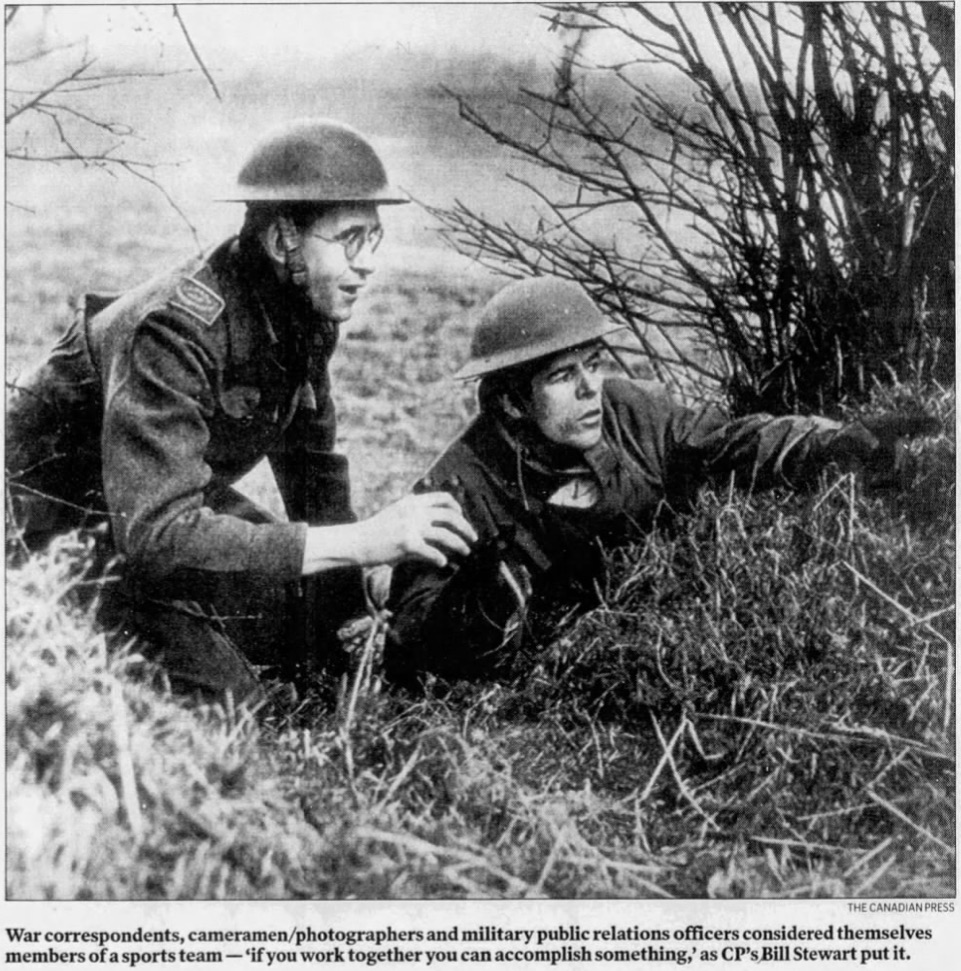
Please click here to view War Correspondents: News Article from The Ottawa Citizen, Dec. 1998
Another entry soon to follow.
Unattributed Photos GH