Showing posts with label odds 'n sods. Show all posts

Thursday, April 15, 2021

Odds 'n Sods: My Dad's Navy Duffle Bag

 A Navy Duffle Bag Hits the Road and Finds its Way Home

A Militaria Collector Follows a Rare Lead. Awesome!

"The Sailor Statue" outside The Museum of the Atlantic, Halifax NS
"I wasn't fussy about handling kit bags and hammocks," Dad said.

Introduction:

My father Gordon Douglas ("Doug") Harrison was a member of RCNVR and Combined Operations during WWII and during the course of his service (June 1941 - September 1945) he was provided two navy duffle bags.

The first followed him from Hamilton ONT to many locations throughout the UK, e.g., during training exercises aboard landing crafts and to theatres of war during 1942 - 43 (including Scotland, London, Southern England, North Africa, Sicily and Italy) before being stolen - along w hundreds of others - from a warehouse in Egypt. (Details at bottom of page).

The second was likely given to him when he began round two of his service at a Combined Operations School or training base (HMCS Givenchy III) at Comox, Vancouver Island BC in January 1944. 

Artwork on Dad's 2nd duffle bag. Let's call her "The Fencer."
Get the point? Photo - Walter Prawak, Militaria Collector

By that time my father had become a bit more confident around women: He wrote about going out on dates while overseas and one relationship seemed pretty-darn-serious ("Where are you, Gracie Purvis?"); he had serious relationships with two women in his hometown of Norwich during December 1943. He married one in April 1944, was divorced within two years and married the other shortly thereafter; the second was the mother of his five children, including me.

About his lengthy leave in December 1943 Doug writes the following: 

What can I say about fifty-two days leave at home? Draw it out... or say it was mostly wine, women and song? I guess that covers it without revealing too much.

"Dad, Well Done" Page 39

Though he doesn't reveal too much, the artwork on his navy duffle bag might indicate 'where his head was at' while on Vancouver Island. Though I do not know who the artist is, I can share a bit of the history associated with that colourful canvas tote.

For example, it travelled from Vancouver Island to my father's hometown of Norwich after he was discharged from duties with RCNVR and Combined Operations in September 1945. Though some of his navy gear likely found its way quickly into a bin, the navy bag survived until 1963 (approx.) in various dusty hiding places until I came across it - in the top level of the family barn behind my family's home. 
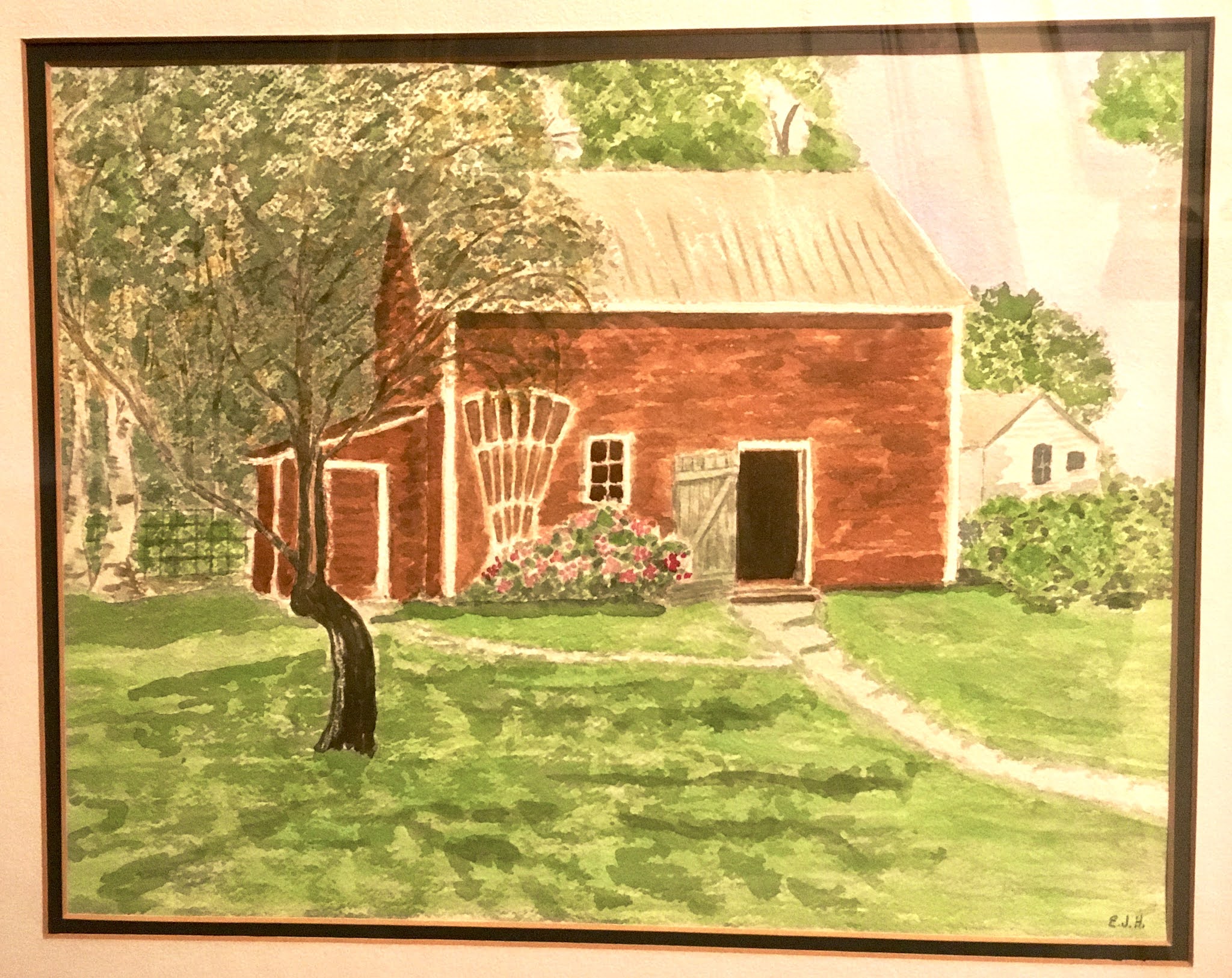
Painting by Edith Jane Harrison, Norwich ONT

After wondering "what the heck is this?" and brushing off year's of dust and inspecting it very closely ("Who the heck is this?") , I used it to carry my camping gear to a weekend-long Scout retreat after a colourful, heated argument - and brief - with my mother. It went something like this: "You're not taking that bag to the Scout camp." "Yes I am." "Take your gear out and use your hockey bag." "No. Good-bye." And away I marched with a couple of grinning mates. 

I never saw the navy bag again after that weekend in the early 1960s, nearly 60 years ago. And several times over the last ten years, when I have been prompted for some reason to think of my Dad's navy career - e.g., while tramping around The Spit at HMCS Quadra near Comox BC, during three trips there - I shake my head at the loss of the duffle bag, believing that it likely ended up at the Norwich landfill site - "It's buried under tons of debris!" - and it's my own fault.

Knowing that another piece of canvas associated with my father's navy career survives World War II helps my mood at times, but the hammock did not personally belong to my father:

Navy hammock as found at CFB Esquimalt Museum, BC. Painted up by
S/Lt. D. Rodgers and given to him by W. N. Katana, Ldg. Stoker.
(Members of RCNVR, Combined Ops, re Operation Husky 1943)

Recently, I received the following email:

Hello Gord,

While doing some research on a navy duffle bag, which I have had in my militaria collection for many years, I have realized that it belonged to your Father (Gordon Douglas Harrison, RCNVR, V8809). Photos are attached. I would like to further discuss the possibility of returning this fantastic historical artifact to your family, if you are interested. I am originally from Hamilton, and now reside in Ottawa. I look forward to your reply!

Regards,
Walt Prawak
Sgt, (Retired) CD
RCCS

Mr. Prawak attached the following photos:

Definitely my father's name and RCNVR enlistment number

Duffle bag manufactured in 1943; Dad arrived in BC in Jan. 1944

I recall the inner cover. My Scout gear is gone!!

"Wow! No wonder my mother didn't want me taking the
Navy bag to a Scout camp." GH

Well, I was flabbergasted by the email. I immediately stood up and started sharing details with my wife while I paced from my study to the kitchen and dining room and living room and back and forth. I was unsettled and a "very happy camper" all at the same time. Later in the day I paced onto the back deck and the words "That's great" spontaneously passed my lips, loudly, prompted only by a fresh thought about a family treasure that flashed through my mind. Other similar responses couldn't be suppressed either. Had neighbours been listening I may have appeared slightly unhinged.

About 24 hours after I'd received the news I was settled and able to respond in kind:

Hello Walter,

Thank you very much for reaching out to me with remarkable information.

I am indeed interested in seeing my father's navy duffle bag, even driving to Ottawa, and hearing how in the world you were able to come to have it, and then locate me based on just the details you have.
I last saw the hammock in 1964 approx., after finding it dust-covered in the upper reaches of my Dad's old barn. I later used it to carry my gear to a Scout camp for a weekend, against my mother's wishes, and I never saw it after that. I believed that it might have ended up in the dump in Norwich ONT, my parents' hometown. To see it in excellent condition is a real treat.

Coincidentally, I talked to my wife just yesterday morning about a trip to Ottawa so that I could connect once again with a person who works at the Navy Museum in downtown Ottawa, near the Jail Hostel (where I usually stay when visiting the capitol). I would also visit the War Museum as well, because I have two other Navy books to add to their collection, one being my father's navy memoirs. At both museums I want to pitch the idea of creating a display of artifacts, photographs and written information re the Canadian sailors (RCNVR) who had also volunteered for Combined Operations and manned landing crafts during WWII raids and invasions - my father being one. Not much has ever been shared about their efforts.

After two years overseas (having served at Dieppe and the invasions of N. Africa, Sicily and Italy), many returned home on leave before continuing their WWII service. Some were placed at HMCS Givenchy III (Combined Operations School or camp) on Vancouver Island, at "The Spit" from Jan. 1944 - discharge in later summer 1945, incl. Doug. 
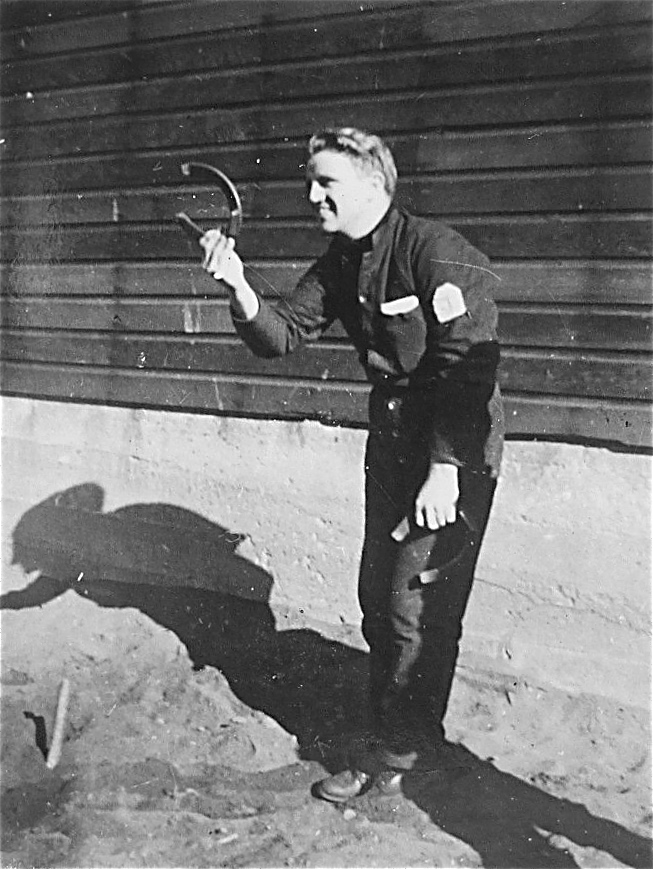
Photos from HMCS Givenchy III, 1944-45:

Doug Harrison lines up a toss

My father guards the putting green, perhaps at Kye Bay


Doug and mates at HMCS Givenchy III

My email to Walter P. concludes:

Dad's chief friends came from Hamilton (they met at Hamilton Division 1 in summer 1941) and they were discharged at HMCS Star in Sept. 1945. I have a good deal of information re his career and am happy to pass along a couple of rare books re Canadians in Combined Ops, 1941 - 1945, if you are interested.

Photos are of the book cover of his memoirs; his foreword with name and volunteer number.

Again, thank you for connecting with me.

Gord Harrison


Walter and I have since spoken to one another by phone. And if things don't get lost in the Royal Mail then more information will soon be provided about a long-lost navy duffle bag.

The significance of the duffle bag is significant as it it a personal item with my father's name and ID number on it. As well, I believe there is a zero-% chance of ever finding his first duffle bag, the one mentioned at top of page, i.e., "stolen - along w hundreds of others - from a warehouse in Egypt."

My father provides details about the loss in a story penned in the 1990s for his hometown newspaper, The Norwich Gazette:

LT/COMDR JACOB KOYL EARNED MY RESPECT

In the spring of 1942, I was stationed for a short time in navy barracks at Roseneath, Scotland. As we Canadian sailors departed from Roseneath I was detailed to work on a baggage party by Leading Seaman Bowen. I told him I wasn’t fussy about handling kit bags and hammocks, at which he replied, “Fussy or not, just get at it and lend a hand.”

After a short argument I refused (which is bad, real bad) and he took me to have a chat with our huge, no-nonsense commanding officer Lt/Comdr Jacob Koyl, later to be known as Uncle Jake. L/S Bowen explained his case about my refusal to Mr. Koyl. With that, Bowen was dismissed and the commanding officer laid his big hand on my shoulder and started to recite, without benefit of the navy book, King Rules (KR) and Admiralty Instructions (AI) about the seriousness of refusing an order. I knew I was in for rough seas as he continued to expound, his big hand bowing my shoulder. Lt/Comdr Koyl wore navy boots so big they looked like the boxes they came in. I know, because I was looking at them; this officer didn’t walk, he plodded.

At the end of his recitation, this man, who later had the undying respect of every Canadian sailor under his command, said to me, “I am not going to punish you so it shows on your records. All I want my officers and men to do is work together so we can get the job done over here and we can all go home, and that includes baggage party.”

“Harrison!” 
“Yes sir!”
“You will be stowing kit bags and hammocks today, and every time a baggage party is required, you will be front and centre, and I’ll be standing by with my little eye on you.”

With that, he took his big hand off my shoulder, I straightened up, saluted, and said a little prayer. I was one lucky sailor; he could have come down much harder on me. The Canadian naval officer had played defense for the old New York Rovers farm team of the New York Rangers in the old six team NHL of 1939 - 40. I remember the dressing down he gave me and how his fingers sank into my shoulder to emphasize a point. A few years later, I remember talking to my sons in the exact same way.

Our particular group of Canadian sailors moved from ship to ship often and our numbers steadily grew until there were approximately 250, and when-ever we moved I was front and centre and, true to his word, Mr. Koyl was not too far away (smiling). Each time I was baggage party I learned a little more about KR and AI. I soon got to know over 200 kit bags personally and my muscles got larger like you wouldn’t believe. My knuckles were skinned on kit bag padlocks and my hands got burned on hammock lashings, and although I rose in rank under Mr. Koyl’s instruction, I remained baggage party. Badly bowed, but unbeaten, I had this job down to a science.

Mr. Koyl enjoyed every minute of it (I knew every wrinkle in his uniform), and once in awhile he heaped a few coals of fire on my head by thanking me for improving the time it took, and if there were medals struck for most improved sailor of the year and baggage party, he would be more than happy to recommend me. Yes sir! I never let on I heard his bantering; he had earned my respect as the hammocks flew and kit bags were piled high.

Late June, 1943 was the last time I helped move that huge mound of baggage. We were in Dejehli, Egypt and we stowed them in a wonderfully clean army building there. I put a navy padlock on the door (I’m kingpin now), the baggage party walked to a waiting truck and none of us ever saw our gear again. Our clothing, photos, souvenirs, everything we owned, went missing.

It took a lot of years, but the baggage episode did have a happy ending for me. In August, 1990 Leading Seaman Harrison visited Leading Seaman Bowen in Ottawa and L/S Bowen was detailed to carry my baggage from the car to the hotel room. Who was it that said, “It’s a long road that has no turning”?

Much decorated Lt/Comdr Jacob Koyl died in November, 1987 and was buried where he had earned his honours - at sea.


Photo - St. Nazaire to Singapore: Canadian Amphibious War 1941 - 1945

The story and many more can be found in "Dad, Well Done" my father's navy memoirs.

More Odds 'n Sods to follow as they come to mind, or are found, or rediscovered.

Please click here to view Odds 'n Sods: A Navy Knife and Spike

Photos GH and W. Prawak, Nepean ONT

Monday, September 14, 2020

Odds 'n Sods: A Navy Knife and Spike

Miscellaneous Items With a Connection to RCNVR and Combined Ops

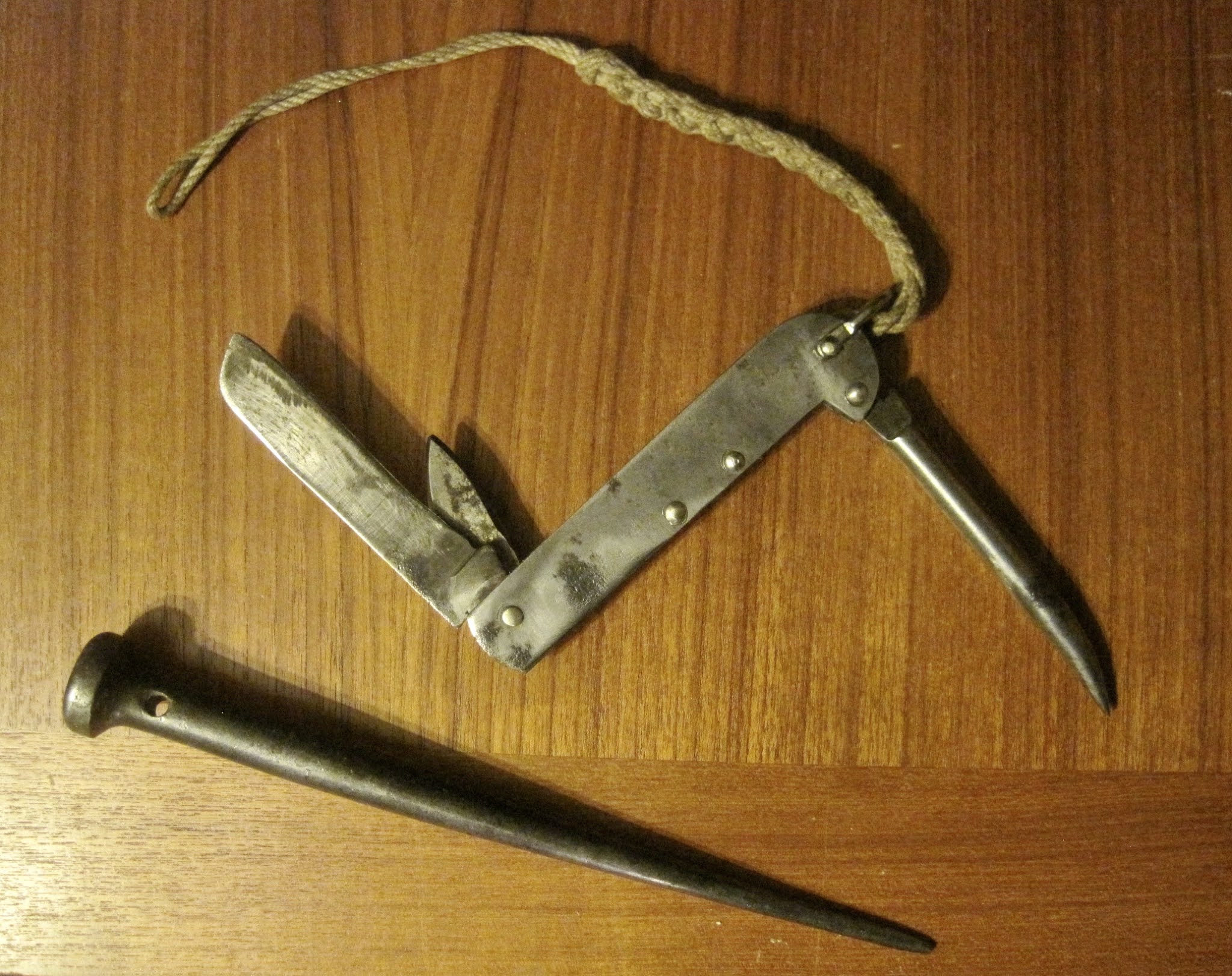
Navy knife, useful spike or needle. Photo - GH

Introduction:

I have spent a few years collecting news articles, photographs, memoirs, and more related to the members of RCNVR who also volunteered for Combined Operations during WWII, including my father Doug Harrison (Sept. 6, 1920 - Feb. 6, 2002), which led to their training for (often unbeknownst to them) and participation in such Allied enterprises as follows:

Operation Rutter (Dieppe raid, July 1942; cancelled);
Operation Jubilee (Dieppe raid, August 1942);
Operation Torch (invasion of Africa, July 1943);
Operation Husky (invasion of Sicily, July 1943)
Operation Baytown (invasion of Italy at Reggio di Calabria, September 1943;
Operation Avalanche (invasion of Italy at Salerno, September 1943), and more.

In my understanding, most of the Canadians who volunteered for Combined Operations, starting with the first draft in November or December, 1941 (while continuing their RCNVR training at Halifax), were thereby shortly thereafter transported to particular training centres in the U.K. to be introduced to various types of landings crafts - and, importantly, how to operate and repair them, and transport men and all the materials of war upon them during hostilities.

I suppose most folks who collect materials related to World War II - in my case, related to the 950 - 1,000 Canadian members of RCNVR who volunteered for Combined Ops - are fully aware of two things: 

1. New written, photographic and other related materials keep growing in availability.

If we compare details re WWII to a jigsaw puzzle, the puzzle would be made up of millions of pieces - our expectation would be that the creation, if ever even near-finished, would be the size of several football fields - and various sections of the puzzle (re personal memoirs; particular battles, e.g., Stalingrad; various Operations, e.g., Rutter to Rangoon; collections of photographs, videos, news reels, etc.) would be being ripped apart daily so that additions could be made.

The gigantic football field would be in constant motion, as sections acquired new parts and the outer dimensions changed to accommodate ongoing discoveries, such as black and white photos  - that had been hiding in a shoebox under the stairs leading to Grannie's basement - depicting Canadian sailors* on the prowl after a few pints at The George (Hotel), Inveraray.

2. Collectors need a section in their archive/library/website/blog/shoebox for Odds 'n Sods. Surely, miscellaneous items abound for sailors, soldiers and pilots alike.

About the above photo of Navy knife and spike or needle. I have in my possession, fortunately, my father's written memoirs and newspaper columns/stories, books, flags and two items from his sailor's wardrobe - but no knife or spike/needle. The knife comes from an antique store (authentic WW2 Navy goods, I'm told) and the spike from the collection of Art Bradfield (courtesy of his son Jack from Simcoe ONT). 

Navy knives and other personal items would have been hard to keep safe for a few years while overseas, and some would surely have been used for barter**, about which a few related stories will follow. The spike is certainly authentic and was likely given good use when heavy rope knots needed to be unknotted, or smaller lines had to be threaded through bigger lines, etc. 

About "Canadian sailors on the prowl" in Inveraray. I'm not far off the mark, I'm sure.

My father wrote the following re nights on the town in Inveraray, circa spring 1942:

Now, at H.M.S. Quebec there were a lot of adventures, therefore many memories. One I will always remember is about getting up in the morning to see the sun shining through the mist onto the purple heather. I made an excursion one day and actually rolled in it - to my delight - even though it was damp.

In our group was a seaman named William Kuntz, pronounced Coontz. Every time at roll call while we were in England or Scotland his name was mispronounced and he used to get really angry. He also liked to go into Inveraray, get drunk, punch out windows and then come back in the morning, his hands all gashed.

'The George' (hotel, on the right) would be a good spot for a pint, I'm sure

On the subject of Kuntz, he was absolutely blind in the dark. O/D Anthony Bouchard and I would take him on each side by the arm and when we spotted a bomb blast door (a wall of bricks to stop a bomb blast from travelling up closes or alleys) we would suddenly pull away from him and let him run headlong into the wall.

Then the air would turn blue.

“Where are you, you SOBs? I’ll murder you, ya bums,” he would yell.

“You can’t murder us if you can’t find us, Willie,” we said. When we had enough laughs we would go back to his side - he would forgive us because he would never get back to base otherwise - but we would get it in the morning.

"Dad, Well Done," page 13


If Navy knives and such are rare, there are some perfectly good reasons. I earlier mentioned some would be used for barter (e.g., for fresh fruit) and one story in my father's collection will reveal the same:

ABOARD THE SS SILVER WALNUT 

[This story concerns the voyage aboard Silver Walnut, from Wallasey and Liverpool to Port Said in the Gulf of Aden in the spring and summer of 1943 on way to the invasion of Sicily by the fighting 80th/81st LCM Flotillas.]

...Diving For Pennies

Early in the morning of the first day of our five-day stopover in Freetown, South Africa, a few of us Canadian sailors were leaning on the rail of the ship when we were surprised to see a canoe coming toward us, paddled by a black man who was doing a good job of singing the Lambeth Walk, a war time song. We were happy to hear the song being sung in our language. The man threw a line up which we tied to the rail and then began a conversation with him. He said his name was Charlie and that he liked to dive for pennies but not too many at a time, please. But three would be nice.

We started pitching the big English pennies into the water, and Charlie dove and retrieved them and returned to his canoe in a short time. This went on for a short time until I asked him, “Can you get us some fruit?” He replied that he would send his friends out with some. We were really in business.

SS Silver Walnut: From the collection of Doug Harrison

We Were Beaten at Barter, But Oh, the Fruit!

Shortly after Charlie left two or three canoes arrived, piled high with wicker ware and fruit. We tied them aboard and started to barter for fruit - we were not interested in wicker. Soon we were passing down clothing, tobacco, navy dirks (large jack knives with many fixtures), and anything we could get our hands on in exchange for mangoes and limes.

Heaven was never like this. By the time the convoy departed our kit bags had shrunk considerably. We were novices and they were hard bargainers and very likeable chaps. But oh, the fruit was wonderful. These black men were expert canoe men. The blades of their paddles caught my eye; they were absolutely round.

All too soon the bartering ended and as the convoy escort ships passed by we gave them a big wave. Soon the capstans on the Silver Walnut went to work. The anchors came in and the convoy moved again out into the Atlantic. Hopefully the engines, shafts or whatever had caused the problem were remedied.

"Dad, Well Done" pages 59 - 60

If you know of other uses for the items, or are in possession of Grannie's black and whites, please email me at gordh7700@gmail.com

Very likely, more Odds 'n Sods to follow.