Showing posts with label commandos. Show all posts

Thursday, January 3, 2019

Context: Dieppe Raid 1942 - Operations RUTTER/JUBILEE (1).

Canadians Trained Like British Commandos

[Photo: Army assault troops landing from invasion craft as naval beach
parties and commandos train at HMS SAUNDERS, Kabrit, Bitter Lakes.
Photo A17724 - Lt. L.C. Priest, RN, Imperial War Museum


A17759. Vigorous action of Naval Commandos during their training course.
Please link to Photographs: Training on Landing Crafts (5) for more details.
Photo - Lt. L.C. Priest, and Imperial War Museum, IWM.

Introduction:

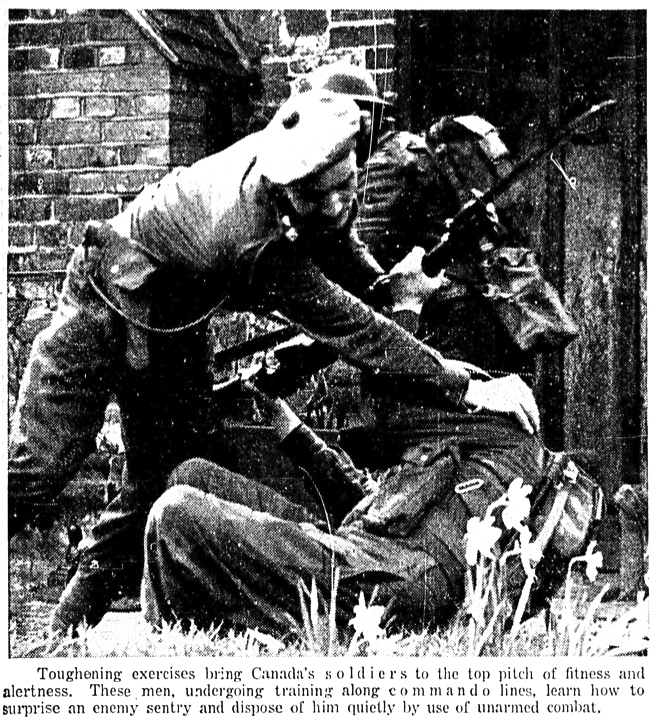
The members of RCNVR who also volunteered for Combined Operations during WW2 became familiar with training routines at various camps in England and Scotland. They often trained with and like commandos, and I have learned that 'commando training' later became part of the daily or weekly regimen for Canadian forces here in Canada.

News featured in The Winnipeg Tribune (June, 1942 issues) informs us of some details related to this type of training, and informative articles about it will follow in this post or entry.

First, I present a few paragraphs - detailing early training days leading up to the Dieppe Raid - from the Navy memoirs of Lloyd Evans (RCNVR, Combined Ops):

LIFE ON A WW2 LANDING CRAFT

.....In April '42 we returned to the familiar surroundings of Hayling Island only this time to HMS Northney I a few miles from the first base we'd used. This one had previously been a summer holiday camp of chalets with two bedrooms, a small sink in each room, and no heating. In the winter months there was usually an icicle hanging from the tap when we arose in the mornings! I used my navy mattress at night in an often vain attempt to keep warm.

Meals were served in a large central dining room which was a welcome relief from the cold. The R.N. types couldn’t imagine why we complained about the cold since we came from the land of ice and snow - not appreciating that our Canadian homes were, out of absolute necessity, well insulated and properly heated.

Like the proverbial yo-yo we returned to Scotland but this time to HMS Quebec situated on the shores of Loch Fyne near Inveraray. Just outside the town was Inveraray Castle occupied by the Duke of Argyll the Chief of Clan Campbell. The food at HMS Quebec was desperate. It improved slightly after a couple of our men threw a rope over a beam, in the style of a Wild West mob hanging, and were heard to mention something about the cook!

We then spent some time in different locations around Scotland and England training on several troop ships, train ferries, and oil tankers that had been converted to mother ships for carrying Assault Landing Craft, i.e., HMT Iris and Daffodil, Ettrick, Ennerdale, Queen Emma etc. We sailed from the Firth of Clyde on one of them, down through the Irish Sea, and somewhere near Lands End, our convoy was bombed...my first night bombing at sea. (Compare to my father's story in Operations RUTTER/JUBILEE (1). Link is provided at bottom of this page).

I hastily donned my tin helmet which always gave me a headache but this time it seemed as light as a feather and caused no problem at all! One of the main A.A. guns, on our fore deck, jammed, and a JU 88 came in real low to take advantage. Our gunners cleared the jam and shot him down before he could drop his bombs. We managed to get away in safety and ended up in Portsmouth. 

We had canteen messing on this posting. Under this arrangement each mess was allowed a sum of money per head to buy food from the canteen. Each day a member of the mess had the duty to prepare the food for the members. When my turn came around I made a rice pudding and put the rice in a pot to soak overnight. I knew it would expand but had no idea by how much. Next morning there was enough rice for the whole crew not just our mess!

We had no clear idea why we were there. The situation was all the more confusing when a large flotilla of Landing Craft, loaded with soldiers and Commandos, set sail that evening and we remained in port. We could see the Commandos putting detonators in their hand grenades and blackening their faces as though they were preparing for action.

The mystery deepened when they returned a few hours later. We found out that they had sailed for a raid on Dieppe, France, but returned when they found out the Germans were waiting for them.

We could never figure out if our presence there was anything to do with the abortive Dieppe Raid and, if it was, why we were not part of it. We later set sail for Clyde Bank and stopped in Cardiff, south Wales, where half of our crowd were given a few hours leave...

Please link to more of Lloyd's memoirs at Combined Operations Command by Geoff Slee.

* * * * *

News Clippings from The Winnipeg Tribune, June 27 - June 30, 1942:


The following article, "Moving Troops and Supplies...", shines a light on the organization that transported men and the materials of war overseas from Canada, often in times of danger upon the seas. One can compare it to the role of Canadians in Combined Operations who later transported these men and all their supplies during raids and invasions onto several foreign shores.   


The above article has a few things in common with this next one. "No Small Roles" comes to mind:


As in "Dieppe Raid 1942 - Operations RUTTER/JUBILEE (1)" I will include a few photographs related to the Dieppe Raid. Later, these will be included in a growing collection, with links to more pertinent materials:

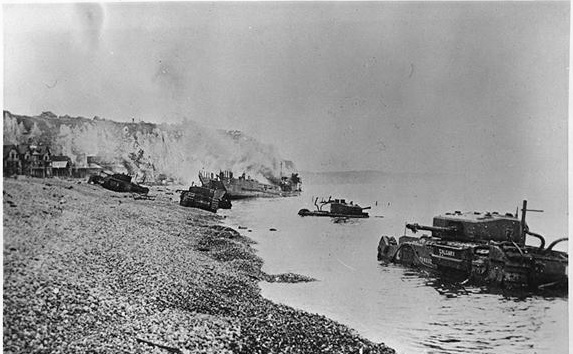
During the Second World War, on 19 August 1942, the Allies launched a major raid on the French coastal port of Dieppe. Operation Jubilee was the first Canadian Army engagement in the European theatre of the war, designed to test the Allies' ability to launch amphibious assaults against Adolf Hitler's "Fortress Europe." The raid was a disaster: More than 900 Canadian soldiers were killed, and thousands more were wounded and taken prisoner. Despite the bloodshed, the raid provided valuable lessons for subsequent Allied amphibious assaults on Africa, Italy and Normandy. 

Link to The Canadian Encyclopedia for more details.

Wrecked Allied tanks and landing craft lie strewn across a beach at
Dieppe, France, following the failed raid there in 1942.

Bodies of Canadian soldiers of the Calgary Regiment lie dead on the beach at
Dieppe, France, following the disastrous Allied raid there on Aug. 19, 1942.

A painting by Canadian war artist Charles Comfort,
of the Allied raid on Dieppe in 1942.

Infantrymen of The Queen's Own Cameron Highlanders of Canada boarding
landing craft before the raid on Dieppe on 19 August, 1942.

Photo A11233. A naval motor-launch seen with four of the landing craft personnel
(large) used during the Combined Operations daylight raid on Dieppe. The landing
craft are numbered (left - right) LCP (L) 85, LCP (L) 41, number not visible and
R 145. Lt. L. Pelman, Royal Navy official photographer,
Admiralty Official Collection, IWM.

The beach at the village of Puys, east of Dieppe, where Canadian
soldiers landed on 19 August, 1942.

A photograph on an interpretative panel in France, showing the bodies of
Canadian soldiers piled up on the beach at the village of Puys, following
the raid on Dieppe on 19 August, 1942.

The graves of Canadian soldiers* -- buried head-to-head in the local style --
at the Canadian War Cemetery at Dieppe.

*Also buried at Dieppe are a few members of RCNVR and Combined Operations, men who among those who manned landing crafts, including one of my father's comrades, Robert Ansley Cavanagh, age 19, RCNVR, HMCS Niobe.

Link to the list of those buried at Dieppe - https://www.militarytour.com/blog/ 

Enemy fortifications are examined two years after the raid.
Photo: Ken Bell, Library & Archives Canada - PA134448

* * * * *

More news articles and photos from The Winnipeg Tribune, June 27 - June 30, 1942:

Training on barges at Petawawa Military Camp, near the Ottawa River, east of Algonquin Park - 


In hindsight we can say that Mr. Cummings report missed by a country mile:


One year after the Dieppe Raid and invasion of North Africa (Nov. 1942), many Canadian members of Combined Operations were transported around Africa on their way to the invasion of Sicily, aka Operation HUSKY in July 1943. After visiting Cape Town and Durban they arrived at the Suez Canal and trained and camped at HMS Saunders (as mentioned in this post's top photo), before visiting Port Said and Alexandria, seen in the map below:


Any news about the loss of Allied ships to German submarines was often staggering:


Pressure for a Second Front, from various sources - one mentioned below - may have had some bearing on the implementation of the Dieppe Raid:


Please link to Articles: Dieppe Raid 1942 - Operations RUTTER/JUBILEE (1).

Unattributed Photos GH

Monday, February 20, 2017

Book: The Beachhead Commandos

The Beachhead Commandos

By A. Cecil Hampshire

Stock image - Book purchased at AbeBooks.com

This book was briefly mentioned in an earlier post concerning a Canadian Beach Commando. Please link to Commandos: Beach Commando Work for more details*.

The book is a 'must read' for those interested in the training and work of Beach Commandos, and the training and assignments of Commandos in general. Details provided, often by commandos themselves, are very honest, revealing and thorough.

As well, some Canadians became Beach Commandos (Commando Unit W was entirely made up of Canadians, many of whom would have initially volunteered for Combined Operations). And other Canadians in Combined Ops working aboard various landing crafts, like my father, would have trained with commandos in some of the training sites mentioned in the book, e.g., at HMS Quebec in Inveraray.

Early commando raids on the coast of Europe are mentioned (e.g., Operation Collar, Operation Comatose), not always successful, but it is interesting to read about the growing pains of "the kind of hit-and-run warfare now visualised." New types of landing craft, new types of training were the result.

Table of Contents

We read about the development of HMS Quebec in Scotland, HMS Northney in S. England and other important Combined Ops sites, the acquisition of new types of craft, and the training of "specialist naval crews":

"Thus while the landing craft building programme was being got underway. a six-week course of basic naval training in the operation and maintenance of the new vessels was inaugurated in a former holiday camp at Northney on Hayling Island, in Sussex. The camp had been requisitioned by the Admiralty early in June 1940 and was commissioned as HMS Northney that same month. Unhappily the capacity of the drains in the camp were sufficient to allow the functioning of only eighteen lavatories." Page 25

About this shortcoming my father wrote (re Jan. 1942), "There was no heat at all in the brick cabins. The toilets all froze and split. But we made out. Our eating quarters were heated." (DAD, WELL DONE, page 11)

Eight of Canada's earliest members of Comb. Ops at HMS Northney. Jan. 1942
(L - R) Al Adlington, Joe Spencer, Chuck Rose, Doug Harrison, Art Bradfield,
Don Linder, Joe Watson, Jake Jacobs. Photo credit - Joe Spencer, Brighton

We read about the selection of Lord Louis Mountbatten to lead Combined Operations (in place of Admiral Keyes), the planning of larger raids (e.g., Operation Archery, "in the vicinity of Vaagso"), and the introduction of "a body of naval officers and ratings whose part in future Allied invasion landings was considered to be among the most important and dangerous of any", i.e., the Beach Commandos.

And their purposes and activities are well-documented, from beginning to end, over the course of 202 pages, including their role at Dieppe, the invasions of North Africa, Sicily, Italy, Normandy and more. Several photographs are informative as well.

 HMS Armadillo. Page 33

 Kabrit, Suez Canal. (L - R) Jack Sibley, Albert Perry, Peter Lightfoot. Page 48

Salerno. First Prisoners. Page 96

*I was able to find this book easily and the price was less than daunting, approximately $8.00 U.S., including shipping.

Please link to Book: A Good Read, A Good Connection

Unattributed Photos GH

Saturday, January 28, 2017

Article: "The Navy Commando Dotes On Fighting"

R.C.N. Commandos Are Ready for Action

As found in The Ottawa Journal

W Commando RCN Beach Cdos. rope training
Photo Credit - Bill Newell. Posted at Commando Veterans Assoc. 

I have presented several articles published in newspapers (e.g., The Herald Chronicle, Halifax; The Montreal Star; The Hamilton Spectator to name a few ) during World War II, with more to come. The news articles, editorials and timely cartoons not only provide useful context for actions undertaken by Canadians in Combined Operations but facts and details about the members themselves.

On May 10, 1944, the following article appeared in The Ottawa Journal (now available on microfiche at a local university) that provides details about a little-known group, Canadian Beach Commandos. We read that it was written from "A United Kingdom Port" for "The Crow's Nest"*, then "published in Halifax by the Royal Canadian Navy".

R.C.N. Commandos Are Ready for Action

Amidst the rugged loveliness of Scottish hills, a group of Royal Canadian Navy officers and ratings, all of them volunteers, have completed training under Royal Navy tutelage for one of the toughest jobs the navy has to offer. Now that their course is completed, they are Commandos, the first Canadians to take the Royal Navy's Commando course as a group.

From their training centre in Scotland, these leather-tough Canadians have moved into a Combined Training Centre where they are working with units of the Canadian army on landing craft flotillas. They are participating in army manoeuvres and will be attached to army beach troops, ready and hardened for the Big Show.

A navy Commando differs from an army Commando. The army Commando is a specialist in fighting, with the hand-to-hand variety preferred; he fights anywhere. The navy Commando dotes on fighting too, but he never leaves the beach which has been chosen for an assault landing. Rather, he defies the enemy to drive him from the beach.


Caption: Able Seamen James Skinner (left) and John Joyce of W-1 Party, Royal Canadian Navy Beach Commando "W", demonstrating how to disarm an opponent attacking with a knife, H.M.S. ARMADILLO, a training establishment at Ardentinny, Scotland, February 1944.

Photo Credit: Lt Gilbert A. Milne / Canada. Dept. of National Defence / Library and Archives Canada / PA-183022. As found at Commando Veterans Association.

* * * * *

The naval Commando lands with the first wave of attacking troops and signals the remainder of the assault in. He helps to organize the beach for the landing of troop and materiel-bearing craft. It is his job, during an invasion, to work on the beach in close contact with the naval officer who is in charge of the landing and who is standing offshore with the assault flotillas. When the beachhead is established, he controls the traffic into and through the beach until a more suitable port for handling the incoming traffic is available.

This Canadian navy "tough type" must be ready for anything. He must be prepared to spend days on a beach under enemy fire. He must learn to live on scanty rations and thrive on them. He must be prepared to fight and fight superlatively well to hold the beach on which he has been landed.

That's why the training he took at this centre in Scotland was aimed at making him tough, scrappy and self-reliant. He learned how to beach his landing craft correctly, how to organize a beach in navy fashion, and how to handle all types of light weapons.

"He is a soldier and a sailor, too," says Lt. Cmdr. Dennis O'Hagan, R.C.N.V.R., of Halifax, N.S., the principal beach master, who wears the George medal and bar for bravery on special duty. "The Commando receives a great deal of army training which ordinary sailors do not get and he learns to make himself comfortable almost any place and under almost any conditions."

* * * * *

Here in Scotland, amidst some of the loveliest scenery in the world, the Canadian navy Commando has learned to kill swiftly and silently in unarmed combat classes. He has gone on days-long exercises under full kit; he has slept and cooked his meals in the open and was ready at the end of the gruelling manoeuvre to take prepared positions by assault.

He has smashed his way through obstacle courses and negotiated tough water hazards with powder and thunder flashes bursting around him and live ammunition cracking like a great whiplash over his head. He is now prepared to get soaked to the skin like a Spaniel and to work and fight that way for days on end if need be. He soon turned into a very tough guy.

Canadian Commando badges: Lt. D. Rayburn, Beachmaster, W-2 Party, RCN
Beach Commando "W", at H.M.S. ARMADILLO, Scotland, February 1944.
Photo as found at British Badge Forum

The Canadian navy Commando has learned to wear with pride the badge of his "trade" on both arms, a black flash and on it, in red, an anchor surmounted by a stooping eagle with a light machine-gun crossing the anchor shank. Above the patch is the word "Commando", and above that again, "Canada".

* * * * *

"These boys will have a big part to play in the coming invasion," says Lt. Cmdr. O'Hagan. "They will be the fighting handy men on the beaches through which our troops and materiel will pour. They are fighting harbor masters, really."

Personnel of Royal Canadian Navy Beach Commando "W" in
the Juno Sector of  the Normandy beachhead, 20 July 20, 1944. 
Photo Credit - Canada at War, Forums

(L-R): Able Seaman (A/B) A.H. (Art) Petty, W-2 Party; D.S. (Don) Murphy of
W-3 Party; unknown; A/B Dan Kroshewsky, Leading Seaman J.P. (Joe) Adams
and Petty Officer Douglas E. McIntyre, all of W-2 Party.

* Back issues of "The Crow's Nest" can be found online, beginning in 1948, at the following link: The Muninn Project - Cold War

Please link to Article: Canadian War Correspondents on the Move

Friday, January 27, 2017

Commandos: Beach Commando Work

"Beach Commando Work"

By E. Gault (Skip) Finley, LT. RCNVR

Photo as found in "St. Nazaire to Singapore" P. 295

E.G. Finley has been mentioned in two other entries on this site.

First, he authored a book entitled RCN Beach Commando 'W' which can be accessed online.

Please link to Books: Royal Canadian Navy Beach Commando W for more information if interested.

Second, Mr. Finley and Ed Storey authored an "informative, eight-page article.... about the Canadian commando, a unit that was formed later in the war to take on many important responsibilities and activities related to landing crafts and amphibious landings."

Please link to Commandos: RCN Beach Commando "W" (Little Known Canadian Units) for more information if desired.

Skip Finley also submitted a one-page article to St. Nazaire to Singapore: The Canadian Amphibious War 1941 - 1945 (Volume 2) in the mid-1990s entitled Beach Commando Work.

Personnel of W-2 Party, RCN Beach Commando "W" outside a German
fortification in JUNO sector of the Normandy beachhead, July 20, 1944. 
Photo Credit - Canada at War, Forums

(Front row, L-R):
Able Seamen (A/B) A.F. Watt, Douglas Kennedy, R.V. Barnes, E.G. Woodall,
D.F. Trewin, A.H. Petty, Ordinary Seaman (O/S) A.E. Morris, A/B J.B. White.
(Rear row, L-R): 
Leading Seamen (L/S) W.R. Murphy, J.P. Adams, A/B J.F. Roy, PO D.E. McIntyre, 
LT. A.D. Rayburn, A/B W.F. Cronkhite, Dan Kroshewsky, J.D. Ross, R.C. Nelson.

Editor David Lewis introduced the article as follows:

Skip Finley enlisted in the RCNVR in May 1941 as Midshipman. Following training and promotion to Sub-Lieutenant in January 1942, he served at HMCS Kings until May 1942.

D. Lewis adds that Finley next served at HMCS Swift Current (until Sept. 1942), then at HMC M/L Q-092 (to Jan. 1943), and at HMCS Shawinigan (to July, 1943). He also notes that Finley ("after three months at HMCS Kings as Divisional Officer") was the youngest man in the RCNVR to be promoted to Lieutenant. Finley trained in the UK with the first all-Canadian Commando Unit after he transferred to the Combined Operations organization. He was badly injured in July 1944 while a beachmaster in Normandy, and was discharged in February 1945 after recovery.

E.G. Finley begins his article as follows:

Our task was to keep the beach to which we were assigned as operational as possible at all times, regardless of what landing craft or vessels were involved. Only minor injuries were sustained as a result of men taking the lines out from the LCI(L) landed gangways.

He says that enemy resistance and bad weather were obstacles to his operations and recalls one particularly "horrendous" storm followed by other "troublesome weather". He and specialists in his crew dealt with mines as well (some mines floated to shore after being cut adrift), though they were chiefly the responsibility of the army. 

Finley lists names of beaches in the Juno sector and provides a reference (i.e., The Beachhead Commandos by A. Cecil Hampshire) for those who would like more information related to RN Beach Commandos participating in Operation Neptune.

Stock Image as found at AbeBooks.com

He also reports where his unit fit in related to the organizational framework for "day to day operations". He recalls that "the Royal Marines had their separate units and carried out special assignments". He also says that US Rangers (units comparable to Allied Beach Commandos) were "quite impressed with the Commando training" courses offered in the UK.

After sharing information about battle dress, badges and what eventually became of the Beach Commando 'W', Finley states:

My own subjective (and to some extend, objective) view is that the year-long "W" Commando experience did contribute to quite successful lives (health-wise, as well as in careers and family relations) by a large percent of those I've been able to contact.

The full article can be viewed and read at "St. Nazaire to Singapore", pages 295 - 296.