Sunday, March 1, 2020

Editor's Research: Invasion of Italy (28) - Montreal Star (Nov. 18-22, '43)

The Cold, Hard Slog in Italy Continues
and Sholto Watt is Very Productive

 News clippings, Photos and Ads from The Montreal Star

Various war fronts continue to be active as winter approaches in the European and Asian continents. The news is generally positive because of slow, aggressive Allied advances, but we know that Rome did not fall until the following year in Italy, just a day or two before D-Day Normandy.

That being said, I continue to search for articles by Sholto Watt, war correspondent for The Star. Several appear in this entry and they add quite a bit of detail to the action that takes place in various corners of Italy. 

Some readers know that Mr. Watt is of high interest to me because "a reporter for The Montreal Star" was mentioned by a Canadian Navy officer (in Combined Ops memoirs) as a passenger at one particular time on a Canadian landing craft as it travelled between Messina, Sicily, and Reggio, Italy. This happens when my father was serving aboard those same landing craft (and I'm assuming the reporter mentioned is Sholto W.).

Some readers also know that Mr. Watt's articles stopped appearing in The Star for a few weeks - after the invasion of Italy at Reggio - and only picked up again when he began reporting from aboard destroyers in the Adriatic Sea, far from the toe of the boot where my father was active. Why the gap? Did he get lost in Messina. Was he assigned to another front the day before an invasion that would have occurred in front of his eyes? I do not know.

But I will continue to collect clippings from microfilm (to the end of December, 1943) with the knowledge that the odds of finding more about Canadian landing crafts is very slim. Maybe I will find news about their exit from The Med. Maybe about the Canadians returning home on extended leave (as was reported about the other Canadian flotillas).

I feel there is still more news out there related to the Canadians in Combined Operations and when I find it, readers here* will be the first to know.

On November 18 we learn of a Commando raid. Canadians in Combined Ops trained with commando units on the lochs in north-west Scotland, so articles about this elite group are always of some interest... at least to me : )


Here is another fine article by Sholto Watt, still miles from where I think he should be!


Canadians in Combined Ops had to deal with ingenious anti-personnel mines while they unloaded all necessary supplies on the beaches in Sicily a few months earlier (i.e., beginning on July 10, 1943; Operation Husky). My father reported that he and his mates exploded several of the mines by throwing tomatoes at them. When in Rome...


Monty and his 8th Army are still hard at work as they move up the Italian peninsula:
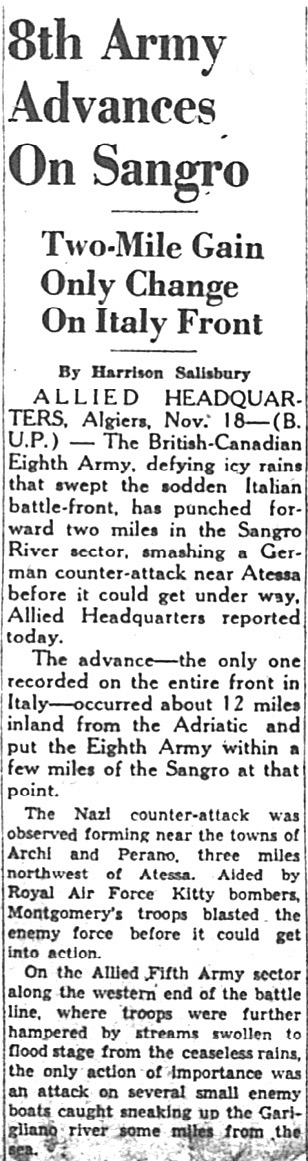


More details from Sholto Watt, out of Allied Headquarters (exact location?):


If I come across a "Ross Munro article", I always clip it out. I really should put them all together in one place... he is Canadian, a very fine writer, and uses the word 'slog' like I do... liberally : ) :


The Montreal Star is one big newspaper!

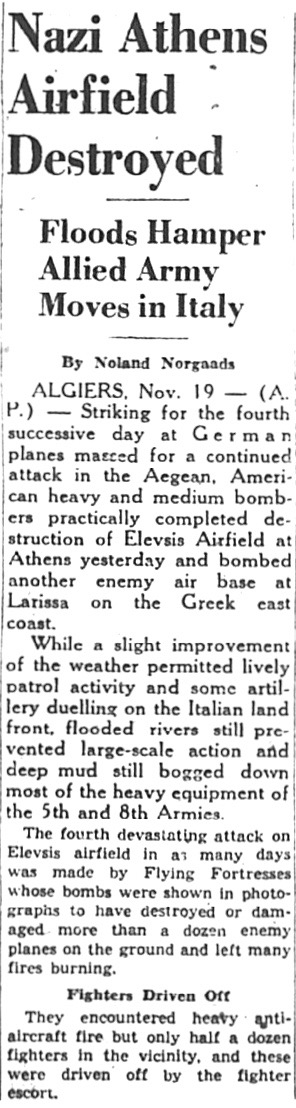


Ross Munro strikes again, this time passing on news from another important Canadian war correspondent:


American submarines are at work in the Pacific:


Does Germany still have potential to hit hard with U-Boats?


Lord Louis Mountbatten, formerly the Commander of Combined Operations, is now at work as Supreme Allied Commander in the far east:


Bad weather was one of the reasons that Allied forward progress was a tough slog in Italy:
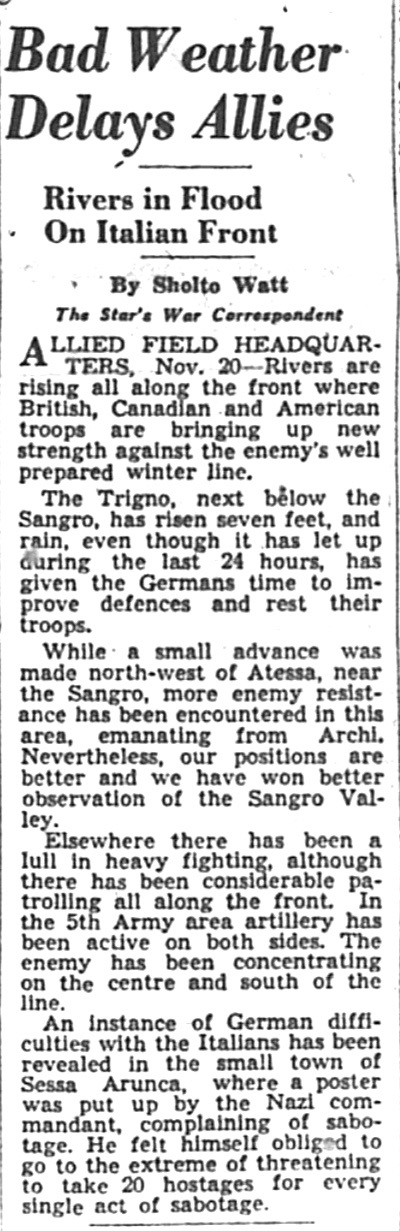

More Canadian forces, with a connection to Montreal, hit the battle front in Italy:


I have included the full article about the new Canadian forces because so many names of officers and soldiers (and their hometowns) are listed. Ernie Pyle, a U.S. war correspondent, did the same thing and folks at home loved him for it:


Troops who had already served in Sicily and Italy found "the new men pale, but admired the smartness of their appearance."  


"Almost tore the decks off!" I think that phrase is a beaut. It describes how Canadians felt about finally getting into a real battle after months of training. I tip my hat to our forces, then and now. And look at the names and towns - they're from everywhere!


A feature-length movie about Lt.-General George Patton (called 'Patton' and starring George C. Scott) dominated movie screens 50 years ago, as much as the actual officer wanted to dominate the war whenever possible. Controversy dogged the man, and to my knowledge, it began in Sicily, 1943:


Movie Poster - Photo credit (linked to Google)


I did not know there was a week in November that was celebrated as 'Navy Week'. And now I do:


As I finish this entry, I present not one but two more articles by Sholto Watt... still about Italy, just not the region that includes the 80th Flotilla of Canadian landing crafts. (But I still hold out hope to find his earlier work, from Sept. 3, 1943, and onward). Also presented, details about a significant ship that still sits in a Canadian harbour in Hamilton, Ontario:




HMCS Haida still survives. I say, "Happy hunting in Hamilton!"

*'readers here': On February 27, 2020, I walked to the University of Western Ontario (UWO) to continue exploring and collecting news clippings from December issues of The Montreal Star (stored on reels of microfilm at Weldon Library). Because I was nearing the end of my research re The Star, I took a peek at September, 1943 issues of another newspaper, hoping to pick up the trail of the 80th Flotilla of Canadian landing crafts as they prepared for the invasion of Italy, at Reggio di Calabria, on September 3rd (aka Operation Baytown). Yes, the other newspaper had good articles about the initial bombardment by naval forces (Sept. 2) and the successful landing of Allied troops (Sept. 3). And... in the Sept. 4th issue I found a story by Sholto Watt, ('delayed from Sept. 3'). Will more - by my prime suspect(!) - follow? You'll be the first to know!

Please link to Editor's Research: Invasion of Italy (27) - Montreal Star (Nov. 13-17, '43)

Unattributed Photos GH

Monday, February 24, 2020

Articles: Down Memory Lane by Doug Harrison, 1991

Learning How to Deal with Seasickness

First published in the Norwich Gazette in June, 1991

Introduction: My father wrote this article for his hometown, weekly newspaper almost 30 years ago, when he was about the same age I am at present. It finds him recalling a chinwag at the Woodstock Navy Club.

His mention of "an inexpensive meal prepared by navy veterans" makes me wonder if that Navy Club is still on the go. Woodstock is less than an hour away by car and I do like chinwags... and inexpensive meals.

He also recalls that he gradually learned how to handle seasickness, which afflicted many young sailors before they even got overseas. Dad wasn't spared but it sounds like he tried remedies that actually worked.

His article is not lengthy, and I have added a few details at the end in order to explain a couple of navy terms he uses, and present a word or two from, and about, Lloyd Evans, another member of RCNVR and Combined Operations that I had the pleasure to meet a few years ago. 

Learning How to Deal with Seasickness

I enjoy going to the Woodstock Navy Club occasionally on Friday for dinner, an inexpensive meal prepared by navy veterans, and there I can sit down with other navy vets amidst some good old navy memorabilia: a ship’s bell, navy flags, and large paintings of warships and ships in convoy that take up whole walls. Encased in a lovely glass cabinet in one wall is a beautiful anchor wreath to remind us of those who died at sea in defence of Canada and other countries.

There is time for some good natured humour though, as well. Recently I found a piece of string on my plate, the type used to tie up a roast, and when I complained to the cook in the galley that I had found someone’s hammock lashing, he jokingly replied that they had plenty, and would I like some more.

The chin wagging at the table leads to the spinning of many salty dips about cramped quarters at sea, action stations, guns, torpedoes, airplanes, the daily tot of rum (now gone), girls, and being seasick.

The only thing I can talk about with any authority is seasickness, because I was never aboard a warship in my navy years (so I couldn’t talk much about most of the other topics circling the table). I went everywhere on Merchant ships and passenger liners. I did spend about six hours aboard a minesweeper during my navy training; the minesweeper, with a rounded bow, rolled so much I could have died standing up, leaning against a ventilator for support, and we weren’t even out of sight of land the whole trip. It felt more like six days than six hours and I thought it would never end.

The minesweeper had its paravane out and we were being instructed on how ships swept the sea for enemy mines. I couldn’t have cared less about mines, paravanes, or anything else; I was having trouble getting my feet to track and my eyes to focus and would have loved to lay down somewhere, preferably ashore, and slept.

A paravane being lowered into the sea from an Australian warship in 1940.
Photo credit - Wikipedia

I knew I could be navy bound a long time so I learned how to combat seasickness by asking weather-bitten merchant seamen, and the story was usually the same: “Eat dry bread or biscuits and walk.” Although I was to be seasick a couple more times, the advice given by the merchant seamen worked quite well for me and the big percentage of my buddies. However, it was hard to find bread or biscuits for quite some time after the news spread through the ranks.

A few sailors suffered chronic seasickness; once the lines were cast off the dock or jetty these boys were sick the whole trip and usually lay on the hammocks in the hammock locker. But with duties to perform they had to suffer through it regardless; there was no medication for seasickness at that time. We felt sorry for these guys.

Those of us who soon overcame seasickness could live quite well in cramped, smoky, sweaty quarters and regardless of how fierce the oceans rushed by the portholes, our stomachs remained calm and our heads quite clear.

There were times on the ship when the seas were running high and in order to walk, we had to wait for a momentary lull, then make a mad dash a short distance, hang onto something, and wait for the next lull.

The long mess deck tables had raised edges, of course, and if the sea had a lively roll you could be eating off your fellow seaman’s plate if he didn’t keep his arm on the table. If the ship was bouncing end to end then the action was across the tables. There was lots of kye (cocoa) and tea spilled, providing that it had arrived from the galley. But in a sudden lurch just about everything that wasn’t fastened down went flying amidst the cursing, navy style.

I was seasick the first night out on the way to England after eating greasy pork chops (the last I was to see), but I grabbed some bread, clasped my hands behind my back (naval tradition) and walked and walked the length of the ship till quite tired then flopped on a bunk, and even with the sound of falling dishes and pails ringing in my ears, I was soon sound asleep.

I wasn’t seasick again until one day on a ship in the Bay of Biscay. The ocean was angry and many of us were sick as the ship heaved - and so did we. It was a wicked day but eventually I lay down in the scuppers on deck, clinging to a handrail cable running along the side of the ship. As the sea water ran over me, it began to seem soothing now and I felt much better, but I clung to the cable for dear life. I soon recovered and was never a victim of seasickness again.

This all reminds me of talk around my home from my sisters about seasickness years ago. It seems some weekends in the summer about 1930, large pleasure craft used to take men and women on trips from Port Dover to Erie, Penn. I heard the girls talk about people being seasick, and although the band played on, the deck was almost empty of dancers. Some around our house on Spring Street vowed never to go again. Actually, that was a cover-up. It wasn’t because of the fear of seasickness, it was because they didn’t have the money.

Doug's three older sisters, sitting beside Spring Street. circa 1935-40
Gertie (front), Myrtle (centre; the oldest), Jessie (right)

Editor’s Notes:

re the paravanes on a minesweeper - the paravane, a form of towed underwater "glider" with a warhead that was used against naval mines and submarines.

Initially developed to destroy naval mines, the paravane is strung out and streamed alongside the towing ship, normally from the bow. The wings of the paravane pull it away laterally from the towing ship, placing a tension on the tow cable. If the tow cable snags the cable anchoring a mine then the anchoring cable is cut by jaws on the paravane, allowing the mine to float to the surface, where it is destroyed by gunfire. If the anchor cable fails to part, the mine and the paravane are brought together and the mine explodes against the paravane. The cable can then be retrieved and a replacement paravane fitted. (link to Wikipedia)

re “the first night out on the way to England” - Canadian sailors were transported overseas aboard the SS Volendam, a Dutch ocean liner, in January, 1942. An earlier attempt to cross the Atlantic took place in December, 1941, but the ship (I believe HMS Bermuda) ran aground on rocks at Chebucto Head (about 20 km. south and west of Halifax) during a blinding snowstorm. Doug and Lloyd mention the same, significant incident in their memoirs.

re "I lay down in the scuppers on deck" - a scupper is an opening in the side walls of a vessel or an open-air structure, that allows water to drain instead of pooling within the bulwark or gunwales (of a vessel), or curbing or walls (of a building).

re seasickness - Lloyd Evans, formerly of Markham, also trained on minesweepers near Halifax. In memoirs he writes, “The highlight of the training was a one-day trip to sea on a Minesweeper for gunnery practice. The whole ship rattled and shook when the four-inch gun went off. It wasn’t all fun - one of our boys was so seasick he pleaded to be thrown over the side!”

When I met with Lloyd a few years ago he said he did not recall meeting or working with my father, even though Dad appeared in one of Lloyd’s WW2 photographs. However, Lloyd did know by name some of Dad’s closest mates.

Lloyd and my father experienced many of the very same events at the same time and their recollections about life aboard landing crafts - the relentless work during the opening stages of an invasion, times of training, times on leave - are similar in many ways. They did hang around with the same crowd while in ports in England and Lloyd possessed a photo of a few mates that included my father, unbeknownst to himself. Though they never became friends, there was an exchange of their books of stories, i.e., I gave Lloyd a copy of my father's memoirs and he gave me a copy of his own. It was a rare deal, not a raw one, and we were both very happy to have connected. Lloyd has since passed away.

Both men were interviewed after returning to Canada in December, 1943. Lloyd by the Ottawa Citizen, Dad by the London Free Press and Brantford Expositor:


Both men knew Chuck Rose of Chippewa (below left) and Al Kirby of Woodstock (centre) quite well. Lloyd is far right, guarding the rolls of wire with a machine gun:


Both men lived aboard landing crafts at times, and in the same port. This is Lloyd's photo and my father appears, fourth from the left, peeking out from behind the fellow who is third from left.


Lloyd's memoirs were helped along substantially by Scotsman Geoff Slee, the creator of a website about the history of Combined Operations (link to combinedops.com)

I have included many entries from Lloyd's memoirs on this site. See 'memoirs re combined ops' under the 'click on Headings' in the right hand margin.

Questions or comments can be sent to me at gordh7700@gmail.com


Unattributed Photos GH

Sunday, February 23, 2020

The Arts of War: Editorial Cartoons, Maps (1) (Montreal Star)

A Picture is Worth a Thousand Words


Introduction:

I think that readers will find a lot of valuable, informative news articles and some rare material from various, determined war correspondents in the many entries I have made on this website under the heading Editor's Research, connected to my searches of microfilm associated with The Montreal Star, 1943 issues. So far I have made 27 entries related to that newspaper.

Readers will also find - in each of the 27 entries I am certain - valuable, informative and creative cartoons or drawings (mostly from the Editorial pages) that relate to the nearby written reports or daily headlines. 

Most of the editorial cartoons in The Montreal Star are provided by James Reidford, a man whose name I thought was Reid Ford for several months, until I checked Mr. Google.

I think that carefully drawn cartoons or illustrations certainly qualify as a member of "the arts of war" because of the information they share (worth 100s or 1000s of words), along with associated moods, tensions, sorrows, etc.

Below I share a handful of the creative drawings I have found while searching for stories re Canadians in Combined Operations (and links to the entries are provided):


About the illustrator, the following was found with the help of Mr. Google:

Reidford was born in Scotland in 1911, and came to Toronto as a baby with his family. He studied at the Ontario College of Art and was employed as a commercial artist in Toronto and London in the early 1930’s. He moved to Los Angeles in the U.S. in 1938 and studied at the Chouinard Institute. He worked as an animator for the Walt Disney Studios for several years.

He returned to Canada and in 1941, began working as an editorial cartoonist for the Montréal Star after the death of A. G. Racey. In 1951 he moved to the Globe & Mail where he worked till his retirement in 1972.

He won three National Newspaper Awards one each in 1950, 1956 and 1957. In 1953, he received a public interest award from the National Safety Council’s 1952 Christmas safety cartoon project. The cartoon depicted “ …the front of a car and its headlights looking back at the drinker out of a glass of liquor …”. Apparently the award was American as it is stated the award was “… in competition with 133 entries from the finest editorial cartoonists in the United States.”

In the 1950’s he illustrated at least two books, by fellow Globe & Mail employee, journalist Lex Schrag. Whether this was the extent of his work or whether he illustrated other books cannot be determined.

Click here for more details about James Reidford.

By "special arrangement with Punch"

There is some very good value in the carefully drawn maps
that appear regularly in The Star. (Nov. 8, 1943)

Adolf Hitler was the main character in a good many editorial cartoons:

"The Russians are coming!" The Star, November 2, 1943

Allied advances on various fronts a powerful signal to Axis leaders:

The Bat Signal!! The Star, October 30, 1943.

Action in the Balkans was popping!


More by "special arrangement ($$$??) from Punch" - a depiction of Himmler (?) getting a taste of his own medicine - and another illustrated and informative map:


Next we see another cartoon by Reidford and two illustrated maps, from The Star, October 12 and 15 issues:


Below we see another detailed drawing by Bernard Partridge, about Hitler and Misgivings, and another by James Reidford, about Canada and Thanksgiving (from Oct. 6 and 11, 1943, The Star):


Readers will perhaps, by now, quickly recognize the difference between a Partridge and a Reidford:

Published by special arrangement with Punch. Oct. 2, 1943, The Star

With the help of Mr. Google, I have found some information about B. Partridge and his careers, one as illustrator for Punch:

Sir John Bernard Partridge (11 October 1861 – 9 August 1945)[1] was an English illustrator. Born in London, he was the son of Professor Richard Partridge, F.R.S., president of the Royal College of Surgeons, and nephew of John Partridge, portrait-painter extraordinary to Queen Victoria. For some years he was well known as an actor under the name of Bernard Gould.[2]


Click here to view 59 illustrations at the National Portrait Gallery. "Cartoons of early 20th century political figures, mainly pen and ink, some gouache, drawn by Bernard Partridge for Punch magazine between 1902 and 1942."


Below we see two more illustrations by Canada's James Reidford:


As found in The Star, Sept. 30 and Oct. 1, 1943

The quality of the reproduction - from old newspapers to new computers - leaves a bit to be desired at times due to the ability of the microfilm reader to focus properly. Once I was told which machine was the newest I did get better results: 


Found on microfilm at UWO, London ONT.

I believe Bernard Partridge has the presentation of Himmler and Hitler down pat:


Editorial cartoons by James Reidford appeared in most issues of The Star, and more will be presented in another entry on this site:

Above two illustrations: As found in The Star,
Sept. 25 and 27, 1943 respectively.

More to follow.

Please link to The Arts of War: Music - When Margaret Was Eleven

Unattributed Photos GH