Tuesday, September 14, 2021

Photographs: From Collection of Lloyd Evans (1)

Lloyd Evans, Member of RCNVR and Combined Operations, 1941 - 45

Some Photos Without Names or Locations! Readers, "Help Wanted"

Seven Canadians in Combined Ops stand easy. But where were they?*
Back row, L - R: Unknown, P. Bowers**, Lloyd Evans, Don Westbrook
Front L - R: Don Linder, Unknown, Doug Harrison w a smoke
From the collection of Lloyd Evans

*Editor's guess - a port in southern England, e.g., Southampton. Or, perhaps somewhere in The Med, e.g., in Gibraltar. [Help Wanted!]

Introduction:

I read the memoirs of Lloyd Evans at a tremendous, detailed website (Combined Operations Command) re members of Allied navies that volunteered (in most cases) for Combined Operations and therefore spent much of their time (in service during World War II) training or transporting the materials of war aboard various landing crafts in various theatres of war (e.g., Dieppe, N. Africa, Sicily, Italy, Normandy and more).

After reading Lloyd's memoirs I felt he must have crossed paths with my father (both were in RCNVR, trained in the many of the same locations, travelled aboard the same ships, were in certain war fronts at the same time, etc.) and - with the help of Geoff Slee, the creator of Combined Ops Command, I was able to connect with Mr. Evans (formerly of Markham, ONT) and then meet him at his home. 

We exchanged information in conversations and traded copies of his memoirs and my father's own. After seeing several photos of my father he said, "He looks familiar but I don't think I knew him." After Lloyd passed away his son Stephen sent me a rich photo file and I will share it here over the course of a few entries and will include some background or additional information when appropriate. And yes, Lloyd and Doug did cross paths and likely relaxed around a few of the same landing crafts in Southampton, or, was it Gibraltar?

Lloyd Evans as a young recruit in Sea Cadets, likely late-1930s in Ottawa:


As I remember Lloyd when we met in 2015 (approx.):


We exchanged books of memoirs, his and my father's;


Readers can link directly to Lloyd's memoirs here.

Readers can link to part of my father's memoirs here.

Photographs from Mr. Evans' collection follow, along with additional shots - that relate in some way - from my father's and from my own collection:

Many members of Lloyd's division volunteered for Combined Operations
Lloyd is in the top row, fifth from the left. P. Bowers** is fourth from left
Name of the division is not given. Date - late 1941 at HMCS Stadacona

The Effingham Division "almost to the man" volunteered for Combined Ops in
late 1941, the first Canadian draft to do so, also while at HMCS Stadacona
My father is front, third from left. From the collection of Joe Spencer

The two divisions appearing above may not have begun their training at HMCS Stadacona in Halifax at exactly the same time, but there was surely some overlap, especially once the divisions began their training aboard landing crafts in early 1942, in the UK. There are a few instances - in photographs I have examined - where I see members of one division with members of the other.

P. Bowers** stands beside Lloyd (on Lloyd's right side) in the first and second photographs, and in the next photo Bowers is seen with at least three members from the Effingham Division.

Back L - R: J. Dale, P. Bowers (from Lloyd's division), Joe Watson
(Effingham Division; above this photo, top row, second from right)
Front L - R: Chuck Rose (Effingham Div.; 3rd row from top, 1st on left),
Joe Spencer (not in the Effingham group shot for some reason; see below)
Photo from the collection of Joe Spencer; taken in Glasgow, 1943

Earlier group shot of Effingham Division, 1941 at HMCS Stadacona,
outside Wellington barracks. Back L - R: Joe Spencer, Chuck Rose, Art
Bradfield, Joe Watson, both of Simcoe, ONT. Photo - D. Harrison

Another example of members of the two earliest divisions mixing together is seen in Lloyd's early photos. Below we see two photos from his file of Richard Cavanaugh (killed in action at Dieppe, August 19, 1942), a member of the Effingham Division (full group shot, 3 photos above, second row from front, 2nd from left):

All aboard! Canadians often took the train while in the UK, e.g., from
Greenock, Scotland to Hayling Island (S. England) in January, 1942 

Out and about in Glasgow?

Lloyd Evans, date and location unknown. Sea Cadet uniform?
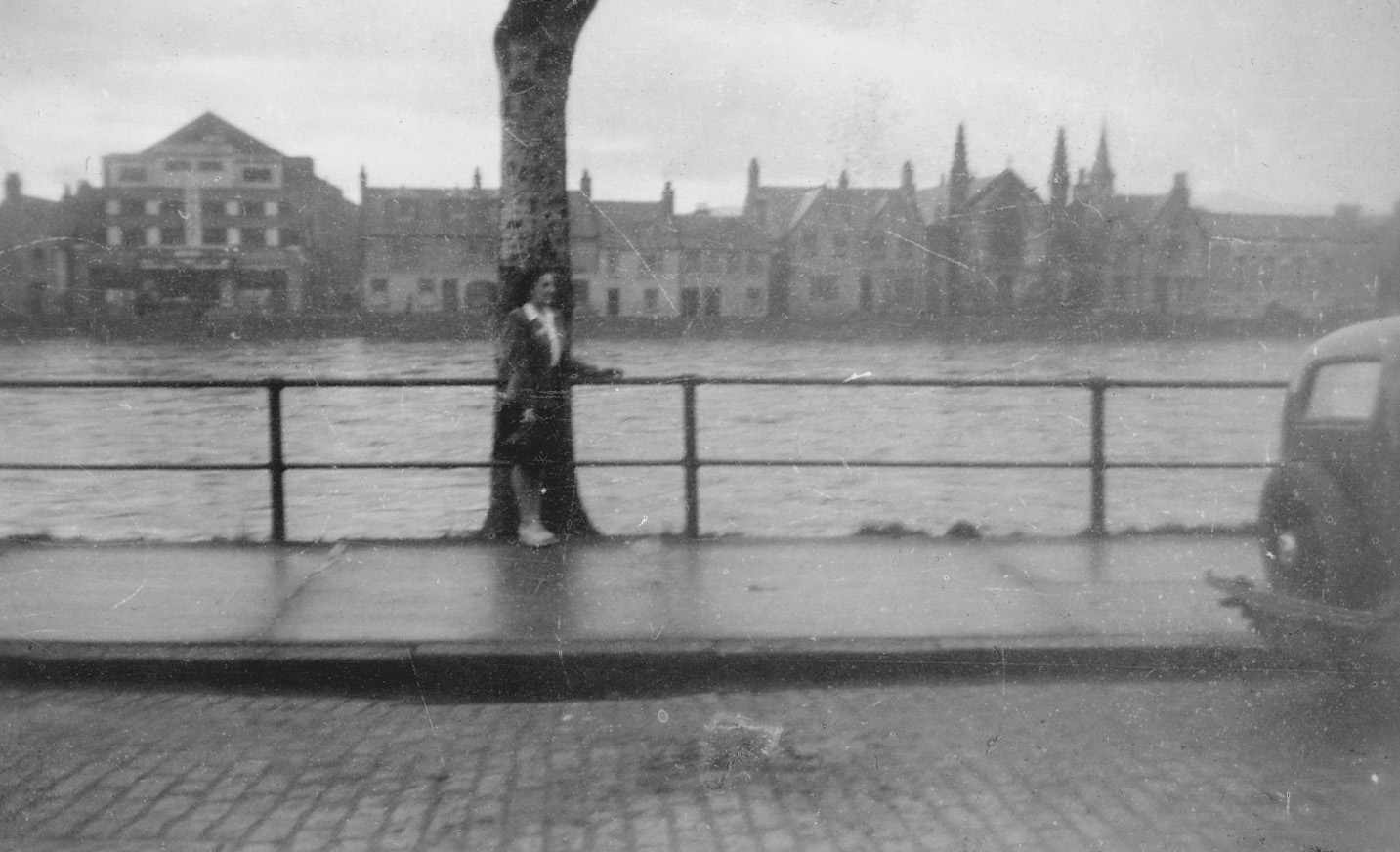
I am guessing a photo of a new friend beside the Clyde, in Glasgow.
Sailors enjoyed leave, dates and dances at The Locarno Club

Help wanted! Leith as seen from Edinburgh Castle?

From my photo files re Edinburgh Castle. Enough similarities to Lloyd's
previous photo for me to say we were standing near the same spot. GH

Canadian flotillas of landing crafts were placed aboard troop ships for
the trip around Africa in summer 1943, prior to Operation HUSKY, i.e.,
invasion of Sicily. A few sailors tell stories of buying monkeys enroute.
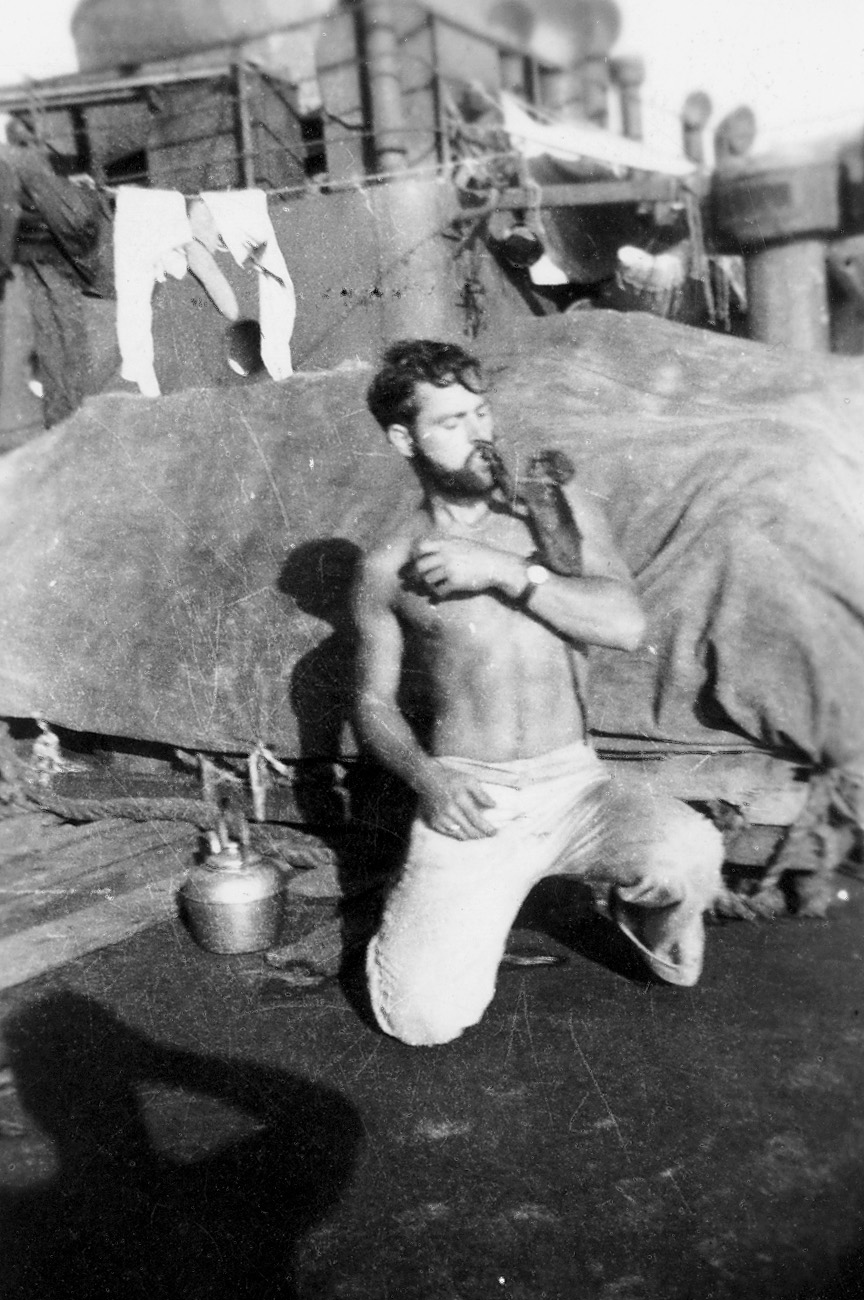
Eephus P. Murphy loved his new pet. Unfortunately, Canadian landing
crafts were bombed about every 2 hours during first 3 days of HUSKY.
It was no place for a wee pet. Click here for story - Monkey Mishap

Lloyd's memoirs mention a few details about his new pet as well

Canadians in Combined Ops were familiar with the iconic scenes below from Loch Fyne, Scotland, home of HMS Quebec, Combined Ops No. 1 training camp. Inveraray is 1 - 2 miles north of here:


A hospital ship. It's purpose in this area is unknown to me. Help wanted.

Lloyd Evans in Ottawa, date unknown. Possibly Dec. 1941, before heading
overseas, or Dec., 1943, after returning from two years service. I lean to '41


Location and date unknown and I make no guesses

One story has come my way about Canadians sailors having the chance to water ski while serving in the Mediterranean, after settling into routines in/near Messina during the invasion of Italy (i.e., Operation Baytown, beginning in early September, 1943). The sailors fashioned water skis from large wine barrels and were pulled by a U.S. MTB. Could this be Messina? It looks like Comox, B.C., but Lloyd did not serve there as far as his memoirs indicate. 


The next photo reveals wave action that was not ideal for water skiing:

Life at sea can be treacherous. "Hold onto the railing!"

So, here we are back at Southampton, Portsmouth or Gibraltar again (1942 - 43), near E Deck and a Fire Hydrant. If Lloyd took the picture, then he and my father were pretty close together again. 

L - R: Don Linder, Unknown behind him, P. Bowers, Doug (Dad) Harrison
(peeking out from behind Bowers), Unknown, Don Westbrook (Hamilton).

L - R: Don Westbrook, P. Bowers, Unknown

Here's one of P. Bowers, and not in Lloyd's collection:

Photo is a still (screen shot), taken from a video re invasion of Sicily,
1943. The 3 sailors to the right of Bowers (smoking) are Canadians.
Recognized by me from other photos, but no names available (yet)

The next three photos from Lloyd's files were most likely taken by Royal Canadian Navy photographers. I know that Gilbert A. Milne accompanied Canadian forces into The Med and to Normandy (his book entitled H.M.C.S.: One Photographer's Impressions... is filled w iconic shots re Canada at war), and many more did as well:

Photos comes w no name or date. Help Wanted.

This might be a peaceful training exercise on England's southern coast

Training exercise again?

A ship taking a torpedo?

Related to the invasion of Sicily or Italy, perhaps.

More photos from the collection of Lloyd Evans will appear shortly.

If you have WWII photos that seem to fit with the purpose/direction of this website, do not hesitate to contact the Editor (Gord H.) via email - gordh7700@gmail.com

To view more photos of Canadian Navy vets, please visit Photographs: Aging Navy Vets Reconnect at Reunions (2)

Unattributed Photos GH

Tuesday, September 7, 2021

Photographs: Aging Navy Vets Reconnect at Reunions (2)

The Veterans Came Together at Naval Reunions

Combined Efforts Produced Rare WWII Books

WWII veterans of RCNVR and Combined Operations reconnect at
the Woodstock Navy Club in August 1988. Photo from D. Harrison
L - R: Al Kirby, Robert Brown, Norm Bowen, Doug Harrison

Introduction:

Three of the four men above are associated with aforementioned books or stories related to operations/incidents that involved our Canadians in Combined Ops during WWII. E.g., Al Kirby wrote a tremendous piece about the Dieppe raid, Norm Bowen contributed an audio file to The Memory Project, and Doug Harrison compiled his naval memoirs in the 1970s, which now serve as the original backbone of this online site.

As of yet I have found nothing written by Robert Brown of Brantford, Ontario, but what was written about him - really, only a few words - inform us of the realities of war and its after-affects.

A short excerpt from prose entitled Dieppe: The Landing by Robert McRae, Lt., RCNVR, describes the action as Lt. McRae's landing craft comes out from behind "a heavy smoke screen" off the coast of Dieppe, France, August 19, 1942:

Coming out on the other side
with a full view now of the coast,
we found we were fatally headed toward
the beach under the steep cliffs,
to the right side of the town
instead of the town front,
with the ominous heads of the enemy
clearly visible lined along the top of the cliffs.
And now they began to pour machine-gun fire
down into the boats.
In our craft, Campbell, who was at the wheel,
received a line of bullets across his thighs
(later as a POW he lost his legs to amputations
and died before Christmas from gangrene).
Cavanagh, standing beside him, was shot in the chest,
and died an hour later thrashing in torment
while his lungs filled up.
My third crewman, Brown*, took something
in the stomach that damaged him
for the rest of his life.
But although wounded, he took over Campbell's place
at the wheel, and for this action received
a gallantry award after the war.
As it was my place to stand behind
the man at the wheel,
Campbell had stopped the machine-gun bullets
I might otherwise have received ....

* Robert Brown, Brantford

As found in St. Nazaire to Singapore: The Canadian Amphibious War 1941 - 1945, Volume 1, page 62.

(The complete, dramatic, eye-witness account by Lt. McRae can be found on pages 61 - 65, by clicking here.)

Lt. Bob McRae writes another, four-paragraph account about that fateful day - during which he was taken prisoner of war - and as a postscript, found on page 66, following McRae's prose, he added the following:

"Brown, I saw last January when he came with some old shipmates to
have lunch here." The photo below records that meeting, mid-1990s

Note - "survival guilt" was written by my father on page 66; I added "where is Lloyd Campbell buried?" for curiosity's sake, along with "Dad wrote "Berlin". I located Lloyd Campbell's Navy records and it includes the location of his burial plot... in Germany. (Click here to read a full story re Lloyd Campbell, London, ONT)

My father (2nd left) is wearing a blazer w Combined Operations badge.
The dark cap is possibly mine, from the 1960s (Beatles fan)

Bob Brown in his burgundy blazer, accompanied by D. Harrison
(left) and Billie Rose (related to Chuck Rose, RCNVR) of Sarnia. 

Six Canadians members of RCNVR in Combined Operations, 1944 - 45,
at HMCS Givenchy III or Naden (at Esquimalt) on Vancouver Island.
Back L - R: D. Westbrook (Hamilton), Chuck Rose (Chippawa), J. Spencer (Toronto)
Front L - R: J. Watson (Simcoe), D. Harrison (Norwich), A. Warrick (Hamilton)

Lt. Bob McRae does not appear in photos re reunions or other get-togethers. As we have read above, he mentioned Bob Brown and two others related to the Dieppe Raid, i.e., Lloyd Campbell of London (died as a POW, buried in Germany) and Richard Cavanagh. Though Campbell and Cavanagh did not survive the war, as did my father and many good mates, I have been fortunate to get early photographs of the two Canadian veterans via research and good fortune.

Lloyd George Campbell, RCNVR

News clip, as found in The Winnipeg Tribune, Nov. 18, 1942

Lloyd Campbell. Photo from Family collection

Lloyd with his sister Madeline (Rollins)

Lloyd with an uncle, possibly at 41 Major St., London ONT

Likely from The London Free Press

Richard Cavanagh, RCNVR, Combined Operations
 
Richard Cavanaugh with Effingham Division, Halifax 1941
2nd row from front, second from the left


Richard C. on left, I believe. But I could be wrong w this one.
From the collection Lloyd Evans, RCNVR, C. Ops

Please link to Photographs: Aging Navy Vets Reconnect at Reunions (1)

Unattributed Photos GH

Sunday, September 5, 2021

Books: Writers on World War II (An Anthology)

A Lengthy Book, Scores of Excellent Contributors

It Surely Provides Piles of Happy Hunting!

I found my copy at Attics Books on Dundas Street, London ONT

Introduction:

A timely comment: I may currently be hindered in my travels by Covid-19 - i.e., the fourth wave in Sept. 2021 - but my stack of used and new books on a nearby shelf has been a lifesaver. It has regularly liberated my mind, at least.

The anthology Writers on World War II (700+ pages), with foreword by Mordecai Richler, guided me expertly to every major country on the globe involved in WW2, and returned me home safely, better educated than when I began.


Though the book does not deal directly with the Canadians in Combined Operations that sit at the heart of my website/archive, it provides context for so many aspects of the war that - to this very day - affects millions about the globe. And with so many informed, creative writers revealed between its covers, a thoughtful reader of our shared WW2 history will find hot buttons to push for years to come.


"Here, powerfully portrayed in the words of novelists, poets, and journalists who lived through it - and in memoirs, diaries and letters - is the full sweep of the Second World War, as it was experienced around the world by combatants and by civilians," says the first statement on the front flyleaf.

In the foreword, Richler provides hints concerning what lies ahead:

"1st September 1939"

 I sit in one of the dives
On Fifty-second Street
Uncertain and afraid
As the clever hopes expire
Of a low dishonest decade:
Waves of anger and fear
Circulate over the bright
And darkened lands of the earth,
Obsessing our private lives;
The unmentionable odor of death
Offends the September night.

W. H. Auden

Richler goes on:

For those who fought on the Allied side during World War II it was, in Herbert Mitgang's phrase, "The Good War," and for those who were too young to fight in it, but lived through it - my generation - it remains, quite simply, the war... 

It was the forces of darkness
that were being engaged, and that were,
furthermore, terrifyingly triumphant
for too long a time.

"Then came Dunkirk," writes Richard Hillary...
On June 14, 1940, Paris fell. 
The Germans, wrote George Kennan,
had in their embrace its pallid corpse.
A week later George Orwell wrote
a letter to the editor of Time and Tide.
"Sir," it began, "It is almost certain that England
will be invaded within the next few days or weeks,
and a large-scale invasion by seaborne troops is quite likely.
At such a time our slogan should be ARM THE PEOPLE."

The Battle of britain began in the autumn.
"The house about 30 yards from ours," 
wrote Virginia Woolfe in her diary on September 10,
"struck at one in the morning by a bomb. Completely
ruined. Another bomb in the square still unexploded."

Then, on December 7, 1941,
the United States was brought into the war...
wrote I. F. Stone in The War Years: 
"The ticker tape at the Press Club,
normally shut off on a Sunday,
carried the first flash telling of the
Japanese attack on Pearl Harbour.
It was a beautiful late-autumn Sunday,
the sky clear and the air crisp..."
James Jones was at Pearl Harbour, of course, and 
wrote of that day in his novel From Here To Eternity:
"... a big tall thin red-headed boy who had not been
there before was running down the street toward them,
his red hair flapping in his self-induced breeze,
and his knees coming up to his chin with every step.
He looked like he was about to fall over backwards.
" 'Whats up, Red?' Warden hollered at him.
'Whats happening? Wait a minute! What's going on?'
"The red-headed boy went on running down the street
concentratedly, his eyes glaring whitely wildly at them.
" 'The Japs is bombing Wheeler Field!' he hollered over
his shoulder. 'The Japs is bombing Wheeler Field!
I seen the red circles on the wings!'

"The red-headed boy went on running... his eyes
glaring whitely wildly..." (Drawing by GH)

"He went on running down the middle of the street,
and quite suddenly right behind him came a big roaring,
getting bigger and bigger; behind the roaring came
an airplane, leaping out suddenly over the trees."

For poet George MacBeth,
author of A Child of the War,
there was the terror that came after darkness,
once German bombers began to patrol over England.

Excerpts from Foreword, pages xxi - xxiii

Richler writes a lengthy foreword and it continued as a good read just by itself. Two paragraphs on page xxv struck a nerve, the first because it referred to men known to Mr. Richler and reminded me of some of my 'first impressions' of my own father's WWII experience (1941 - 45):

"The Kugelmass boy (from Richler's neighbourhood),
one of the first to join up, was killed when his
Harvard Trainer crashed not far from Montreal.
A cousin of mine volunteered for the Commandos
but failed their intelligence test, venturing the original
notion that "A.D." stood for "After the Depression."
However, he did manage to get into the merchant marine.
He was torpedoed in the North Atlantic and survived
ten days in a lifeboat before being picked up."

My father pointed out to me, when I was a teen, an air strip west of Woodstock, Ontario (near our hometown of Norwich), home to sturdy yellow Harvard Trainers. They were linked in his mind to WWII. Also, my father trained with Commandos - beginning in 1942 - while learning all there was to know about LCAs and LCMs (Landing Craft Assault, and Mechanised, respectively) at HMS Quebec (No. 1 Combined Operations Training Camp) near Inveraray, Scotland, then later in the same year at RAF Dundonald and Camp Auchengate (Navy) near Irvine, Scotland. One early, lasting impression I had re Dad's WWII experiences was that he'd been a member of the Merchant Marine (MM) and I'd strongly felt, especially after reading U-Boat Wars, that anyone who had joined the MM made a big mistake. (I eventually learned my father had first volunteered for RCNVR in June, 1941, and Combined Operations about six months later). 

New RCNVR recruits in Hamilton (volunteers at Division 1), Aug. 1941.
After this parade they were sent to HMCS Stadacona for further training. 

Doug Harrison (left) and Buryl McIntyre, both of Norwich ONT
standing easy outside Nelson barracks (aka Wellington Barracks)
at HMCS Stadacona, Halifax, from Sept. - Dec. 1941

The Effingham Division "almost to a man" volunteered for Combined
Operations (Canada's first draft of volunteers to C.O.) in Dec. 1941
Three above photos from the collection of Doug Harrison

The first paragraph (to strike a nerve) ends with a merchant ship being torpedoed "in the North Atlantic" and my father bears witness to such an event - during his passage overseas in Jan. 1942 - in his memoirs:

The Dutch captain lined us all up and assured us we would arrive safely because the Volendam had already taken three torpedoes and lived to sail. This was very heartening news for those of us who had never been to sea except for a few hours in Halifax upon a mine-sweeper. Our first meal was sausage with lots of grease. Naturally, many were sick as it was very rough.

Late at night I was on watch at our stern and saw a red plume of an explosion on our starboard quarter. In the morning (a) four-stacker was not to be seen. The next evening I heard cries for help, presumably from a life-raft or life-boat. Although I informed the officer of the watch, we were unable to stop and place ourselves in jeopardy as we only had the Firedrake (HMS, destroyer) with ASDIC (sonar) to get us through safely.

After some days we spotted a light on our port stern quarter one night. It was the light of the conning tower of a German submarine. How she failed to detect us, or the Firedrake detect it, I will never know. I was gun layer and nearly fell off the gun (4.7 gauge). I informed the Bridge and the Captain said, “Don’t shoot. Don’t shoot. It could be one of ours.” But as it quickly submerged we did fire one round to buck up our courage.

"Dad, Well Done" page 8

The second paragraph by M. Richler on page xxv struck a chord as well:

"In 1945, once victory seemed assured,
our magazines began to feature "thought-provoking" articles
by learned psychiatrists warning us that when the boys came home
they would be trained killers and would need time to adjust.
We were also instructed never to ask them
what things had been like over there.
When the boys did come home, however,
they adjusted to peacetime life in a jiffy
and were visibly upset only when we tried
to change the subject each time they started in
on a story about their adventures in the war."

As many readers will perhaps know, many men did not adjust "to peacetime life in a jiffy." The silence of our veterans was the norm in many households after the war was over, and the silence perhaps held depression, survival guilt and several other mental challenges in check for a time, but not forever.

Yes, good books like the aforementioned fill some gaps. But definitely not all, of course. The book, Writes On World War II), is recommended to all readers and some significant passages will be added at a later date on this site. [Check the following link from the A - Z Directory, side margin - passages from WW2 books]

Please link to an earlier entry related to rare books (filled with original stories) written by Canadian veterans of Combined Operations at Books: New Link to a Rare, Two-Volume Set.


Unattributed Photos GH