Monday, October 4, 2021

Video: Prep Work for "FAINT FOOTSTEPS WWII, Pt. 5"

I Think There is a Story in Here Somewhere

The Prep Work is Well Worth the Work

Inveraray, Scotland: Combined Ops training occurred 1 - 2 miles south
of the current town centre (which has not changed much since WWII).
Photo of a photo found in a restaurant on Inveraray's centre-most street

Introduction:

While preparing the video "FAINT FOOTSTEPS World War II" (Part 5) I realized that I assembled a great deal of material (i.e., useful, rare and significant photographs and links related to the script's core message), a goodly portion of which gets discarded at the end of the video-making process. I thought that while the material is still on my computer's desk top I would put it together as a post that reader's could refer to for more information about Canadians in Combined Operations. One or two photographs or links usually lead to more photos and links, which lead to more links and photos, and so on.

Hopefully, a few readers will find the background work as useful as the video itself. If so, it is because they have been willing to put in a bit of work as well. Cheers!

The script for video 5 follows with assorted photographs and links that could not all be used during the production:

Title - FAINT FOOTSTEPS, World War II (5)

Sub-Title - Good Training in Lovely Scotland

H14572. Troops charge ashore from landing craft during combined operations
training in the presence of the King at Inveraray in Scotland, 9 October 1941.
Photo - Capt. W.T. Lockeyear, Imperial War Museum (IWM)

(Readers can link to more photographs taken by Capt. W.T. Lockeyear, attributed to the IWM, and related to training aboard landing crafts at Inveraray).  

The charming town of Inveraray, Scotland, sits on the shore of Loch Fyne, a long and lovely stretch of water - longer even than Loch Long - about 90 minutes by car northwest of Glasgow.

Inveraray's centre-most street. Photo GH 2014
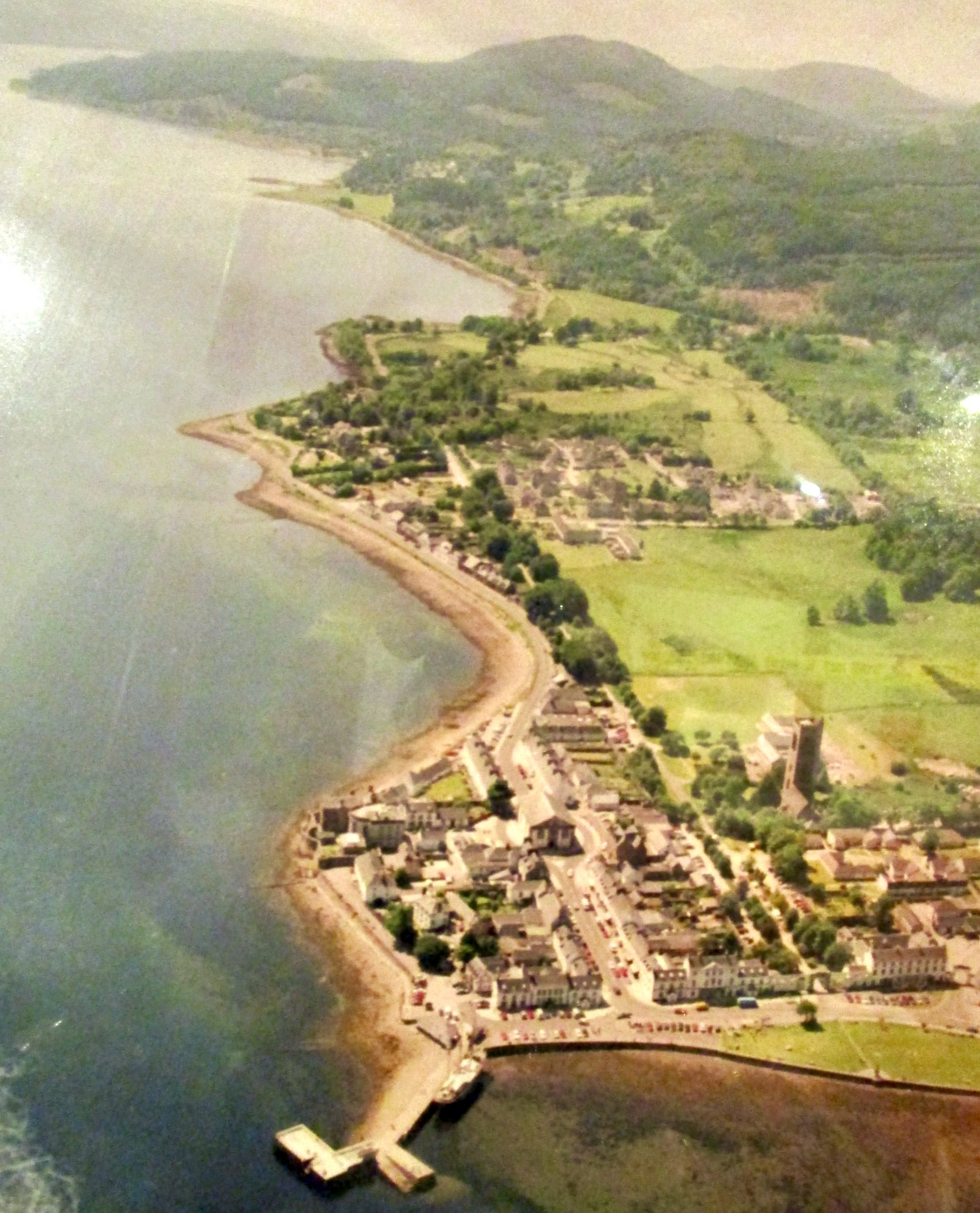
Photo - as found on restaurant wall, Inveraray, Main Street. GH 2014
Combined Operations training camp would be near top of the photo.

Loch Fyne possesses many isolated, shallow beaches, and beside them many large camps were built during WWII where sailors and soldiers could practice and master many necessary assault skills outside the range of German bombers.

See #4, HMS Quebec in western Scotland. 
Map in Combined Operations by C. Marks 


"Loch Fyne possesses many isolated, shallow beaches"
Photos by GH, 2014; 1 - 2 miles south of Inveraray

Plastic plate from Combined Ops museum (now closed), Inveraray
Given to GH by Jim Jepson, Furnace, Scotland

The main goal of the largest establishment, i.e., Combined Operations No. 1 Training Centre (called H.M.S. Quebec, situated near Inveraray), was to train servicemen how to use various craft “for landing assault troops, supplies, ammunition and weaponry onto heavily defended enemy occupied beaches.”

"Various craft "for landing assault troops, supplies, ammunition..."
Photo A12054. LCT (2). Photo Credit - Lt. R.G.G. Coote
As found at Imperial War Museum, UK.

A12056. LCT (2), front view with ramp down.
Lt. R.G.G. Coote, IWM.

A12061. LCM (3). Lt. R.G.G. Coote, IWM.

A12063. LCM (3), front view with ramp down.
Lt. R.G.G. Coote, IWM.

H14597. Troops coming ashore from a landing craft under a smoke screen
during Combined Operations training at Inveraray, Scotland. "Mad Jack"
Churchill can be seen holding a sword. Capt. W.T. Lockeyear, IWM.

H.M.S Quebec is now a caravan or trailer park and I explored the repurposed site in 2014. I learned that “250,000 Allied personnel passed through the centre from 1940 - 44... up to 15,000 were billeted in the area at any one time.” 

H.M.S Quebec, now a caravan or trailer park. GH 2014

More about the history of Combined Operations Command
can be found at www.combinedops.com by Geoff Slee

Canadian seamen arrived at H.M.S. Quebec in jam-packed lorries in late March 1942, perhaps puzzled by its name, and very likely learned - in due course - the name was linked to Canadian military history.

Modern traffic travels to Inveraray by a modern highway, the horizontal
line across the middle (approx.) of the photo above. "Jam-packed lorries"
took the low (and winding) road. Photos GH 


The rain did not dampen my spirits while driving to Inveraray. GH

It was the busiest of camps, as well, and with the Dieppe Raid and invasion of North Africa only months away - unbeknownst to our raw recruits - a cadre of strict instructors wasted no time putting my father Doug Harrison and mates through their paces in small, flat-bottomed vessels that could run or slide up onto a shore in 8 inches of water when empty.

The caravan park is home to a significant memorial to those who served


"Dieppe Raid and invasion of North Africa (were) only months away"

WW II 'drill hall' still stands, a few touches from 1940s remain

Brick walls and sturdy wooden doors stand the test of time

“We did much running up onto beaches,” my father Doug Harrison writes in memoirs, “so soldiers could disembark and re-embark, always watching the tide if it was flowing in or going out. You could be easily left high and dry, or broach too (i.e., turn sideways), if you weren’t constantly alert. We took long trips at night in close single formation, like ducks lined up close, because all you could see was the florescent waters churned up by propellors of an Assault Landing Craft up ahead, or Landing Craft Mechanized.”

Photo - Capt. W.T. Lockeyear, Imperial War Museum (IWM)

Troops rushing ashore from a landing craft during combined operations
training by 29th Infantry Brigade Group at Loch Fyne, Argyllshire.
H11185 IWM. Major W. G. Horton, War Office official photographer


Join-up panorama of HMS QUEBEC, showing part of the training
pool reserve and pier. A29894 IWM by Zimmerman, E A (Lt)

Join-up panorama of HMS QUEBEC, showing part of the training
pool reserve and pier. A29895 IWM by Zimmerman, E A (Lt)

(Readers can link to "A Compilation of Photos re Training Camps, Landing Crafts").

The Canadian sailors transported so many different regiments and commando units on the lochs that there were too many to remember. Most of our boys, however, took to the new training and terminology related to different landing craft like the aforementioned ducks to water.

Port, starboard, fore, aft - got it. High, low, flood, ebb, neap tides - check. Kedges, winches, cables, anti-broaching lines - check. Breakfast 0600 - yipes!

"Ramp is down. Soldiers - get out! And take yer dog." "Check. I got it."
H25389. Men of the 1st Battalion, Queen's Own Royal West Kent Regiment
wade ashore from landing craft during combined operations training in
Scotland, 17 November 1942. Photo - Capt. W.T. Lockeyear, IWM.
 
One detail my father noticed seemed troublesome. He says, “ALCs carried three rows of soldiers - two outside rows, (with) a center row completely exposed. LCMs carried soldiers or a truck, Bren gun carrier, mines, gasoline, etc. ALCs were made of 3/16th inch plating, thick enough to stop a bullet. But LCMs wouldn’t.”

"ALCs made of 3/16th inch plating, thick enough to stop a bullet."
Photo H21363. Canadian troops in an assault landing craft (LCA) during a
combined operations exercise, July 1942. Photo Credit - Lts. Tanner
and Lockeyear, War Office Official Photographers, IWM.

(Editor's Note: It looks more like 3/4-inch plating (in above photo) to me, but I wasn't there. What I have learned as well is that my father was assigned to LCMs most often. At least LCMs were not made of plywood. GH)

Though many of the crafts used at H.M.S. Quebec - and later at Dieppe - were made almost solely of plywood, the good training did produce good results.

Canadians could clamber up and down scrambling nets and Jacob’s ladders very proficiently aboard the Ettrick, a liner anchored just offshore downtown Inveraray.


My father writes, “We got so it took about three seconds to drop 30 feet from the hand rails to the water line on the scrambling nets, because we learned to use only our hands”.

Hard work in beautiful surroundings toughened the sailors in memorable ways. The nearby hills caught many eyes and 30 years after the war’s end my father wrote, “I will always remember getting up in the morning to see the sun shining through the mist onto the purple heather. I made an excursion one day and actually rolled in it - to my delight.”

About that first trip to Scotland one could say, so far so good. So far.

Two Canadians from Effingham Division at HMS Quebec, 1942
Ray Ward (left) and Jim Cole, are seen together below as well.
Photo from the collection of Jim Spencer

Ray and Jim are together in the middle row, 2nd and 3rd from right
Jim Muirhead, on Ray's right side, is middle of back row below.
Joe Spencer is first on left, back row. Photo - Lloyd Evans, 1941

Scotty Wales, with pipe, first one on the left of the middle row above,
at HMS Quebec, 1942, appears first on the left in the front row in the
large group shot. Readers might spot one or two others in both pics.

Art Warrick, Hamilton, is seen here at HMS Quebec in 1942.
Art appears in the large group shot, 2nd from left, middle row.
From the collection of Joe Spencer

And in conclusion, we see two photographs taken from a rooftop at HMS Quebec during World War II.

A29892. General view of HMS QUEBEC, Inveraray, from the North.
RN Photographer Lt. E.A. Zimmerman, Imperial War Museum.

A29893. View of HMS QUEBEC looking south west from the water tower.
RN Photographer Lt. E.A. Zimmerman, Imperial War Museum.

The 5th video in the series entitled FAINT FOOTSTEPS World War II will soon follow.

Please click here to link to Video 4, Dark and Lonely Nights at Combined Ops Camp, 1942

Unattributed Photos GH

Wednesday, September 22, 2021

Story: 'A Good Life' by Eldred (Ed) Whelan

A Canadian in Combined Ops Looks Back on His WWII Service

"I was one of 28 who volunteered under Cmdr. Mountbatten..."

Navy vets, WWII. L - R: Doug Harrison, Norwich; Ed Whelan, Guelph;
Arthur 'Gash' Bailey, London ONT. June 1988, Guelph
Photo from the collection of Doug Harrison

Introduction:

In earlier entries pertaining to photographs of WWII Navy veterans while attending Navy reunions I shared the above picture, and the ones that follow. Some information about some of the veterans of RCNVR and Combined Operations has been provided in the earlier entries and readers can click here to link to Photographs: Aging Navy Vets Reconnect at Reunions (2).

As well, recently, an important link to three rare and significant books full of veterans stories (re RCNVR and Canadians in Combined Operations) was provided and within readers will find submissions provided by the three veterans above and many, many more.

Excerpts of stories by/about Combined Operations veterans Harrison, Whelan and Bailey follow:

A Good Life by Ed Whelan, LT(E) i.e., Engineer, RCNVR

Preface: Honour is due to the oldest responder to the Questionnaire now entering his tenth decade. It is an honour to be able to print his letter which accompanied his Questionnaire. Since this letter Ed has suffered a slight stroke, and now lives at Oxford Lodge, 135 Oxford St., Guelph, Ontario.

The preface was written by David Lewis (above), seen here with
other veterans of Combined Ops in London ONT, mid-1990s

Back, L - R: Art ('Gash'), Clayton*, and David Lewis (David wrote and
collected stories for St. Nazaire to Singapore (two lengthy volumes)
Front L - R: Doug and Al (full names are w top photo)

(*Clayton Marks wrote Combined Operations which inspired Mr. Lewis to do some writing/collecting of his own).

The following is by Ed Whelan:

I will try to recall as much of my Combined Operation's experience as possible but you should know something of life previous.

Came to Canada at age ten years, an orphan of Dr. Barnardo Homes**, raised on a farm until seventeen years of age and became employed with a textile firm.

(**Doug Harrison's mother entered Canada as a child in the same manner).

During the depression of 1929/30 I worked four days a week, I was advised to take a course in Diesel engineering which I did by correspondence and attained an 80%-plus on this. I attended Hempill Diesel in Chicago for their practical course, concluding with a permit to operate Diesels up to 750 H.P.

It was with this permit that I applied to the Naval Branch at HMCS York, Toronto. There they said I had no place for my qualifications but would advise me later. I was informed to apply in May, 1941 to HMCS York and was taken in for basic training for a few weeks. On completion I was forwarded to HMCS Esquimalt, BC, to work on the boats which had been taken over by the navy.


(Editor's Note: The first drafts of sailors from HMCS Stadacona, Halifax, followed much the same path after volunteering for Combined Operations in late 1941. Once overseas in January, 1942, they were sent to Havant and Hayling Island on England's south coast, and soon thereafter to Inveraray and Irvine in Scotland for more training aboard various landing crafts, some commando training included. Their first action was the Dieppe raid, i.e. Operation Jubilee, August 19, 1942, followed soon there after by Operation Torch, the invasion of North Africa, beginning in November, 1942. The invasions of Sicily and Italy followed in 1943.)

Ed Whelan continues:

I received my first Mention in Dispatches in May 1943 and the other one in August 1943. They were for recognition of the performance of our boats.

On returning to Halifax after leave, I was told by the naval authorities I would not be returning to England but that there was a mine sweeper down at the dock and they wanted an engineer. I was a Sub-Lieutenant in charge of machinery of HMCS Transcona (details re ship at Wikipedia) and stayed with her until I received word from my wife's doctor that I should resign my position which Captain G. put through, and was passed out June 20, 1945. I returned to my hometown in Orangeville. But on 9 July, 1945 my wife passed away.

I have wondered why you wished this information or is it just curiosity? I am now in my 91st year with degrading hearing and eyesight, living alone and not the best of health, living in a rented building for the past twenty-five years.

As found in St. Nazaire to Singapore: The Canadian Amphibious War 1941 - 45, Vol. 1, page 17 (click here for access to Volume 1)
 
Art 'Gash' Bailey (left) and Ed Whelan, Oxford Lodge, Guelph, 1988

In Volume 2 of St. Nazaire to Singapore we find a few words from Art Bailey (aka 'Gash', a navy term for leftovers) another Canadian in Combined Ops. 

Mr. Bailey shares the following, as part of a response to the Canadian Combined Ops Questionnaire:


The above excerpt appears as found at St. Nazaire to Singapore, Vol. 2, page 391. Click here for access to the online book. And click here to read a passage by Bob McRae re Dieppe and circumstances related to the death of Richard Cavanagh.

Photo as found at page 65, St. Nazaire to Singapore, Vol. 1

'Gash' finishes his brief recollection with the following:

Stop me if I am wrong, but when you (David Lewis, writer/editor re St. Nazaire to Singapore, Vol. 1 and 2) were in Roseneath did you not have me out in front of a work party to show them how to swing a sledge hammer? We were irrigating the land for the prospective camp and damn the rock was hard. Would you believe that a couple of the guys accused me of showing off? And here I was trying to work off a hang over. 

Though David Lewis, in his preface to Ed Whelan's letter above, makes mention of Ed's Questionnaire, it does not appear along with Art Bailey's and those belonging to several others. If other excerpts belonging to Ed can be found, I will add them to this post.

Please link to an earlier entry, Story: Normandy - Operation NEPTUNE Part 2

Unattributed Photos GH

Friday, September 17, 2021

Photographs: From Collection of Lloyd Evans (2)

Lloyd Evans' Travels via RCNVR and Combined Ops

Ottawa, S. England, Scotland, N. Africa, Sicily and More

Able Bodied Seaman Ashley (A. K.) McDonald (above left) 
is featured in later photos. From Lloyd Evans' Photo File

Introduction:

Photographs taken and collected by Seaman Lloyd Evans (formerly of Ottawa and Markham ONT; now deceased) during World War II are a valuable asset as we attempt to learn more about the role and adventures of Canadians serving in Combined Operations. I have access to enough old black and whites - some seen here for the first time in Canada - to present 3 - 4 entries, accompanied by a few other related shots I have gathered over time.
 
Readers with related photographs are invited to contact me via the comment section or via email. I would be happy to add more photos and details to these posts:

Two of Lloyd's photos relate to training aboard landing crafts, likely off the southern coast of England, e.g., near Hayling Island (HMS Northney), or off the western coast of Scotland, e.g., at Irvine (RAF Dundonald, Camp Auchengate) or Inveraray (HMS Quebec):

No names or details re location are provided but first sailor
on left could be Thibadeau, front row, first on right below

Photo taken at HMCS Stadacona,  Halifax, beside Wellington Barracks

During early training days, a story circulated about the trouble Thibadeau got himself into by mishandling a bottle of milk. Poor aiming ability? I hope he did better with the machine gun!

My father writes:

Training was very severe in Halifax. We were now known as Effingham Division under the good old White Ensign. Names for divisions were taken from old battleships of the Royal Navy. We went six weeks before being allowed to go ashore and that also was ruined by a seaman known only as Thibadeau. The division was really angry, Thibadeau dropped a pint of milk out of a window nearly hitting the Officer of the day making his evening rounds to see if everything was clean. Our leave was cancelled indefinitely.

We went to our Leading Seaman Instructor, L/Seaman Rose* (see next photo) but he said he couldn’t help us, but we probably wouldn’t be seen if we ourselves took a course of action. Into the cold showers went O/D Thibadeau, clothes and all, as if the barracks weren’t cold enough for him already. He was on good behaviour from then on and we soon got permission for a few hours leave every other night.

Page 6, "Dad, Well Done" 
 
Same landing craft, same day in my opinion, with steady hands on camera.
L - R: Chuck Rose (Chippawa), Admiral Dewey perhaps (above, front row)
and Lloyd Evans for certain. Type of gun? Keeping Luftwaffe at bay? 

We now see that Mr. Evans traded in his Lewis machine gun for a trumpet! Dates, names, locations are not provided:


Play on my friend. Play on.

I searched the photo below to see if Lloyd played in the brass section, but I had no luck. However, the photo comes by way of Seaman Don Westbrook's family and I know he was in the Effingham Division, the first group to volunteer for Combined Operations (He is in the front row, beside Admiral Dewey, in the large group photo above). Lloyd's division was the second draft from Canada to enter Combined Operations, and though their training schedule may have only been a month apart, I have found no large group photo with the two divisions together. That would be a historic find, for sure!

I cannot be sure but a few players in this band seem to be sailors
from the Effingham Division. Full photo in previous post.

That being said, by 'googling' "HMCS Stadacona bands" I located the next photo, and I think the first drummer on far left - under the band master's right elbow! - is Lloyd Evans. Apparently, he may have traded in those drums for a Lewis machine gun and later swapped that hot iron for brass!

Please click here to view Stadacona Bands RCN

Don Westbrook on his way out west to Combined Ops School, Jan. 1944
And that is another big story told on this site. Visit Comox, B.C.

Lloyd did not volunteer for service out west after his return to Canada in December, 1943, as did Don Westbrook (above), Chuck Rose, my father, and many more of their mates. Lloyd's memoirs reveal that he continued his service on the East Coast, e.g., at McNab's Island, and perhaps that is where the next two photos were taken:

Return to Canada

We sailed the following morning as one of the escorts for a large convey to St. Johns, Newfoundland. The journey itself was uneventful insofar as enemy action was concerned. However, one night when I was on lookout duty on the bridge, I spotted a merchant ship through a clearing in the fog. It was on a collision course with our ship! I called out urgently to the bridge Officer and we went full speed ahead. It was just a freak of the fog that I was able to see the ship when the stern lookouts could not and even more remarkable, since my duties did not include looking to the stern. I'll never know if I changed the lives of hundreds of people that night but I wouldn't like to replay the action to find out!

On another occasion, I stood lookout in the Crows Nest. This put me a lot closer to my maker, in more senses than one, than all the bombing raids I'd witnessed. I had not fully regained my strength since my time in hospital and was still very weak in the legs. I found the climb up the mast almost impossible to negotiate with all the heavy bulky clothes essential for the North Atlantic winter. My legs seemed to be paralysed and the whipping motion of the mast made it impossible for me to move up or down. For a moment, I considered whether to fall off when I was over the steel deck or over the water. Either way, there was only one possible outcome. Self preservation must have kicked in, because I finally made it to the top of the mast and into the relative safety of the Crows Nest. The view from up there was unbelievable. When the ship was at the top of a wave, I could see almost all the ninety or so ships in the convoy and the next minute I couldn’t see any. On another day, there was a submarine alert at the rear of the convoy and we were dispatched back at full speed but couldn’t find anything and we rejoined the convoy at our usual station.

A planned transfer at sea to a corvette that was proceeding to Halifax was abandoned, so we found ourselves at HMCS Avalon in St. Johns, where we stayed for a week. During this time, I was able to try the famous or infamous "Newfie screech" before catching HMT Lady Rodney for the overnight run to Halifax. I went on leave for a month at home in Ottawa and Detroit and then reported to HMCS Scotian, where I learned that our flotilla had already left for overseas duties. The authorities refused to allow us to rejoin them, even though it was our wish to do so. Our two convoys had probably crossed paths as we journeyed to Canada. It was January 1944.

I heard they were looking for people to work in the Harbour Craft Office. I applied and was accepted as crew on one of the many harbour craft. One day I was informed that our craft was going to Shelbourne for the summer. The prospect of working for the particular officer in charge didn't appeal to me, so I applied for a Coxswain's course at the Leadership School in the dockyard and was accepted. At the end of the course I was given the craft stationed at McNab's Island at the entrance to Halifax harbour. My job was to ferry supplies and personnel between McNab's Island and the dockyard. It was 24 hours on and 24 hours off as there were 2 crews.


One can read more of Lloyd's memoirs at the following link - Combined Operations Command by Geoff Slee, Scotland


Lloyd, first on left. The names of the CWACs and other sailor are
unfortunately not given. I would say "it's likely 1944." GH

My father's only photo w a CWAC is below. Wouldn't it be something if the CWAC w Dad was also one to greet Lloyd when he arrived back in Canada:

From collection of Doug Harrison, RCNVR, Comb. Ops 1941 - 45

Lloyd photographed a news article that was first published in The (Ottawa) Evening Citizen:

Details re this article are explored in an earlier, lengthy post on this site

As in the first entry in this series, I share a photo or two from Lloyd's visit of the Edinburgh castle (1942 or '43). And since I also have visited the castle (2014), I again share one or two that match up with Lloyd's, and will say here, "Some things change, some things stay the same!":

Admiral Dewey once again? I am not certain. And I am only 
guessing that the location is Edinburgh at this time.

The statue and stone base are the same, though - based on the
background buildings - the statue's location has changed


Colour photos - GH

Happy hunting for details re any change in location of Earl Haig

The phots follow re warships and fellas on board:


Card game on the go?


More Canadians in Combined Ops with a card game on the go.
Bill Eccles has got a pretty good hand! Pre-Normandy, 1944
From the collection of Bill's son, Reg Eccles, N. S.

Lloyd may have been friends with AB Seaman Ashley MacDonald, as well as first cousins, as both came from Ottawa at the time of enlistment. He had these six photos of Ashley, a young man who was declared missing "after the torpedoing  of the Canadian destroyer Athabaskan."


Sailor on the left is unidentified.


A. K. MacDonald is remembered at The Canadian Virtual War Memorial

More photographs from the L. Evan's collection to soon follow.

Questions and comments can be addressed to Editor at gordh7700@gmail.com

Please link to Photographs: From Collection of Lloyd Evans (1) to view the first post related to this collection of WWII photographs.

Unattributed Photos GH