Friday, September 9, 2022

Research: Post-Dieppe, Sept. 1 - 7, 1942 (Part 3)

News About Dieppe is Fading. North Africa (OP. TORCH) is Next

The War, Three Years Old, is on Several Different Fronts 

From the back cover of Operation Sea Lion by Peter Fleming
Published 1975 by Pan Books Ltd., London

Introduction:

Dieppe, North Africa, Stalingrad, Japan. Hitler, Rommel, Churchill, Stalin, Eisenhower, Montgomery. Places and leaders are changing or coming into focus after three years of World War II. 

The news clippings from a newspaper solidly 'alive and well' in Canada's heartland help tell the ever-changing, always-developing, never-stagnant tale:


I know. The headline has nothing to do at the moment with Canadians in Combined Operations, the chief focus of this online site. But a bit of news re the Dieppe Raid is coming, and news related to various war fronts provides a bit of context re what the 950 - 1,000 Canadians who volunteered for Comb. Ops. (and soon thereafter learned how to handle various landing crafts) got themselves into when they raised their hands back in Canada, beginning in late 1941.

Readers may wish to view more of the stories introduced by The Winnipeg Tribune. Please follow this link to the University of Manitoba and explore the vast archives of 'The Trib.'


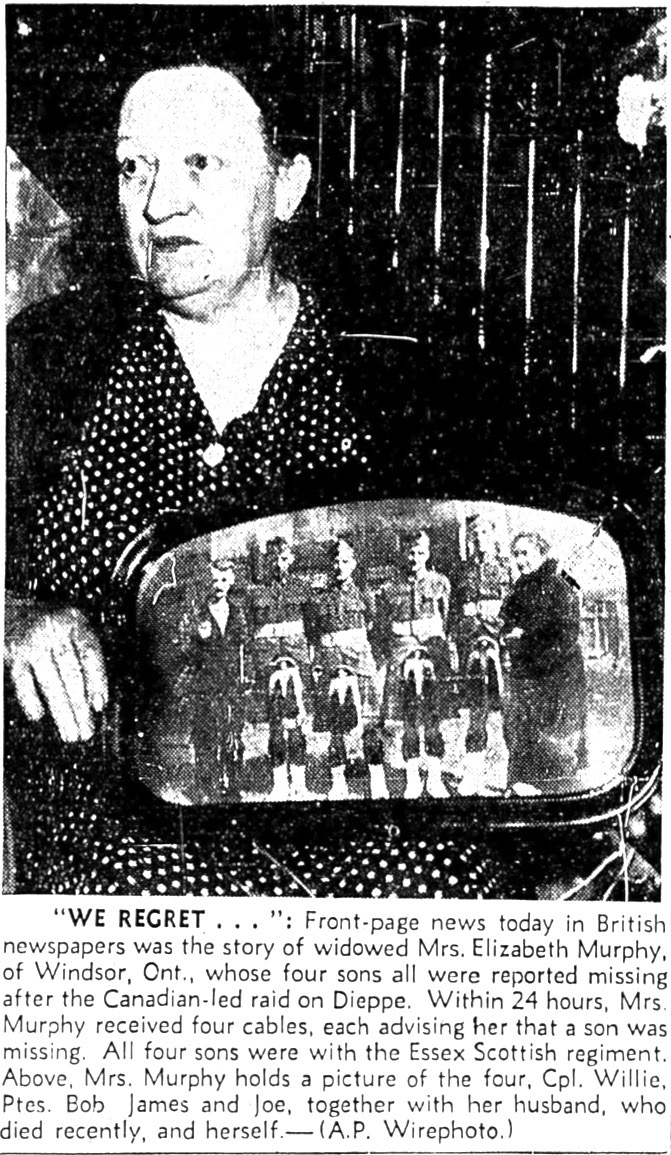
The movie "Saving Private Ryan" comes to mind when considering the photograph below. Did any of Mrs. Murphy's four boys survive the Dieppe raid? The caption leaves us hanging!

History reveals that the Essex Scottish Regiment was nearly wiped out during the raid, as were other regiments. Please click here to information related to and in honour of The Royal Canadian Regiment, landed at Blue Beach. 

Great interest was shown in the Dieppe Raid by rapt audiences across Canada, and tickets to see and hear Canadian war correspondent Ross Munro would have been a very hot item!


Related to the Dieppe Raid, one of the reasons surmised that it took place when it did was to appease Russia's leader Joe Stalin, who was demanding there be a Second Front to take some of the heat off of his own armies. There was some talk about an earlier date for a second front (than June 6, 1944, D-Day Normandy) but Churchill's desire to attack Germany via the Mediterranean Sea (North Africa, Sicily, Italy) prevailed in the end:


Allied countries were not alone in thinking/discussing/planning concerning a second front:


Stalingrad will be much in the news for some months and the eventual outcome was surely one of the most significant 'tide-turners' of World War II:


Want some Canadian salmon? Try your luck in 1943!


Dieppe Raid makes the news in more ways than one:


Can't get salmon? Try the peaches instead:


Just one more day before Eagle Squadron - featuring actual combat scenes - hits local theatres, guns a-blazing:


Another editorial cartoon my Mozel, found on page 6, Sept. 3, 1942

Some good reasons for continuing to expand Allied air forces given below:


About a year after Ross Munro finished his speaking tour he was back in action in Italy, as were Canadian forces on the sea, on land and in the air. Below are two articles as found in The Montreal Star on Sept ember 9 and 10, 1943:


Canadians in Combined Operations operated landing crafts, e.g., between Messina (Sicily) and Reggio ("the Canadian main landing beach", on the toe of Italy's boot) for 4 - 5 weeks beginning on September 3, 1943. Click here for more information about "Operation Baytown" (a series, Parts 1 - 11) in Italy:

Both articles were delayed by one day

More to follow soon from the week of September 1 - 7, 1942 from The Winnipeg Tribune.

Please click here to view Research: Post-Dieppe, Sept. 1 - 7, 1942 (Part 2)

Unattributed Photos GH

Friday, September 2, 2022

Research: Post-Dieppe, Sept. 1 - 7, 1942 (Part 2)

News Clippings Related to the Dieppe Raid Still Appear

And the Positives Are Still Mixed with the Negatives

After three years of war, German forces are facing more than a few setbacks
Cartoon by Mozel. Found in The Winnipeg Tribune, Sept. 2, 1942, page 6

Introduction:

The first two-thirds of the book Combined Operations: The Official Story of the Commandos by Hilary St. George Saunders (also author of The Green Beret) provides detailed descriptions of the raids in which Commando units were involved, including the raid on Rommel in North Africa, Vaagso in Norway, Bruneval and St. Nazaire in France, and Diego Suarez on Madagascar, and more. The last third deals with Dieppe. 

St. George Saunders entitles the first chapter about Dieppe "Reconnaissance in Force" and begins as follows:

The raid on Bruneval had been small, short and sharp: its success had been complete. The raid on St. Nazaire had been larger, longer and sharper; its success, measured in terms of the Battle of the Atlantic, also complete. It was time to plan the next stage.

Combined Operations: The Official Story... tells a good deal about the planning of the raid, its overall goals, and the results of the raid at the various places along the French coast where men and tanks (mostly Canadians), etc., were put ashore. News clippings after the fact from The Winnipeg Tribune provide a few more details, thus my online research and numerous entries here. 

I recommend St. George Saunders' book to readers as it provides a good deal of history related to the Combined Operations organization, the importance of 'combined operations' as a strategy and the significance of the Dieppe Raid. For example, the excerpt from The Official Story... continues:

In the spring of 1942, the demands of other and distant theatres of war still prevented the concentration in England of a United Nations force large enough and sufficiently well trained and equipped to launch a full-scale invasion of German-occupied Europe... 

...What could be done was to raid Europe in force. To mount a raid on a much larger scale than that which had been carried out on St. Nazaire would not only harass the enemy, which is, it cannot to too often repeated, the primary object of raiding; it would also be a means of providing the Allied General Staffs with very important and, indeed, essential information concerning his defences in the West. 

His strength must be tested, his methods examined at the point of the bayonet and the Bren gun, if the military problem which the forces of the United Nations will have to meet, should it be decided to launch an army of invasion across the narrow seas, is to be solved.

The task was hazardous, but then so is any operation of war, and the end was imperative. (Page 110) 

Photo from Combined Operations: The Official Story of the Commandos
British Official Photos - Crown Copyright

Please examine any and all of the news clippings that follow, including a few rare pieces touching on those involved in the Dieppe raid, August 19, 1942:


British and United States forces would be involved in the invasion of North Africa, Operation TORCH, about two months after the above article was shared. Members of the first draft of Canadians in Combined Operations (from the RCNVR) were placed into service aboard Allied landing craft and delivered both U.K. and U.S. troops to various beaches near Oran and Algiers.

My father (left) "Doug" Harrison and mate Buryl "Mac" McIntyre trained in
Halifax in 1941 and (with most in their division) volunteered for Comb. Ops

Here's one story from the Dieppe Raid that I never heard!


One soldier gets kicked out of a landing craft and another gets picked up by a limousine...


The Nazis might crack a defense line in Stalingrad but in the end their own back will be cracked:


Have you heard the term "Cologned" before? Here goes...


Canadian forces, during WWII, made a mark on land, on the sea and in the air:


There is a newsreel out there that will reveal video re "Allied Commandos Raid France." Link to "University of South Carolina" and join the hunt:


Had enough of the heat and humidity in this 'sweaty summer of 2022? Here's what you can get for 60 cents including tax, and they'll return you to point of departure!!


The 20th casualty list appears, interestingly, 14 days after the Dieppe raid (i.e., on several days there must have been two lists):


A near miss! 


My father had a very significant near miss as well. He missed the Dieppe raid by one day because of a scheduled leave. He knew something big was happening while on leave so he returned early, and was sent to clean up the returning (badly damaged, blood covered) landing crafts. I don't think he ever got over the "survival guilt."

My father (RCNVR, Combined Ops) wrote "survival guilt" under his officer's letter
as found in St. Nazaire to Singapore, Volume 1, pg. 66 (The other notes are mine)
And 'yes,' I do know where Lloyd Campbell is buried now. Near Berlin.

Also found in St. Nazaire to Singapore, Volume 1. My father, front center,
is wearing my Beatles cap from the 1960s. I'd like to have that now! GH


I am not sure if Canadian officers were handcuffed. Below is a pencil sketch of Lt. Robert McRae, mentioned a few items above, while he was POW  - and masterful piano player - after the Dieppe raid:

As found in  St. Nazaire to Singapore: The Canadian Amphibious War
Volume 1. The skilled artist is unknown at this time, 2022

The previous article continues:


Spareribs at 18 cents per pound caught my eye:


England and Canada's 'productive capacity' grew by leaps and bounds during WWII. But no other country out-produced the American military industry:


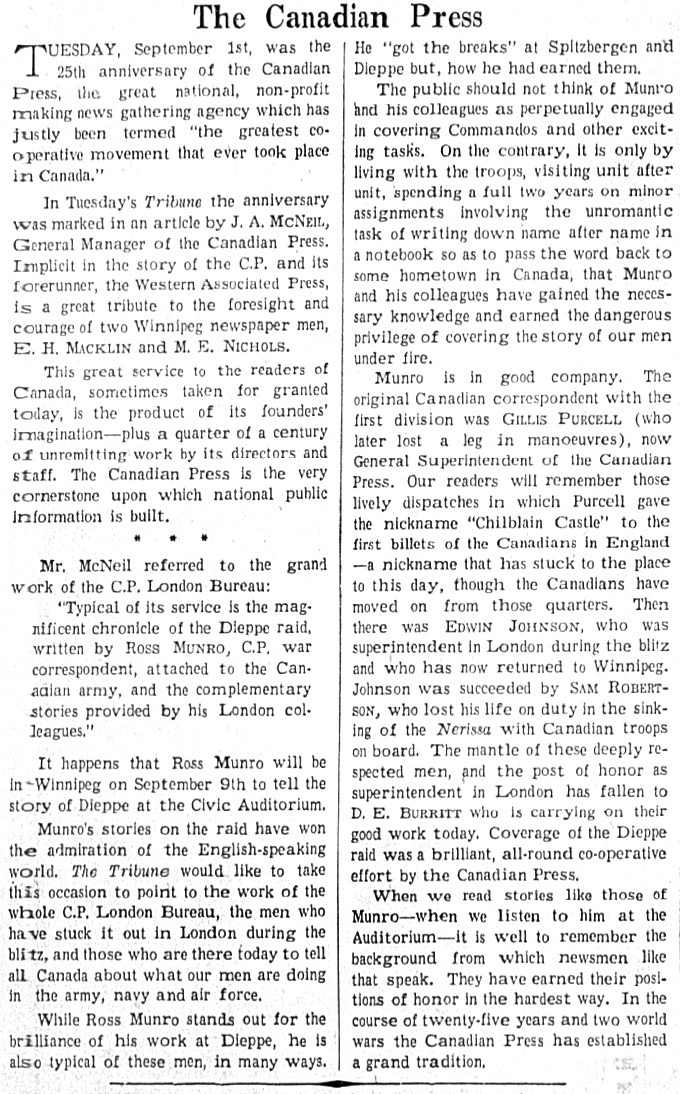
Also from the Editorial page. It could be said that The Canadian Press out-produced all other Canadian news bureaus, perhaps thanks to Canadian war correspondent Ross Munro:


Ross Munro, mentioned above, would return to Europe and post many stories from the war in the Mediterranean, i.e., from Sicily and Italy:

Canadian war correspondents, videographers and film producers in Italy, 1943.
Click below to learn more about their work in the Mediterranean.


Here's news of a Commando movie with a strong Canadian connection... 

Much filming for the movie was done in British Columbia, Canada

Not a good poster. Click here for better resolution photos and video!

The movie hit theatres as "Commandos Strike at Dawn" starring Paul Muni and Lillian Gish and "a flock of extras". I have come across a few photos that relate to the movie; the first one was used in the above movie poster:


Note the date stamp in lower right hand corner; same as the Dieppe raid

Where on the Vancouver Island? Help Wanted!

And now, back to the real world news from The Winnipeg Tribune:


More news clippings re the Dieppe Raid, the role of Canadians in Combined Ops, and other events during WWII (in 1942) will follow shortly.

Please click here to view Research: Post-Dieppe, Sept. 1 - 7 (Part 1)

Unattributed Photos GH