Thursday, October 20, 2022

Research: Post-Dieppe, Sept. 1 - 7, 1942 (Part 5)

End of the Line? Is Dieppe Fading From View? And if so...

What Will be the Next Stage of WWII to Fill the Papers?

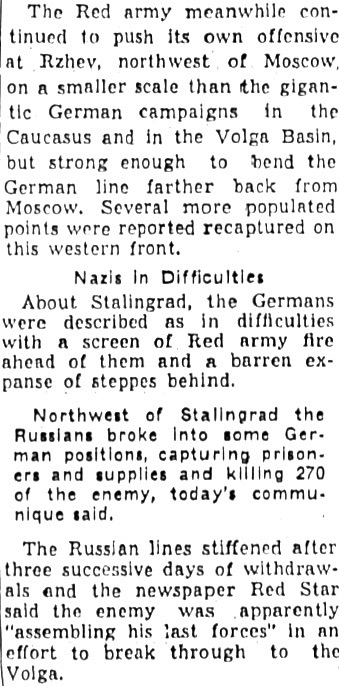
News from Stalingrad will surely last for many more days - weeks
Peruse future issues of The Winnipeg Tribune at your leisure 

Introduction:

The Dieppe Raid took place over the period of two days, i.e., launching from the southern shores of England (e.g., from Southampton and New Haven) on the evening of August 18, 1942, and then landing in various places along the shores in and near Dieppe beginning in the early hours of the 19th, with the survivors, the weary, the wounded and some of the dead returning hours later. Newspapers around the world began sharing news of the fateful event shortly thereafter.

On these pages (or entries) readers will find but a small portion of the interviews, stories, articles and numerous casualty lists related to the raid, from the day of to Saturday, September 5, 1942 (Monday, Sept. 7 to soon follow). They will notice casualty lists in great number (the Canadian Defence Dept.'s 22nd list appears below), poignant interviews and eye-witness news, including descriptions about what happened on the beaches of Dieppe by trusted Canadian war correspondent Ross Munro. Details from one of his presentations to a grateful audience also appear below.

Readers will also notice - when these pages are all considered from August 20 to September 7 - that the war goes on, news from other fronts is growing more and more, items about Dieppe are less and less... as is to be expected. 

So, where do we go from here? One article is shared below re a 'second front' and - according to my father's WWII memoirs - it seems to be a natural fit for one of my future plans.

But first, news of the day:


The following headline is but half of it!


"I bought this copy new - a rare move (!). Worth the money? Yes!"
'Fateful siege' is correct. Hitler would not admit defeat, and his
army's overall strength - so pivotal - was greatly depleted. GH

Churchill made mistakes and miscalculations as well. Related to Dieppe? Quite possibly. (My father, a Canadian sailor who missed Dieppe by one day and lost mates there, would say, "For certain.") But the PM did many things right as well:


The Allied position in North Africa will get stronger and may prove pivotal in its own way. More opinions to follow:


RCAF gets an honourable mention:


Canadian war correspondent Ross Munro wrote the news while in Dieppe and later made the news upon his return to Canada:

More news about Ross Munro - and his eye-witness account re
the fateful Dieppe raid - will appear below!


I think the 'Axis Fear' is well-founded. Operation Jubilee (the raid on Dieppe) took place on August 19, 1942. Operation Torch, the Allied invasion of North Africa - on three expansive fronts - only about 5 weeks (beginning November 8, 1942) after this article appeared: 


Canadians in Combined Operations were sprinkled among British landing craft
crews as part of the Centre and Eastern Task Forces. GH has inserted the map
between sections of the headline for this informative article. 


A second insert from Editor GH. Five weeks after the above article appeared, U.S. troops landed east of Oran - as part of Operation Torch -  with an assist from British landing crafts, some manned by Canadian sailors. I will likely 'beef up' my Operation Torch material after this 'Post-Dieppe' series is finished. One reason is offered below:

Editor's caption: A Canadian sailor (my father, Doug Harrison, RCNVR (V8809))
assists U.S. troops disembarking from a British 'Landing Craft, Assault' (LCA)
IWM caption: Troops and ammunition for light guns being brought ashore from a
landing craft assault (ramped) (LCA 428) on Arzeau beach, Algeria, North Africa,
whilst another LCA (LCA 287) approaches the beach. Photo - Lt. F. A. Hudson*,
RN Photographer at Operation 'Torch,' Nov. 1942. Imperial War Museum (IWM) 

*Hudson snaps a photo of Harrison. Did he snap a few more? Were words exchanged? Does IWM have anything else on file re that particular day? I should try to find out!

Occasionally, when losses are listed, the term "Butcher's Bill" is used. It seems the cost is always high:


About the following I say, "Mere lemonade, eh!"


This is likely not the last casualty list but I think it's near the end:


Related good news:


This may seem an odd article - about a burst boiler - to add to a collection of WWII pieces but my eye was drawn to the writer's name. Dick Sanburn's tag is attached to many excellent WWII articles connected to Canadian's in Combined Operations, particularly during the invasion of Italy beginning in early September, 1943, when he was with The Ottawa Citizen:


Just a reminder that WWII was a world war:


I'm dating myself by including this wee article that includes references to a man - originally of radio fame - I saw a few times on the Ed Sullivan Show (on TV Sunday nights at 8:00) and a woman who rode on a horse called 'Buttermilk' while she and her hubby (Roy Rogers, riding on 'Trigger' (now stuffed and likely in a museum somewhere in Texas)) chased after the bad guys. And as I recall, Dale and Roy were married in real life too: 


From the days when comic books were a dime! Photo - my comic shop


If the following provides final details re the Dieppe raid (in this particular series) then I could not ask for a better-prepared or authoritative eye-witnesses, including Ross Munro and Col. Dollard Menard:


From the days when "favourite recipes" included KLIK in a Kan:


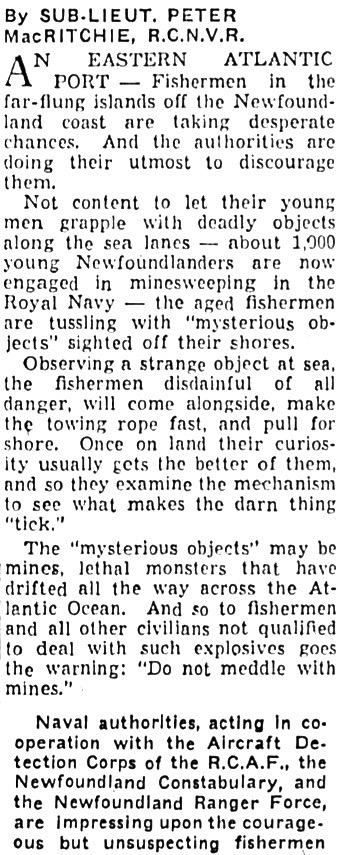
Somewhere on this blog re '1,000 Men, 1,000 Stories' is a story that is very, very closely related to the one that follows, about dangerous work done by members of RCNVR. As you read it you might just imagine how tempting it may have been for a fisherman - finding a large, heavy, mysterious, bulbous item in his nets - to look closer to see if it was "a molasses puncheon" or something of value. Believe me, it could (and did) happen. And somewhere, a few years ago, I found the first edition of a story like this, featuring a fisherman who called for help because he had caught a mine - as was encouraged by the Navy - but got tired of waiting. What he did while waiting is revealed in the last paragraph. 


If I find the original tale, re the lucky fisherman - he didn't blow up - I'll tuck it in here.

News follow from The Tribune London Bureau:


Though not a good "photographic reproduction" of a secret paper - "printed, published and read at the risk of the lives of editors and readers" - the story is clear:


Men and women risked their lives everyday in a variety of ways, including by being a member of an underground movement. One patriot's diary ended abruptly...


More news clips to follow.

Please click here to view the last entry in this series, Research: Post-Dieppe, Sept. 1 - 7, 1942 (Part 4)

Unattributed Photos GH

Monday, October 17, 2022

Passages: Combined Operations - The Official Story of the Commandos (2)

First Action of Canadians Who Volunteered for Combined Operations

"Reconnaissance in Force: Dieppe" Pages 110 - 146

Photo as found in Combined Operations: The Official Story... Pages 12 - 13

Introduction:

This book under review takes us on a wide range of travels from small, pin-pint raids upon coastal installations in Norway and France to an invasion upon several shores of North Africa, i.e., Operation Torch, beginning November 8, 1942.  

However, before Operation Torch, Commandos were involved in a significant raid - with a reputation that is discussed heatedly to this day - that included a majority of troops from Canada, and sailors from Canada who were volunteers for Combined Operations Command involved in a military action (the first for most, manning landing crafts) that they would recall vividly for the rest of their lives.

Passages from the book that inform, enlighten and engage readers about the role of Commandos (and Canadian sailors who trained with and like Commandos) will follow. Questions or comments can be addressed to GH at gordh7700@gmail.com:

Reconnaissance in Force: Dieppe

The raid on Bruneval had been small,
short and sharp; its success had been complete.
The raid on St. Nazaire had been larger, longer and sharper;
its success, measured in terms of the Battle of the Atlantic, also complete.
It was time to plan the next stage.


What could be done was to raid Europe in force.
To mount a raid on a much larger scale than that which
had been carried out on St. Nazaire would not only harass the enemy,
which is, it cannot be too often repeated, the primary object of raiding;
it would also be a means of providing the Allied General Staffs
with very important and, indeed, essential information
concerning his defences in the West. 

His strength must be tested, his methods
examined at the point of the bayonet and the Bren gun,
if the military problem which the forces of the United Nations
will have to meet, should it be decided to launch an army of invasion
across the narrow seas, is to be solved.

The task was hazardous,
but then so is any operation of war,
and the end was imperative.
Planes, therefore, for a large-scale raid
against a point on the French coast,
were under discussion early in April, less than
three weeks after the raid on St. Nazaire.
It was decided that Dieppe was a suitable objective
for an operation of the size contemplated. It was chosen
from a number of French ports, all equally well defended,
as could be seen from the study of air photographs.

The Dieppe defences could therefore be taken
as a fair sample of what the attackers might have to
meet at whatever point an assault was launched
along the coast of Northern France.

Pages 110 - 111

In memoirs, my father (RCNVR, Combined Ops) - who lost his first mates during the Dieppe Raid - wrote the following:

Much has been written about Dieppe
so I will not enlarge upon it too much.
My opinion is - it was a senseless waste of blood.
The Germans were ready because we ran
into a German convoy in the channel. 

The element of surprise was lost.

The times of arrival at beaches were to be during
the night, but some turned out to land in full daylight
up against cliffs unable in any way to be scaled.

No softening up of defences
by bombing was ever carried out.
I will make it short and say I will remember it
as a complete, useless waste of good Canadian blood
and no one - even those who say we learned a valuable lesson there -
will ever change my mind. No mock raids were held,
as for St. Nazaire against home defences.

It was simply a mess.

I lost my first comrades at Dieppe. Others were wounded.
O/S Cavanaugh - killed. O/S Jack McKenna - killed.
A/B Lloyd Campbell, London, Ontario died of wounds
after his legs were nearly cut off by machine gun fire.
Imagine Higgins boats made of 3/4 inch plywood
going in on a beach like that.

"Dad, Well Done", pages 20 - 21

He felt military planners should have known the beach was treacherous because British citizens (perhaps his own relatives) would vacation on the coast of France at or near Dieppe.

Notes about the beaches follow from Combined Operations: The Official Story... :

Natural Obstacles and Coastal Defences

The planners were at once confronted with two difficulties,
the first provided by Nature, the second by man.
Not inaptly has that stretch of France's seaboard...
been called "The Iron Coast." Nearly all of it
is made up of high cliffs, mostly unscalable,
broken here and there by narrow clefts
or by the mouths of rivers. 

The chief of these is Arques, on which
the town and harbour of Dieppe was built.
Here the gap is something above a mile in width.
At the foot of the cliffs lie stony and inhospitable beaches,
the haunt of picnic parties and bathers in peacetime
during the summer months. To land at low water
on these beaches is very difficult and dangerous
because of the rocks in the sea's bed and the angle of the
shore itself, which make the task of beaching a landing craft
and taking it away a matter of the greatest skill and judgment.
The clefts behind the beaches are not numerous and those
which exist are, for the most part, narrow and very easily defended.
Men moving up to them to the attack are at the mercy of the
defenders in position at their top, who can destroy the attackers
with the greatest ease as they clamber laboriously upwards.


To the natural obstacles of such a coast, the Germans
have added defences disposed so as to cover, with a
formidable fire of all arms from 5.9 coast-defence guns to rifles,
every likely landing place, especially the main beach
running parallel to the Dieppe promenade.
Not only this, but many of the defences
have been designed to prevent ships from coming
close to shore and certainly from remaining there.

The planners, therefore, came to the conclusion
that naval support to the land forces attacking Dieppe
- an indispensable adjunct of success - could only be provided
if two heavy coast-defence batteries, one at Berneval on the east and the
other at Varengeville-sur-Mer on the west of Dieppe, were first subdued. 
Their fire would do too much damage to ships
to make a daylight attack a feasible proposition...


Pages 111 - 112

Another short passage, from page 113, contained a brief note that related to training exercises in preparation for the Dieppe Raid. If I am correct, then a helpful link follows re those official exercises:

Two Full-Dress Rehearsals

While the troops, still in complete ignorance
of the real object of their exercises, were engaged
in practising climbing up steep places, street fighting, negotiating wire,
attacking pillboxes, advancing with tanks, handling weapons of all kinds
- they carried out two full-dress rehearsals - and while the staffs
were perfecting the plans and drafting the orders for their execution,
large quantities of stores, ranging from ammunition for the 6-pounder guns
in the tanks to the self-heated containers of food to be carried
in the landing craft, were being collected in secret.

H11177. A landing craft containing a Valentine tank being launched down the
slipway of a landing ship during combined operations training on Loch Fyne
in Scotland, 27 June 1941. Photo - Major W.G. Horton, War Office, IWM.


Much has been written concerning the Dieppe Raid and some fine passages and stories are found on this site. Follow the A - Z Directory, right hand margin, and email GH for specific links to one Canadian sailor's eye-witness account if you cannot locate Al Kirby's memoirs. gordh7700@gmail.com

The Prime Minister, Speaking in the House

[The expedition returned to the ports from which it sailed, some of the ships not berthing until past midnight (i.e., August 20, 1942)]

In the words of the Prime Minister, speaking in the House of Commons on the 8th September, 1942,

"The Dieppe Raid must be
considered a reconnaissance in force.
It was a hard, savage clash, such as is likely
to become increasingly numerous as the war deepens.
We had to get all the information necessary
before landing operations on a much larger scale.
This raid, apart from its reconnaissance value,
brought about an extremely satisfactory air battle in the west,
which Fighter Command wish they could repeat every week."


These results were
purchased at a high cost in casualties.
The Canadians suffered particularly heavily.
It was announced in Ottawa after the operation
that of 5,000 Canadian troops engaged a total of
3,350 were killed, wounded or missing.
Subsequent announcements raised the total to 3, 372.
This included 593 officers and other ranks killed or died of wounds,
1,901 who were prisoners of war or otherwise detained on the Continent,
and 287 missing; while 591 returned wounded to England.

Text from Combined Operations: The Official Story..., pg. 144 and 145

...Where that larger landing would take place, and when,
they did not know, but German political warfare, which from
the beginning of the war had taken and maintained the offensive,
began on the day of Dieppe to turn to the defensive.

The enemy's apprehension
concerning a major assault was well founded.
Eighty days later the occupation of French North Africa began.

Readers can peruse newspaper clippings related to the Dieppe Raid, and numerous casualty lists, at the following link - Research: Post-Dieppe, August 26 - 31, 1942 (Parts 1 - 5)


Lieut. Jake Koyl (RCNVR, Combined Operations) was my father's commanding
officer, highly regarded. From The Winnipeg Tribune, August 31, 1942. Pg. 11

Please click here to read other significant passages from Combined Operations - The Official Story of the Commandos

Unattributed Photos GH

Tuesday, October 4, 2022

Passages: Combined Operations - The Official Story of the Commandos

 Combined Operations: The Official Story of the Commandos

by Hilary St. George Saunders, Published 1943


Front and back covers - Hilary St. George Saunders also authored
The Green Beret: The Story of the Commandos 1940 - 1945

Introduction:

After reading the book I realized it is 99% identical to St. George Saunders' book under a slightly different title - Combined Operations 1940 - 1942. I do not feel like I've wasted money by buying the same book twice because I took in or understood parts more clearly second-time-'round. 

Some passages meant more to me because I could see my father fully taking part in a particular exercise that was being described, now that I know more about 'where he went and when' as a member of the RCNVR and Combined Operations Command. At the same time the book is informative, entertaining and inspiring, though some will be hoping for more pages because the tale ends before the invasion of Sicily, Italy and Normandy France, 1943 - 1944. But there are many more books that will fill in details of WWII, some of which are listed under the heading (in side margin) "books re Combined Operations".

A brief review of the book is offered here - Combined Operations: The Official Story...

Below please find a few thoughtful and meaningful passages and photographs from the book at hand:

About Early Raids: June 23rd/24th, 1940

By the 15th June, 1940, a depot,
first a converted yacht but soon other quarters,
on shore had been established on the south coast of England
and the training of both Services (the Royal Navy and the Army)
in amphibious warfare began. Intense energy prevailed from the start,
and on the night of 23rd/24th June the first raid took place.

It was a reconnaissance of the French Coast between Cap d'Alprech
near Boulogne, and the Pointe du Hautbanc near Berck.
Two hundred men were to be landed in six (later changed to four) parties,
to discover the nature of the German defences, and bring back prisoners.
The landings were, if possible, to take place at
the same time in order to confuse the enemy...


...German aircraft flew constantly
over their heads but did not see them.
Another boat approached the coast near Boulogne.
When close in, the men on board her perceived that
they were in the midst of an enemy seaplane anchorage.
To land undetected was obviously impossible.
It was decided to wreck one of the seaplanes;
but, as the boat moved towards it, the aircraft selected
suddenly took off and roared over their heads,
missing them by a few feet.
The Germans on shore were now on alert, and
since surprise was lost the troops did not land.


Major Todd was about to engage them with his
tommy gun when the magazine fell off with a clatter.
The Germans opened fire and then fled.
Lieutenant-Colonel Clarke was hit a glancing blow behind the ear.
This was the only casualty sustained throughout the operation and
the wound was superficial...


Their troubles did not end when they got to shore, for they were
then arrested by the Military Police who took them for deserters.
At another port, the companies of the ships in harbour
cheered the raiders as they made fast to the jetty.
Those cheers were echoed in the Press...

In fact, it was no more than a reconnaissance,
not even in force, but it achieved its purpose.
Not only had information of military value been brought back,
but men of the Royal Navy and the Army had together
carried out a combined operation against the enemy and
had laid the foundation of mutual confidence that
was to be of such vital importance later on.

Pages 18 - 20 


Photos found on pages 16-17, Combined Operations: The Official Story...
Editor's opinion - Above photos are from HMS Quebec, Inveraray, Scotland

Below is another early story re Combined Operations Command, with Canadians involved. (First drafts of RCNVR members, including my father, were not in Comb. Ops training at this time. They would, however, arrive in Scotland less than one year later):

Deny the Spitzbergen Coal to Germany

An agreement was reached by Great Britain, the U.S.S.R.
and Norway in July 1941, that immediate steps should be taken
to deny the Spitzbergen coal to Germany.
It was not thought desirable to maintain
a permanent garrison in the islands.
What could be done was to to disable the mines as to ensure
that the Germans could derive no benefit from them, to destroy
any stocks of coal and evacuate the inhabitants.
 

Found on pages 16 - 17, Combined Operations: The Official Story...

No opposition from the enemy was encountered, however, and the
force anchored in Green Harbour in the Ice Sound of West Spitzbergen.
The inhabitants showed great friendliness, and immediate preparations
were made to evacuate them, the Soviet citizens
to the U.S.S.R., the Norwegians to England.

Once the former had been got aboard,
the demolition parties went to work.

Essential parts of the mining machinery were removed or destroyed.
A disused wireless station was blown up and were removed or destroyed.
A disused wireless station was blown up and the overhead conveyor system,
bringing the coal from one of the largest mines to the dock side, was destroyed.
450,000 tons of coal lying in ordered heaps were set on fire
together with 275,000 gallons of fuel oil, petrol and grease.

"Exploding barrels," states an eye-witness,"
were seen rising to a height of about 250 feet
and were thrown out from the pile, flaming,
to a distance of from 350 to 400 feet..."

...The final task was the destruction of the two wireless stations.


Of all the Allied raids that took place before the ill-fated Dieppe Raid in August 1942, the most significant and dashing was the raid at St. Nazaire. Entire books have been written about the raid, it was the first that involved a Canadian or two aboard landing crafts, and Combined Operations: The Official Story of the Commandos devotes 3 chapters and 30 detailed pages to the topic, i.e., it's goals, elaborate actions, its positive results. A few details are shared below:

Only Brest and Lorient can rival
the importance of St. Nazaire as a
German naval base for enemy forces
engaged in the battle of the Atlantic.
St. Nazaire contains not only every kind of facility
for the maintenance, arming, provisioning and repair of U-boats,
but also the only dry dock on the Atlantic seaboard
capable of holding the battleship "Tirpitz." 

It was towards this great dry dock, called by some
the Forme Ecluse, by others the Forme Louis Joubert,
which is over 1,100 feet long, that the "Bismarck" was undoubtedly making
when she was sunk on the 27th May, 1941. If her sister ship, the "Tirpitz,"
were tp replace her in the Atlantic battle, she would, on return from her cruise,
have to make use of the Forme Ecluse, or else
find her way to the German North Sea bases
to undergo the necessary refitting.

Combined Operations: The Official Story of the Commandos, page 71

St. Nazaire - The Raiders Go In, as found on page 83

More about the results of the raid, sometimes called 'the Butcher's Bill':

Paragraph as found on page 98

On page 99 details re overall results and Allied losses are revealed:

...Having overcome (several) preliminary hazards
and retained surprise to the cannon's mouth, the principal object
was completely achieved and most of the demolitions
carried out with the utmost speed and effect.


The attack on St. Nazaire showed what contribution
could be made by a combined operation (emphasis mine, GH)
against an enemy base towards winning the Battle of the Atlantic.
The manner and method in which it was carried out
proved that it was possible for a comparatively small force
to attack a heavily-defended port under cover of darkness
by exploiting to the full the element of surprise.* Page 99

*Surprise was a critical element in the planning of an upcoming raid, again in France... upon the beaches of Dieppe. However, it was lost at approx. 0345 hours on August 19, four and a half months after the successes at St. Nazaire.

In a chapter about a little known raid (CH. 13. The Storming of Diego Suarez) on the island of Madagascar, a couple of informative paragraphs reveal more about the role of Commandos and the significance of Combined Operations Command and their need for "specially trained men", including Canadians who volunteered for Combined Operations in late 1941, at first only by the score:

Wanted: Amphibious Equipment and Specially Trained Men

Most of the Royal Navy landing ships and craft that were used
to transport the troops, which included No. 5 Commando, and to
put them ashore, were provided by Combined Operations Command.
These did not form the majority of the ships and troops taking part.
It is impossible, however, to tell the story of No. 5 Commando,
which was the Command's land contribution, without
giving some account of the land operations as a whole.

HMS Keren, portside of troopship w landing craft attached

Training and troopship Ettrick on Loch Fyne at Inveraray, Scotland
Combined Operations No. 1 Training Camp is 2 miles south

"RFA Ennerdale off Grenock (Scotland)". Photo - Joe Spencer, RCNVR, C. Ops

The Madagascar operation, in which the Command acted as
an assistant and not as a principal, brought out for the first time
what has now become one of its most important functions.
This is to provide amphibious equipment and specially trained men,
and to help generally in making possible the conduct of combined operations
on a scale much larger than those involved in raiding the enemy.


Another of its functions, equally important, is to arrange special training
for the troops who take part in these larger operations and to help stage
the final rehearsals which are carried out before
the forces chosen are launched upon the enemy.

Pages 102 - 103

More passages from Combined Operations: The Official Story of the Commandos to follow, focussing on the Dieppe Raid.

Please click here to read more about The Greatest Raid of All (re St. Nazaire)


Please click here to read passages from another World War II classic (in my opinion): Ernie Pyle's War - America's Eyewitness (Pt 2)

Unattributed Photos GH