Saturday, November 9, 2024

Photographs: His Majesty's Canadian (HMC) Dockyard (B.C. Trip, 2012) (1)

HMC Dockyard in Esquimalt, Vancouver Island, B.C.

Good Thing I Carried a Small Camera in 2012

Click here to view Google Map of HMC Dockyard, Esquimalt, 2024

Introduction:

During WWII, several members of RCNVR (who later volunteered for Combined Operations as well) did their initial training on Vancouver Island, B.C., likely at HMCS Naden III located on The Spit in Comox. Interested readers can click on Photographs: The Roy Burt Collection, RCNVR and Combined Operations (1) in order to see a photo or two of a very young Roy Burt training at HMCS Naden III, circa 1939 - 1940.

Several other sailors (also RCNVR/Combined Ops) completed their WWII service at the same location, beginning January, 1944, but known as HMCS Givenchy III (as of October, 1943) and associated with Canada's only Combined Operations School. My father served there from January, '44 - September, '45 and was discharged from the RCNVR at HMCS Star, in Hamilton, Ontario on September 5, 1945, one day before his 25th birthday. And his records (next photo below) show a final entry for Givenchy III  dated '10 July 1945' followed by an entry for Naden - signed out on 16 July 1945 - before ending up at HMCS Star. Did Doug spend a few days in Esquimalt sorting out his luggage or was it just a pit stop for his official papers?

Questions or comments about my father's Navy records above
can be addressed to Gord H. at gordh7700@gmail.com

Below are several photographs that I took while visiting CFB Esquimalt (NADEN) in 2012, first to see a unique Navy hammock at a military museum on the grounds, followed by a tour of several significant sites on the base. Among many other things, I spotted one of the submarines that Canada's Dept. of Defence had purchased from the Brits (but was told to put my camera away!) and a work shed where hawsers (braided ropes) were still made. That was a significant find for me, as my father had to climb up a long one in order to catch a meal, a tot and a well-deserved rest during Operation TORCH.


I hopped a bus in downtown Victoria to get to CFB Esquimalt's 
Naval and Military Museum. I made my 10AM appt. on time

I was handed white gloves and helped unroll this WWII Navy
hammock, seen "by appointment only." Dad had never seen it!

The names of some of the officers and sailors belonging to the 80th
Canadian Flotilla of Landing Crafts were printed on the hammock.
Photo sent to me by staff of CFB Esquimalt Navy Museum (2011) 

The following information about the lengthy life of the Navy hammock appears in St. Nazaire to Singapore: The Canadian Amphibious War 1941 - 1945, Volume 1  (page 167):


Please click here to link with the full book of WWII Navy veterans' stories (RCNVR/Combined Operations) St. Nazaire to Singapore: The Canadian Amphibious War 1941 - 1945, Volume 1, created and editted by David and Kit Lewis, and Len Birkenes (circa 1995).

The hammock was loaned to Robertson by W. Katanna (Engineer) while
circling Africa aboard Silver Walnut prior to Operation HUSKY, July '43

Several members of the 80th Flotilla are seen here aboard the Walnut
Photo as found in St. Nazaire to Singapore, Vol. 1, page 161

Members of the 80th served for three months in the Mediterranean, 1943


Yes, I was very grateful to staff at the museum, to be able to see my father's
name once the hammock - which smelled like diesel fuel(!) - was unfurled


My father wrote a few words (correction - more than a few!) about the return of the hammock ("a long term loan") in 1986:

As found in St. Nazaire to Singapore, Vol. 1, page 166
The paragraphs above conclude a lengthy story re the Walnut's
struggling journey (at times as "submarine bait"), pg. 160 - 166

If I am able to return to the West Coast with my sons in the next few years
then the hammock will be unfurled one more time. It's a BIG DEAL : )
 
From the Navy Museum I made the long hike to HMS Dockyard.
Another important appointment, but I got lost and was 15 min. late!


My tour inside the circled area began shortly after I knocked
on His Majesty's Canadian (HMC) Front Door (see arrow)

I was almost immediately dwarfed by HMCS Vancouver


This is the size of ship I'd be comfortable to captain, if they'd have me

My cheerful tour guide and I traversed a narrow walkway adjacent
to a spacious dry dock, empty at the time


The same walkway is empty in the above photo (see yellow arrow) but the
dry dock is now home to one of Canada's (nuclear?) subs* from the U.K.

*Canada's submarines: At the time I visited I was not permitted to photograph the recently purchased subs. One of them had caught fire while under repair, I seem to recall. It wasn't top secret! And now one of the subs appears on the Google Map of the Navy base!!

I vowed not to take a photo of anything that was Top Secret

However, I did take several photos of buildings that seemed older, WWII vintage, thinking they might have meant something to my father:

This one - with a huge chimney - definitely seemed older than many others

This old frame shed certainly seemed older than most and reminded me of
the West Coast setting of one of my favourite photos of Dad and his mates

Back, L - R: Don Westbrook, Chuck Rose, Joe Spencer
Front. L - R: Joe Watson, Doug Harrison, Art Warrick
Out West, circa 1944 - 45


Stately brick buildings caught my eye, and all are 'heritage buildings'

Maritime Forces Headquarters (centre), not top secret
Photo taken while standing on A Jetty

Bickford Tower Federal Heritage Bldg. plus a very rare Telus Phone booth!!

Bickford Tower

Admiral's Residence D101 Federal Heritage Building

A look north toward Rainbow Drive and a white van on A Jetty

We walked past a strange bunker-like building on our way toward Duntze Head

Looking toward two cannons sitting at Duntze Head. Cannon fire might
not reach the opposite shore and Fort Rodd Hill

Nice views follow from Duntze Head


We stopped in at The Factory D51 Federal Heritage Building because I just
happened to spot a hawser (braided rope) in the front window. An employee
was willing to explain how hawsers were made (it's complicated) and the
machinery was still in place. Awesome!  

My father scrambled up a hawser "hand over hand" to get aboard Reina Del
Pacifico during the invasion of N. Africa in November 1942. Details here.

Large amounts of braided rope act as fenders on large ships

Old boots - with a lot of miles on them - make fine pieces of art


My guide discusses the art of rope making with a helpful 'Factory' employee

The old brig where sailors went to think over their mistakes.
No one can exit that back door!! No way! You're stuck!!

The side of the brig faces Carden Street and the pine trees are still there!

I don't know where this photo was taken. It could be Top Secret!

The following two photos were taken at a downtown Victoria 'military museum' and I took a few dozen photos while inside. I hope to share some of them on this site in the near future:


If you are ever in Esquimalt, B.C., Google Maps will certainly help you find your way around the Canadian Navy base. If guides are still available sign up for their assistance!


If you have questions or comments about any photograph please
send an email to gordh7700@gmail.com

More photos of HMCS Naden  can be found at For Posterity's Sake

To view more photos related to Canadians in Combined Operations please click here - Photographs: The Roy Burt Collection, RCNVR and Combined Operations (2)

Unattributed Photos GH

Tuesday, November 5, 2024

Editor's Column: FAINT FOOTSTEPS, World War II (14)

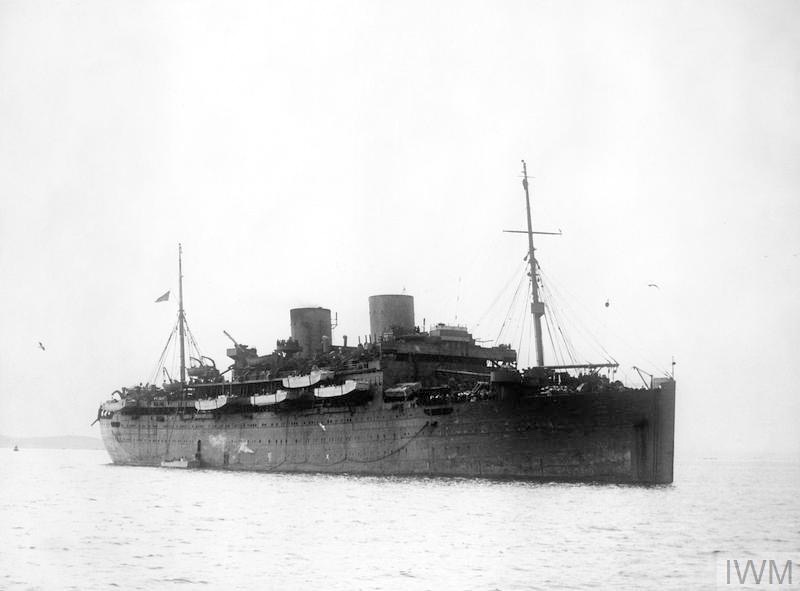
The 'Queen of the Pacific', HMS Reina Del Pacifico

Favourite Ship of Many Tired Sailors During WWII

'HMS Reina Del Pacifico' transported U.S. troops to North Africa, 1942.
Four landing craft can be seen hanging from davits. Another is in the water
near the stern of the ship, alongside an open door - for exitting troops. Photo
by J. Hall at Gourock, Scotland. FL18191, Imperial War Museum (IWM)

Introduction:

In July, 2018, I received news that my columns would no longer be needed by The Norwich Gazette, my father's hometown weekly newspaper. It was closing its doors. I was very disappointed, I didn't think my columns were that bad!!

Now it is common knowledge that small- to medium-sized newspapers across the land are under threat from other forms of news media and that problem is not all my fault. So, I'm going to continue my series of short stories related to my father's Navy memoirs and the several submissions he made to The Gazette and a few other interested parties.

Questions, comments and related information re the 900 - 1,000 Canadian sailors that volunteered for Combined Operations (many manned landing crafts during the Dieppe Raid and Operations Torch, Husky, Baytown, Avalanche, and D-Day France) can be sent to Gord H. @ gordh7700@gmail.com

North Africa PT 3: A Big Tot of Rum on the 'Reina Del Pacifico'

("Getting There was Half the Fun")

American troops manning their landing craft assault from a doorway in the side of
HMS Reina Del Pacifico during Operation 'Torch', the Allied landings in N. Africa,
November 1942. Two of the landing craft are numbered LCA 428 and LCA 447.
Photo Credit: RN Photographer Lt. F. A. Hudson, A12647, Imperial War Museum

*I believe that my father is helping get his LCA (Landing Craft, Assault) into position to take on U.S. troops. It was work, work, and more work for the first four days (without rest) during his 11 days serving near Z Beach and Arzew.

* * * * *

"TORCH was a compromise operation that met the British objective of securing victory in North Africa while allowing American armed forces the opportunity to begin their fight against Nazi Germany and Fascist Italy on a limited scale." Operation Torch, Wikipedia

* * * * *

"The six Flotillas of Canadian Landing Craft included in the forces which made the landings at Oran and Arzew (sic) had an easier time than expected; and their heaviest casualties occurred after all resistance was over, when the ships returning to England were torpedoed... The Canadian Landing Craft ferried in American and British troops almost without incident, although they were occasionally under sporadic fire from French ships and shore batteries. After the nervous initial stage was over, the men were inclined to make a picnic of the work. Nevertheless, at the conclusion of the landings it was reported that it had actually been difficult to get the men out of their craft to be relieved." Combined Operations by Clayton Marks, London, Canada. Page 69

* * * * *

My father, Doug Harrison, unloaded U.S. troops and their supplies at
Arzew, Z Beach, upper right. Map - Combined Operations, pg. 66

Arzeu and Z Beach are in the upper right side of the above map as well.
As found in The Campaign for North Africa by Jack Coggins

"Getting There was Half the Fun"

My father, Doug Harrison, writes about some of the difficulties associated with getting "the men out of their craft to be relieved" in his Navy memoirs (excerpts below from ("Dad, Well Done", pages 25 - 26):

"I worked 92 hours straight and I ate nothing except for some grapefruit juice I stole..." 

After the 92 hours my officer said, "Well done. An excellent job, Harrison. Go to Reina Del Pacifico and rest."

Such kind-hearted words must have been greatly appreciated, but before my father could gratefully comply a few "snipers in a train station" had to be eliminated. It was recorded that American gunners in a half-track flattened the station "to the ground level." Shortly thereafter (perhaps with the smell of fresh cordite still hanging in the air above Beach Z), my father made his way by landing craft - likely with all aboard feeling somewhat safer and more secure - to the side of the Reina Del. It was a very popular liner as far as some very tired Canadian sailors were concerned, and was stationed about a mile or two off shore. 

Once the small landing craft was positioned beside the resting hulk of the liner my father reached for a single fat rope dangling from far up over his head.

"I then had to climb hand over hand up a large hawser (braided rope) to reach the hand rail of Reina Del Pacifico and here my weakness showed itself. I got to the hand rail completely exhausted and couldn't let one hand go to grab the rail or I would have fallen forty feet into an LCM (Landing Craft, Mechanised) bobbing below."

Braided rope, aka hawser, found in front window of a lovely
building (below) at a Canadian Navy base. Photo GH

"Lovely building" on the grounds of CFB Esquimalt, British Columbia
Various types of braided ropes are still made inside. Photo GH

Are these called "fenders for large ships?" Made inside that
same building at Esquimalt, BC. Photo GH

Photographs found in England's Imperial War Museum reveal that U.S. troops exitted the Reina Del through an open door - with help from a rope ladder - situated no more than 8 - 9 feet  above a waiting LCA. No such short cut to the upper deck was available to Doug, but fortunately, an angel smiled in his direction when he reached the end of his rope. 

He writes, "I managed to nod my head at a cook in a Petty Officer's uniform and he hauled me in. My throat was so dry I only managed to say, Thanks, you saved my life."

Under the heading "getting there was half the fun," the better half of the fun associated with my father's journey to a ship he long-remembered* was about to begin. Though the Reina Del served in general as a troop ship from 1939 until 1946 as well as the floating HQ for a Senior Naval Officer of Landings in Sicily - less than a year after my father's visit (i.e., during Operation HUSKY beginning July, 1943) - it served up the best of hospitality for a particular worn-out young sailor.

Also in memoirs (written in the comfort of his own home during the early 1970's) my father recalls the following:

"The Reina was a ship purposely for fellows like me who were tired out, and I was fed everything good, given a big tot of rum and placed in a hammock. I slept the clock around twice - 24 hours - then went back to work."

(And after his work was completed...) "In seven days I went back aboard the Reina Del and headed for Gibraltar to regroup for the trip back to England." 

With a mind full of good memories about the Reina Del (good food, good rum, good hammocks) I bet my father was one the first to climb aboard whether by the side door or hawser.

More stories based on my father's 'Faint Footsteps' will soon follow.

*"long-remembered": Please click here to read a final article my father wrote in the 1990s - for his hometown newspaper - re Reina Del Pacifico, undoubtedly one of his favourite ships.

Please click here to read FAINT FOOTSTEPS, World War II, Part 13

Unattributed Photos GH