Sunday, May 17, 2020

Passages: "ECLIPSE" by Alan Moorehead (4).

A Barrage, An Invasion. Operation Baytown, Success.

British artillery bombards the Italian mainland from Messina in Sicily prior 
to the initial landings at Reggio. Operation Baytown: the invasion of Italy.
Photo Credit - World War II Today, Imperial War Museum (IWM)

Introduction:

At Wikipedia we read that "in military usage, a barrage is massed sustained artillery fire aimed at a series of points along a line. As well as attacking any enemy in that line, a barrage intends to suppress enemy movement and actions through that line.

Ray Ward, an officer with the Argyll and Sutherland Highlanders (one of the thousands who landed at Reggio after witnessing the Allied barrage of Italy's coastline) writes about what he saw and heard:

We boarded our landing craft and cast off at 1900. At 0335 on 3 September 1943 — the fourth anniversary of the start of the war — the night exploded with an ‘Alamein barrage’, a ferocious 600-gun bombardment. The sky sang with shells from Sicily as we chugged across the straits in the dark, watching in frozen fascination as the barrage straddled the enemy coast. World War II Today 

War correspondent Alan Moorehead was on hand as well and witnessed the Allied barrage from a different vantage point. 

No Gun Fired Back

     The barrage lasted only half an hour.
     It was night, and we could see little except the yellow flame.
     Here we sat in the Sicilian hills above Messina,
     and the guns fired out of the olive groves.
     We fired out of Italian farms on this side of the Straits,
     and the shells made the short passage of a mile or two
     across the sea and landed on Italian farms on the mainland.
     The peasants on the Sicilian side were told:
     "You must leave your cottages because the blast is going
     to break your windows and would cause you injury."
     They would not move until the first rounds were fired,
     and then they ran screaming into the open. 

     On the other side of the Straits
     the civilians expected the barrage, and they went into
     caves in the hills while their homes were destroyed.
     There were no Germans to hit. The enemy rearguard was
     retreating up the toe of Italy exploding bridges as it went.
     British commandos had already lodged themselves
     in the Calabrian cottages, and there they sat decorated
     with flowers awaiting the arrival of the main army.
     No gun fired back at the British.

     There may have been military reasons for making this barrage,
     but even at the time it was difficult to see that the shells
     accomplished anything more than a gesture and an insurance.

     A number of monitors and destroyers ran close to the Italian shore
     and advanced the destruction from Reggio to San Giovanni. 
     A little before dawn the rocket-ships sent out a series
     of immense tearing broadsides to pulverise the beaches.
     The rockets were an extraordinary sight,
     a kind of upward flowing yellow waterfall, and the
     noise was monstrous, even worse than the barrage.

     Excerpts from Pages 25 - 26

The aforementioned Officer Ray Ward (Argyll and Sutherland Highlanders) had the following impressions of the pulverising barrage: 

All this turned out to be a complete waste of ammo. When we hit the beach at 0615, four kilometres north of Reggio di Calabria, our landing was unopposed. We were slightly dazed by the silence after the profligate bombardment. If someone had bothered to recce the beaches, I thought, or checked aerial reconnaissance photos, the shelling of an undefended coastline should surely have been avoided. But Monty had the firepower and there was an inevitability in its use. World War II Today 

Germans troops were not affected by the barrage and the people of Reggio expected it and many were safe in the hills. We learn more about Reggio in the following offering from Wikipedia:

 "Between July and August Reggio suffered eight major raids, prompting 35,000 people to leave the city; another two raids took place in early September, while Allied artillery shelling from the Sicilian side of the straits caused further damage. Sicily had been invaded by the Allies on 10 July and secured by 17 August. Italian Army officer Giorgio Chiesura, evacuated from Sicily on 13 August, wrote in his diary that "Reggio is destroyed, and I am impressed by its empty streets"; by early September, only 17,000 of Reggio's 110,000 inhabitants were still living in the city. In early September Reggio also suffered naval bombardments in preparation of Operation Baytown."

.   .   .   .   .   .

After the bombardments came the landings related to Allied troops and their supplies, and Moorehead describes the scene:

Peaceful Invasion and Landings, For the Most Part

     Then at last many hundreds of boats and little
     ships filled with men arrived off the beaches.
     They tumbled ashore in the half-light, finding no enemy
     to fight, not even serious minefields on the beaches.
     There were two or three casualties caused
     by men slipping and falling as they got off.

     Towards nine o'clock I drove down to
     Montgomery's headquarters a little below Messina.
     He was in a brisk and amiable mood...
     We walked down to the road and got aboard a duck.

Amphibious DUKWs* loaded with men and equipment, enter the water at Messina
in Sicily to cross to the Italian mainland. Photo as found at WW2Today (IWM)
(*a six-wheel-drive amphibious vehicle, aka 'duck')

The Straits of Messina separate Messina, Sicily (closest) from The Toe.
Photo as found in Eclipse by A. Moorehead, Page 33. 

In every cove from Messina to Catania a variety of landing crafts were parked, ducks included, awaiting the order to carry troops and/or the materials of war to a designated landing beach on the toe of the boot. Artist E. J. Ardizzone created the following scene that depicts troops marching toward ramps of Landing Craft (for), Tanks (LCTs) and Landing Ships (for), Tanks (LSTs):

Art LD 3384.  The Invasion of Sicily: Troops and vehicles embarking
on invasion craft at 'Charlie' Beach near Santa Teresa di Riva, Sicily,
 3 September, 1943. Found at Imperial War Museum (IWM)

Moorehead continues:

     This was the first time ducks had been used on a large
     scale, and already there were excellent reports of them.
     The Italian peasants on the other side had gazed in horror
     and fled when they saw the vehicles waddle out of the water.
     Montgomery sat in the front seat.
     Once in the sea we transshipped into a large motor launch.
     The duck, with one of the general's A.D.C.s at the wheel,
     was towed behind.
   
     We could see nothing of Italy.
     Heavy clouds of smoke started by the barrage rolled over the shore.
     Around us, dancing and bobbing about in the brilliant sun,
     were the invasion barges and the troop carriers, the big transports
     filled with vehicles, the destroyers and the distant cruisers,
     some pressing forward towards Italy; others already coming back.

 The landing barges go ashore. A Landing Craft Tank (LCT), heavily loaded 
with troops, makes its way past a cargo or troop ship. There are three large ships
parked side by side, with Assault Landing crafts (ALCs) hanging from davits.
Photo Credit - ECLIPSE by A. Moorehead. Page 27

Landing Ship, Tanks (LSTs) were larger still than LCTs.

Moorehead continues:

     The ducks sailed in Vee formation - like ducks.
     The sea had just enough movement to make
     an occasional white ripple on the surface.
     On the beach Sicilian girls were offering fruit
     to the Tommies as they embarked. 
     A few seagulls wheeled about in search
     of litter in the wake of the ships.
     Irresistibly the scene was like a regatta;
     or some yachting carnival perhaps, even Cowes.

     We coasted along very placidly.
     Every few minutes we overtook a shoal of ducks
     or a flotilla of blunt-nosed barges.
     The soldiers laughed and waved.
     Some of them saw Montgomery's red and black pennant
     on our mast and whistled shrilly across the water.
     Montgomery himself stood near the prow of the launch
     looking across to the point where the Italian coast
     was beginning to break through the clouds of smoke.
     Messina was on our left now, Reggio on our right;
     both partly in ruins.
     
Earlier we read that Moorehead observed a variety of landing crafts travelling, as he was, toward Reggio, and that "others (were) already coming back." My father may have been in a Landing Craft, Mechanised (LCM) heading back to Messina for a second or third round of troops or supplies. In his Navy memoirs he writes the following:

Although no one ventured a word (while resting or recuperating in Malta during August, 1943), we all had Italy in the back of our minds. Before we got too settled in, we were throwing our hammocks aboard our landing craft again and heading for Sicily.

Our flotillas beached at the mouth of a now dried up river bed at Mili Marina, then a few days in Catania Harbor itself, where we had a good view of German low-level attacks on a British cruiser. At night we watched German planes try to take evasive action as they were caught in the searchlights which circled the harbor. During the day we could see the smoke from Mt. Etna.

At midnight on September 3, 1943 our Canadian landing craft flotilla, loaded once again with war machinery, left the beaches near Messina, Sicily and crossed the Messina Strait to Reggio Calabria in Italy. The invasion of Italy was underway.


Troops disembark at Reggio from an LST, left.
2 or 3 LCMs are next (right), perhaps Canadian.

It was no different touching down on the Italian beach at Reggio Calabria at around midnight, September 3, 1943 than on previous invasions. Naturally we felt our way slowly to our landing place. Everything was strangely quiet and we Canadian sailors were quite tense, expecting to be fired upon, but we touched down safely, discharged our cargo and left as orderly and quietly as possible.

In the morning light on our second trip to Italy across seven miles of the Messina Straits we saw how the Allied artillery barrage across the straits had levelled every conceivable thing; not a thing moved, the devastation was unbelievable and from day one we had no problems; it was easy come, easy go from Sicily to Italy.


"Dad, Well Done" Pages 115 - 116

Moorehead continues:

     It was impossible to feel that this, at last, was the day,
     the invasion of Europe after three years, the reply to Dunkirk.
     Outside there was no firing. Just the gentle
     crowded passage of the boats back and forth...

     The traffic became much thicker
     as we approached the beach just north of Reggio.
     Three or four German planes dived out of the sun just ahead of us,
     and their bombs made waterspouts between ships, hitting nothing. 
     Then when they came for a second dive
     Montgomery and all the rest of us except the gunners
     went down full length on the deck.
     The Oerlikons on the launch opened up simultaneously,
     a terrific din when one was only a couple of feet away.

     Presently when it was quieter 
     we climbed back into the duck and sailed directly for the beach.
     An immense commotion of unloading was going on.
     Half a dozen big landing ships had already flung open
     their doors in the bows, and the lorries and tanks were splashing ashore.
     
     On the beach itself Italian prisoners and British soldiers
     were working together pinning wire mesh into the loose sand
     and digging a track up to the coastal road.
     The road was blocked with hundreds of vehicles.
     Little groups of soldiers were making tea on the beach.
     To the left and right of us hundreds of other boats were making
     towards the shore. One had the impression that all this
     had been going on here for months instead of just five hours.

     The soldiers caught sight of
     Montgomery as soon as we touched the sand.
     None of them could have hoped for such an easy landing as this.
     They had massed for an assault, and in the darkness each man
     in these many thousands had had the prospect 
     of being killed or drowned or hurt. 
     
     The strain of fear which exists in every front-line before attack
     is probably brought to its highest pitch in a night sea landing.
     
     And now in a few hours
     all that had gone.
     The sun streamed down.
     They were ashore
     and safe.
     
Monty enters Reggio aboard a DUKW (duck), Sept. 3, 1943
Photo as found in Eclipse by A. Moorehead, Page 29. 

To read other significant passages from ECLIPSE by Alan Moorehead, please link to Passages: "ECLIPSE" by Alan Moorehead (3)

Unattributed Photos GH

Friday, May 15, 2020

Passages: "ECLIPSE" by Alan Moorehead (3)

Getting Back to War. Will it be Easy?


Taormina, in north-eastern Sicily, lies about 20 kms. south of this lovely beach,
at Santa Teresa di Riva. Photo - Fabrizio Sergi, Film Maker (Santa Teresa)

Introduction:

Author Alan Moorehead, along with other war correspondents, Allied officers and troops caught their breath in north-eastern Sicily at the end of August (while Canadian Navy boys rested, recuperated, repaired landing crafts in Malta) for a short time before the invasion of Italy, beginning (D-Day) September 3, 1943, at Reggio di Calabria.

For some there was time for swimming and wine, women and song (e.g., for Moorehead, at Taormina). For others, fat books of battle plans had to be studied and countless preparations made, because a vast armada of Allied ships and smaller vessels (e.g., various types of landing craft) was positioning itself for its approach to Italian shores. There would be no haphazard barrage or disembarkation on Italy's shores. It would be organized down to the last detail.

Sicily was in the net. Minds and hearts and bodies were gradually turning again to war.

The Little Man. The Big War.

     One day merged into another.
     More and more soldiers poured through the town
     (Taormina) and took up positions along the coast.
     Invasion barges began to drift into all
     the little anchorages along the shore.

TAORMINA 1943, Canadian army parade in the Umberto Corso
in front of Piazza 9 April (Photo by Fabrizio Sergi, Santa Teresa).
As found at - CARTOLINE D'EPOCA RIVIERA JONICA.
Posted by Salvatore Coglitore 

"Invasion barges began to drift into all the little anchorages along the shore,"
e.g., at Santa Teresa. Photo credit - Fabrizio Sergi, Film Maker, Santa Teresa

Mr. Moorehead continues:

     General Montgomery took up his headquarters
     in the big villa just below ours, and there was a procession
     of staff cars coming up the driveway all through the day.

     Messina fell in ruins.
     The last German crossed the Straits into Italy,
     and when one looked across at that other shore,
     the mainland of Europe, the vineyards and village houses
     were utterly quiet and all the coast seemed to be gripped
     in a sense of dread at what inevitably was going to happen.
     The invasion.

     One could not drag one's mind down to the invasion.
     It had to come. But not yet. Not today or tomorrow.
     One needed just a little more time.

     The truth was that we were very tired.
     We were suspended in the very middle of the war at a point
     where we could neither remember the beginning nor see the end.
     Only lately, in the past year, had we grown used to advancing.
     Alamein, Tripoli, Tunis, Sicily. All victories.
     But the way seemed endless. No matter how far
     you advanced - a thousand, two thousand miles -
     there was always the enemy in front of you,
     always another thousand miles to go.
     And still we had not invaded the mainland of Europe.
     Still Italy was in the war. Still we appeared to make
     no appreciable hole in the German armour.

     One night the commandos with whom I used
     to swim below Taormina came back with a prisoner.
     They had nipped across the Straits in the darkness
     and scooped up this little man as he was walking down
     the highway towards Reggio on his way to work.
     He was a railway clerk, a quaint and pathetic little figure
     with a black tie and hat and an attaché case under his arm.
     He sat in the stern of the invasion barge as it came back
     from Italy and he was completely unnerved by the
     hideous fate that had overtaken him in the night.
     At one moment he had been walking down the street quite alone.
     Then suddenly he was surrounded by enormous rough men
     who spoke a strange language and hustled him into a boat.
     And now he was far from home and probably about to die.
     Someone on the beach gave him a tin of bully beef.

     I asked him how many Germans were waiting to repel our invasion.
     "None," he cried, "none. Absolutely none. They have all gone away.
     You can land on Italy this afternoon if you want to."

     Was it possible then that we were going to have an easy time?
     A dry landing? A barrage across the Straits and then a quick rush
     across the beach? Not too many mines?

     Abruptly one began to realize how far one had shrunk
     from the prospect of making the invasion, how far
     one had retreated into this brief hedonism in the villa.
     One was a little ashamed that a piece of incidental intelligence
     from an Italian clerk, a piece of information which said, 
     "It's all right. It will be easier than you thought,"
     should have been the gently graded path
     that led one back to austerity and reality.

     Once begun the process of resuming interest in the war
     was very quick indeed. Snowball fashion it fed on itself.
     The studied fabric of the army, the business of uniforms
     and ranks that assures the soldier, "it's all right, you are
     at home with your own people," began to exert itself.
     It required no great effort to slip into the habits of three years.
     "Let us now study the form, gentlemen.
     Let us see what we have to do."

     The form was not simple, but it could be
     reduced to a few immediate simplicities.
     The Italian empire was broken.
     In all Africa no enemy soldier remained.
     The enemy fleet in the Mediterranean was broken.
     But Italy was still in the war; shaky, but still there.

     Excerpts from Pages 18 - 19. 

The day that Italy unconditionally surrendered was not very far away.

.   .   .   .   .   .

Alan Moorehead, while in Taormina, Sicily, lived in a villa not far from where General B. Montgomery ("Monty, he's our man") established his headquarters for an undetermined number of days or weeks. Monty played a significant role in the collapse of Italy. He showed up with a rested, loyal and experienced Eighth Army.

Monty may not have been present when the plan for the invasion of Italy was hatched, but he was certainly involved in how it was carried out. 

Moorehead not only shares details about 'the plan' but was present when it was carried out. 'Eclipse' reveals valuable insights and observations.

The Big Plan: Conception to Execution

     In the previous winter
     when Churchill and Roosevelt and their generals had met in Casablanca
     three broad alternatives had presented themselves.

     To invade directly through Sardinia and Corsica
     and on to the mainland in southern France - the quick route.
     To invade through Sicily to Italy
     and thus throw Italy out of the war - the obvious route.
     To invade through Greece and the Balkans - the attractive route.
     Or perhaps a combination  of two or more of these alternatives.

     Number One, the French route, went out.
     Too dangerous. Not enough air cover.
     Number Three, the Balkan route, went out.
     Too involved, and in any case it could be tried later on.
     Number Two was chosen because of its very obviousness.
     We wanted the Mediterranean. The only way to open
     the Mediterranean was to conquer Sicily. Sicily was near.

     We could have a dress rehearsal on the island of Pantellaria.
     We had already made a landing - in North Africa -
     but that was against very little opposition...

U.K. landing crafts enjoyed calm waters in some parts of N. Africa, but not all.
Canadian Doug Harrison (centre) escorts U.S. troops in U.K. Assault Crafts.
Operation Torch, Nov. '42. Photo - A12671, Imperial War Museum (IWM)

[Caption with above photo as found at IWM: "Troops and ammunition for light guns being brought ashore from a landing craft assault (ramped) (LCA 428) on Arzeau beach, Algeria, North Africa, whilst another LCA (LCA 287) approaches the beach." Royal Navy Photographer Lt. F. A. Hudson]

Moorehead continues:

     ...now, in the late summer,
     we had done it, done it in one month.
     True we had failed to catch the German garrison.
     It had simply fled out of the net that neither Patton in the north
     nor Montgomery in the south could draw quite tight enough.
     But we had conquered Sicily and brought Italy
     to the edge of surrender...

     By now we were
     thoroughly committed to our plans.
     Route Number Two: Italy.
   
     Indeed, such plans have to be made
     at least three or four months previously in order to
     get the troops and ships and aircraft into position.
     We deployed an army in Sicily ready to invade, a British army.
     We had another army, America,  in North Africa.
     Where should they land? Obviously there should be one landing
     across the Straits of Messina. That was the easy one. But where else?
     The journey up through the toe of Italy
     was long and mountainous with many bridges.
     One had to strike nearer to Rome than that.
     After arguing carefully it was decided:
     "We cannot land without air cover."*
     In the end that proposition dominated the planning.
     There must be air cover. We would land at the extreme limit
     of our air cover and as near to a major port as possible.
     And so inevitably the choice fell on Salerno.

Operation Baytown, smooth landings at Reggio, commenced on September 3rd.
Operation Avalanche, rocky landings at Salerno, commenced on September 9th.
Salerno is seen above, about 200 miles NW of Reggio and Italy's toe.
Drawing is found in Eclipse, page 32

Moorehead continues:

     And then? Then the larger project.
     The capture of Foggia, Foggia with its dozen airfields.
     Given those airfields we could mount a thousand bombers
     we could mount a thousand bombers for the assault on the
     untouched parts of southern Europe, and moreover keep flying
     when the weather was bad in that other major air-base, England.
     Foggia was the ultimate aim of the campaign.

     Gradually the plan took shape.
     First object: make good the landing in Europe
     and throw Italy out of the war.
     Second: capture a port - Naples.
     Third: start a new air-base at Foggia.

     Given these three things, who knew what would happen?
     Rome might fall, and all the rest. There was reason to believe
     that the Germans might get clear out of Italy...

     So in this surrounding atmosphere of hesitation and doubt
     and uncertainty the planners of Algiers fell back on a plan
     in which they felt they had some element of security.
     A quick close landing. Limited objectives.
     Air cover all the way. Wait and see.

     Alexander was again given command
     in the field. Under him again two armies - 
     one the Eighth under Montgomery, with Empire and British troops;
     the other the Fifth under the American command of General Clark,
     and composed of equal numbers of British and Americans.
     The Eighth was to carry out the smaller operation... in Italy's foot.
     The Fifth would make the big landings on the ankle at Salerno.

     Passages from Pages 19 - 23.

*"We cannot land without air cover."* One of the many lessons drawn from the tragedy at Dieppe?

Please link to Passages: "ECLIPSE" by Alan Moorehead (2).

Unattributed Photos GH

Tuesday, May 12, 2020

Passages: "ECLIPSE" by Alan Moorehead (2).

War Correspondents Trek Upward for an Exceptional View

A view of the toe of Italy's boot - the dark shadow under the farthest clouds, left,
from Santa Teresa di Riva, Sicily. Photo: From Fabrizio Sergi, Santa Teresa 

Introduction:

In Section 1 (of passages from 1945's Eclipse by Alan Moorehead), we catch a glimpse of conditions in war-torn north-eastern Sicily as a trio of war correspondents make their way along the beach and through a beach town toward their destination, Taormina.

In the following excerpts we read about Moorehead's trek from the beach outside the village of Giardini to the top of the cliff upon which resided Taormina, one of the last stops before Allied forces reached Messina and positioned themselves for the first landings upon the coast of Italy, beginning on September 3, 1943 (i.e., Operation Baytown, an active field of play for about 250 Canadians in Combined Operations who manned essential landing crafts as members of the 80th Canadian Flotilla).

Though the book jacket of Eclipse depicts a vast scene on Normandy's shore during June, 1944, it is surely very similar to what the coast of Sicily looked like when landing operations began in the two weeks that followed Mr. Moorehead's strenuous climb.

The jacket is a reproduction of a painting by Barnett Freedman.
Photo Credit - Trusteeship of Imperial War Museum (IWM) U.K.

Up the Face of the Cliff
"It's a Long Way to Taormina!"

     We turned off the road and struck straight up
     the face of the cliff along a twisting bridle-path.
     The ramparts of the town were directly above us, but
     one had neither the breath nor the energy to look upward.
     Many little groups of Italians were lying concealed
     at their machine-guns at the bends in the track.
     They waited till we came abreast of their dugouts
     and then they came out and called to us: "We surrender.
     What shall we do? Do you want our weapons?"
     "Throw them down the cliff."
     They ran to the edge of the track
     and threw their guns and cartridges into the ravine.
     They did this very solemnly and with childish dignity,
     wanting to make a formal act of surrender.

     We were now half-way up the cliff,
     and I for one was sobbing for breath.
     The sweat ran down the open neck of one's shirt
     and even one's shorts were becoming sodden with it...
     The sea was now a pond below. Directly above,
     the people were gathering on the stone ramparts,
     and they were making a queer staccato ululation
     that might have been a warning or a welcome.
     They could see us clearly as we
     crept slowly up the goat track.

     When I got to the top the others were there,
     surrounded by a mob of Italians, all chattering,
     many of them waving white flags.
     More and more were running down the hill.
     They waved their rifles in the air.
     The children kept plucking at our clothes as we
     we sat on the parapet trying to regain our breath.
     Biscotti. Caramelle.

     There was a long broken story of how they had fought
     the Germans in the night, and how the Germans had looted
     the villas and the hotels before they left...

     Far below lay the Mediterranean,
     so vitreous that all the green formations of the seabed
     showed clearly through the water.
     A great shoulder of rock butted out to the north,
     and there beyond it, over a stretch of water no wider
     than a river-mouth, lay Italy itself.

     One was hardly prepared for its nearness.

     Passages from Page 13.

.   .   .   .   .

Views from Taormina were exceptional, from the writer's point of view.
Staging areas, from Taormina to Messina, for the invasion of Italy, were
as well, from Allied planners' point of view. Photo - Page 32, Eclipse

Alan Moorehead makes an effort to describe the scene before him once he has reached the vantage point offered by the town of Taormina (lower left in the map or drawing above), and after "we sat drinking beer in a little cafe." I would have paused at the cafe as well if I'd been there in sodden shorts.

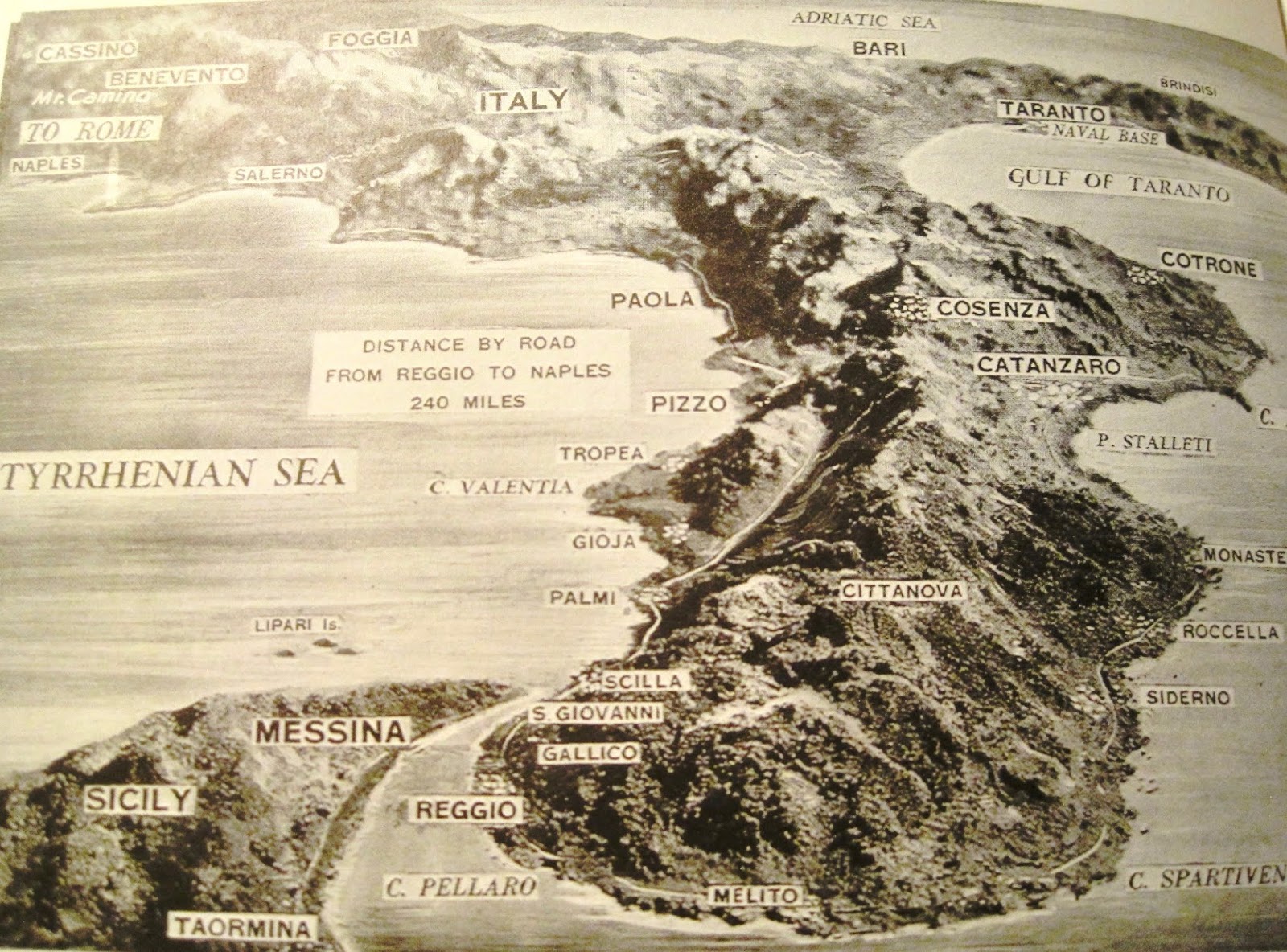
The city of Reggio was the first and perhaps most significant of the Allied landing areas in Italy (beginning on Sept. 3, 1943), and the landing strip is known to have widened as far as Melito on the right (above) and Scilla on the left. One or two weeks before a devastating barrage was aimed at Italy, to soften what turned out to be an easy landing, Moorehead gazed across the Messina Strait. 

Stand and Look

     There was no boat on the Straits, nothing between us
     and the unknown enemy country, a great high stretch of coastline
     that grew up quietly out of the water. It was so close you could
     discern the roads and the occasional houses among the olive groves.
     It needed no great imagination to find German trucks
     passing along the roads and guns pointing from the rocks.
     This was the country toward which the Eighth Army
     had been fighting for three years, and so this first vision
     of the shore came as a naturally dramatic moment.
     All of us had many times lost hope, or at least
     the immediate sense of hope; and now that we had
     arrived in sight of Italy it was an unaffected joy
     merely to stand and look and look.

Four arrows point from Sicily to the four major landing zones in Italy.
Invasion from Messina's coastal region to 'The Toe' was first, Sept. 3

Moorehead continues:

     I imagine this moment had the same effect upon all of us.
     As we looked, the feeling of urgency which carries everyone
     through a campaign began to drain away.
     There it was: Italy.
     No need to do anything more now.
     Not at any rate for the time being.
     No more fighting. No need to move.
     The invasion was still to come, but that was a long way off;
     perhaps next week, perhaps next month.
     It did not matter much exactly when.
     There would be an infinity of days here in the sun, drinking wine,
     swimming from the beach, meeting the women.

     Far back along the road the army was slowly winding
     forward to fill in this gap between them and the enemy.
     They would filter through the villages and
     along the coast until they reached the tip of Sicily.
     Then they would sit down and gather strength.
     It would be a time of holiday for everyone, a time to forget
     the fighting on the Primasole Bridge and across the Catania Plain.
     They were tired, and now just for a little time they would be 
     suspended between this campaign and the next, between
     what they had done and the indefinite future.

     The five of us who had come to Taormina were well used
     to the ways of seizing a holiday at a moment like this.
     One man went off to find a villa.
     Another took a truck for wine. 
     A third engaged Italian servants.
     We gathered fruit and vegetables,
     eggs and fresh fish from the beach.
     For the rest there were our cases of army rations,
     cigarettes, soap and chocolate; all the things
     that had grown as precious as life in Europe.

     Passages from Page 14, Eclipse 

.   .   .   .   .

Find a villa. Find a beach. Find some swim trunks. Relax.

Navy boys and war correspondents knew how to unwind.

A14313. Heading - THE ROYAL NAVY DURING THE SECOND WORLD WAR.
Caption - Naval ratings off duty enjoying a bathe on the North African coast at
Oran or Mers-El-Kebir. RN Official photographer Lt. C. H. Parnall, IWM.

A14314. Heading - JACK TAR IN HIS ELEMENT. 25 AND 26 JAN. 1943,
ORAN AND MERS-EL-KEBIR. Naval ratings off duty enjoying a bathe
on the North African coast. Photo - Lt. C.H. Parnall, IWM.

Canadian war correspondent Matt Halton (featured below; cheeky fella!) and my father likely swam in the same water and walked - bare-bummed - on the same beaches in North Africa, though perhaps a year apart as far as their written accounts go. And they may have crossed from Messina, Sicily to Reggio de Calabria, Italy during the same week in September, 1943, and possibly in the same flotilla of landing craft. Mr. Halton appears in the photo below, as found in his book (link provided).

Please link to Dispatches From The Front by M. Halton, far left.

For more 'passages from significant texts', please link to Passages: "ECLIPSE" by Alan Moorehead (1).

Unattributed Photos GH 

Monday, May 11, 2020

Passages: "ECLIPSE" by Alan Moorehead (1).

The Beginning of Something Quite Unexplored and Different

The jacket on Eclipse is a reproduction of a painting by
Barnett Freedman. Trusteeship - Imperial War Museum

[Please link to more information about B. Freedman at Wikipedia. The painting is called The Landing in Normandy; Arromanches, D-day plus 20, 26th June 1944 (Art.IWM ART LD5816)]

Introduction:

Alan Moorehead was a war correspondent connected to the British press and his articles often found their way into Canadian newspapers. I have collected hundreds of articles from The Winnipeg Tribune, The Montreal Star and The Ottawa Citizen and though Moorehead's efforts only appear on occasion, the quality of his work is evident.

His book Eclipse was published in 1945 and the edition in my possession (located at a local used-book store for $20, hardcover) was published in 1967. It is a book in four parts and details the collapse (eclipse) of German domination in Italy, France, the Rhine and the centre of Germany.

Thousands of Canadians in our nation's army were dutifully and heavily involved in the separate invasions of Sicily (beginning on July 10, 1943) and Italy (beginning two months later), and hundreds of members of the Canadian permanent and volunteer navies helped get them to those shores in the Mediterranean and supply them with all of the necessary materials of war, delivered to contested and uncontested beaches in LCAs and LCMs (Landing Craft, Assault, and Mechanised).

"Sicily was hot. Italy was easy," said my father in memoirs.

Because I am currently presenting news, memoirs, photographs, and more, on this site related to the invasion of Italy (chiefly Operation Baytown, beginning September 3, 1943), I will share selected excerpts or passages from Moorehead's book related to that time.

The Sicilian Campaign Was Over

     In the summer, towards the middle of August,
     the three of us began walking up the road to Taormina...
     Even at the time I believe we were conscious that
     this was the end of one set of experiences, and the
     beginning of something quite unexplored and different.

     The army, as I remember, had stopped a little short
     of the village of Giardini, on the eastern coast of Sicily,
     just above Catania.

Taormina is seen, lower left, near the tip of Sicily.
Credit - The Ottawa Citizen, Sept. 3, 1943

Credit - The Ottawa Citizen, Sept. 3, 1943

Moorehead continues:

     ...the vehicles could not get through,
     and the soldiers lay about in the shade
     accepting grapes from the peasants
     and awaiting the order to go on again.

     It was hot.

     There was a clear leaping brilliance in the sea,
     and at midday everything had turned into strident colour,
     red rocks, green vineyards, a blaring cobalt blue in the sky
     and then all the bright colours of the tumbledown houses
     along the shore.

     A gunboat, keeping close to the beach,
     ran on ahead of the front line, and was aimlessly
     turning circles in the bay below Taormina.

     The Sicilian campaign was over, or almost over.
     Catania had fallen. In the north the Americans were advancing
     upon the Straits of Messina, and from Messina itself the enemy
     were streaming across the narrow waterway back into the toe of Italy.
     Only the rearguard was left behind.

     Of all the lovely towns of Sicily
     only Taormina remained untaken - the loveliest of all.
     As we stood with the forward platoon and argued
     we could see the great hotels on the heights above.
     They stood a sheer thousand feet above the sea
     upon an immense red cliff; the hotels where the tourists
     used to go before the war, a place that looked like
     a holiday poster, "drenched in sunshine and remote."
     This was the last important point we had to take in Sicily, and
     the taking of the town would be the last gesture of the campaign
     before we set out upon the invasion of Europe.

     Excerpts from Pages 11

By mid-August, the Canadians in RCNVR and Combined Operations who had manned Landing Crafts, Mechanised (LCMs) at George and How Beaches between Syracuse and Noto (SE Sicily) from July 10 - August 6 (approx.), were in Malta enjoying rest and recuperation, followed by about two weeks of hard, hectic work repairing LCMs for the invasion of Italy.

About 250 Canadians would return to NE Sicily once their landing crafts were in good shape and get into position in several coves, harbours and bays in order to take on loads of troops and supplies for the first of a few significant landings in Italy. The first landing was Operation Baytown, beginning September 3, 1943, and the heart of their landing zone was Reggio, on the toe of the boot.
.   .   .   .   .


Before the commencement of Operation Baytown, Allied forces still had ground to cover in Sicily to secure Messina and miles of coastline south of that capital city. Allied troops, under the charge of U.S. General George Patton and U.K. General Bernard Montgomery, and the war correspondents that followed them, continued their march northward.

The Advancing Army and the Retreating Enemy

     The village of Giardini must be a mile long.
     A main road and a line of houses on either side.
     Then the sea and the mined beach.
     Here and there a house was burning.
     The villagers had fled into the hills, and those who had
     stayed behind looked at us incredulously and with that sort of fear you
     see sometimes in animals - the fear that prevents them from running away.
     Only the very old or the very crazy were left behind.
     They were half-mad from hunger.
     They waved, but when we stopped it was
     a long time before they would answer coherently.

     "Yes, yes. The Germans have gone."
     "The soldiers have gone. There are no soldiers in the village."
     And then: "Pane. Biscotti. Caramelle." Bread. Biscuits. Sweets.

     All the way through Sicily the peasants had been crying for food,
     and the cry had been reduced to this three-word formula
     and had been repeated so often that now it began to take on
     the meaningless persistence of the Fascist slogans on the walls.
     Mussolini ha sempre ragione. Mussolini is always right.
     Do not question - Obey. Fascist Italy goes forward to a greater tomorrow.
     Credere - Obbedire - Combattere. Believe. Obey. Fight.

Photo Credit - Life Magazine

Photo Credit - Imgur image

     The letters were a foot thick and two feet high on the crumbling villa walls,
     a persistent stream of sounding phrases that lost all meaning and after a while
     even ceased to be ridiculous. They jarred the eyes in  this peaceful landscape,
     just as one is jarred by a persistent tiny noise in a quiet room.

     A little group of Italian soldiers in dirty green uniforms were
     standing on the beach waving a white flag at the British gunboat.
     When they saw us on the road they ran forward calling: "We surrender."
     There was something essentially childish in their dark and troubled faces.
     Much later, after the war perhaps, they would posture again and make
     a show in the village street. But not now. All that was gone entirely.
     They were tired and hurt and frightened, and
     it was embarrassing to feel their deflation.
     Wanting to please, they said eagerly,
     "Two British officers have already gone down the road."
     They added: "No. There are no Germans.
     The last of them left this morning."
     
Taormina and Giardini Naxos, Sicily, are 
1 - 1.5 inches above the 'r' in Giardini : )

Moorehead continues:

     There was the usual hush over this gap
     between the advancing army and the retreating enemy.
     Everything goes to earth. The road is clear and it is
     a little adventure to turn each corner. You smell the enemy.
     Here and there, for no explained reason, a house burns quietly
     and there is no one to quench it;
     it burns in a vacuum with not anyone to watch.
     The discarded helmets and webbing of the enemy lie about.

     You never take your eyes off the road.
     Twice we saw the usual pattern of square holes in the macadam,
     and picked our way past the teller mines lying just below the surface.
     We kept to the middle of the road and walked on
     into the centre of Giardini.
     The gunboat came steaming back along the beach
     and disappeared around the bend.
     At the railway station there was a great deal of disorder.
     The bombing had carried black debris across the road
     and a stationary train full of some chemical
     threw out a strange sickly smell.
     There were craters in the highway,
     and these appeared to have been mined
     with a smaller type of mine, which is quite concealed
     and is designed to kill single men on foot.

     Excerpts from Pages 11 - 13
.   .   .   .   .

Members of the RCNVR who manned landing crafts for several weeks during the invasion of Sicily often had to find their own accommodation and scrounge for food. For a couple of weeks or more my father and dozens of mates lived inside a limestone cave near Avola, well south of Taormina and Giardini. However, the beaches near the cave (known to the sailors as "The Savoy") were littered with perhaps another version of "a smaller type of mine."

My father writes:

We used a pail of sand saturated with gasoline to heat our meals on if any food was available. Later we moved into a limestone cave, dank and wet, but safe from bombs. We hung a barrage balloon over it, about 1,000 feet up, and... we had 50 - 60 feet of limestone over our heads.

I had 27 days at Sicily living on tomatoes and Bully Beef. I swore I would kick the first bull I saw in Canada right in the posterior if I got back.


Everywhere I looked there were anti-personnel hand-sized grenades that needed only to be touched to go off. They were built to maim and not kill because it takes men to look after the wounded, but if you’re dead, you’re dead.

We threw tomatoes at a lot and exploded them in that manner.

"Dad, Well Done", page 34

To read other significant, poignant passages, please link to Passages: They Left the Back Door Open (2).

Unattributed Photos GH

Thursday, May 7, 2020

Context: Operation Baytown (3) Ottawa Citizen (Sept. 4-6, 1943).

The Tide is Turning. Allies Step Into Italy Easily

Caution. The first step was easy, that is, the landing at Reggio.
Moving northward toward Naples and Rome will not be easy

Introduction:

On September 4th, 1943, a reader of any major newspaper in North America would find details about various war fronts that were 1000s of miles apart.

German troops were "falling back under heavy Russian blows"; two million pounds "of bombs (were) hurled on Berlin"; Italian troops were surrendering in large numbers after "the Allied landings in Calabria"; and, if one was to dig deep enough, news from the South Pacific would be discovered as well.

Amongst all the news articles and photographs, one with an interest in what Canadians in Combined Ops were doing in 1943 would find some informative details here and there.

For example, before the day of invasion (D-Day was early morning, Sept. 3) we read that "in virtually every cove, landing craft were drawn up on the sand awaiting their cargoes of men and weapons of war." And in those landing craft would be found sailors born and raised in towns and cities across Canada.

Photo from an online site - RAF Beach Units, W.S. Sinclair

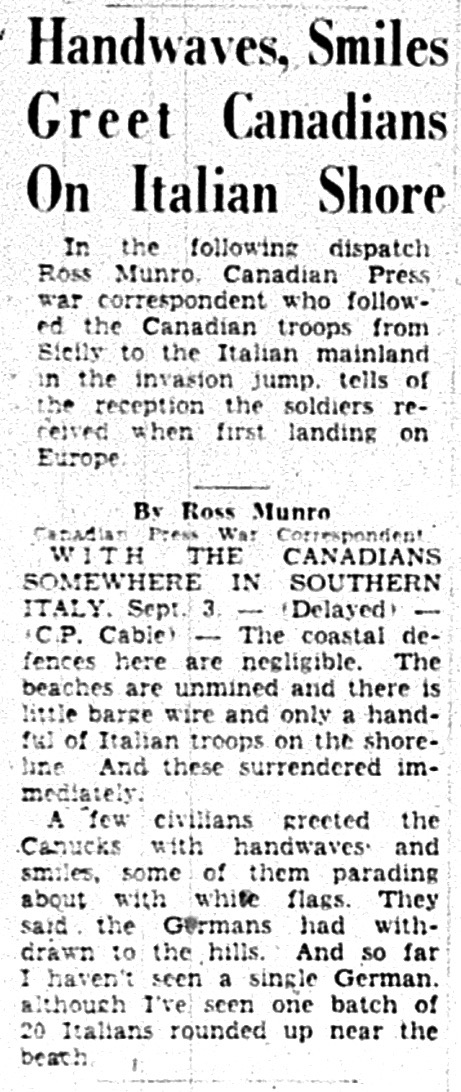
As well, two or three days after the invasion at Reggio (on the toe of Italy's boot, on the very early morning of September 3rd) we discover that "Canadian sailors, including some from Ottawa... are getting a bit bored running a shuttle service between Sicily and Italy."

Bored already? Based on my research, the young men of the RCNVR who manned landing crafts (as volunteer members of the Combined Operations organization) still had about 4 week's worth of work ahead of them before the beachheads were firmly established and properly supplied.

Fortunately, the initial landings in Italy were quite peaceful and boredom was vanquished in several ways once an 'on and off' work schedule was organized.

One paragraph from my father's notes reveals that the sailors did enjoy some freedom to travel once their work for the day was completed:

     We operated our landing craft under these conditions (i.e., "from day one we had no problems; it was easy come, easy go from Sicily to Italy.") with skeleton crews and we enjoyed time off. Some of us went to Italy, hitched rides on army trucks, went as far as we were allowed to go and had a good look at some of Italy. We lived on the edge, because not far from the shoulder of the asphalt road were high cliffs and we could look down on the Adriatic Sea, its beautiful beaches and menacing rocks.

"Dad, Well Done", page 116

More details about their work and recreation will be presented as more entries are made from The Evening (Ottawa) Citizen.

The following news clips will, for the most part, provide a variety of details from the Mediterranean theatre of war, in which about 200 Canadians in Combined Ops participated for one month or more:


And now, something completely different:


I know. A story about poultry seems to have little or no place in the serious actions related to WW2. I agree. But what about a place in non-serious actions in Sicily?

My father writes:

     One day at Messina, the late LT Andy Wedd asked me if, with my rural background, I knew about poultry. I informed him that the subject was right down my alley. He then told me of the location of six or eight beautiful hens and asked if I would help him divest the owner of the same.

     When he asked how we could keep the hens quiet, I told him, “With an axe!” Or, we could firmly grasp their necks and tuck their heads under their wing and rock them for awhile. We chose the latter because it actually works. By now, of course, our mouths are watering.

     We went in at dark, like another raid, and entered the outside pen with a flashlight, a kit bag and mitts on. Andy slowly cinched each one by the neck, handed them to the master who rocked them to sleep and lowered them quietly into the kit bag. His idea of a beautiful hen sure didn’t match mine! Anyway without a squawk we cleaned the roost and proceeded to the officers’ mess, kit bag between us.

     In the morning, the Sicilian cook came in with one hell of a snit. Somebody had stolen his mama mia’s chickens. Andy said he was the first Sicilian he had met that was ready to fight and never let it out of the bag about our midnight raid and feast.


“Tuck their heads under their wing and rock them for awhile...”
Doug Harrison in later years. He loved his chickens! GH

"Dad, Well Done", page 71


The Canadian flotilla of landing crafts (LCMs) was instrumental in helping Allied forces establish "a series of sub-joined bridgeheads":


War correspondent Ross Munro (mentioned above) was one of a few Canadians who witnessed the initial landings at Reggio. (Munro accompanied troops aboard our landing crafts and more about that will appear later. His stories are of no small significance to this day).   

Another correspondent I grew very interested in was Sholto Watt of The Montreal Star. He contributed a large number of stories while in The Med and readers can find several by visiting Editor's Research in the A - Z Directory (see 'Click on Headings' in right hand margin). 

This article appears previous entries because Mr. Watt was an eye witness to the 100s of landing crafts abuzz in the waters of the Messina Strait:


The people of Sicily - some very weary of war, I am sure - were witness to a vast barrage before the invasion of Italy took place. Also of note, this is the first time I have read the phrase "stand up invasion." It likely means that because there was little opposition and the beaches were flat (they were "dream beaches" said one Canadian navy officer), troops were able to walk - not run - off the landing crafts without being decimated by German resistance. 


Though the landings were peaceful on the toe of the boot, once the Allied troops moved inland they soon encountered stiff resistance and delaying actions (mine fields). Allied troops did not reach the centre of Rome until June, 1944:


Many informative articles are found in the next issue of The Ottawa Citizen as well:


Readers are quickly reminded that the war front is very wide!


Russian forces are pushing forward and also meeting stubborn resistance in the form of German minefields and more:


Along the "Toe" the Allied landings are swift and successful. Yes, but don't get your hopes up! (The Salerno landings on Sept. 9 were a different matter entirely. Details will follow):


Please note that this lengthy article, by Edward Kennedy, Associated Press (AP), includes information from Paul Kern Lee (AP), above, and now from three other war correspondents, one from the U.S. and two Canadians you may have already heard about in this post. On a few occasions I have come across articles like this and have learned that war correspondents invested time and energy into team work, by sharing resources and reports.

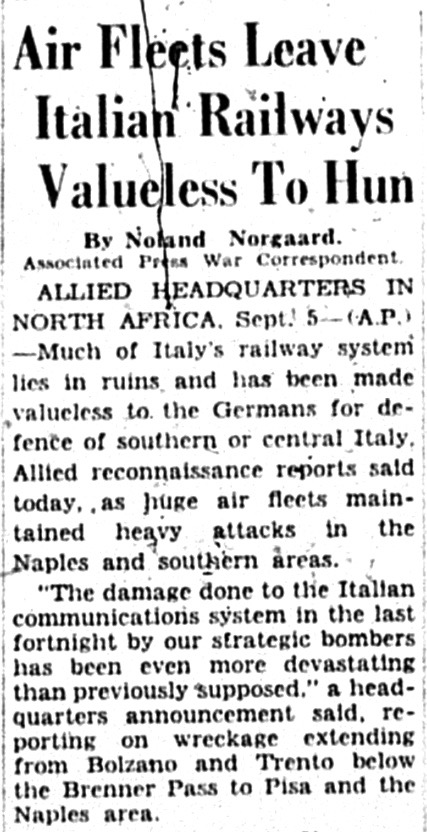
Readers will undoubtedly notice the "less than stellar quality" of my reproduction of the news articles from The Citizen. Only a small amount of wartime news has been digitized (producing excellent clarity or resolution) and the quality of microfilm and microfilm readers varies from 'quite good' to 'not so good'. Though I could type the articles myself, I find it easier and faster to share the news 'as is'. (If I had to type everything, we would still be back in 1939).

Hopefully, readers can survive with 'good enough' until digitization catches up to the millions of newsreels, films, newspapers, etc., produced in the 1940s.

Edward Kennedy continues:


Speaking about team work in the media: We learn about progress made by Canadian forces working with the British 8th Army in a Canadian newspaper running a C.P. article out of the U.S. from the British Broadcasting Company by way of the C.B.S. Team work!


A significant article follows by Canadian Ross Munro:


Please note the important connections between particular Canadian forces in the last paragraph above. So much of the success of operations - even the possibility of success of operations - depended on getting feet on the ground, via landing crafts, and then supplying those feet on the ground with continuous mountains of supplies via landing crafts and a vast transportation and communication network. I have said before, there were no small roles during World War 2.


No reporter's name is given with this short piece. But someone decided, just for a moment, to shine a spotlight on one million of the Sicilians (among other millions) who were sensing and tasting freedom after year's of subjugation by Fascist Italy and Nazi Germany. I wish I'd been in the Strait of Messina with the Canadian flotilla of landing crafts during Operation Baytown:


The following article was included in the memoirs of Canadian sailor Lloyd Evans, who I was fortunate enough to meet in Markham, Ontario, before he passed away. We traded stories and written memoirs (his own for my father's book). It serves as a centrepiece for a short series I am doing on this site, now only partly finished. 

Please link to "Canadian Flotilla of Landing Crafts in Italy (2)" for more details.


The Ottawa Citizen was chock full of good news for and about Canadians in Combined Operations on September 6, 1943, even though they were far from finished their work shift (which extended into October):


Another excellent article by Ross Munro, one that could surely act as a centrepiece - in the near future? - for a short series of posts re Canadians in Combined Ops! 


Any time I see a name linked to London, Ontario (my place of residence) I feel I need to start looking through the phonebook to see if family members of the veteran still survive. We shall see what we shall see.

More news from The Ottawa Citizen to follow.


Unattributed Photos GH