Showing posts sorted by relevance for query Lord High Admiral. Sort by date Show all posts

Wednesday, February 24, 2016

Article: "Stout Heart Required in War-Time England"

Stout Heart Required in War-Time England

By Doug Harrison, RCNVR and Combined Operations, 1941 - 1945
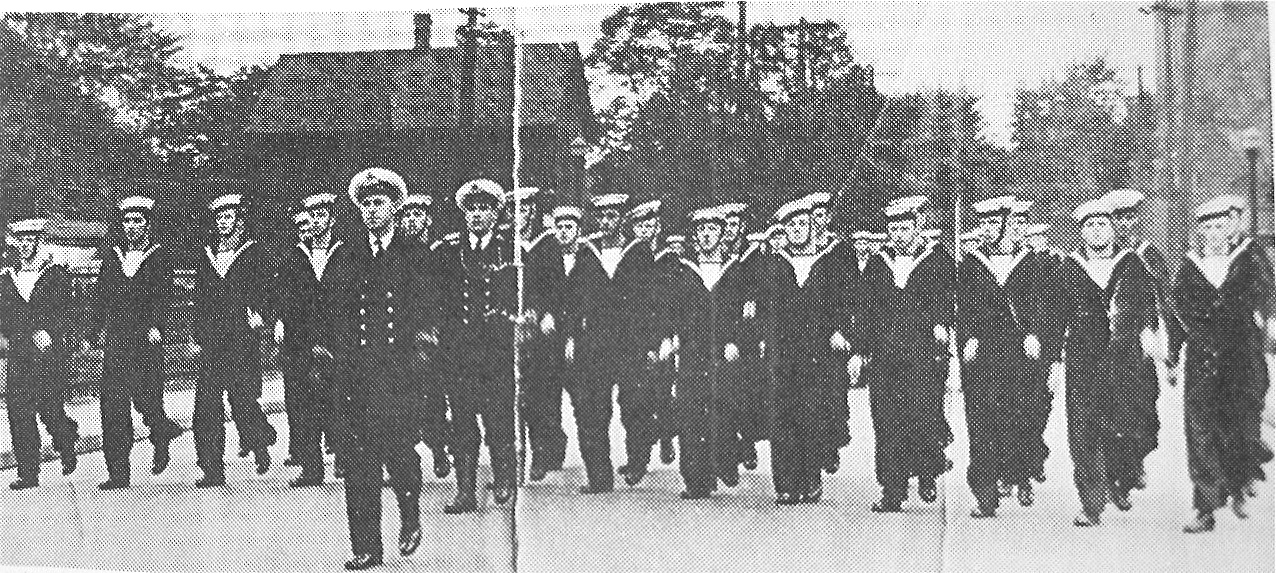
Raw recruits in Hamilton, 1941 (above), are seasoned veterans in England, 1942

[This article was first published in the Norwich Gazette, circa 1992]

During the couple of years I was in Britain during the Second World War, I enjoyed more than my fair share of leave. When I wasn’t in training on landing craft or on an invasion, I was usually in London or Glasgow. Most often I was in London where I had relatives.

While training in England and being granted leave I stated on my ‘leave chit sheet’ that my destination was Glasgow. This earned me two extra days for travel. Then I just hopped into London where I always stayed at the Westminster YMCA for a couple of shillings a night. It was across the road from the Abbey, and I could hear Big Ben sounding the hours. When training in Scotland I did the reverse and put my destination as London, and claimed two days leave. (No vices, no virtues.) Had I been caught in this swindle I probably would still be singing the Prisoner’s Song, staring through the bars of some dark navy dungeon with my fingers bleeding from picking oakum.


"Poor Private Ewing. Singing the Prisoner's Song and picking oakum"
Inside the Military Prison, Edinburgh Castle, 2014

There was method in navy madness. While on leave the navy did not have to feed me. I paid for my own meals and I could inflict my own form of punishment on London or Glasgow.

My friends whispered in my waiting ear about a pub up the way from the Y, and that I should visit it the next time in London. “This is not your average hole-in-the-wall pub,” they told me. I liked travelling in London alone and unhindered and at night. It is true I’m sure, that a person could live in London all his life and not see it all.

The next time I was in London I prepared myself for the Lord High Admiral pub. The clocks, during war-time in England, were set ahead at least two hours so I had plenty of time to walk the long mile up Whitehall to Trafalgar Square where my boyhood hero, Lord Nelson, stood on the tall column, guarded by his faithful lions, and where people milled about feeding large flocks of pigeons. Nearby was St. Martins in the Fields, and Canada House, where I could call to see if there was any mail from home. A fleet mail office was set up there for the Canadian sailors and it was staffed by Canadian girls - a reminder of ‘home sweet home.’ Close by also was the Beaver Club, an all-Canadian service club and oasis, where substantial meals were served at all hours by volunteer ladies. There was a staircase on either side of the entrance to the Beaver Club which led to a large landing. Many times I leaned on the bannister watching the entrance for Norwich boys and did visit with several.

A news clip from the Norwich Gazette, April 30, 1942

Upon completing a meal at the club I walked back to the Y, tidied up, and then started up the way toward the Lord High Admiral. It wasn’t dark yet, but I have vivid memories of Old London at night; amber street lights, seemingly long distances apart, tripping on the curbs up to the sidewalks, hundreds of people walking silently and little chatter, gaiety or laughter. One fear, I suppose, was that we might awaken an enemy airplane. War was serious business for each and every one of us. There were weak, grotesque shadows cast upon the nearby walls whenever we passed a street light. Then it was completely dark again. Who could forget it? What those stout-hearted people endured night after night, clinging to the hope of better days and that the lights would come on again.

The taxis were not so quiet with their dim headlights reaching into the dark, and they seemed to go a mile-a-minute. The daring drivers knew the roads like the back of their hands. It was to risk your life to cross the street. Taxis owned the roads at night, speeding past buses, horns honking, careening around corners with screeching tires as if there was no tomorrow. They never stopped; the buses, however, gave up about midnight.

‘It’s a Long Way to Tipperary’ according to the old song, and it was even further to The Lord High Admiral. At long last, just after dusk, I reached the blackout curtains and stepped into the lighted bar. My friends were right. This was not a hole-in-the-wall pub. This was a big place with a piano covered with beer mugs, a built-in player sitting on his piano stool under a blanket of smoke which reached down to sting his eyes. The first song that greeted me from the group of young service men and women at the piano was ‘Happy Days are Here Again.’ The lyrics, in part, went like this:

     Happy days are here again, blue skies above are clear again,
     Let’s sing a song of cheer again. Happy days are here again.
     All together shout it out, there’s no one who can doubt it now,
     So let’s tell the world about it now. Happy days are here again.

Songs such as this were good therapy during the Second World war. We could use some like it now during these hard times.

*   *   *   *   *

The above article begins, in part, with the lines, 'When I wasn’t in training on landing craft or on an invasion, I was usually in London or Glasgow. Most often I was in London where I had relatives.' I include this second article here, also written by my father, Doug Harrison (for his local paper, the Norwich Gazette, circa 1992), because it pertains to a Christmas dinner enjoyed with relatives in London, 1942.

Canadians in Combined Ops were involved in the invasion of North
Africa six weeks before sitting down to Christmas puddings, 1942

Christmas Pudding Came from Canada

[Norwich Gazette editor’s note: The Gazette has had on file several articles written by Doug Harrison before his death. So many people enjoyed his work, that we will be publishing the remaining articles.]

Dear Editor: I don’t know how to start this article but I must try. I am in the U.K. and moving from the Norwich, England area to London, England near Christmas Day, 1942. I was on leave and staying with my aunt (mother’s side) and uncle. I introduce them as Aunt Nellie and Uncle Wally.

A couple of friends came and five sat down to a great Christmas dinner complete with the English tradition of burning the pudding. The blinds were all drawn and the burning pudding made a nice sight. This was a first for me and I was a wee bit afraid at the opening explosion of rum.

The dinner ends, the dishes are put away, the friends depart and the three of us make ready to walk to South Kensington rail yard where work goes on, Christmas day and all. Remember there is a war and England is expecting an invasion. Uncle Wally works at the rail yard. But first we make a short pit stop at the South Kensington pub for a pint or two of ale, a few cracks at the dart board and off to work. It was quite a walk so Aunt Nellie and I took a bar stool and asked the Governor (owner) for a couple of pints. She gave Uncle Wally a peck on the cheek and he was off into the night through the black out doors. Aunt Nellie and I got to the singing stage, pushed our way through the canvas blackout doors and headed for home.

"In 2014, I was unable to locate the South Kensington rail yard or pub" (GH)

It was very dark, not a light to be seen except the amber coloured pole lamps. In the shadow of tall buildings it was darker still. We were almost unaware where we were going at times. Aunt Nellie and I walked arm in arm and without any notice she started singing a First World War song. My mother had taught me many WWI songs and soon we were singing song after song. Our mood was good and as we closed in on home, in a quiet moment I thought, we belong to London and London belongs to us. All is so quiet.

At the apartment we were met by the bomber alarm, a little wire-haired terrier. Dogs usually gave the alarm two or three minutes in advance of incoming planes. It was a busy day and I was soon sawing logs at 107 Emlyn Gardens, Shepherds Bush, Hammersmith, London, England.

Aunt Nellie lived to be 94 and I visited her twice. She was always thankful that my mother sent the ingredients (except for the rum for the burning) for the Christmas pudding in ’42. 


"In 2014, I did locate Emlyn Gardens. And I did chat with the occupant of 107"

Thursday, October 6, 2016

Presentation: Dad's Navy Days Part 7

Dad's Navy Days, 1941 - 1945

By G. A. Harrison

“This could be the beginning of a beautiful friendship”

Introduction: The following post will be part of a Nov. 2016 presentation regarding my father's WW2 service with the RCNVR and Combined Operations organization.

Part 7 - On Leave: Gracie Purvis, Christmas Pudding and Lively Pubs

Most of my father's stories about going on leave appeared in the 1990s as articles in the Norwich Gazette, his hometown newspaper. One unique story, however, can be found in the book St. Nazaire to Singapore, Volume 1, and tells of his unique relationship with Gracie Purvis of Croydon, a "lovely brunette" and WAAF Corporal, that formed in 1942, initially after the Dieppe Raid, and continued after the invasion of North Africa. 

It follows in its entirety, with an introduction by David Lewis, the RCNVR officer and member of Combined Operations who compiled and contributed to the afore mentioned volume: 

This beautiful story is about two people in those magical times and it expresses so wonderfully the feelings and experiences of thousands back then; the boundaries of conduct not everyone observed.

THE SILENT PACT AND ITS EPILOGUE 

My Navy buddy, Frank Herring, and I engaged in a Silent Pact overseas. When we were not required on board for duty we conspired to be the first ashore to get the pick. No Liberty Boat inspection for us - case the joint and slip ashore quickly and hopefully unseen.

Ashore very early at Southend-On-Sea, we went straight through the black-out doors into the Top-Hat pub. Oh Boy! Two WAAF Corporals, a beautiful blonde and lovely brunette. With two or three Johnnie Walkers tucked under our belts for courage, we asked if we could sit down with them. The answer was in the affirmative. I sat by the blonde and Frank by the brunette. Things are great, going according to plan. Time passes and all too soon it’s “Time Gentlemen Please” by the governor.

It was suggested by the girls that we go to a penny arcade down the street where there were pin ball machines and even one-armed bandits. Away we go. No pain. I grasp the arm of the blonde and Frank the brunette. There is a big pile up at the black-out doors. People going out and some coming in, trying to get a last beer. We finally manage to get out into the darkened street and when we arrive inside the lighted penny arcade Frank has the blonde and I have the brunette. Such is life.

The remainder of this story doesn’t sound so consistent with the Silent Pact. I suppose it is a Silent Tribute to all the WAAFs, I don’t know, but it’s all true. Events were to prove, in my own mind at least, that I did not lose in the shuffle in the black-out doors of the Top-Hat Pub at Southend. 

My father meets a young lady, CWAC; date and location are unknown

I am reminded of those often repeated words by Humphrey Bogart to Audrey Hepburn in the movie African Queen, “This could be the beginning of a beautiful friendship” because that was what it turned out to be although it wasn’t to last too long.

The WAAF Cpl who worked in the kitchen or bakery of an Air Force barracks nearby was named Gracie Purvis. Her home was in Croydon and she established very early in our relationship that she was engaged to an English Army Lieutenant with Montgomery in North Africa. She was firm that she wished to remain faithful to him. I accepted this loyalty which gained my respect for Grace, and our friendship was free of all encumbrances and we became very good friends.

Each day or evening we were free of duty we met at the Top-Hat Pub and had a drink or two, a sandwich, a game or two at the Penny Arcade and sometimes we walked arm and arm around Southend wishing in our hearts that there wasn’t a war and things could be different. We spoke of Mums and family and the Army Lieutenant. Also we spoke of letters sent and received, about after the war, our dreams and aspirations.

The barracks I was at was HMS Westcliff, I believe, and I think the time was after Dieppe and prior to the North African invasion. Grace and I arranged that if either of us were no-shows for two nights, she had been posted or I was on my way somewhere else - and she alone promised to write. We had pleasant times because she was a pleasant person. I often think of her and her fine qualities. It wasn’t to last because I became a no-show. There were no good-byes or “I’ll see you again.” No more spearmint gum or cookies from the baking either.

Six weeks later we arrived back from North Africa to Liverpool on the Reina-del-Pacifico and in a few days the mail arrived from FMO and among my stack was a letter from Grace, now serving at the summer resort town of Blackpool. Could I get a weekend leave? If so, she said she’d arrange rooming quarters and give me a phone number to call at a precise time. That’s if things became favourable for me, which they did, and quite soon I was stepping onto the train platform at Blackpool with Grace waiting with open arms.

I had a 72 hour pass and stayed at a Seniors Boarding House with a lovely room. I sat down at meal times with Seniors dressed in formal bib and tucker to shepherd’s pie - and Brussel sprouts, of course.

Friday night and Saturday night we had a drink or two and enjoyed a dance and restaurant and renewed our friendship. Then I went back to the boarding house. Sunday (this would be late November, 1942) we went to see a large aquarium, sharks and all. The weather was foreboding, like the feeling in our hearts. On the surface we were enjoying ourselves but underneath I think we were both quite sad for we feared the end.

We walked with arms about each other’s waist out over the shallow beach water on Blackpool’s famous long pier. The cool wind blew our hair and we sat on a bench at the end of the pier. I shared my Burberry (raincoat) as we huddled there and I confess I felt more than a friend as we spoke again for what we both knew would be the last time, of our meeting at Southend, our homes and what we both hoped would be in our future. This loyal lady had still kept up correspondence with her Lieutenant. I had deep admiration in my heart for her as I felt her warmth and sadness under my coat.

We strolled back to the beach area where there was a type of midway still operating along the beach and we attempted to lift our mood by taking rides on ferris wheels, etc. Grace had a few small red burns on her face from flying burning fat and declined to have her photo taken.

I returned to the boarding house to pick up my attache case and all too soon I am again on the train platform, whereas 72 hours earlier we had had such a happy reunion. A mist swirled around us as we once more shared my Burberry. Through it all not a word was spoken of future letters or anything else. We were friends just hanging on through the tears.

I’m not prepared for the “All Aboard.” I never liked good-byes. I still wanted this moment over with. It was taking too long. “All Aboard.” We kissed good-bye. I climbed aboard and my guts were churning as I took a seat by the window. Grace stood so alone. This was not a happy moment. The train slowly moved out and Grace Purvis of Croydon turned and walked away. We were as two ships that had passed in the night.

I have been unable to locate Grace. I pray her Lieutenant came safely home and all her dreams were fulfilled. We filled a need in each others lives and I have no regrets. 

St. Nazaire to Singapore, Volume 1, Page 48 - 49

*****

About a happier time during the same season, my father writes the following, as found in the Norwich Gazette:

CHRISTMAS PUDDING CAME FROM CANADA

I don’t know how to start this article but I must try. I am in the U.K. and moving from the Norwich, England area to London, England near Christmas Day, 1942. I was on leave and staying with my aunt (mother’s side) and uncle. I introduce them as Aunt Nellie and Uncle Wally.

A couple of friends came and five sat down to a great Christmas dinner complete with the English tradition of burning the pudding. The blinds were all drawn and the burning pudding made a nice sight. This was a first for me and I was a wee bit afraid at the opening explosion of rum.

The dinner ends, the dishes are put away, the friends depart and the three of us make ready to walk to South Kensington rail yard where work goes on, Christmas day and all. Remember there is a war and England is expecting an invasion. Uncle Wally works at the rail yard. But first we make a short pit stop at the South Kensington pub for a pint or two of ale, a few cracks at the dart board and off to work. It was quite a walk so Aunt Nellie and I took a bar stool and asked the Governor (owner) for a couple of pints. She gave Uncle Wally a peck on the cheek and he was off into the night through the black out doors. Aunt Nellie and I got to the singing stage, pushed our way through the canvas blackout doors and headed for home.

It was very dark, not a light to be seen except the amber coloured pole lamps. In the shadow of tall buildings it was darker still. We were almost unaware where we were going at times. Aunt Nellie and I walked arm in arm and without any notice she started singing a First World War song. My mother had taught me many WWI songs and soon we were singing song after song. Our mood was good and as we closed in on home, in a quiet moment I thought, we belong to London and London belongs to us. All is so quiet.


I locate 107 Emlyn Gardens on a trip to London, England in 2014

At the apartment we were met by the bomber alarm, a little wire-haired terrier. Dogs usually gave the alarm two or three minutes in advance of incoming planes. It was a busy day and I was soon sawing logs at 107 Emlyn Gardens, Shepherds Bush, Hammersmith, London, England.

Aunt Nellie lived to be 94 and I visited her twice. She was always thankful that my mother sent the ingredients (except for the rum for the burning) for the Christmas pudding in ’42.

****

STOUT HEART REQUIRED IN WAR-TIME ENGLAND

During the couple of years I was in Britain during the Second World War, I enjoyed more than my fair share of leave. When I wasn’t in training on landing craft or on an invasion, I was usually in London or Glasgow. Most often I was in London where I had relatives.

While training in England and being granted leave I stated on my ‘leave chit sheet’ that my destination was Glasgow. This earned me two extra days for travel. Then I just hopped into London where I always stayed at the Westminster YMCA for a couple of shillings a night. It was across the road from the Abbey, and I could hear Big Ben sounding the hours. When training in Scotland I did the reverse and put my destination as London, and claimed two days leave. (No vices, no virtues.) Had I been caught in this swindle I probably would still be singing the Prisoner’s Song, staring through the bars of some dark navy dungeon with my fingers bleeding from picking oakum.

There was method in navy madness. While on leave the navy did not have to feed me. I paid for my own meals and I could inflict my own form of punishment on London or Glasgow.

My friends whispered in my waiting ear about a pub up the way from the Y, and that I should visit it the next time in London. “This is not your average hole-in-the-wall pub,” they told me. I liked travelling in London alone and unhindered and at night. It is true I’m sure, that a person could live in London all his life and not see it all.

The next time I was in London I prepared myself for the Lord High Admiral pub. The clocks, during war-time in England, were set ahead at least two hours so I had plenty of time to walk the long mile up Whitehall to Trafalgar Square where my boyhood hero, Lord Nelson, stood on the tall column, guarded by his faithful lions, and where people milled about feeding large flocks of pigeons. Nearby was St. Martins in the Fields, and Canada House, where I could call to see if there was any mail from home. A fleet mail office was set up there for the Canadian sailors and it was staffed by Canadian girls - a reminder of ‘home sweet home.’ Close by also was the Beaver Club, an all-Canadian service club and oasis, where substantial meals were served at all hours by volunteer ladies. There was a staircase on either side of the entrance to the Beaver Club which led to a large landing. Many times I leaned on the bannister watching the entrance for Norwich boys and did visit with several.

The Lord High Admiral Pub. Photo - Pub History

Upon completing a meal at the club I walked back to the Y, tidied up, and then started up the way toward the Lord High Admiral. It wasn’t dark yet, but I have vivid memories of Old London at night; amber street lights, seemingly long distances apart, tripping on the curbs up to the sidewalks, hundreds of people walking silently and little chatter, gaiety or laughter. One fear, I suppose, was that we might awaken an enemy airplane. War was serious business for each and every one of us. There were weak, grotesque shadows cast upon the nearby walls whenever we passed a street light. Then it was completely dark again. Who could forget it? What those stout-hearted people endured night after night, clinging to the hope of better days and that the lights would come on again.

The taxis were not so quiet with their dim headlights reaching into the dark, and they seemed to go a mile-a-minute. The daring drivers knew the roads like the backs of their hands. It was to risk your life to cross the street. Taxis owned the roads at night, speeding past buses, horns honking, careening around corners with screeching tires as if there was no tomorrow. They never stopped; the buses, however, gave up about midnight.

‘It’s a Long Way to Tipperary’ according to the old song, and it was even further to The Lord High Admiral. At long last, just after dusk, I reached the blackout curtains and stepped into the lighted bar. My friends were right. This was not a hole-in-the-wall pub. This was a big place with a piano covered with beer mugs, a built-in player sitting on his piano stool under a blanket of smoke which reached down to sting his eyes. The first song that greeted me from the group of young service men and women at the piano was ‘Happy Days are Here Again.’ The lyrics, in part, went like this:

     Happy days are here again, blue skies above are clear again,
     Let’s sing a song of cheer again. Happy days are here again.
     All together shout it out, there’s no one who can doubt it now,
     So let’s tell the world about it now. Happy days are here again.


Songs such as this were good therapy during the Second World War. We could use some like it now during these hard times.


Unattributed Photos GH

Friday, October 23, 2026

Editor's Research: Three Months in the Mediterranean, 1943 (32)

Montreal Gazette News Clippings Provide Context for "How

Goes the War" and "Where's Your Dad At in Malta?"

The (Montreal) Gazette, August 11, 1943. The series starts here.

Introduction:

This series of entries related to news clippings from The Gazette, providing some context for the three months that Canadians in Combined Operations served with Allied forces in Sicily (beginning July 10, 1943) and Italy (beginning September 3, ending in early October at the 'toe of the boot') will one day - not soon apparently!* - include 60-plus offerings, ending with the members of the 80th Canadian Flotilla of Landing Crafts (LCMs) returning to England for a well-earned leave. And since my father's memoirs touch on numerous instances of fun and frolic (and provide the names of several pubs in London where some of the fun and frolic took place, e.g., The Lord High Admiral) I will share a few stories in the "On Leave" section of the 'Directory A - Z' found in the right-hand margin.

*not soon - I have a few more issues of The Gazette on a handy USB-stick and will, hopefully, after sharing those issues return to my habit of visiting the dust-covered rolls of micro film still available to me at the University of Western Ontario, London, Canada

Unfortunately this lovely building no longer exists but there are still
a few other pubs that do... from the WWII era. Photo Credit

The clippings shared below are from August 11, 1943, at which time my father and mates in the 80th Flotilla - now all on the island of Malta - were recovering from dysentery at Hill 10 hospital (in my father's case), or resting in a 'tent city', relaxing on leave and/or repairing their landing craft, mechanised (LCMs) prior to going back into service for Operation Baytown, the invasion of Italy at 'the toe about three weeks away.

About Malta my father writes (in part):

After approximately 27 days
(of hard work in Sicily, with a poor water supply) I came down with severe chills and then got dysentery. I was shipped to Malta on the Ulster Monarch and an intern came around and handed me 26 pills. I inquired how many doses was that? “Just one,” he replied. 

At Malta I was let loose on my own to find Hill 10 Hospital. I did after a while and they asked me my trouble. I said, “Dysentery.” “Oh, we’ll soon cure that,” they said. How? “We won’t give you anything to eat.” So for four days all I got was water and pills and soon I was cured, though weak. I thought of those poor devils in the desert (i.e., his mates who got dysentery at HMS Saunders in Egypt prior to the invasion of Sicily).

Blue arrow points to Don Westbrook, Hamilton (RCNVR/Combined Ops)
in his 'borrowed shorts' after recovering from dysentery while at HMS
Saunders (June - July, 1943). Tents visible (barely) in background.
Photo - Collection of Doug Harrison (RCNVR/Combined Ops)

When I felt better they sent me to a tent where I got regular meals. I saw an air force newspaper and on the front was a picture of Bob Alexander of Norwich, a school chum. But Bob returned to the fray and was lost on one of his bombing missions. How sorry I was to hear that news. He had already done so much.

I suggest that some of the LCMs above might belong to the 80th and 
81st Canadian Flotillas. Some ALCs might be from the 55th and 61st
Canadian Flotillas, all active in Sicily beginning July 10, 1943 

Soon all the boys returned to Malta and we prepared for Italy, though all our barges (not entirely true, some Canadian sailors drove LCMs to Malta) stayed in Sicily. We took a Landing Ship Tank (LST) back to Mili Marina, Sicily, and if memory serves me correctly, attacked Italy at Reggio di Calabria across Messina Straits on my birthday, September 6*, 1943. 

*September 6. That is my father's birthdate but the invasion of Italy began 3 days earlier.

Original caption: "convoy, Sicily to Malta, J Spencer in boat 2nd in
foreground" Photo Credit - Joe Spencer (RCNVR/Combined Ops)
Used with permission. GH

Questions or comments about Combined Operations in the Mediterranean can be addressed to me @ gordh7700@gmail.com

News clippings from The Gazette now follow:

"British Forces Reach Within Six Miles of Randazzo" on their race
to get to the city of Messina before US troops. One week to go!!

Lionel Shapiro, 'War Correspondent of The Gazette' provides our first report of Allied progress for the day:


Will the Germans achieve their goal? Will the "sacrifice companies and road demolitions" allow Hitler's troops - "aided... by the mountainous country and scarcity of roads" - to escape the island in force and then drag out the Allied advance through Italy for another year or more? Read Lionel Shapiro's book ("They Left the Back Door Open") about what subsequently happened in Sicily. Oh! Did I give away the plot line? Drat!


Map of Sicily, 1943 as found at Wikipedia with added 'blue oval'


While some of the Canadian landing crafts are being repaired in the Grand Harbour, Malta, with members of the 80th Flotilla of LCMs  - including my father - preparing (unknowingly!) for the invasion of Italy in early September, some of the German landing craft in Messina are taking a beating from the RCAF and RAF. See below:


Click here for more 'About the Citadel, Quebec' Source


The hugely versatile and high-performance DH98 Mosquito was unquestion-
ably de Havilland’s greatest contribution to the success of the RAF in


More details from the Quebec capital:


Lionel Shapiro has his own byline! Excellent!


Lionel B. Shapiro, war correspondent, off the coast of Sicily
Photo Credit - CAFU, Canadian Army Film Unit, Album 61

Here's how to make YOUR meat ration last even longer!


Another of Canada's prolific war correspondents shares the following:


Canadian artillery is definitely leaving its mark in Sicily against German troops:


And what are you having for supper tonight? (I've got my menu planned!)

"Only thing we want is a spaghetti dinner and a bottle of beer." 
"A can will do." Photo - CAFU (Canadian Army Food Unit) GH


The only reason I added this clip is because my father worked at the Cotton company while training for the Navy at Hamilton Division 1, now known as HMCS Star. He writes in memoirs:

June 21, 1941, I went on probationary strength of HMCS Star in Hamilton, corner of McNab and McNutt streets, a building which was at one time a cider mill. By probationary I mean I went nights from 7 to 10 p.m. and took instructions on semaphore, rifle drill, marching, compass work, bends and hitches, knots and splices etc.

I lived with my late sister Gertrude Stopps on Bay St., Hamilton. During the day I was employed at James St. North Hamilton Cotton Mills where I progressed from one job to another very rapidly.
("Dad, Well Done" page 3)


When some of the Canadians in RCNVR and Combined Operations returned to Canada in December, 1943, they were assigned to Canada's Combined Operations training school at HMCS Givenchy III on Vancouver Island. William H. Pugsley (ex-RCNVR), author of Sailor Remember, includes several photos from that time, e.g., one of a sailor 'swinging the lead':

Sure looks like my father "heaving the lead"!! 
Sailor Remember page 95

Please click here to view more 'Arts of War' including hand drawn illustrations of landing crafts.


"Almost like a holiday... at times?" Raw recruits at a training camp on
Vancouver Is., B.C., Canada.  Diving tower in background. Photo
Credit - Roy Burt, RCNVR, Combined Ops (back, center)


More news clippings from the Montreal Gazette to follow related to providing some context re Canadians in Combined Operations in Malta - after approx. 30 days service in Sicily.


Upcoming: More stories and photographs from Sicily (above) and
Malta and Italy (Operation Baytown, beginning Sept. 3, 1943

Please click here to view Editor's Research: Three Months in the Mediterranean, 1943 (31)

Unattributed Photos GH