Monday, November 20, 2017

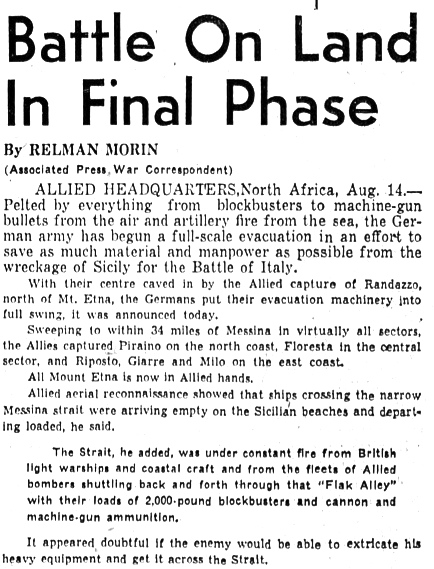
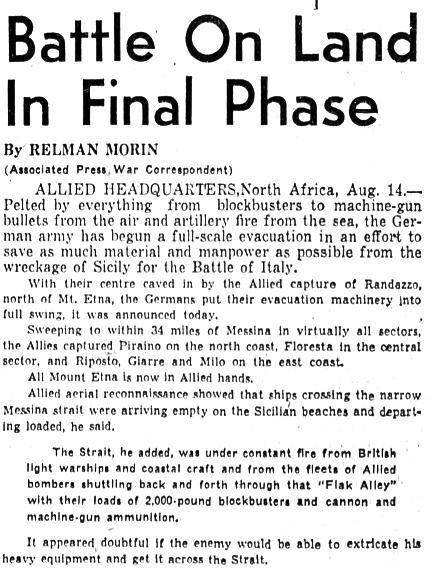
Articles: Sicily, August 12 - 14, 1943 - Pt 15.

Gearing Down in Sicily. Gearing Up for Italy.

German troops exit Sicily to retrench in Italy; Canadians in Combined Operations
repair in Malta before their return to Sicily, to prep for the invasion of Italy.


Introduction:

As the battle front in Sicily moved slowly toward Messina, a city but a few miles away from the toe of the boot of Italy, Canadians in Combined Operations and their landing craft underwent necessary recuperation and repairs on the small but significant island of Malta.

Focus of Canadian news was upon the work of Canadian troops as they worked their way to Messina. One article by Dick Sanburn of The Winnipeg Tribune appears below.


Now in Malta, members of Combined Ops, likely unaware that their 80th Flotilla of landing crafts would be motoring back to the NE coast of Sicily within a few weeks (for a four-week stint of moving troops and war supplies to, e.g., Reggio Calabria), are mentioned chiefly in memoirs.

My father Doug Harrison wrote the following article for The Norwich Gazette in the early 1990s:

FOOD, SUSTENANCE AND MAIL WERE FOUND ON MALTA

At the end of the Sicilian campaign several Canadian sailors and officers became ill. Fatigue brought on by long hours of work and poor nourishment for over a month had now taken its toll and showed up in various ways. Salt water sores, rashes, sunburn, dysentery, things we hadn’t time to bother with before now began to manifest themselves.

Fear was now gone and the inaction caused many to have letdowns. Many had not relaxed for weeks and now that it was over they had difficulty handling it. Mail from home would have helped at a time like this; most of us hadn’t had mail since April and it was now the middle of August. I would have given my right arm for a cool drink of Norwich water and Sweet Caporal cigarettes from the Women’s War league. Parcels and letters were awaiting us in Malta and we were heading that way by landing craft and ship.

If we had a doctor I don’t recall one, but someone, possibly an officer, doled out quinine for malaria, as mosquitoes were really bad. Under the worst possible conditions we tried to keep clean; the only clothes we owned were on our backs and we weren’t to get more until our return to England sometime in October. Khaki shorts and shirts were our uniforms.

After being free from dysentery, I now felt its ravages. Luckily though, I went the 100 miles or so to Malta aboard a real old veteran ship named the Ulster Monarch. Whenever there was a campaign this old stalwart was there. None of us were basket cases and certainly enjoyed being flaked out in bunks on the Monarch. I remember the ship’s sick bay assistant (Tiffy) handing me a fistful of pills. I counted them and there were 16. I asked him how many doses they were and he answered, “One. What are you going to wash them down with... the deck hose?” We all laughed but I wish I hadn’t.

In a few hours, with my orders from the ship’s doctor to report to Hill 10 Hospital, I climbed the cement steps in Valletta Harbour as best I could. Malta isn’t very large and by asking a few natives I found my way to the hospital, dragged right out.


I wandered in and reported my condition to one of the English orderlies. I’ll never forget how cheerful his reply was in that God-forsaken place. “Oh, we’ll soon cure that, Canada.”

“Yeah? How?” I said.
“We’ll starve you for a week.” (So, what else was new?)

But I was in no condition to argue and for a few days I found out how severe dysentery can be, and hunger was no stranger to me, but after four or five days the staff relented and gave me a little boiled cabbage. Here was FOOD and SUSTENANCE and I suffered very few side affects. I was on my way, even my ribs looked better. After about 10 days I was given a clean bill of health and released to wander freely about Malta and wait for my comrades who were late coming from Sicily in landing craft.


(To be continued below).

At about the same time, British PM Winston Churchill was visiting Canada:


News, cartoons, ads from August 12 - 14, 1943 issues of The Winnipeg Tribune provide some context of those war days:


Doug Harrison continues:

I found a vacant array of Air Force tents to sleep in and was fortunate to scrounge some food from the natives. I thought I had it tough - but I couldn’t hold a candle to these folks. I investigated a bit of the catacombs where many slept and lived through the intense bombing raids - no wonder the island was awarded the George Cross.
I can’t remember the name of the service paper I found in the tent, but there before my eyes was a photo of a Norwich air force boy, Bob Alexander. The paper reported that Bob had completed 30 missions and had returned to Canada to become an instructor. It’s a small world. I carried that paper for a long while.

When my friends returned from Sicily in their landing craft, I was waiting for them at the bottom of the cement steps. Our commanding officer Lt/Comdr Koyl and a few hands disappeared for awhile and when they returned they were weighted down with kit bags of parcels and mail. The blues disappeared and quietness settled in as every one of us, in a different posture, chewed on an Oh Henry bar and read news from home. The war wasn’t so bad after all. We shared with anyone who hadn’t received a parcel; no one went hungry. We feasted on chocolate bars, cookies, canned goods and the news.

There were still about 250 of us - we hadn’t lost a soul, but one man* had a terrible shrapnel wound in his arm.


(*Editor: The injured man was most likely Al Adlington, London, Ontario).

We conserved parcels for a rainy day and were dispersed to ships and tents to live for a few days while our stoker got the engines on each craft ready for the invasion of Italy. Of course, no one knew when that would be, but urgency was the order of the day and repair parts were non-existent. We toured the island of Malta and some sailed over to Gozo, another small island. We mingled with the inhabitants but generally we took the opportunity to get some rest and re-read mail. I saw a movie, and before the show the music consisted of western songs by Canada’s own Wilf Carter.

Although no one ventured a word, we all had Italy in the back of our minds.
(The Norwich Gazette)

More news, cartoons, ads from August 12 - 14, 1943 issues of The Winnipeg Tribune:


An article about Kiska, 'ripe for invasion', mentions unique challenges faced by landing craft crews in Sicily:


Clayton Marks of London contributes the following about the Canadians in Malta, as found in his book entitled Combined Operations:

On August 5th operations ceased on the Sicilian beaches, and the two Flotillas (80th and 81st) returned to Malta. After a month of hard work under exceedingly difficult conditions the men were looking forward to a fourteen-day leave which had been promised them, always subject to "exigencies of the service". The news which greeted them on arrival in Malta was, first, that civilian dockworkers were on strike, and secondly, that their craft must be put in condition at once for a landing on the Italian mainland.

Twenty-four cranky LCMs, which had been overworked consistently for a month to land 40,959 men, 8,937 vehicles and 40,181 tons of stores, must at once be retuned to concert pitch by the equally over-worked men who had operated them. Complaints were loud, eloquent, sustained and unavailing, but once this routine gesture was over with, the Canadians manifested, as always, a peculiar zest for anything mechanical. At the end of two weeks, during which all the fit men of both Flotillas worked day and night, they announced to amazed dockyard authorities at Malta that their craft were ready to sail again.


The Canadian Army units received well-deserved praise for their work in Sicily. Lt. Jake Koyl, a Canadian officer in charge of the flotillas of landing craft, also made mention of his Navy boys in positive terms, and gives a few more details about their time in Malta in August 1943:

At the end of the 28 days, eighty LCM's in the two squadrons of three Flotillas each which had been working "GEORGE" and "HOW" sectors, remained in operation. The record of the Canadians was particularly good since only two of their craft out of twenty-two were non-operational.

In another Flotilla working the same sector, the 83rd LCM Flotilla, only three craft out of fourteen remained operational. The eighty operational LCM's proceeded under their own power down the east coast of Sicily, anchored under the shelter of Cape Passero, and made Malta the next afternoon, the 7th of August.
Refits -

At Malta the crews expected to have a fourteen day rest and to get enough water for drinking and washing and rations not quite so uninteresting as the "Compo" rations which the Army had given them in Sicily. When they arrived, however, they were told by the Senior Landing Craft Officer that due to the political situation it would be necessary to make a landing on Italian soil in the near future for which all available landing craft would be required.

It was therefore essential to put the craft in full working order once again and repair the wear and tear of hundreds of beachings. All the spares of all Flotillas were pooled and the refit of about seventy craft was completed in fourteen or fifteen days, to the amazement of dockyard authorities at Valetta.

The Maltese dockyard maties took advantage of the critical situation to strike for two weeks just when the work of repair was about to begin. However, all Flotilla stoker and maintenance personnel turned to and helped in every variety of work from welding to carpentry. Number four dry dock was allocated for LCM's and first priority was given for all materials which could be supplied. Twenty craft were docked at once for hull repairs and bottom fittings such as propellers, shafts and A-brackets while the remainder of the craft were drawn up on the hards for engine repairs and above water repairs.

The Flotillas worked fourteen hours a day and got the job done. After the first twenty dry docked craft had been repaired, another forty-two craft were put in dock while engine and above water repairs on the original twenty were carried out on the hards. Quarters were extremely crowded in Valetta and most of the Flotilla personnel slept in an LST and in tents above the town.
(Pages 182 - 183, Combined Operations by C. Marks)


Please link to Articles: Sicily, August 3 - 11, 1943 - Pt 14.

More articles to follow.

Sunday, November 19, 2017

Presentation: Dad's Navy Days, Part 2 (3)

D-Day Sicily, Plus Thirty Days

SE Sicily: A rare mention of Canadian flotillas. "Dad is here!"]

My father recalls the following about D-Day Sicily:

July 10, 1943. We arrived off Sicily in the middle of the night and stopped about four miles out. Other ships and new LCIs (landing craft infantry), fairly large barges, were landing troops. Soldiers went off each side of the foc’sle, down steps into the water and then ashore, during which time we saw much tracer fire. This was to be our worst invasion yet.

The new LCI(L)s were more common during D-Day Normandy in 1944. Dad likely thought the sets of stairs on each side were an interesting modification. “Off they go, twice as fast!”

His comment,  “This was to be our worst invasion yet” requires some explanation, because early reports delivered to Canada were mostly very positive.

For example, this article by Louis V Hunter, CP War Correspondent, as found in The Winnipeg Tribune, July 14, 1943:

Headline: Local Tars Help Put Army on Sicilian Beach

It is estimated today that 500 Canadian naval men took part in the Sicilian landings.

There were no casualties in the two R.C.N. flotillas which have returned to port, an R.C.N. spokesman announced today. Other flotillas have not returned. Some of the Canadian seamen ferried in British troops who were part of the first wave of the invasion forces to move onto beaches in the southeastern corner of Sicily.


I will add the following:

1. The 500 Navy men were not all in Combined Ops. E.g., some were RCNVR, serving on RN troop ships.

2. The 55th and 61st Flotillas of Assault Landing Craft (ALCs) deposited troops ashore in Sicily, without a great deal of resistance, and when finished that task returned to home base, likely in Alexandria, North Africa. The 80th and 81st Flotillas of Landing Craft Mechanized (LCMs) were not too busy for the first few hours because - in Sicily, unlike in North Africa - they were not heavily involved in moving troops. Their job related to transporting the materials of war after troop landings were complete. Once in operation, they stayed in Sicily for 3 - 4 weeks.

About the early hours of the invasion Hunter tells us the following:

The majority of the Canadian seamen were veterans of the Dieppe and North African landings last summer and autumn and were perfectly trained for their task.

The Canadian sailors were not perturbed when they were briefed for the landings a few days before the assault. But when told that Canadian soldiers* would be part of the invasion force they "were simply delighted."


(*Editor: Canadian sailors on landing crafts did not transport Canadian troops until Sept., in Italy.)

Hunter continues:

The story of Petty Officer E.H. Randall, of Halifax, shows how well trained these Canadians were. Although his assault craft was not under fire a heavy sea was running when a line fouled the propeller, forcing him to drop behind.

In the darkness he attempted to clear the stern but realized he would not be able to, so he decided to continue with one engine and by skillful manoeuvring was in the exact position he was supposed to be at the proper time.

Some assault craft brought back the wounded to the ships offshore.

The morale of the men was "tremendous". Before the landing operation started, a public relations officer went below decks to see what the men were doing and counted seven keen card games* in one mess.


(*Editor: Doug Harrison was not there. He writes that he went fishing. “But there were no fish.”)

Hunter continues:

The Canadian seamen were dressed and ready to go ashore. They were a motley crew, in khaki or blue jerseys with grey flannels. Each wore the inevitable tin hat and carried emergency rations. They sipped cocoa, coffee, ate cheese, as they prepared for the landing. The traditional tot of navy rum was absent.

The first landing craft encountered some brisk opposition but the troops wiped out machine-gun nests and other opposition. The naval bombardment facilitated the later movements of the troops ashore. The naval craft delivered the fighting men right up on shore where the water was no more than ankle deep. The troops spoke in muffled tones as they moved ashore. One muttered, almost under his breath, "”I wish we could have this invasion in a place where we could get over bridges."


In my opinion, the first hours of the landing were certainly not a cakewalk because there was some brisk opposition. However, something is missing from the news story that the Canadian crews of the 80th and 81st Flotillas of LCMs encountered to make it “the worst invasion yet.”

My father says the following:

We started unloading supplies with our LCMs about a half mile off the beach and then the worst began - German bombers. We were bombed 36 times in the first 72 hours - at dusk, at night, at dawn and all day long, and they said we had complete command of the air.

So, what newsman Hunter and the early troops missed was the German Air Force, perhaps only by one hour.

My father continues:

We fired at everything. I saw P38s, German and Italian fighters and my first dogfights. Stukas blew up working parties on the beach once when I was only about one hundred feet out. Utter death and carnage. Our American gun crews had nothing but coffee for three days and stayed close to their guns all the time. I give them credit.

He adds:

A signal came through, i.e., “Do not fire on low flying aircraft, they are ours and towing gliders.” What, in the dark? Next morning, as we slowly moved in, we saw gliders everywhere. I saw them sticking out of the water, crashed on land and in the vineyards. In my twenty-seven days there I did not see a glider intact.

Lloyd Evans, from Markham, is another RCNVR and Combined Ops veteran like my father. His memoirs are so similar to my father’s, I thought at first they were oppos, Navy term for close work mates. When Lloyd and I met in 2014, he did not recall Doug, but he did have this photo:

Canadians in RCNVR and Combined Ops, S. England, perhaps Portsmouth.
Doug Harrison (4th from left) peeks out from behind C. Dale's shoulder. 

Lloyd recalls the following in his memoirs, about the landing in Sicily:

The initial landing was fairly quiet but later heavy enemy artillery opened up. This was quickly silenced by a few salvos from the 16-inch guns of a supporting Monitor. An hour or two into the landing, enemy planes started bombing the beach area. It was very intensive in the first 24 hours with nearly thirty raids but continued for several days at less intensive levels. The first of the raids each day was a regular wake up call!

By the waters edge and beach area there were several crashed American gliders which had been cut loose too early and failed to reach their designated landing zones. They still had bodies in them.


My father said:

Ephus P. Murphy’s pet monkey went mad and we put it in a bag of sand meant to douse incendiary bombs and threw him over the side. The Russian Stoker on our ship, named Katanna, said Dieppe was never like this and hid under a winch. Shrapnel and bombs just rained down.


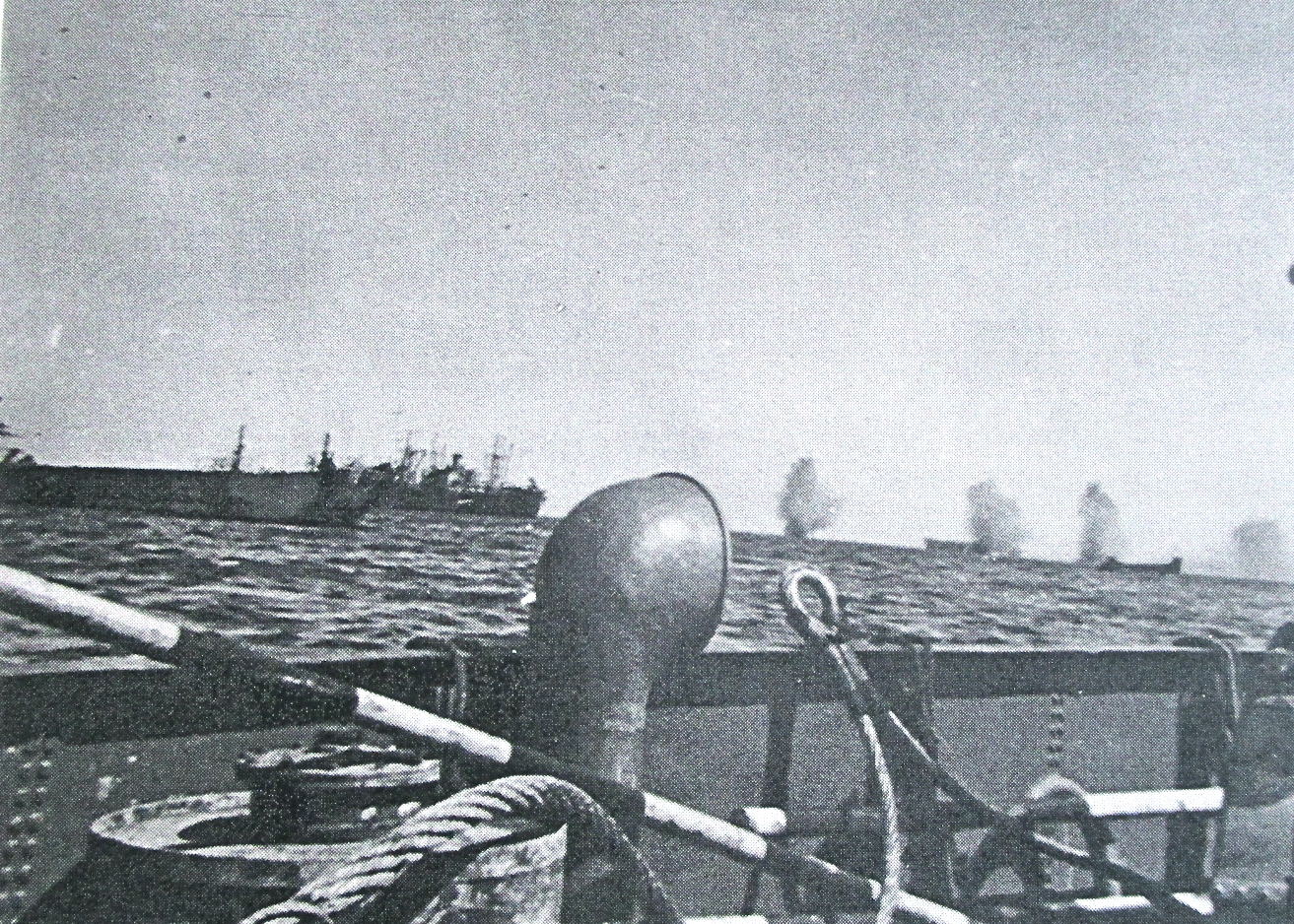
Sticks of enemy bombs hit the water offshore Sicily, seen from a Canadian landing craft. 
Photo found in St. Nazaire to Singapore, D. Lewis.

Once, with our LCM loaded with high octane gas and a Lorrie (truck), we were heading for the beach when we saw machine gun bullets stitching the water right towards us. Fortunately, an LST (landing ship for tanks) loaded with bofors (guns) opened up and scared off the planes, or we were gone if the bullets had hit the gas cans. I was hiding behind a truck tire, so was Joe Watson of Simcoe. What good would that have done?

Our beach had machine gun nests carved out of the ever-present limestone, with slots cut in them to cover our beaches. A few hand grenades tossed in during the night silenced them forever. Slowly we took control and enemy raids were only sporadic...


Several of the Canadian boys in the 80th were eventually able to set up camp, in a cave they called The Savoy. From there they continued their work in Sicily into August.

About day to day work and meals my father says:

Later we moved into a limestone cave, dank and wet, but safe from bombs. We hung a barrage balloon over it, about 1,000 feet up. So, we had 50 - 60 feet of limestone over our heads.

I had 27 days at Sicily living on tomatoes and Bully Beef. I swore I would kick the first bull I saw - right in the posterior - if I got back to Canada. We used a pail of sand saturated with gasoline to heat our meals on. Everywhere I looked there were anti-personnel, hand-sized grenades that needed only to be touched to go off. They were built to maim and not kill, because it takes men to look after the wounded, but if you’re dead, you’re dead. We threw tomatoes at them and exploded a lot of them in that manner.


My father's commander, Jake Koyl, writes the following about the same time period in his memoirs:

The 81st Flotilla Officer, Lieutenant Mullins, went ashore on the second day, after a day of ferrying high octane gas through air attacks, and managed to arrange with the Army for the billeting and feeding of his men at a rough camp about three minutes walk from the beach.

The 80th did not fare so well and had to fend for themselves. They found, after living and feeding from ship to ship until the 21st of July, a cattle cave near the beach, which provided shelter but was uncomfortable and dirty. Both Flotillas lived mainly from Army "Composite" rations and what meals they could get from merchant ships they were unloading.

The LCM's were kept on the job for longer than had originally been planned. Ports had been destroyed and obstructions in the water also hindered ships in coming alongside any dock. Therefore a greater volume of stores had to be taken over the beaches. This proved unexpectedly difficult in the last days of the operation when ships were unloading into LCM's bulky cargoes* originally intended for discharge onto the docks of Catania.


(*Editor: Life was not all bad for the sailors unloading LCMs. My father recalls that one day a shipment of Navy Rum landed aboard his craft. Labels read, "Consigned to Officer’s Mess." It didn’t arrive at the Officer's Mess.)

Jake Koyl writes:

In spite of everything the projected totals of stores taken over the beaches from Landing Craft was considerably exceeded; in other words, the operation as a whole was most successful in its achievement, however hard it was on the personnel who did the job....

Koyl adds details from another officer's report:

"GEORGE" sector will close 1200 tomorrow 5th of August. In 25 days, during two of which we had no ships here, we have discharged 24,959 personnel, 4,871 vehicles and 19,814 tons of stores. In addition 1,900 prisoners of war have been embarked....

That is a grand job well done and it has been done due to three things: common sense, guts and real co-operation between services.


Lt. Koyl concluded:

At the end of the 28 days, the record of the Canadians was particularly good. The eighty operational LCM's proceeded under their own power down the east coast of Sicily, anchored under the shelter of Cape Passero, and made Malta the next afternoon, the 7th of August. (Page 181 - 182, Combined Operations by Londoner Clayton Marks)

LCMs enroute to Malta, August 1942. Collection of Joe Spencer]

The LCMs were perfectly capable of travelling under their own steam from Sicily to Malta. My father, however, got to Malta a few days ahead of his mates.

He writes:

After approximately 27 days I came down with severe chills and then got dysentery. I was shipped to Malta on the Ulster Monarch and an intern came around and handed me 26 pills. I inquired how many doses was that? “Just one,” he replied.

At Malta I was let loose on my own to find Hill 10 Hospital. I did after a while and they asked me my trouble. I said, “Dysentery.” “Oh, we’ll soon cure that,” they said. How? “We won’t give you anything to eat.” So for four days all I got was water and pills and soon I was cured, though weak. I recalled those poor devils in the desert.

Days later, Lt. Jack Koyl, Joe Spencer, Al Kirby, Chuck Rose, Westy Westbrook, and others in Combined Ops landed in the Great Harbour of Malta. Doug Harrison was there, to greet them. There they stayed for a few weeks for rest, recovery and repair. Italy was 4 weeks away.

(More details concerning the “rest, recovery and repair” in Malta and the invasion of Italy, and more, will follow in next year's presentation.)

These Canadians in Combined Ops were capable young men, who trained with and like Commandos at times, and excelled in handling their landing crafts with skill.... and more.

Dick Sanburn, a Winnipeg Tribune War Correspondent, wrote the following about them in June, 1943.

Headline: Canadians Train for Deft Landing of Commandos

Tough Canadian seamen today are training in Combined Operations for heavy responsibilities in what Prime Minister Churchill has called "the coming amphibious operations of peculiar hazard and complexity."

I visited a South Coast training base to see these Canadians at work with their British companions-in-arms. They were learning to become skilled in the operations of all types of landing craft. In no other branch of the British Navy does such a heavy responsibility fall on naval ratings. The entire crew of the smaller craft are non-commissioned men. As few as three ratings can be responsible for the safe landing of many soldiers and valuable equipment.

Several complete flotillas are manned by all-Canadian volunteer crews. I saw one all-Canadian flotilla in charge of Lt. Johnny O’Rourke*, of Calgary. They were slamming each other about in unarmed combat.


(*Editor: More information about Lt. Johnny O'Rourke, is found in St. Nazaire to Singapore: The Canadian Amphibious War 1941-1945: E.g., "....on March 28, 1942, John O'Rourke was present at the heroic, bloody but effective raid on St. Nazaire.)

Sanburn continues:

The only comment of one British officer was: “Canadians are too enthusiastic. Sometimes they hurt each other. They are also a trifle rough on the English in inter-camp contests.”

Canadians are training amid constant reminders of tragically glorious Dieppe. Several craft used in that reconnaissance in force are now employed in Commando training.

The crews are trained to fight the sea and to fight battles. If necessary, they can fight ashore like soldiers. Each man can do many jobs and in a pinch any one seaman could operate the small landing craft. I observed that troops were led ashore in a matter of seconds under a smoke screen laid by support craft and the flotilla. The craft were unbeached again to dart away under the cover of their own smoke screen.

The landing craft crews are building up their own traditions. They hate being regarded as anything but pure Navy. They also have a violent dislike of anybody who calls their fast, efficient craft "barges."


It is evident that Canadian Navy boys built up their own traditions while overseas and their own language as well. In the back of Combined Operations, by Clayton Marks, a healthy glossary of navy terms is listed.

For example:

Oppo - a close friend (opposite number)
Wet - stupid ("That’s wet.")
Salty dip - a tale of an experience at sea. 

There are dozens more.

Scott Young, father of musicians Neil and Astrid Young, was a Canadian Press Staff Writer article during WW2. He wrote an article entitled “No Joe Gets Nattered With Slops Like This” about the slanguage in the three armed forces he encountered during WW2.

He writes:

One of the best army terms is "glass house" - meaning jail, a bit of slang with just as much quality as anything any of the other services have produced. But for quantity go to the fliers and sailors. The air force and navy have quite a few slang terms.

A navy stoker may tell you that he is extremely "nattered" by it all and is going immediately to "flake" himself out for a "spot of biz." Translated that means that he is bored and is going to lie down and sleep.

He may have been "bottled" (bawled out) for doing the same thing before but he knows the "Jimmie" (first lieutenant) and his buffer (petty officer who carried out officers' orders) are both ashore so he is safe.

In all three of the services "Pukka Gen" is information and "guff gen" is a wrong steer or misinformation. (“No guff,” I say.) The army uses "pugged" for anything tough, "dummy up" for shut up, "armored cow" for canned milk, and "Joe" for anyone in the ranks instead of "type."

Joe has replaced entirely the words guy, fellow and chap.
(Joe still lingers today).

In navy "slops" are stories, "hang upon" means correct and "beat up" means a party. A mid-shipman is a "snottie," a sub-lieutenant is "subbie" and when a buffer carries out an officer's order, he is "tying on the can." Anything free is "gash."*

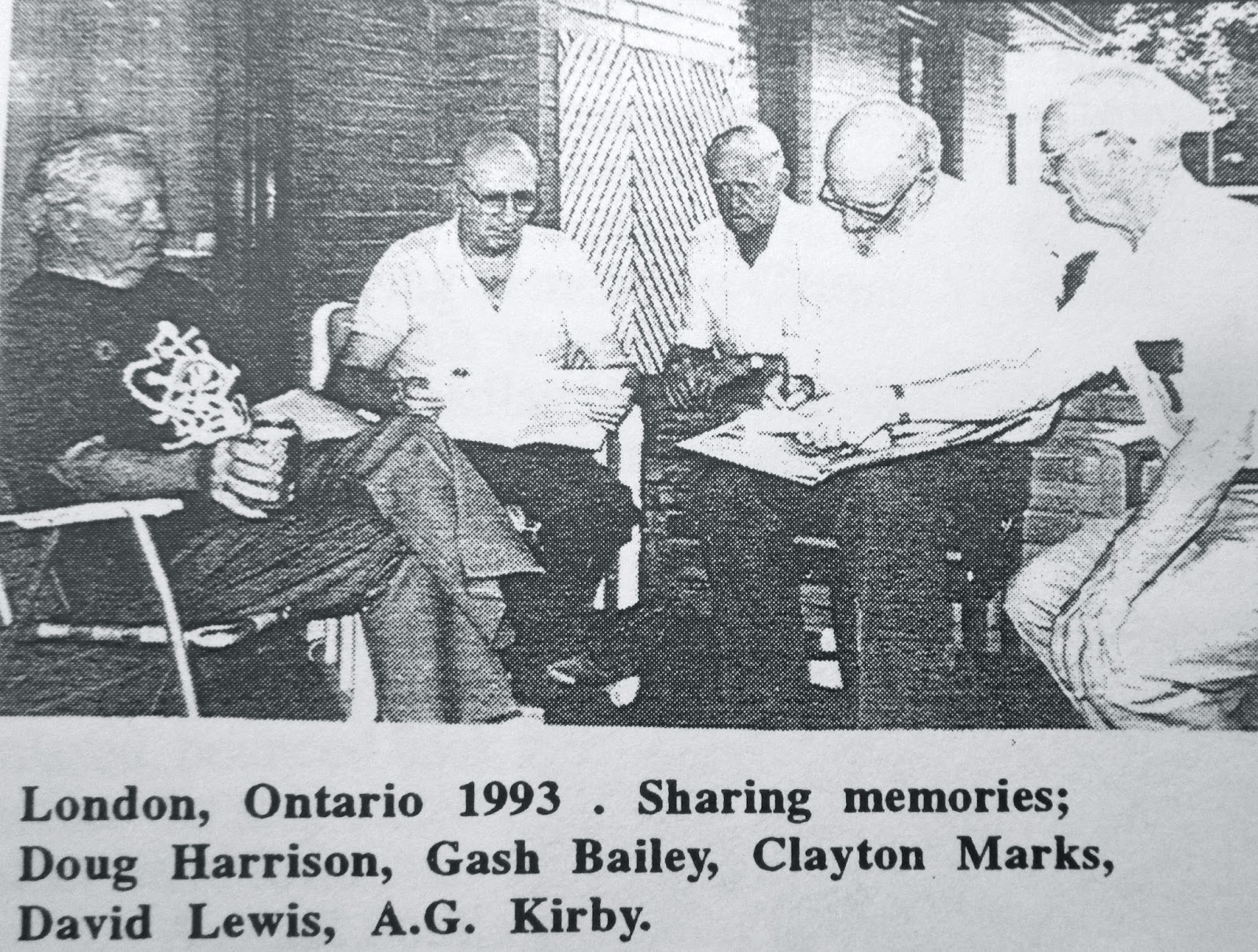
Dad, *Gash Bailey, Clayton Marks, David Lewis, Al Kirby

These men, about 50 years older in the above photo than when they returned home to civilian duties in 1945, and many more Canadians like them, still have hundreds of stories to tell you, about resting up in Malta, working like bees during the invasion of Italy, returning to Canada for Christmas 1943, and then serving again for almost another two years in many new locales, in Europe, Singapore, and here in Canada. In my father’s case, at a Combined Operations Training Grounds in Comox, Vancouver Island.

The Spit at Comox, Vancouver Island. AKA Givenchy III, 1943 - 1946.
Canada's Combined Operations training. Now home to HMCS Quadra

Conclusion:

I follow faint footsteps when looking for more information about my father and other Canadians who served in the RCNVR and Combined Operations.

Most WW2 veterans with important stories are dead. Significant places no longer exist as they did in the 1940s. Artifacts lay in dust, sometimes in a garden shed.

That being said, we are fortunate to have good stories, photographs and more - already in hand - to inform us now and also provide clues to help us find more historic treasures in the future.

So, the search is on and more stories will be shared in the future, to help us remember all men and women who have served their country without thought of any great reward and who deserve on Remembrance Day, and all other days a heartfelt “JOB WELL DONE.”

Resource List, as provided on Nov. 8, 2017:

Resources related to Canadians in Combined Operations, WW2 

Books:

"DAD, WELL DONE" The Navy Memoirs of Leading Seaman Coxswain Doug Harrison, compiled by Gord Harrison

Combined Operations by Londoner Clayton Marks

St. Nazaire to Singapore: The Canadian Amphibious War 1941 - 1945, (2 volumes) by David and Kit Lewis and Len Birkenes

The Watery Maze - The Story of Combined Operations by Bernard Fergusson

Dieppe, Dieppe, by Brereton Greenhous


Websites:

1,000 Men, 1,000 Stories - Canadians in Combined Operations, WW2, by Gord Harrison @ http://wavynavy.blogspot.ca/

Combined Operations Command by Geoff Slee, Scotland, @ http://www.combinedops.com/

St. Nazaire to Singapore: The Canadian Amphibious War 1941 - 1945 Volumes 1 and 2 @ Canada’s Local Histories Online http://www.ourroots.ca

Imperial War Museum, re photos - WW2  http://www.iwm.org.uk/collections/item/object/205186062


Web Links to Stories:

The Grounding of the Queen of Bermuda, 1941 @
http://wavynavy.blogspot.ca/2016/03/story-canadas-early-days-in-combined-ops.html

Small Landing Craft Training (Memoirs of Lloyd Campbell) -
http://www.combinedops.com/Training%20in%20Landing%20Craft%20Operations.htm

Full Interview, London Free Press, 1944 - NORWICH BOYS IN THICK OF TWO INVASIONS - http://wavynavy.blogspot.ca/2016/01/articles-re-combined-ops-norwich-boys.html

Dieppe: The Landing by Lt. R.F. McRae - http://www.ourroots.ca/e/page.aspx?id=882820

“REINA DEL PACIFICO SERVED WELL IN WAR YEARS” - Gazette article (1990s) - @
http://wavynavy.blogspot.ca/2016/01/short-story-re-combined-ops-n-africa.html

News Articles from The Winnipeg Tribune: July 14, 1943: http://wavynavy.blogspot.ca/2017/03/articles-sicily-july-14-1943-pt-8.html

News articles about Sicily; Research re Combined Ops in Canada: http://wavynavy.blogspot.ca/search/label/Editor%27s%20research

A link to all you wanted to know about Sicily but were afraid to ask: http://wavynavy.blogspot.ca/search/label/Sicily

A link to my archive re Dieppe: http://wavynavy.blogspot.ca/search/label/Dieppe

What goes good with Navy Rum? Ask a sailor.
From The Winnipeg Tribune, July 1943

Please link to Presentation: Dad's Navy Days, Part 2 (2)

Unattributed Photos GH

Sunday, November 12, 2017

Presentation: Dad's Navy Days, Part 2 (2)

Reflecting on Another 75th Anniversary - A More Positive Note.

The Invasion of North Africa: D-Day, November 8, 1942

U.S. troops disembark from Reina Del Pacifico; D-Day Nov. 8, 1942. Photo - IWM
They board British ALC 428, manned by Canadians in Combined Ops

Before I tell you how I came across the earlier photo of my father unloading U.S. troops on D-Day N. Africa, I’d like to say a couple of quick things about the invasion.

For example: What was the purpose of Operation Torch? An online source says:

Map of N. Africa, 1942, with 3 Allied forces shown

The purpose of the landings at Oran (centre), Casablanca (west), and Algiers (east) was to secure bases on the coast of North Africa. After the bases were secured, there would be rapid exploitation to acquire complete control of French Morocco, Algeria, and Tunisia and extend offensive operations against the rear of Axis forces to the east.

Also, I’ve learned that once the north coast of Africa was firmly under the control of the Allies, there would be sufficient bases to enable the invasion of Europe, i.e., through Italy, but starting with Sicily, less than one year later.

How were Canadians in Combined Ops involved? They numbered about 200 strong now, and set out from Greenock, Scotland in Oct. 1942. My father was attached to the 80th Flotilla of LCMs, and these crafts, aka workhorses, were carried upon the Derwentdale and Ennerdale, former oil tankers. Along with American troops, they were part of the Centre Task Force.

Canadian Chuck Rose, at Greenock, “central station Glasgow” 1942
[From the collection of Joe Spencer, RCNVR, Combined Ops]

Online source says:

The Center Task Force would go ashore at three beaches in the vicinity of Oran on 8 November at 1 AM, the exact hour when the Western Task Force coming from the United States was to land at Casablanca and the Eastern Assault Force, mostly British, was to touch down at Algiers.

The most important landing was in the Gulf of Arzew, twenty-five miles east of the city of Oran, where there were two coastal batteries and a French garrison. A company of American Rangers was to spearhead the assault, followed by the 16th and 18th Regimental Combat Teams (RCT's).


Map of Arzew

My father writes: The Derwentdale dropped anchor off Arzew in North Africa and different ships were distributed at different intervals along the vast coast. My LCM had the leading officer aboard, another seaman (besides myself), a stoker and Coxswain, L/S Jack Dean of Toronto.

In St. Nazaire to Singapore, Vol. 1 Dean says:

"We worked steadily for 11 days. It was a 24 hour a day job and we would catch a couple of hours sleep at night if the sea was calm... Our landing craft carried American troops ashore and then ferried in supplies: bulldozers, ammunition and tons of light equipment until the merchant ships were empty.”

U.S. troops climbing onto landing crafts. Jack Dean on bow of ALC 428

The above stories and photos answer some questions re sailors duties. I.E., transport troops ashore, and everything they would need in battle. But the photos raise questions as well. The above crafts are ALCs, not the larger LCMs.

Did Canadians work aboard ALCs filled with troops first, then switch over to the LCMs? Apparently, yes. The next year, however, in Sicily, more Comb. Ops. volunteers had signed on. Larger flotillas were formed. And the two jobs of moving troops, and transporting their supplies, were separated among the flotillas.

And finally... How did I get my mitts on such lovely photos of my father?

Long story short. I travelled to Scotland in 2014 for research purposes. In Edinburgh I met Geoff Slee, creator of combinedops.com. “Ever been to Inveraray?” he asked. “Oh, it’s too far,” I said. He kindly told me that Scotland is not Canada. Okaaaay, so, we went. We meet Jim Jepson, former curator of Combined Ops Museum in Inveraray. Thumbs up. We tour the former site of Combined Ops Number 1 Training grounds. Two thumbs up. It’s now a trailer park, no wooden cabins remain from WW2, but the drill hall, the loch and its beaches where landing craft training took place are the same. We retire to Jim’s house for tea. He hands me a book. “You should get this.” Front cover reveals photo of training in Loch Fyne, Inveraray. Lovely. We were just there.

Beaches at Inveraray, WW2. Photo from front cover
of the book "Assault Landing Craft" by B. Lavery

I thumb through the book. Looks interesting. I turn to pages 102-103. I say, under my breath, “That’s my Dad.” I flew back home, got the book. 99.99% sure - it’s Dad.

I turn to pages 102-103. U.S. troops on D-Day, Dad out front.
Photo as found in the book by B. Lavery

I Googled it. Found same photo at IWM. Catalogue number A 12671. RN photographer Lt. F. A. Hudson. I entered catalogue system and manipulated the catalogue numbers, up and down, and found 8 by F.A. Hudson. Dad’s in several. That’s a great find!!! 3 exclamation marks!!!

 U.S. troops unload while Dad handles anti-broaching lines, left of ALC


 Above photos by  RN photographer Lt. F. A. Hudson. Found at IWM

Time for intermission. Ad from The Winnipeg Tribune.

And how did I find Dad’s metal helmet? In my oldest sister's garden shed - on PEI, south of Souris, not far from where Joe McKenna grew up. So, more research will follow in PEI.

After N. Africa, Dad and mates returned to the UK. At some point he went to Hammersmith, East London, and spent Christmas with his Uncle Wally and Aunt Nellie. A related story appears in “Dad, Well Done”. After Christmas he travelled to a Comb. Ops. camp for more training, unaware he and his mates would be put to great use during the invasion of Sicily.

Ocean Voyage linked to the Invasion of Sicily, July 1943

Clayton Marks records the following about the lead up to this significant invasion:

The armies for the invasion were gathering in England. Many of their divisions were already hardened, trained and ready. Weapons, stores and supplies were accumulating in enormous volume, in incredible variety.

England’s small towns and villages along the southern coast were jam packed with military equipment of all kinds, ready to be loaded when required.

Great fleets of Allied bombers were now battering at German industries, cities and strategic centres; at the country's brain, nerve centres and heart. The war seemed to be moving toward its climax, as indeed it was.

Yet the grand diversion, the round-about closing in from the south of Europe - which had begun with the invasion of North Africa in November 1942 - was still in progress. Sicily lay between North Africa and Italy, and it was chosen by Allied planners as the next step toward Rome (and the dismantlement of Italian and German forces there.)

About the middle of March, 1943, several large convoys left British ports for Suez. The end of the North African campaign was coming in sight, and the next step would be the forcing of a passage to Italy. The convoys, which were to round Africa and come up through the Red Sea to Suez and Port Said at the eastern entrance to the Mediterranean, carried the Combined Operations Flotillas and a portion of the troops for the landings on Sicily.


And Doug Harrison was there. (Oh, I added that last bit).

In Dad’s memoirs I’ve read the following:

As a member of the 80th Flotilla of landing craft he was transported around Africa to the Red Sea and Port Said in the Silver Walnut, a ship he at first described as a real dud. He writes extensively about the 3-month trip, and he stopped in many strange and beautiful cities.

Due to many engine failures, stoppages and breakdowns during the trip around Africa, all aboard were regularly exposed to the fear of German submarines.

On a more positive note, my father writes: 

One of the merchant officers, James Robertson, had borrowed a hammock during the trip. It reappeared 43 years later during Navy Week in Melbourne, Australia. Robertson had painted the Combined Operations Insignia (inside a large green Maple Leaf) and the names of the Canadian sailors who had served aboard the Walnut many years ago.

Hammock, at Navy museum, Esquimalt BC]

And again, Doug Harrison was there! That is, his name was on the hammock. It was returned to Canada, to the Navy Museum in Esquimalt, BC, but my dad never saw it, only photos.

I saw it, “on his behalf” in 2013, ten years after his death. I unrolled the hammock and held it up.... i.e., up to my nose. I detected - after 70-odd years - the smell of oil and fuel. That was no surprise. It had once belonged to a Russian stoker, or mechanical engineer, named Katanna. In addition to Dad’s memoirs, I certainly felt more closely connected to Dad’s voyage around Africa after that experience.


Hammock, and Editor at Navy Museum, Esquimalt, BC

All of the Canadian Flotillas eventually arrived at well-established training camps in Egypt. My father and others on Silver Walnut had gained the reputation of being “submarine bait”, but my father recalls a positive side to the ship’s late arrival:

The other boys who arrived in the desert long before us, because of our slow ship, were the unfortunate ones, and were found sleeping in tents - hot in the day and cold at night - and most had severe dysentery, some were just shells. I spent one night only in the desert so I was lucky. Thanks, old slow ship.

About the continued Combined Ops. training in Egypt Mr. Marks writes:

Far from Sicily, the men of the Landing Craft Flotillas trained under the broiling sun of Suez. Large-scale amphibious exercises, as tough and realistic as possible, ironed out difficulties remembered from the Torch landings, tested the men and the craft to their limits, and gave rise to excited speculation as to what actual coast resembled the "dummy" beaches against which the exercises were directed.

A rare article from The Winnipeg Tribune, dated July 27, 1943, mentions the role of Canadians on board a ship carrying troops and landing craft:

Headline: Practice Made Perfect for RCN at Sicily.

The Navy today told something of the careful preparation behind its share of the invasion of Sicily - the first “Combined Operation” in which Canadian naval personnel retained their identity as a Canadian unit, manning their own flotillas of landing craft. In command of the new units as group officer was Lieut. Jack E. Koyl, of Saskatoon, a veteran of Dieppe and North African landings.

Lt. Jack Koyl (back row first left), with Canadian sailors,
including Al Kirby, front row, first right)

The article mentions the trip around Africa and a full dress rehearsal, likely at Bitter Lakes, involving the navy, merchant navy, army and air force (in a “combined operation”). The scene described aboard the troop ship would have been like the action seen aboard ships on D-Day:

Jack Koyl, who would lead the landing craft afloat, checked his watch.

"If you're ready...." He suggested to an army officer. The word was passed down the lines and the troops commenced embarking. I.E., climbing aboard landing craft that were on the ship.

Comb. Ops. Seamen stood by to help. There was no hitch.

Then it was the turn of the Merchant Navy. The carrier ship was manned by her own merchant crew. They were on duty at the davits, waiting the order to lower. After the order, the landing craft started to descend to the sea. Greased falls, silent winches, dropped them. The splashing of keel against water was the only sound. And then, with engines turning quietly, falls were cast off and the craft, one by one, slipped away into the darkness to form into a flotilla ready to land their troops.


Large and small craft could be lowered from davits

An army officer, commenting on the fact the landing craft seemed to be running on unbreakable schedule, said, "These Canadian fellows know their job." The R.C.N.'s new unit was ready for Sicily, its first big show.

The last sentence is not fully correct. Many in the “Canadian Flotillas” had experienced Dieppe and N. Africa.

In Combined Operations we read:

On July 4th all Combined Operations Officers were called together for final instructions (“for the big show”), and on July 5th (5 days before D-Day) the assault convoys sailed from Port Said for a rendezvous position south of Malta.

My father recalls the following:

The convoy formed for Sicily at Alexandria and ran into heavy submarine attacks and mines. I actually saw one torpedo miss us. I was now on the American Liberty ship Pio Pico, because the Silver Walnut was abandoned. One ship was hit and had to be beached and I believe Theo McReady of Burgessville was aboard and was killed. (Burgessville is 5 miles from Doug's hometown of Norwich).

From the rendezvous position south of Malta the “Biggest Armada of All Time” set a course for the south eastern tip of Sicily. Ships carrying four Canadian Flotillas of landing craft, the 55th, 61st, 80th and 81st Flotillas, landed troops and all the materials of war near the towns of Avola and Noto, i.e., south of Syracuse, on July 10, 1943.

Map of SE Sicily with a rare mention of Canadian flotillas.
As found in Combined Operations.

More to follow.

Photos GH

Presentation: Dad's Navy Days, Part 2

Dressed for the train ride to Combined Ops training camp, Comox, B.C.
January, 1944. L - R: Don Linder, Kitchener. Doug Harrison, Norwich.
Joe Watson, Simcoe. Buryl McIntyre, Norwich. Chuck Rose, Chippewa.

On November 8, 2017 I presented an hour-long talk about my Dad's WW2 experiences. I did the same type of presentation on November 9, 2016 and that year's lengthy notes from which I quoted are listed in their entirety at the following link: Dad's Navy Days (Parts 1 - 11).

I will share the notes from Nov. 8, 2017's talk, which included much new material when compared to 2016's notes, on this website in three sections, with links to each section.

Introduction: The following 2-minute-long video, related to my father and his experiences related to serving in WW2 with other Canadians in Combined Operations, sets the stage for Part 2, “Dad’s Navy Days.”

Video Link - YouTube video (https://youtu.be/VISULzR_ex0)

Video narrative:

My father, Doug Harrison, turned 19 in September,1939, the same week England and Canada declared war on Germany. He gave up his steady job at the Norwich Co-op a year and a half later and volunteered for the Royal Canadian Navy Volunteer Reserve.

One of Dad’s weekly columns in the Norwich Gazette tells how he soon volunteered for another organization as well, one that would direct all his wartime duties from 1941-45.

He writes:

March the first, 1941, I left my employment at the Norwich Co-op and joined the navy in Hamilton. I took instructions each evening until June, at which time I went on active strength. I then took ten more weeks of training with many young men from the area.

Next, we entrained for Halifax where we underwent similar navy training, but now we marched to a far more serious drummer.

Upon completion of our course rumours came to our ears about overseas duty. Our commanding officer confirmed the rumours and said a request had been made by England’s Royal Navy for Canadian Navy volunteers for hazardous duty overseas. We were given a few days to make a decision....

We had come to know each other very well over a period of six months, and were swayed greatly by the fact that it seemed an excellent way to stay together. So, come what may, we volunteered for the unknown, almost to a man.

On that fateful day, fifty Canadians volunteered - with eyes wide shut - for the Combined Operations organization, the section of the British War Office charged with planning offensive operations during WW2. Small raids were mounted at first, including the best known, at Dieppe. Ever greater operations followed upon their heels, such as Operation Torch, the invasion of North Africa, and then D-Days in Sicily, Italy and France.

Before WW2 ended, about 1,000 other Canadians followed the first 50 into Combined Ops. Where did they go? What did they see, and feel?

To help answer these questions, please read the detailed WW2 stories about my father, Doug Harrison, and some of his Navy mates, supported by memoirs, news stories and photos.

These stories will hopefully encourage your personal remembrances on Remembrance Day, whether you recall WWI, WW2 or modern day veterans of war and their significant sacrifices.

About “remembering” my mother Edith wrote the following;

They went to war together,
So our country would be free.
They fought together on land, in air, on sea.
They died together in muddy fields,
In blazing skies, in deep, cold seas.
Let us remember them, together.

[Nov. 8, 1942, Doug Harrison, centre, unloads U.S. troops
and supplies from British ALC 428. IWM]

November 11 is a very important historical date. On the "eleventh hour, in the morning of the eleventh day of the eleventh month" the hostilities associated with WW1 ended, in 1918. Ever since, citizens of many countries around the world have reflected on the sacrifices of wartime veterans on that date.

As well, the 11th month is linked to a very memorable event in WW2. On November 8, 1942, 75 years ago today, my father and scores of his mates, took part in their 2nd big operation - the Allied invasion of N. Africa. It took place less than three months after the Dieppe Raid.

Caption of the photo above reads: Troops and ammunition being brought ashore from LCAs (landing craft assault 428) at Arzeu in Algeria during Operation 'Torch', Nov. 8, 1942. (Found at Imperial War Museum, U.K.)

My father’s Navy duties included transporting U.S. troops to the beaches at Arzew. Here he is, front and centre. After troops were safely ashore he climbed aboard a larger craft, an LCM, and began to deliver all the necessary materials of war to the same shores.

How do I know that? Dad said as much in his memoirs. And how did I get my mitts on that lovely photo of my father in North Africa? More details about that, later.

The presentation is made up of three 3 parts. First, I touch on two events that reached 75th anniversaries this year, the Dieppe Raid and Operation Torch. Then I share some details about Operation Husky, the invasion of Sicily, and the role Canadians in Combined Operations played there in July and August, 1943.

Part 1:

[The Effingham Division, in Halifax, 1941. 
Dad, front row, 3rd from left. Al Adlington,  London, 4th row, 3rd from left.
Lawrence Lantz, 4th row, 2nd from right]

I want to first take you back to HMCS Stadacona in Halifax, November, 1941. Sailors are in the mess hall. Al Kirby, an 18-year-old recruit from Woodstock, has just read a ‘Volunteers Needed’ bulletin, for hazardous duty overseas, on small craft. Soon, the mess hall is abuzz with talk. Men volunteered, left and right. Was Kirby the catalyst that prompted almost the entire Effingham Division to join the Combined Operations organization? I don’t know.

What I do know is that in January 1942 about 100 young Canadians shipped out to Scotland together, and were soon training aboard landing crafts at Combined Ops camps in the U.K. The raid at Dieppe was their first action.

I also know that young Al Kirby from Woodstock has likely written one of the finest reports about the Dieppe Raid one will ever read.

Excerpts appear in Dieppe, Dieppe, published in co-operation with the Dept. of National Defence. However, Kirby’s 25-page story appears in its entirety in a book entitled Combined Operations.

Canada’s early connection to the C.O. organization is presented very clearly in this book by Londoner Clayton Marks, first printed in 1993, and reprinted last year by his family members, Valerie Martens, Steve Marks, and Andrea Martens.

Kirby’s tale covers a period of several days, from getting the assignment to link up with a particular landing craft, to participating in the Dieppe Raid as a landing craft crew member, then returning to England after the raid.

What follows are a series of excerpts:

A Few Days Before the Raid

The shrill Bosuns' call broke the peace of a Saturday afternoon 'Make and Mend' as forcefully as the action bell on a destroyer. "The following ratings report to the quarter deck on the double," it commanded... "Able Seaman Adlington, Seaman Bailey, Seaman Belontz - say again, Adlington, Bailey, Belontz.”

I lay on the lockers of our mess deck lazily passing the afternoon, when that call shook me back to reality. Adlington....Adlington....Holy cow, that's me....well, not me, but since I'm standing by for Adlington I'd better get to the quarter deck to see what dirty job I'm being offered now.

What one learns is that Kirby’s participation in “some dirty job” came about innocently enough - he was standing in for Al Adlington of London, Ont., for the price of one British Pound, a lot of money in those days. Bailey and Belontz also had friends standing by for them, i.e., Lawrence Lantz, age 18, from Quebec, and Joe McKenna, “a well mannered, very likable and quiet guy, about nineteen, from Souris, P.E.I.”

I will skip quickly over the early days re their job: The boys were sent to a lorrie and were soon in New Haven, having packed only an attache case for a weekend stay.

The three Canadians, and many more, were assigned to various RN landing crafts.

They remained in the dark about “what appeared to be a rather large exercise.”

Kirby writes about his assigned R-boat:

These "R" boats were a very nice craft to handle. The keel and frames were built of 1" thick plywood, while the plating was 3/8" plywood. They offered no more protection than a cigarette paper. One other defect - you could hear them coming from miles away.

Kirby, Lantz, and McKenna were witness to German raids that hit nearby Eastbourne.

One of Kirby’s paragraphs stands out, almost like prose. Poignant words describe the memory of the night time bombings, perhaps never fully forgotten:

As the sunlight retreated even further over the horizon,
the vivid red and orange flashes of the bombs exploding
in and around Eastbourne seemed to scream out to us
of the untold suffering and anguish of countless women and children,
unable to react in any way, to ward off the vicious onslaught
of the venomous Dorniers and Heinkels that thundered overhead.
And then, as abruptly as it had started, it was over.

Aug. 18 - One day before the raid, landing crafts were loaded with troops, i.e., Cameron Highlanders, and bicycles.

Kirby senses this exercise may be the real thing.

At about 8 PM, Aug. 18, they slipped their moorings, and left the shore.

Kirby spots McKenna’s boat, R-84, “about six feet in front of us.”

Al writes, “I shouted to McKenna to get that crate out of our way or we would run him down. He gave us a good-natured wave and we all settled down to keeping station as we slowly made our way out of the harbour.”

Kirby was greatly impressed with a feeling of responsibility and elation.

“Here I am at the wheel of a landing craft, loaded to the gun’ales with heavily armed, highly trained Canadian soldiers, headed for what I hope is a real life battle. Imagine the letter I could write home telling of great deeds and brave conquests, if only it turns out to be true.

Shortly after midnight, Aug. 19 (the date of the raid), the landing crafts stop to refuel. A Canadian soldier tries to light a cigarette. Kirby explodes.

“Put that bloody light out, we're pouring gasoline up here and the fumes will be running right down inside the well. Do you want to die even before you hit the beach?" I said that still thinking that we were headed for an exercise, and quite unaware of our final destination.

After refueling Kirby hears, at last, the plans related to the exercise. But no location is given.

A chill begins to creep over me as I slowly absorb the fact that we really are about to land on enemy territory. And even worse, the south Saskatchewan Regiment will be landing ahead of us so German defences will already be in action by the time we hit the beach.

"Where are we going anyway?" Kirby asks a soldier.

"Don't you know? You are supposed to be taking us there."

"I'm just following the boat in front of me," Kirby replied. “But to where?”

"It's a coastal town called Deepy," the soldier volunteered, "somewhere in France."

Hopes for a surprise landing disappear.

Al says, “Shortly before 0400, the sky ahead of us suddenly lit up with a myriad of tracers knifing into the heavens.* We all realized that we were getting close to our target, as the Infantry briefing indicated a touch down at 0500. Now it appeared that the enemy was awake and at action stations. Our hope of a surprise landing was dashed."

[*Kirby likely witnessed a sea fight between Canadian landing craft and a German convoy that spotted one another at 0300 hours. Details of such an encounter are found in other texts.]

At 0515 Kirby spots the coast of France; there was still no fire from the enemy as they drove parallel to the coast, one or two miles out. The relative quiet, however, soon passes.

Smoke screens from landing craft.
Photo - Canada at War

He writes, “Then, all our craft turned 90 degrees to port and we headed into the beach in line abreast. Just as I was climbing up onto the stern to ignite the smoke generator, all hell seemed to break loose, the water ahead of us began to erupt like a massive sea volcano as a rain of mortar fire descended upon the water in front of us. Smoke billowed from our generator and piled up behind us in great clouds that obscured everything in that direction.”

Plowing through the wall of mortar fire the noise was deafening, but more than that. The concussion of each burst pressed on our ears as though we were being smitten with giant pillows. I looked down along the line of landing craft and so far no one seemed to have been hit yet.

Looking over the top of the canvas cover, I am amazed at the sight of a piper standing up on the foc’sle of the second boat over, playing away as though he was alone in a field of heather. Shortly before touching the beach the din is joined by the staccato chorus of a number of automatic weapons from the cliffs on either side of the beach. The roar, the crash, the rattle and smash have reached a crescendo.

I feel the grinding of the hull on the beach, I undo the lashings on a bicycle. I shout to the closest man to take the bike. He looks at me in disbelief as I attempt to hand it to him. Ignoring me, he turns and runs for the sea wall, scrambling for all he is worth, stumbling over the bodies of his dead and wounded comrades. I drop the bike in the stones, turn and run, shouting to Hop as I go, "All clear, all clear, get us out of here Hop!"

Charging out through the smoke, we all prayed that we didn't hit anyone coming the other way. We couldn't see beyond our own bow.

We soon cleared the smoke and proceeded over to a destroyer and sat along side her. We are sure that we have put the Infantry where they belonged. Our damage is minimal, but looking around, the other boats are not so lucky.

From his vantage point upon the small landing craft, Kirby was an eye-witness to continuous explosions ashore. He also saw dogfights, and then heard the order to return to the beach. On the way in - they received a pounding.

I saw the boat on our left go up in a deafening blast. A small tidal wave hit the side of our boat and tossed us to starboard like a match stick. R-84, Joe McKenna’s ALC, seemed to be taking a blast of fire from the left hand cliffs, probably heavy calibre machine guns.

The landing craft retreated, Al Kirby not knowing why. After Navy shells pounded back at beach fortifications, his flotilla headed once more for the beach, and for the last time. They soon retreated again, and Kirby was left with many heavy questions.

Looking back I saw the LCA Flotilla heading into another hail of fire. After half an hour of heading out to sea, I learned that we were heading back to England. Who is going to pick up our Camerons? What happened to the LCA's which continued on to the beach? What was the lot of the entire operation? We are still four boats missing from our own Flotilla.

Good weather lay ahead, but the landing crafts presented not so rosy a picture.

I watched for opportunities to get a glimpse of either McKenna's or Lantz's boat but was unable to recognize either one. I noticed that two of our crafts were in tow.

Kirby returns to New Haven and finally meets up with Lantz.

What a mixture of feelings went through my body as I climbed up to the jetty and surveyed the shambles throughout the harbour. So relieved to be home. So ashamed to have come home alone. After half an hour I ran into Lawrence Lantz coming along the jetty. As we met, we said simultaneously, "Have you seen Joe McKenna?" We both answered, "No, not since we left here Tuesday night." I told Lantz that I had seen McKenna's boat taking some fire on the mid-morning trip. At midnight, after a meal, we walked back to the freight shed to our beds. We were very dismayed that McKenna was not in his bed, and we hoped we would see him in the morning.

Next Morning, August 20, 1942. Kirby writes:

Lantz and I decided to scour the boats alongside to see if we could find out what happened to McKenna.

They find McKenna’s craft, R-84, tied up beside the jetty. They both jumped down into it. The story doesn’t end there, but I will, for the most part. The last paragraphs - with enough disappointment involved to last Kirby and Lantz a lifetime - tell about the gutted condition of the landing craft, and the fate of Joe McKenna.

They were told that there would be a funeral service at the graveyard in Newhaven, and they planned to go in the hope of “finding McKenna.” (Kirby’s words). But they were both ordered to muster at their boats at 8:00 AM, to drive the landing craft back to Portsmouth. Consequently, they were unable to go to the funeral, or to say good-bye - at least in some way.

When Kirby wrote his memorable tale, perhaps he felt he was finally bidding a suitable farewell to Joe McKenna, a mate from his youth. I say now, “Well done, Mr. Kirby.” Let us remember them, together.

Al Kirby (right) with another mate (Doug Harrison).
Likely at Roseneath Camp, Scotland, 1942

Dad’s list with Joe McKenna, Lloyd Campbell (London) and others.
As found in St. Nazaire to Singapore, Vol. 1

The following photo, from the collection of Joe Spencer (RCNVR, Combined Ops.), and taken on August 20, 1942, was not shown at the November 8 presentation.

Caption: ALC 269 returning to Southampton from New Haven.
Charlie Sheeler, Joe Spencer (under White Ensign)

Part 2 to follow.

Unattributed Photos - G. Harrison.