Saturday, June 16, 2018

Context: Operation TORCH, N. Africa, Nov. 1942 (Pt 1)

The Allied Invasion of North Africa
News Clippings from Nov. 2 - 3, 1942

[Photo Caption - A12654. General view of the convoy en route for Gibraltar
bathed in sunlight and stretching into the distance. RN Photographer Lt. F.A.
Hudson. From the Photo Collection of Imperial War Museum (IWM).

Introduction -

In late winter to spring and early summer 1942, newly volunteered Canadians in Combined Operations did much training aboard landing crafts in southern England and north-west Scotland in preparation for they-did-not-know-what.

Their first call to action was to take part in Operation Rutter, a raid on Dieppe, France. It was scheduled for July 7, 1942 but was cancelled near or on the day of the event.

Some related details re Rutter are provided here:

Operation Rutter was planned to take place between the 4 and 8 July. After weeks of training and preparation the troops embarked on their craft but the order to sail was not given as the period of time when the tides were most suitable coincided with a bout of very unsettled weather. On top of this, the Germans spotted the convoy gathered in the Solent and bombed them. While very little damage was done, it was possible that the enemy would now be alerted to the fact that some sort of amphibious operation was about to be undertaken. This, coupled with the weather getting even worse, forced the operation's cancellation. (Link to source - History of War)

Much has been written about the next operation involving Canadians in Combined Operations, i.e., Operation Jubilee, the raid on Dieppe that took place on August 19, 1942, about five weeks later. Links to several stories and photographs can be found in the right hand margin under 'click on Headings' and 'Dieppe'.

Once Canadians and their landing craft returned from Dieppe and southern England ports they went back to work in such places as HMS Westcliff at Southend-on-Sea, east of London, and at HMS Quebec, near Inveraray, Scotland. 

My father Doug Harrison (RCNVR, Combined Ops) writes the following about some of their training:

A lot was learned about landing craft during the early months of 1942. Dad writes:

We did much running up on beaches (with Assault Landing Crafts ALCs and Landing Crafts Mechanized LCMs) so soldiers could disembark and re-embark, always watching the tide if it was flowing in or going out. You could be easily left high and dry, or broach too (i.e., turn sideways toward the tide), if you weren’t constantly alert. We took long trips at night in close single formation because all you could see was the florescent waters churned up by propellors of an ALC or LCM ahead.... (Navy memoirs)

At Inveraray: A12063. LCM (3), front view with ramp down. Lt. R.G.G. Coote, IWM

Their next call to action was to man landing crafts for Operation Torch, the invasion of North Africa, scheduled in early November. Again, little to no information about the specific time/locations would be shared with sailors until the day of the operation. Plans, shared earlier with officers, involved landings in three main areas, each area subdivided into different and extensive sections, as partially illustrated below:


In the following post and its companion pieces, I will present newspaper clippings from November 1942 as found in The Winnipeg Tribune (Link - digital collection, University of Manitoba), along with related items of interest from navy memoirs, Imperial War Museum (IWM) collections and more.

Canadians in Combined Operations were involved with British and American forces and, in my opinion, have unique and important stories to tell from their vantage point as operators and workmen aboard landing crafts that transported troops and all necessary materials of war to significant beaches at a significant time during World War II.

A few newspaper articles will mention good information about the Canadian sailors (RCNVR mainly) who also volunteered for Combined Operations and served during Operation TORCH, and such articles will be shared under the heading "articles re Combined Operations".

Most news clippings or articles, editorials, editorial cartoons, etc. provide general information for readers wishing to learn more about the World War II events on various fronts that have some bearing on Allied troops, including the Canadians in Combined Ops. Since specific details re the 100 - 200   Canadians in Combined Ops are rare, most news clips, etc., will be listed under the heading "context for Combined Ops".

From November 2, 1942:


The purpose of Operation Torch is well documented. It is stated briefly here:

The purpose of the landings at Oran, Casablanca, and Algiers was to secure bases on the coast of North Africa. After the bases were secured, there would be rapid exploitation to acquire complete control of French Morocco, Algeria, and Tunisia and extend offensive operations against the rear of Axis forces to the east. The next object was the complete annihilation of the Axis forces opposing the British forces in the Western Desert. At El 'Alamein Montgomery had launched his attack against Rommel three days before the TORCH convoy sailed from England. (Online link)

We will hear more of Monty and the Desert Fox as materials are presented.


Drives related to Victory Bonds continues at a relentless pace:


The photograph below has a bit of a local connection for me. The buildings and grounds seen below still exist in St. Thomas, Ontario, about 15 - 20 kilometres south of London.


News Clippings from The Winnipeg Tribune, November 3, 1942:


Allied forces related to Operation Torch are already sailing toward Africa and will soon be landing to support the ongoing Allied push illustrated below:


Fresh supplies of nearly everything will soon be delivered to the right beach at the right time. 


The battle for Stalingrad is still ongoing and merciless.


Landings related to TORCH, Casablanca, Algeria and Tunisia will take place far to the west of Egypt and Libya:


"Loose Lips Sink Ships." A British seaman pays with his life:


News about a POW from Dieppe -


More articles and related items (to provide some context of the times) to follow.

Please link to Context: Dieppe Raid 1942 - Operation JUBILEE (1).

Unattributed Photos GH

Tuesday, June 12, 2018

Editor's Column: As Published in Norwich Gazette (11).

FAINT FOOTSTEPS, World War II (11)

Lloyd Campbell died in Germany on October 21, 1942

Introduction: My father knew Lloyd Campbell of London, included some details about Lloyd related to an incident (June, 1942) aboard the Ennerdale while they voyaged to an embarking site for the first running of the raid upon Dieppe (Operation Rutter, cancelled on the day it was scheduled, July 7, 1942).

The Ennerdale at Greenock, Scotland with landing crafts hoisted, port side
Photo credit - Joe Spencer, RCNVR, Combined Operations 

My father knew Lloyd had died while in captivity as a POW but did not know the date, as evidenced in the top illustration (a published submission to St. Nazaire to Singapore, Volume 1). Berlin is the correct place of burial ("Well done, Dad," I say), and I have since located the exact site.

The following is the 11th column in a series of 24 I have submitted to my father's hometown newspaper, the Norwich Gazette, to inform readers of work done by Canadians in Combined Operations during the Second World War.

Dieppe Raid Pt. 3: Buried With Full Military Honours

If Dad was sitting beside me right now I’d ask him if he’d like to learn more details about the death of his mate Lloyd Campbell (wounded and captured during the Dieppe Raid), and where he is buried. And if Dad was agreeable, I’d hand him the news clipping I found one week ago.

He’d likely recall first that he believed Lloyd was buried in Berlin. He said as much in memoirs. He’d recall his commanding officer (Lt. Robert McRae, also taken POW) had written at length - once repatriated (1945) - about what happened to his crew on August 19, 1942.

McRae wrote: “We found we were fatally headed toward the beach under the steep cliffs. They began to pour machine-gun fire down into the boats. In our craft, Campbell, who was at the wheel, received a line of bullets across his thighs (later as a POW he lost his legs to amputation and died before Christmas from gangrene). As it was my place to stand behind the man at the wheel, Campbell had stopped the bullets I might otherwise have received”. (St. Nazaire to Singapore)

“The clipping shares a wee bit more,” I’d say.

Navy Casualty. OTTAWA, Nov.18 - The Royal Canadian Navy reported today, in its 130th casualty list of the war, that Able Seaman Lloyd George Campbell, whose sister, Mrs. Madeline Rollands, lives at London, Ont., died Oct. 21 while a prisoner of war in Germany. AB Campbell had undergone amputation of his right leg while in Camp 9-C in Germany. (Winnipeg Tribune, Nov. 18, 1942)

News clipping as found in the Winnipeg Tribune

‘A wee bit more’ sounds right, yes? Or, short and sweet. Because even in scant details (i.e., sister’s name, Oct. 31, Camp 9-C, etc.) a key to an important door is occasionally provided. Within 24 hours, with help from phonebooks and Google, I possessed Lloyd Campbell’s Service Record, significant family letters, and several official documents.

From his Attestation Form: Lloyd joined the Navy (London Division) three months before his 19th birthday. Occupation - knitter at Holeproof Hosiery.

From his Active Service Sheet: He served aboard corvette HMCS Eyebright doing escort duty in the Atlantic before travelling to Scotland for landing craft training at the same Combined Ops camps as my father.

As well, eight days after Lloyd was severely wounded at Dieppe, Madeline Rollands was sent the following letter from Secretary, Naval Board:

It is with deepest regret that I must... inform you that your brother... has been reported missing on active service. It is not possible to say definitely whether your brother was taken prisoner or whether he lost his life... (once) further information is received you will be informed.

POW Lloyd Campbell sent his last message home two weeks after the raid: “This isn’t my handwriting, because my arm isn’t well yet. I am in a hospital in Germany looked after by British Doctors and orderlies.... I have had to have my right leg off, below the knee due to bullet holes, but it might have been worse and I hope to be about soon.” 

Lloyd Campbell's last communication his sister Madeline Rollins, London
As found at collectionscanada.gc.ca

The message (above) reached Canadian Postal Censorship, Ottawa, on Oct. 24, 1942. It therefore reached Lloyd’s sister Madeline and mother Mary* in London shortly after Lloyd’s death due to medical complications.

If Dad was sitting beside me, I’d read, “After his last operation he suffered the minimum of pain and his last hours were very peaceful. Lloyd was buried... with full military honours... the coffin was, as is usual, draped with the Union Jack.’ (Letter from ‘Senior British Medical Officer’)

And when I locate surviving members of Lloyd’s family I’ll provide these details and more, including the exact location of Lloyd’s gravesite in Berlin.

*I have since learned that Lloyd's mother Mary (and father Thomas) had passed away a few years earlier. And I have since found surviving family members and passed along all details I have discovered.

Please link to Editor's Column: As Published in Norwich Gazette (10).

Unattributed Photos GH

Saturday, June 9, 2018

Articles: Italy, Oct. 14-16, 1943 - Pt. 14.

Navy Boys on Their Way Home.

[Photo: British forces gradually press toward Rome but they are several
months away from entering the Italian capital. Canadians in the 80th Flotilla
of Landing Crafts are homeward bound. Credit - The Winnipeg Tribune ]

Introduction: 

Interested readers will find a steady supply of articles related to the slow march of Allied troops toward Rome, in The (Digitized) Winnipeg Tribune.

That being said, the trail of Canadians in Combined Operations has technically gone cold because they have pointed their landing crafts toward North Africa for the return ride back to the United Kingdom. 

In Navy memoirs my father writes the following:

After our work from Sicily to Italy was done and our armies were advancing we returned to Malta. We stayed but a few days, then took MT boats to Bougie in Algiers, and were soon after loaded onto a Dutch ship, the Queen Emma. The ship had been bombed and strafed, her propellor shaft was bent and we could only make eight knots an hour under very rough conditions. Her super structure was easily half inch steel, and in various places where shrapnel had struck I could see holes that looked like a hole punched in butter with a hot poker, like it had just melted.

We arrived at Niobe barracks in Scotland and in true navy style were put on a train and sent to Lowestoft in England, not too far from Norwich, England (my hometown’s namesake or visa versa) on or near the east coast.

Backing up a bit. While on the Queen Emma we had an attack of boils break out and we were taking exams to become Acting Leading Seamen. It was my fortune to not get boils at first, and I teased everyone aboard. But my turn came. I got three beauts close together on my neck. I went to sick bay, and what did they put me on? You guessed it - mercurochrome. I said, I won’t be back, same as when I broke my toe, and I didn’t. I passed my exam, got my book and carried the boils clear to Lowestoft.

I heard mess deck buzz. We were getting a lot of money and going on leave. The stipulated time for ratings is twenty-four months overseas and we were closing in. No more raids. Thanks God, for pulling me through. The mess deck buzz proved to be correct, they gave us all a pile of money (pound notes), and I thought it was too many for me because I made a big allotment to my mother. 


How they ever kept track of our pay* I’ll never know, and to my dying day I will believe they gypped me right up to here. 

[*Editor: Navy records were kept up-to-date by legions of people, some based at COPRA camps (e.g., at Largs, Scotland). COPRA stands for Combined Operations Pay Record and Accounts and photos of some sites are archived at Imperial War Museum. Please link to Photographs: Training on Landing Crafts (13)]

Before going on leave I went to Stoker Katana and I said, pinch out these boils. “I’ll lean on the top bunk and no matter how it hurts, pinch them out.” I never felt a thing because they were as ripe as cherries. I slopped on a big bandaid and away I went on leave, never bothering to answer a ton of mail. I also received eight hundred cigarettes.

We were due for a do and we did it up brown. You couldn’t possibly lose me in London, England even when I was three sheets to the wind. No way.
(Page 37, "DAD, WELL DONE")

And after just a few pints of brown ale, I'm sure, many (including my father) returned to Canada. They arrived home aboard the Aquitania during the first week of December and shortly thereafter were presented with a challenging decision, related to "where to serve next?"

By mid-January, a large contingent of Canadian sailors would be riding the rails across Canada on their way to a Combined Operations training grounds on Vancouver Island (i.e., HMCS Givenchy III at Comox). My father would marry his first wife a few months later, in the spring of 1944, and be on active duty on The Spit (Comox) until discharge in the fall of 1945.

Canadians in RCNVR and Combined Ops stop in Hornepayne ONT
on their way to Vancouver Island. Photo - Doug Harrison, Jan. 1944


Wedding Bells. Late April or early May, 1944. Photo GH.

We leave the battle in Italy - an incredibly long and difficult slog for Allied troops - with the following and final news clippings from the Tribune.


Unattributed Photos GH

Tuesday, June 5, 2018

Editor's Research: Lloyd Campbell, London Ont.

From a Dieppe Beach to Stalag 9-C

[Photo: As found in Dieppe, Dieppe by B. Greenhous]

TOGETHER

They went to war together
So our country would be free.
They fought together
On land, in air, on sea.
They died together
In muddy fields
In blazing skies
In deep, cold seas.

Let us remember them,
Together.

Edith J. Harrison

Introduction: Four entries have been produced for '1000 STORIES, 1000 MEN' concerning Lloyd George Campbell (RCNVR, Combined Operations), a man from London, Ontario who stayed at the wheel of his landing craft while approaching a beach at Dieppe on August 19, 1942. On that day he was seriously wounded, and taken prisoner of war. On October 21 he died from his wounds while under British care in a German hospital. He was buried in Berlin, where he resides to this day.

The four entries and a newspaper article related to Mr. Campbell are provided below:


2. Editor's Research: Lloyd Campbell, London Ont. (2)

News clip, as found in The Winnipeg Tribune, Nov. 18, 1942

3. Editor's Research: Lloyd Campbell, London Ont. (3)


Photo as found in St. Nazaire to Singapore: The Canadian Amphibious War


Please link to another editor's column in which Mr. Campbell is briefly mentioned.

Photos GH

Monday, June 4, 2018

Editor's Research: Lloyd Campbell, London Ont. (4)

Many Final Details, and Remaining Mysteries.

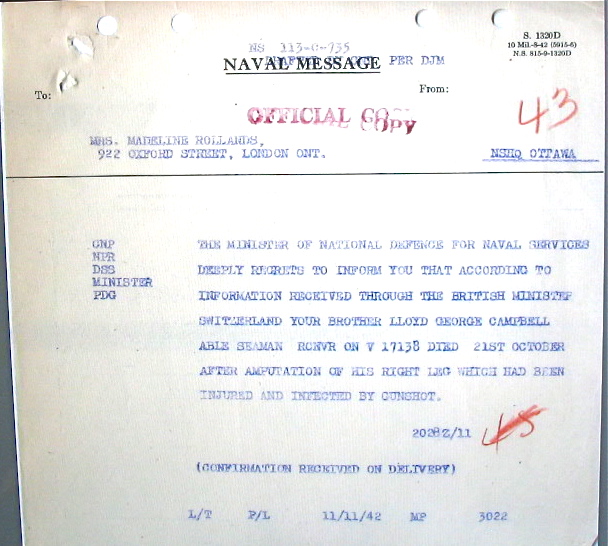
[Photo: "Your brother Lloyd George Campbell Able Seaman RCNVR Died"]

Introduction:

Lloyd Campbell's file folder contains not only his last letter home to his sister in London but communications related to his death, and many details related to the cause of death.

Below one will find many more letters and documents pertaining to Lloyd's demise and where he was/is buried. Some items clear up some matters, others add to a certain level of confusion about Lloyd's family. All in all, much can be learned with what lies before us, but it may take a trained detective - which I am not - to tighten up and tie off remaining loose threads.

About the above telegram: It is dated "11/11/42" (bottom line), 21 days after Lloyd's death. However, as will be revealed all in good time below, Lloyd's sister already knew about his death by that date.

Documents, Communications Related to Lloyd Campbell V17138:

The following pages are provided in the order found in Lloyd's file with some explanation from the editor if required, e.g., for context or clarification.

1. Those who have noticed the numbers listed in red pencil crayon will see this letter was originally marked number 55, and changed to 37. If the numbers indicate the chronological order of paperwork associated with Mr. Campbell, then this letter was sent or received prior to the top telegram, number 45, later changed to 43.

Paragraph 1 likely refers to Lloyd's last words to his family (see previous post). Lloyd is referred to as a "marginally named party", which may mean that, back at headquarters, he is not fully known to them, in terms of his role and duties with any particular armed force. Lloyd's sister is therefore asked to help fill in the blanks.


2. Lloyd's sister Madeline responds to the above about Lloyd's death. His last letter, listed chronologically as number 36, had ended on a positive note: "I hope to be (up and) about soon," said her brother. Note the date, i.e., Nov. 8/42. Madeline responded very quickly in this instance. And the red pencil crayon number is 38, and follows the above letter, marked number 37. 


"I have been both stunned and shocked at hearing this dreadful news." Mrs. M. Rollins. (Many communications had indicated "Rollands" as her last name.) No mention is made of Lloyd's mother who, I had been lead to believe by an earlier document, lived at the same address, i.e., 992 Oxford Street.  Note above, M. Rollins is now living at 626 Lorne Avenue, London.


3. A second letter from Madeline, now living on Askin Street, three blocks from my current address. It was sent and received in October, 1945 and matters related to Lloyd's estate are addressed.

We learn details about Lloyd's family: His father had died during the past July; he had three brothers living in the United States and another sister living in London, Ont.; his mother is again not mentioned.


Below we notice that Madeline's letter was to be placed within Lloyd's closed file.


4. Distribution of funds, attributed to Mr. Campbell, is addressed. $253.76 had been distributed earlier, and that may relate to his pay when he served aboard corvette Eyebright before volunteering for (or being assigned to) Combined Operations and work aboard landing crafts. The money was made payable to Thomas Campbell (Lloyd's deceased father), c/o Madeline Rollins.


5. This "Death Certificate" is similar to one written in German, as seen in a previous post. Lloyd's mother's maiden name is listed - Cadham.


6. The original death certificates crossed the desk of Captain R. I. Agnew, R.C.N. Capt. Agnew had not always had a desk job: Link to the following - HMCS Prince Henry, December 1940; Order of the British Empire; RCN Officers second officer listed; commanding the Prince Henry, distinctive action!


7. In Madeline's letter from 1943, related to making claims, we learn that Lloyd's mother had passed away when Lloyd was a young person. Madeline had likely lived in her mother Mary's house at 992 Oxford Street for a number of years, and may have been making claims on her mother's behalf or in her name.


8. Three pages of Lloyd's belongings reside in his file, and I have listed the first and third pages.


9. A letter addressed to Lloyd's second sister, related to her share of his estate.


10. A significant discovery is made here, in my opinion, going back to 1953. 


The site of Lloyd's grave had been changed from Meiningen to Berlin. Duly noted!

Surviving members of Lloyd's family, wishing to visit his grave to honour his service, or lay a wreath, could do so, perhaps without great difficulty. My father had listed his burial place as 'Berlin', perhaps by chance or luck, or news had been provided at a Navy reunion. 


11. This is the link I followed to see Lloyd's records as presented here, after Googling 'Madeline Rollands, London'.


When Googling Madeline's name, searchers now also will come upon a link to my site.


More information about Madeline might also be available at geni.com


GH

Thursday, May 31, 2018

Editor's Column: As Published in Norwich Gazette (10).

FAINT FOOTSTEPS, World War II.

[Photo: "I lost my first comrades at Dieppe. Others were wounded." D. Harrison]

Dieppe Raid Pt. 2: Norwich Boy Deals with Aftermath 

My father trained for the Dieppe Raid for several months. He sailed to, and assembled at, the operation’s embarking point on two occasions. But he did not participate in it. He says he missed the action by one day. And I say, thank goodness for that.

Close comrades, however, were killed. His commanding officer and stoker were captured as POWs. So, though he missed the actual action, he did not entirely miss its aftermath. I feel he may have passed the next 61 years of his life dealing with - at times - deeply-felt losses and associated anger, unanswered questions and doubts about the raid’s validity, and more, related to the event.

In memoirs, penned in 1975, he says, “I wasn’t there, I was on leave (with about 35 other sailors). But I came back early because I knew there was a raid coming, though I didn’t know where, and was in position to see the troopship Duke of Wellington carrying barges, my oppo (i.e., my opposite, or closest regular workmate) and other buddies to Dieppe and certain death for the soldiers.”

He saw troops and mates leave, perhaps with a sense of dread, and was then on hand for the return of survivors.

The Brantford Expositor (1944) reports that my father “returned to duty just as the Dieppe casualty lists were coming in” and it was likely then he discovered, officially, that “seven of his Combined Operations colleagues failed to come back from that cross-Channel venture.”

And how did he handle the news that comrades had been wounded, taken prisoner or killed?

He says, “I was asked to go and clean up Assault Landing Crafts as they struggled back from Dieppe. I absolutely refused. I was so incensed I also refused to go to church there. I went to the door but never went inside.”

His sense of loss, anger and doubt were evident from that day forward.

Thirty years after the war ended he started writing memoirs, and when he mentioned Dieppe his first words were, “The next (raid) on August 19, 1942 should have been aborted too,” soon followed by, “it was a senseless waste of blood. The Germans were ready because we ran into a German convoy in the channel... I will remember it as a complete, useless waste of good Canadian blood and no one - even those who say we learned a valuable lesson there - will ever change my mind.”

Fifty-four years after Dieppe his feelings appear only slightly softened. He writes, “So much has been written and televised (e.g., captured films), with many reasons given for the raid. Possibly much was learned but I am convinced more was lost.”

In part he was referring to Lloyd “Let me at ‘em” Campbell (London; mentioned in an earlier column), Joe McKenna (PEI), Richard Cavanaugh (Ottawa), all manning landing crafts and lost to him on August 19.

Fortunately, my father’s commanding officer and stoker (POWs) returned to Canada after the war and he had important opportunities to visit them both.

Stoker R. Brown (left), D. Harrison, (Lt.) R. McRae (back), Gash Bailey.
Combined Ops veterans reunite at a Navy gathering, circa 1980.

Better still, in the mid-1990s he often visited certain other veterans, and together they reached out to fellow survivors in order to compile their stories about the RCNVR and Combined Operations - the WW2 training, raids and operations, gains and losses, chaos and carnage, even humorous times on leave.

Dozens of vets responded, and the books produced were then and are now very important works, in my opinion.

Those that were lost at Dieppe and other operations are remembered well. And the survivors, including my father, surely gained some rewarding, helpful (even therapeutic) insights from the many stories. For example, they were not alone in suffering deep loss, associated anger or survival guilt.

More columns to follow.


Photos GH, as found in St. Nazaire to Singapore: The Canadian Amphibious War Volume 1*

* There are two volumes of veterans' stories related to their WW2 experiences as members of RCNVR and Combined Operations. Several stories from the books are presented on this website. See 'short stories re Combined Ops' in 'click on Headinds' in right hand margin.