Sunday, September 5, 2021

Books: Writers on World War II (An Anthology)

A Lengthy Book, Scores of Excellent Contributors

It Surely Provides Piles of Happy Hunting!

I found my copy at Attics Books on Dundas Street, London ONT

Introduction:

A timely comment: I may currently be hindered in my travels by Covid-19 - i.e., the fourth wave in Sept. 2021 - but my stack of used and new books on a nearby shelf has been a lifesaver. It has regularly liberated my mind, at least.

The anthology Writers on World War II (700+ pages), with foreword by Mordecai Richler, guided me expertly to every major country on the globe involved in WW2, and returned me home safely, better educated than when I began.


Though the book does not deal directly with the Canadians in Combined Operations that sit at the heart of my website/archive, it provides context for so many aspects of the war that - to this very day - affects millions about the globe. And with so many informed, creative writers revealed between its covers, a thoughtful reader of our shared WW2 history will find hot buttons to push for years to come.


"Here, powerfully portrayed in the words of novelists, poets, and journalists who lived through it - and in memoirs, diaries and letters - is the full sweep of the Second World War, as it was experienced around the world by combatants and by civilians," says the first statement on the front flyleaf.

In the foreword, Richler provides hints concerning what lies ahead:

"1st September 1939"

 I sit in one of the dives
On Fifty-second Street
Uncertain and afraid
As the clever hopes expire
Of a low dishonest decade:
Waves of anger and fear
Circulate over the bright
And darkened lands of the earth,
Obsessing our private lives;
The unmentionable odor of death
Offends the September night.

W. H. Auden

Richler goes on:

For those who fought on the Allied side during World War II it was, in Herbert Mitgang's phrase, "The Good War," and for those who were too young to fight in it, but lived through it - my generation - it remains, quite simply, the war... 

It was the forces of darkness
that were being engaged, and that were,
furthermore, terrifyingly triumphant
for too long a time.

"Then came Dunkirk," writes Richard Hillary...
On June 14, 1940, Paris fell. 
The Germans, wrote George Kennan,
had in their embrace its pallid corpse.
A week later George Orwell wrote
a letter to the editor of Time and Tide.
"Sir," it began, "It is almost certain that England
will be invaded within the next few days or weeks,
and a large-scale invasion by seaborne troops is quite likely.
At such a time our slogan should be ARM THE PEOPLE."

The Battle of britain began in the autumn.
"The house about 30 yards from ours," 
wrote Virginia Woolfe in her diary on September 10,
"struck at one in the morning by a bomb. Completely
ruined. Another bomb in the square still unexploded."

Then, on December 7, 1941,
the United States was brought into the war...
wrote I. F. Stone in The War Years: 
"The ticker tape at the Press Club,
normally shut off on a Sunday,
carried the first flash telling of the
Japanese attack on Pearl Harbour.
It was a beautiful late-autumn Sunday,
the sky clear and the air crisp..."
James Jones was at Pearl Harbour, of course, and 
wrote of that day in his novel From Here To Eternity:
"... a big tall thin red-headed boy who had not been
there before was running down the street toward them,
his red hair flapping in his self-induced breeze,
and his knees coming up to his chin with every step.
He looked like he was about to fall over backwards.
" 'Whats up, Red?' Warden hollered at him.
'Whats happening? Wait a minute! What's going on?'
"The red-headed boy went on running down the street
concentratedly, his eyes glaring whitely wildly at them.
" 'The Japs is bombing Wheeler Field!' he hollered over
his shoulder. 'The Japs is bombing Wheeler Field!
I seen the red circles on the wings!'

"The red-headed boy went on running... his eyes
glaring whitely wildly..." (Drawing by GH)

"He went on running down the middle of the street,
and quite suddenly right behind him came a big roaring,
getting bigger and bigger; behind the roaring came
an airplane, leaping out suddenly over the trees."

For poet George MacBeth,
author of A Child of the War,
there was the terror that came after darkness,
once German bombers began to patrol over England.

Excerpts from Foreword, pages xxi - xxiii

Richler writes a lengthy foreword and it continued as a good read just by itself. Two paragraphs on page xxv struck a nerve, the first because it referred to men known to Mr. Richler and reminded me of some of my 'first impressions' of my own father's WWII experience (1941 - 45):

"The Kugelmass boy (from Richler's neighbourhood),
one of the first to join up, was killed when his
Harvard Trainer crashed not far from Montreal.
A cousin of mine volunteered for the Commandos
but failed their intelligence test, venturing the original
notion that "A.D." stood for "After the Depression."
However, he did manage to get into the merchant marine.
He was torpedoed in the North Atlantic and survived
ten days in a lifeboat before being picked up."

My father pointed out to me, when I was a teen, an air strip west of Woodstock, Ontario (near our hometown of Norwich), home to sturdy yellow Harvard Trainers. They were linked in his mind to WWII. Also, my father trained with Commandos - beginning in 1942 - while learning all there was to know about LCAs and LCMs (Landing Craft Assault, and Mechanised, respectively) at HMS Quebec (No. 1 Combined Operations Training Camp) near Inveraray, Scotland, then later in the same year at RAF Dundonald and Camp Auchengate (Navy) near Irvine, Scotland. One early, lasting impression I had re Dad's WWII experiences was that he'd been a member of the Merchant Marine (MM) and I'd strongly felt, especially after reading U-Boat Wars, that anyone who had joined the MM made a big mistake. (I eventually learned my father had first volunteered for RCNVR in June, 1941, and Combined Operations about six months later). 

New RCNVR recruits in Hamilton (volunteers at Division 1), Aug. 1941.
After this parade they were sent to HMCS Stadacona for further training. 

Doug Harrison (left) and Buryl McIntyre, both of Norwich ONT
standing easy outside Nelson barracks (aka Wellington Barracks)
at HMCS Stadacona, Halifax, from Sept. - Dec. 1941

The Effingham Division "almost to a man" volunteered for Combined
Operations (Canada's first draft of volunteers to C.O.) in Dec. 1941
Three above photos from the collection of Doug Harrison

The first paragraph (to strike a nerve) ends with a merchant ship being torpedoed "in the North Atlantic" and my father bears witness to such an event - during his passage overseas in Jan. 1942 - in his memoirs:

The Dutch captain lined us all up and assured us we would arrive safely because the Volendam had already taken three torpedoes and lived to sail. This was very heartening news for those of us who had never been to sea except for a few hours in Halifax upon a mine-sweeper. Our first meal was sausage with lots of grease. Naturally, many were sick as it was very rough.

Late at night I was on watch at our stern and saw a red plume of an explosion on our starboard quarter. In the morning (a) four-stacker was not to be seen. The next evening I heard cries for help, presumably from a life-raft or life-boat. Although I informed the officer of the watch, we were unable to stop and place ourselves in jeopardy as we only had the Firedrake (HMS, destroyer) with ASDIC (sonar) to get us through safely.

After some days we spotted a light on our port stern quarter one night. It was the light of the conning tower of a German submarine. How she failed to detect us, or the Firedrake detect it, I will never know. I was gun layer and nearly fell off the gun (4.7 gauge). I informed the Bridge and the Captain said, “Don’t shoot. Don’t shoot. It could be one of ours.” But as it quickly submerged we did fire one round to buck up our courage.

"Dad, Well Done" page 8

The second paragraph by M. Richler on page xxv struck a chord as well:

"In 1945, once victory seemed assured,
our magazines began to feature "thought-provoking" articles
by learned psychiatrists warning us that when the boys came home
they would be trained killers and would need time to adjust.
We were also instructed never to ask them
what things had been like over there.
When the boys did come home, however,
they adjusted to peacetime life in a jiffy
and were visibly upset only when we tried
to change the subject each time they started in
on a story about their adventures in the war."

As many readers will perhaps know, many men did not adjust "to peacetime life in a jiffy." The silence of our veterans was the norm in many households after the war was over, and the silence perhaps held depression, survival guilt and several other mental challenges in check for a time, but not forever.

Yes, good books like the aforementioned fill some gaps. But definitely not all, of course. The book, Writes On World War II), is recommended to all readers and some significant passages will be added at a later date on this site. [Check the following link from the A - Z Directory, side margin - passages from WW2 books]

Please link to an earlier entry related to rare books (filled with original stories) written by Canadian veterans of Combined Operations at Books: New Link to a Rare, Two-Volume Set.


Unattributed Photos GH

Tuesday, August 24, 2021

Photographs: Aging Navy Vets Reconnect at Reunions (1)

The Veterans Came Together at Family and Naval Reunions

They Combined Efforts to Produce Rare WWII Books

Five significant books were produced by four of the Canadian men above

Introduction:

In an earlier post I share updated links to a rare, two-volume set of books (veterans' stories related to their involvement in key WWII operations from Dieppe to Normandy). The above photo - as found in St. Nazaire to Singapore: The Canadian Amphibious War, Vol. 1 - and another colour shot from my father's collection of the same five gentlemen is shared as well.

The colour shot is part of a group of photos in my possession, most taken and shared at navy reunions. I share more of them here along with others that are closely related. Informative, historical details are provided as well when possible. 

Back, L - R: 'Gash', Clayton, and David Lewis (David wrote and collected
stories for St. Nazaire to Singapore  (two lengthy volumes)
Front L - R: Doug and Al (full names are w top photo)

A link to collected stories by David Lewis is provided under the top photo and those interested in an example of Clayton Marks' efforts can link here to Short Story re Invasions of Sicily and Italy.

Details related to more of the books and stories the men wrote and published will be provided in the next or a future post. GH

Doug Harrison (left) and Art Bailey at Parkwood Hospital in London.
Taken 1987, perhaps when visiting WWII veterans, or Legion members.
Both men are contributors to St. Nazaire to Singapore

Doug Harrison (Norwich), Ed Whelan (Guelph), Art Bailey (London)

Art and Ed. Taken in Guelph, June 1988

Art Bailey, Doug Harrison, and Joe Watson of Simcoe, ONT
Location/date of photograph is not known

Art 'Gash' Bailey and my father (Doug H.) are mentioned together in a significant story re a training exercise (Schuyt 1) aboard landing crafts near Irvine, Scotland prior to the Dieppe Raid. 

Joe Watson, as found in news article, circa 1944

As well, Joe Watson and my father served on the same landing crafts for some period of time during the invasion of Sicily and both mention a particular episode in stories or newspaper interviews. 

My father and Joe Watson and several other Canadians in Combined Ops ended their WWII service (after two years of service overseas, Jan. 1942 - Dec. 1943)) at a Combined Operations School on Vancouver Island (Jan. 1944 - discharge,  Sept. 1945). Here are five sailors ready to board a train for their trip out west:

L-R: Don Linder, Kitchener; Doug Harrison, Norwich; Joe Watson, Simcoe;
Buryl McIntyre, Norwich; Chuck Rose, Chippawa ONT. Toronto, Jan. 1944

The train stops for water/supplies in Hornepayne ONT, January 1944
L-R: Linder, Rose, McIntyre, Watson, Don Westbrook (Hamilton)

At HMCS Givenchy III (1944-45): J. Watson, C. Rose, F. Bruce

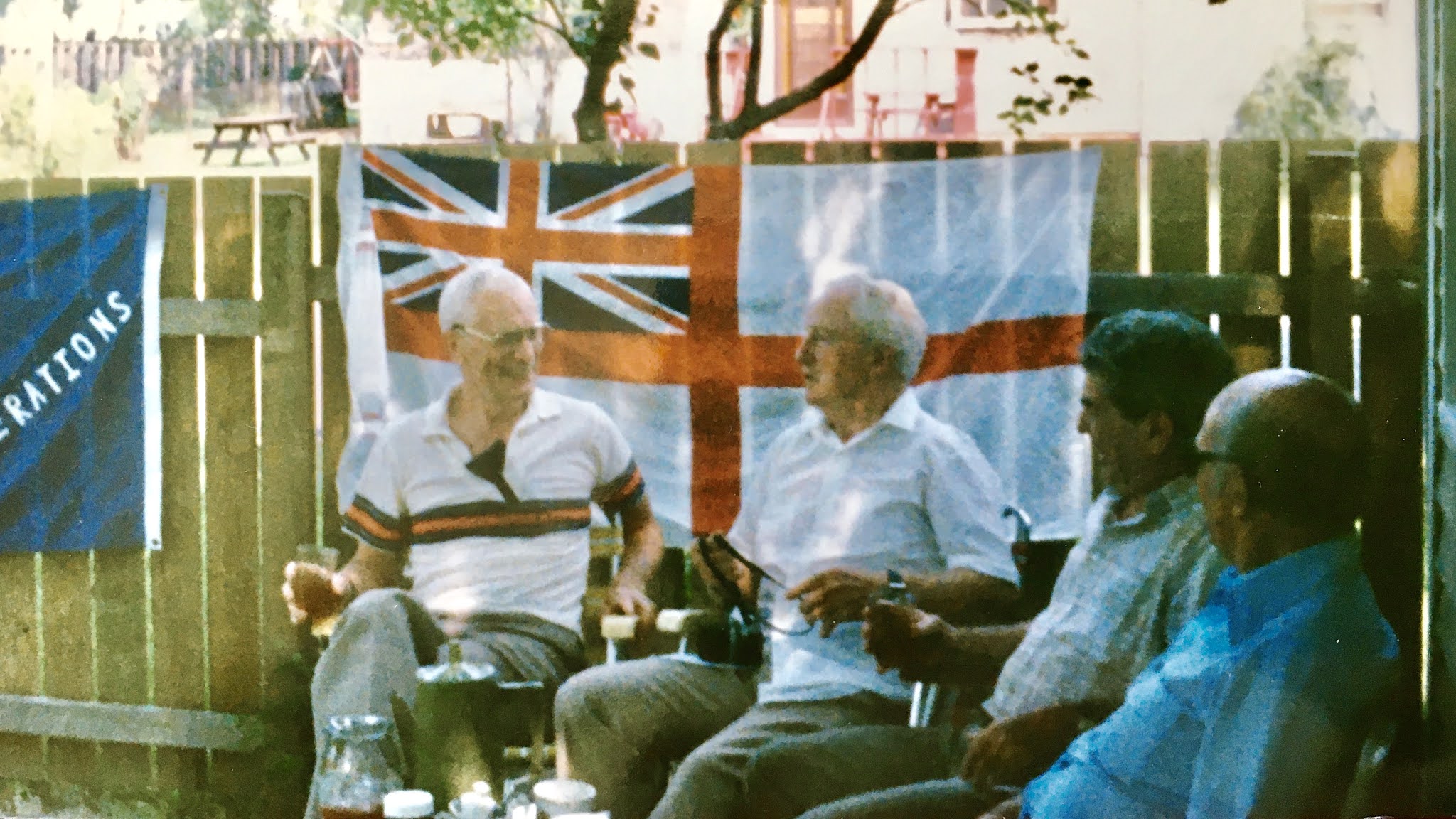
Sailors who had initially served as raw recruits in the '40s made attempts to meet again at reunions or other significant occasions. The next two photos were taken at the Woodstock Navy Club in August, 1988. The third was likely taken the same day in my parents' backyard in Norwich (16 miles south of Woodstock). I say this because the shirts worn by 3 - 4 men all match up in the three shots.

L - R: Al Kirby, Woodstock; Robert Brown, Brantford; Norm Bowen,
standing, from Constance Bay; Doug Harrison, Norwich

We can now see Art 'Gash' Bailey of London (far left) and Nelson
Langevin of Hull, Quebec is standing in Norm Bowen's spot.

Now in Norwich: Al Kirby, Doug Harrison, Nelson Langevin and Art
Bailey.  The sailors were proud to sail under the White Ensign.

Norm Bowen, Doug Harrison and their commanding officer, Jake Koyl, are mentioned in one story written by my father. Norm asked Dad to help load navy duffel bags and my dad refused. Jake Koyl had to speak with my father about the refusal and meted out a punishment.

The first two paragraphs of the story follow:

In the spring of 1942, I was stationed for a short time in navy barracks at Roseneath, Scotland. As we Canadian sailors departed from Roseneath I was detailed to work on a baggage party by Leading Seaman Bowen. I told him I wasn’t fussy about handling kit bags and hammocks, to which he replied, “Fussy or not, just get at it and lend a hand.”

After a short argument I refused (which is bad, real bad) and he took me to have a chat with our huge, no-nonsense commanding officer Lt/Comdr Jacob Koyl, later to be known as Uncle Jake. L/S Bowen explained his case about my refusal to Mr. Koyl. With that, Bowen was dismissed and the commanding officer laid his big hand on my shoulder and started to recite, without benefit of the navy book, King Rules (KR) and Admiralty Instructions (AI) about the seriousness of refusing an order.


Lt. Cmdr Koyl is far left (back row). And among others we see Al Kirby,
far right (front). Camp Saunders, Egypt 1943, prior to Operation Husky

The full story informs me that Dad's punishment lasted awhile but all ended well... eventually. (Link)

Photo of Jake Koyl and others at a reunion, perhaps.
As found in St. Nazaire to Singapore, page 333

More photos - with a few details attached - soon to follow.

Please link to more photographs at Imperial War Museum, 2014 (1)

Unattributed Photos GH

Sunday, August 22, 2021

Books: New Link to a Rare, Two-Volume Set

WWII Stories by Canadian Veterans of Combined Operations

Found in St. Nazaire to Singapore: The Canadian Amphibious War

Volume 2 is back online at The University of Alberta in Calgary!
To buy the 2-volume set is near to impossible. To view it is not

Introduction:

I have been waiting to share an online address or a link to the rare book pictured above for many years. It is mentioned in several posts, and an old link was/is provided (until corrected). But the people in charge of posting the two books - filled with WWII veterans' stories (i.e., veterans of RCNVR, RCN and Combined Ops) - changed how the book was presented on a university website, years ago, and the books have been unavailable since that time. 

The two books are entitled St. Nazaire To Singapore: The Canadian Amphibious War 1941 - 1945 and were prepared, self-published and originally distributed at Navy reunions (etc.) by David and Catherine (Kit) Lewis and Len Birkenes in the mid- to late-1990s.

My father's copies are dated November 1997:

The first page includes drawings re landing crafts (by DIL - David Lewis)
My guesses from L - R: LCP, LCM, LCA, LCT, LCI(L), LST
with a larger troopship in the background, e.g., Prince David

David Lewis was inspired to write about his own experiences in Combined Operations, and collect and publish the experiences of other WWII veterans, after reading a book (of collected stories, entitled Combined Operations) created by another Canadian in Combined Ops, i.e., Clayton Marks of London, Ontario. The path begun by Mr. Marks, aka 'Red', is mentioned in the President's* Introduction included at the front of Lewis' volumes:

*Don Kemsley was President of the Royal Canadian Naval Association, 1997

A fitting dedication follows the President's introduction

FYI - Clayton Marks' book is just as rare but can be purchased from me or from his surviving family members. Email me for details at gordh7700@gmail.com

Mr. Marks' history of the role Canadians played (as members of RCNVR, RCN and Combined Ops) in major operations of WWII (incl. Dieppe, invasions of N. Africa, Sicily, Italy and Normandy) and the stories from others that he collected and published in 1993 appear in many places on this site. The first half of his Table of Contents reveals the breadth of his accounts:

Front cover of Clayton's book

The above headings represent about half of Clayton's text
To read Al Kirby's fine account re Dieppe, click here

Clayton Marks, David Lewis and three contributors to the collected stories - all Canadian WWII veterans of Comb. Ops. - meet at Clayton's house in London, 1993:

As found in St. Nazaire to Singapore, Vol. 1, page 333

From the collection of Doug Harrison. Lewis sports the beard

David Lewis, foreground right, w beard, pipe, checks out Myrtle the Turtle
My father Doug Harrison peeks at the scene from centre of back row
Full story in St. Nazaire to Singapore, page 383


The 'Forward' to the two-volume set, written by David Lewis (approx. 1997) is provided below:


The collection of three volumes by Marks and Lewis make up the best history related to the war experiences of Canadians in Combined Operations that is available today. And my father's compilation of stories in book form is a very suitable companion to the three volumes.

Unattributed Photos GH
Friday, August 13, 2021

Passages: "The Second World War" by Antony Beevor

Comprehensive Book Touches on Countless Poignant Details

The International Air Force, Chaos, Fear, and Stress

Poignant passages are a regular component
of Beevor's well-written text. GH

Introduction:

Dictionaries define 'poignant' in the following ways:

- evoking a keen sense of sadness or regret. "a poignant reminder of the passing of time"
- painfully affecting the feelings : PIERCING
- deeply affecting : TOUCHING
- designed to make an impression : CUTTING "poignant satire"

One online source states:

Did you know? Poignant comes to us from French, and before that from Latin-specifically, the Latin verb pungere, meaning "to prick or sting." MOVING, IMPRESSIVE, POIGNANT, AFFECTING, TOUCHING, PATHETIC mean having the power to produce deep emotion. 

The author of The Second World War, in his 783-page account, not only informs the reader but moves, impresses and pierces as well. A few excerpts are provided below.

From Chapter 8, Operation Sealion and the Battle of Britain, June - November 1940:

An International Air Force

In that momentous summer,
Fighter Command took on the character
of an international air force.
Out of the 2,940 air crew who
served during the Battle of Britain,
just 2,334 were British.
The rest included 145 Poles, 126 New Zealanders,
98 Canadians, 88 Czechs,
33 Australians, 29 Belgians,
25 South  Africans, 13 Frenchmen,
11 Americans, 10 Irishmen and
several other nationalities.

Thrown Into the Routine

...Fresh pilot officers arriving as reinforcements
eagerly questioned those who had been in action.
They were thrown into the routine...

The waiting was the worst part.
That was when pilots suffered from dry mouths
and the metallic taste of fear. Then they would hear
the dreaded sound of the field telephone's cranking ring,
and the cry of 'Squadron scramble!' They would run out
to their aircraft, their parachutes thumping against their back.
The ground crew would help them clamber into the cockpit,
where they ran through the safety checks.
When their Merlin engines had roared into life,
chocks were hauled away and the pilots taxied
their fighters into position for take-of;
they had too much to think about to be scared,
at least for the moment.

Keep 'Eyes Skinned at all Times'

Once airborne, with the engines straining as they gained altitude,
the newcomers had to remember to keep looking all around.
With a constantly swivelling head, necks were
rubbed raw by regulation collars and ties.
It had been drummed into them to
keep their 'eyes skinned at all times.'
Assuming they survived their first action,
and a number did not, they returned to base to wait once more,
eating corned-beef sandwiches washed down with mugs of tea
while their planes were refuelled and rearmed. Most fell asleep
immediately from exhaustion on the ground or in deckchairs.

When back in the air again, the sector controllers
would direct them towards a formation of 'bandits'.
A cry of 'Tally ho!' over the radio signified that a formation
of black dots had been spotted by another member of the squadron.
The pilot would switch on the reflector sight, and the tension mounted.
The vital discipline was to keep fear under control,
otherwise it would lead rapidly to your death.

Pages 132 - 133

Spitfires, Hurricanes, Bombers, and Chaos

The priority was to break up the bombers
before the umbrella of Me 109s could intervene.
If several squadrons had been 'vectored' on to the enemy force,
the faster Spitfires would take on the enemy fighters,
while the Hurricanes tried to deal with the bombers.

International Air Force: Czech pilot, FO John Vasicek, in an RAF Spitfire

Within seconds the sky was a scene of chaos,
with twisting, diving aircraft jockeying for position
to 'squeeze off' a rapid burst of gunfire,
while trying to remember to watch out behind.
Obsessive concentration on your target gave an enemy fighter
the chance to come in behind you without being spotted.
Some new pilots, when fired on
for the first time, felt paralysed.
If they did not break out of their
frozen state, they were done for.

If the engine was hit, glycol or oil
streamed back and covered the windscreen.
The greatest fear was of fire spreading back.
The heat might make the cockpit hood jam,
but once the pilot had forced it open and released his harness straps,
he needed to roll his machine upside down so that he fell clear.
Many were so dazed by the disorientating experience that they
had to make a conscious effort to remember to pull the ripcord.
If they had a chance to look around on the way down,
they often found that the sky, which had seemed so full of aircraft,
was now suddenly deserted and they were all alone.

Pages 133 - 134

Savage Exaltation, Exhaustion, Fear and Stress

The honest pilot would admit to 'a savage, primitive exaltation'
when he saw the enemy plane he had hit going down.
Polish pilots, told by the British that it was not done
to shoot German pilots who baled out, resorted in some cases
to flying over their parachute canopy instead so that it collapsed
in the slipstream and their enemy plummeted to his death.
Others felt a moment of compassion when reminded 
that they were killing or maiming a human being, 
rather than just destroying an aeroplane.

The combination of exhaustion and fear built up dangerous
levels of stress. Many suffered from terrible dreams each night.
Inevitably some cracked under the strain.
Almost everyone had 'an attack of the jitters' at
some stage, but pushed themselves to continue.

A number, however, turned away from
combat, pretending they had engine trouble. 
After a couple of occurrences, this was noted.
In official RAF parlance it was attributed to 'lack of moral fibre',
and the pilot concerned transferred to menial duties.

The vast majority of British fighter pilots were aged under twenty-two.
They had no option but to grow up rapidly...

Pages 133 - 134

FO John Vasicek, 'missing after air operations'
Photo - from the collection of Charles Vasicek


More information about FO John Vasicek can be found in an earlier post by Editor GH.

For more poignant details re WWII and Canadians in Combined Ops please link to Passages: Canadian Sailors in Convoys

Unattributed Photos GH

Wednesday, August 11, 2021

Book: "The Second World War" by Antony Beevor

An Excellent "Overall, World-wide View" of Changing Tides

Where, Why, When, Who and How Much (783 Pages)

Very comprehensive coverage of changing war fronts, globally

Introduction:

The book by Antony Beevor is not related specifically or in a really significant way to Canadians in Combined Operations, i.e., my chief area of interest, as regular visitors to this site already know. But as I read it I gained more insight into the immensity of the war, its scope globally, its ultimate costs, its causes and ongoing affects and much more. As well, in certain chapters and passages I learned a bit more about the conditions in various theatres of war faced by my father and his 1,000 Canadian mates (approx.; they'd volunteered to join Combined Operations beginning in late 1941, and manned landing crafts during the Dieppe raid and subsequent invasions of N. Africa, Sicily, Italy and Normandy; some also acted as skilled trainers re use of cutters and landing craft on Vancouver Island from 1944 - 45).

The chapter headings listed in the table of contents reveal the breadth and width of Beevor's undertaking:


The quality of Beevor's research, as he walks readers from one theatre of war to another, chronologically, is continually evident. Poignant passages and close up views of action and devastation are gripping.

The quality of the writing is excellent as the following early paragraphs reveal:

Excerpt is from page 27

Excerpt is from page 28 

Several useful maps and dramatic photographs appear as the pages turn:

From page 23:


After page 274:

Dunkirk, rescue of survivors from the destroyer Bourrasque

I found many, many significant details that reminded me that World War II was, in part, an amphibious war; 1000s of ships of various descriptions and uses would be required by all participants. I read that two of the most well-known leaders, e.g., Hitler and Churchill, faced the same "almost impossible task of assembling enough ships and craft" to accommodate their armies' transport needs.

In the book by Antony Beevor we read:

... Hitler came to a decision. Having mulled over possible strategies against Britain and discussed an invasion with his commanders-in-chief, he issued 'Directive No. 16 for Preparations of a Landing Operation against England'.... Grossadmiral Raeder had insisted that an invasion could be attempted only after the Luftwaffe had achieved air superiority. Hadler, for the army, urged that an invasion should be a last resort.

The Kriegsmarine faced the almost impossible task of assembling enough ships and craft to transport the first wave of 100,000 men with tanks, motor transport and equipment across the Channel. It also had to consider its decided inferiority in warships against the Royal Navy...

Pages 126 - 127, June - November 1940

A few fine books and websites provide information about how the Combined Operations organization began in the UK and how Canadian involvement in it originated. The book A Watery Maze by Bernard Fergusson, copyright 1961, is one such fine resource.

In it one finds the following passages that reveal that Hitler and Churchill thought along the same lines at times. For example, Churchill's verbal briefing (with Lord Louis Mountbatten, in October, 1941) ran something like this:

I want you to succeed Roger Keyes in charge of Combined Operations. Up to now there have hardly been any Commando Raids. I want you to start a programme of raids of ever-increasing intensity, so as to keep the whole of the enemy coastline on the alert from the North Cape to the Bay of Biscay. But your main object must be the re-invasion of France.


Mountbatten: Photo Credit - A Watery Maze

You must create the machine which will make it possible for us to beat Hitler on land. You must devise the appurtenances and appliances which will make the invasion possible. You must select and build up the bases from which the assault will be launched. Before that you must create the various Training Centres at which the soldiers can be trained in the amphibious assault. I want you to bring in the Air Force as well, and create a proper inter-Service organisation to produce the technique of the modern assault. I want you to consider the great problem of the follow-up, and finally, I want you to select the area in which you feel the assault should take place and start bending all your energies towards getting ready for this great day...

All other headquarters in the United Kingdom are at present on the defensive. Your headquarters are being created to be on the offensive. You are to give no thought to the defensive. Your whole attention is to be concentrated on the offensive. 
(Pages 87 - 88)

Just a few pages later we read:

Obviously two of the most urgent problems were the provision of landing ships and craft, and the crews to man them... As an illustration of the magnitude of the crew problem, the Joint Planners, in the very month of Mountbatten's appointment, had persuaded the Chiefs of Staff that our requirements in LCTs alone (i.e. landing craft for tanks) for the eventual invasion would be 2,250 - a figure to daunt almost anybody. And where were the crews to come from? Canada made an offer, which was gratefully accepted, of 50 officers and 300 ratings, but this was a drop in the bucket. (Page 93)

Photo Credit - A Watery Maze

My father, Doug Harrison (left) and Buryl McIntyre, both of Norwich, ONT
were among the first members of Canada's 300 Comb. Ops ratings
Photo from November 1941, HMCS Stadacona, Halifax


The Effingham Division, in Halifax, Canada, 1941. Almost to
a man, this group was the first to join Combined Operations

There are several other passages from A. Beevor's fine book that reveal details indirectly connected in some way to the Canadians in Combined Operations as well, along with details re Hitler and Churchill and certain plans of war that did not hold water in some situations.

I have listed a few poignant passages concerning the Battle of Britain here: Passages... by A. Beevor.

I recommend the book to my readers. I've seen Beevor's account re WWII in both new and used condition in local stores in my home city, London ONT. I hope interested readers can find it as easily. Happy hunting, I say.

Please link to several details re another good read, "One Day In August" by David O'Keefe .

Unattributed Photos GH