Thursday, May 12, 2022

Photographs: Canadians in "Combined Operations" (Pt 9)

The D-Day Normandy Crossings and Landings

Work Horses of Allied Landing Craft Flotillas

Jack Anderson and David Lewis grappling with the Sgt. in the water
From Combined Operations by Londoner Clayton Marks, page 136

Introduction:

In the top photo it is difficult to see J. Anderson and D. Lewis in the water between a troop ship (unidentified, right) and Landing Craft Infantry (Large), aka LCI(L) 311 (264th Flotilla). However, they are a bit more visible in the next photo, also found on page 136 of Mr. Marks' rare book about the Canadians who volunteered for the Combined Operations organization during WWII.

Jack Anderson climbing to safety. David Lewis and Sgt. still in the water

The book Combined Operations by Clayton Marks, once distributed at Navy reunions in the early - mid 1990s, inspired David and Catherine (Kit) Lewis and Len Birkenes (RCNVR, Combined Ops) to write, collect, edit and print another batch of stories by Canadian Navy veterans. The books are entitled  St. Nazaire to Singapore: The Canadian Amphibious War 1941 - 1945 (Volumes 1 and 2) and can be read in their entirety online. Use the following valuable links: Volume 1 here; Volume 2 here. 

Clayton Marks hosted a get-together at his London home in the 1990s that included David Lewis and three other RCNVR/Comb. Ops veterans around the time Clayton's book was being printed and Lewis's was getting started:

Five significant books were produced by four of the Canadian men above

Back, L - R: 'Gash', Clayton, and David Lewis (David wrote and
collected stories for St. Nazaire to Singapore (two lengthy volumes)
Front L - R: Doug (my father) and Al (full names are w top photo)
For more information about these and other veterans, click here

Below is an excerpt from David Lewis' work in Volume 2 related to the earlier photo of "Jack Anderson climbing to safety. David Lewis and Sgt. still in the water." David (D) is chatting with Murray Baker (M) - a former shipmate - while looking at old black and whites re WWII:

The excerpt is from St. Nazaire to Singapore, page 351

Four full-page photographs follow from Combined Operations, from pages 137 - 140. Photo Credits are not listed:

Caption - Debarking D-Day
Photo Credit - NA [Help Wanted!]


Caption - D-Day Crossing

Caption - Embarking Southampton

Caption - Debarking - Rhino Ferry Dock - D-Day

While looking at RCN Photographer Gilbert A. Milne's book entitled H.M.C.S. - One Photographer's Impressions of the RCN in WWII I spotted the following photographs and caption on pages 102 - 103. The first photo is the same as the first one in Clayton Marks' group of four above, and I would not be surprised if Milne deserves the credit for many of the unattributed photos reproduced in Combined Operations:


Jack Anderson was mentioned in the caption of the first two photographs in this entry (top of page) and his lengthy written report (an 8-page diary entry) re the Normandy crossings and landings is included in the book Combined Operations, pages 141 - 148. I share the first two pages below:

LCI(L) - 311 "DIARY" 

by Lt. J. Anderson

Monday, June 5 D-l (D-Day minus 1)

Started out as a normal day with the usual sloppy hands fall in. Dave (Lewis likely) slightly annoyed because he couldn't get us all in the picture. Ian (Barclay) with a pre-invasion enthusiasm, actually left the ship by 845 to scour the town for liquor. By noon, with only one wine merchant and a brewery to canvas, he had only managed a case of Guinness for each craft. Oh well, Guinness is good for you. Most of the day was spent in trying to get in various lists and forms all of which were marked secret and obviously as important as European plans. By five p.m. it appeared the big show was definitely on and the morale of the ship's company bucked up 100%. The first ship in our trot slipped at 715 and we pulled away from the jettyside about 730. There were only four people there - Chief Biggs, the writer and two Yanks from the 75 which came down to let go our lines. All that was said were a few "goodbyes and good lucks". Most uninspiring.

The passage down Southampton waters and the Solent was a nightmare. Dave had gone below to try to catch a few winks so I found myself almost alone on the bridge - that is (if) one drunken C.P.O. and a stupid Army officer count. Ian came up shortly. At the old docks a few soldiers and dockyard mateys took off their hats and cheered. They could almost be heard on the ship but the troops got the idea and cheered back again. Then started the old Army songs - a bunch of new ones too - apparently picked up in North Africa. I'm still waiting to hear Dirty Girtie though. Just beyond Calshot Light Vessel an ex-cruiser, now a minelayer, had her crew lined up in number threes on the maindeck. As each craft passed they all cheered. Only twenty craft passed but they must have been rather hoarse at the end of the evening. At ten o'clock we went through the Hamplead boom. As we did, two Hunt class destroyers came speeding UP and took up their respective positions ahead and astern of the Flotilla. By 130 Dave came on the bridge and Ian and I went below. Had a Guinness with the Army Majors and turned in.

Tuesday, June 6 D-Day

1:30 seems to come quickly, especially when you get to sleep at midnight. I stumbled around for about 15 minutes and finally got up to the bridge about two o'clock. Dave was curled up in a corner trying to sleep likely most uncomfortable. Ian went down for a short nap. There was nothing out of the ordinary until about four when great white flares were dropped about twenty miles on our port bow. Our aircraft had been droning over all night so it was hard to say who dropped them. It did liven up the middle a bit though. Our trip was uneventful until we dodged two mines, one to starboard and one to port.

At 9 a.m. we arrived in the waiting area. As far as the eye could see along the beach, the water was covered with ships. The cruisers, one to every shore battery, were firing the odd salvo and there appeared to be a lot of smoke along the beach. At this point we started Kyle capers in the form of ring-a-round the rosie until eleven when we were ordered to beach. We formed sub divisions in line abreast and charged at the beach at flank ahead. Our pretty manoeuvers were ruined however by the number of craft on the beach - they don't look good high and dry. Made a nice beaching and the troops got off quickly chiefly due to Dave's turning on the loud hailer and screaming continually "get off my bloody ship" at them. After the first five minutes they decided he meant business and literally fell over themselves trying to get down the ramps. When we came out we realized that we had floated over the top of the German beach barriers. It's luck the tide was high. The only excitement, aside from seeing about 150 German prisoners sullenly marching along the road, was the ping of a few rifle shots fired by some damn fool on an LCT. Ain't war hell! Kyle, the Gunnery Officer, was disappointed with the lack of excitement and the fact that the cruisers and destroyers were shelling inland positions. Later, when we anchored, he deflated his ego by firing a few rounds from his pistol in the water. After this was all over we went out and anchored about a mile from the beach and started squaring off the ship. Just after supper we had an alert, the first hint of enemy opposition from the air. At ten thirty Dave sounded action stations so I had to get out of bed. I was too tired to take even a remote interest- so after watching the tracers for a few minutes I went back to the old bunk and crashed - right through two later air raids.

Wednesday, June 7 D+l

Having slept through these two air raids, Dave and Ian decided I needed sleep so they let me snore on until nine.

About 10:30 a.m. we received a signal from S.O.F.C. saying that "five infantry carriers are arriving at 1700". We were to unload them. By 11:00 we were under way searching for 5 carriers. We found three in one place but they were in Force J area. Finally by 2:30, after having darted back and forth between endless lines of ships, anchored and doing nothing, we went back to these three and started unloading one, the Bibby liner "Cheshire". We took 250 Cameron Highlanders and about 150 Pioneers.

In the midst of all the excitement, Dave jumped in to help a sergeant that had fallen off the Jacob's ladder. I climbed down the thing with a knife in my teeth, pirate style, so Dave could cut him loose. Unfortunately I had to get wet. Meanwhile Ian had broadcast to the world his profound opinions of the Allied landings over the B.B.C. The announcer was genuinely concerned over all the firing from the cruisers, one shell in every ten minutes (and only one cruiser was firing) and a large red ensign. He had put these two tidbits together and concluded there was an air raid on and so heroically, in the midst of battle, broadcast the unloading of the "Cheshire" troops. One amazing sight is the number of cruisers and destroyers which are anchored off the beach. They serve no apparent purpose, but they do look nice. There cannot be that many senior staff officers requiring H.Q. ships. If there are, it helps explain a lot of things about a lot of other things.

The beach on the whole looked a lot better as they managed to beach 10 LST's.


Readers can read the entire diary entry by Lt. Anderson by clicking here: D-Day Normandy - Lt. Anderson's Diary

More photographs follow from Combined Operations by Clayton Marks:

Caption: What a Mess! Looking for a place to debark. Page 149

Caption: Landing D-Day - LCAs (work horses, as were LCMs)
Page 150. Photo Credit - N/A

Mr. Marks includes a page from the February 29, 1944 issue of the Evening Standard. (Help Wanted. What city in Canada?):

As found on page 170, Combined Operations

Final Photos; all have been squeezed together on pages 171 and 172. I have taken separate photos of the following shots, likely taken by a collection of sailors, officers, and RCN photographers. No photo credits are provided:


The book Combined Operations concludes with the following entries:
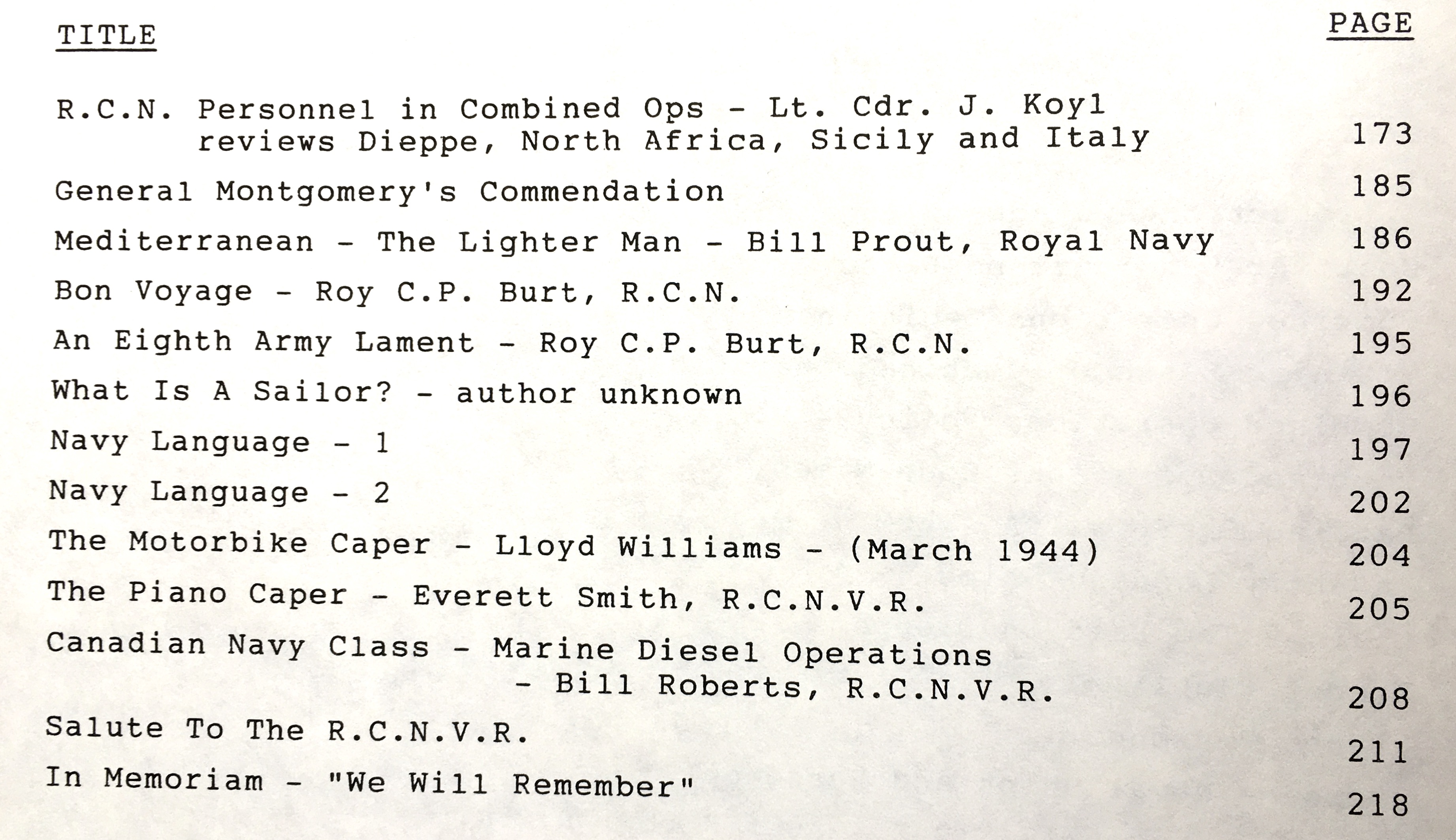
Table of Contents, Combined Operations, page ii

An informative excerpt by Lt. Cdr. Jake Koyl, beginning page 173, is provided below:

R.C.N. PERSONNEL IN COMBINED OPERATIONS

Recorded information from files of Lt. Cdr. J.E. Koyl D.S.C. - R.C.N.V.R. (deceased)

The idea of Combined Operations is not by any means a new one but merely the bringing back to life of an old war idea. After the evacuation of Dunkerque, Combined Operations began to take on a definite plan under the leadership of Sir Roger Keyes who was appointed Chief of Combined Operations (C.C.O.) on July 17, 1940. This Junior branch of the Navy had facing it all the problems and difficulties which a new idea or branch encounters in a service built up on centuries of tradition. This was most unfortunate as it could not enjoy the necessary co-operation to build itself up to the degree of efficiency which would be required for the tasks that lay ahead,

Up until and as late as January 1943, Flotilla Officers who were then building up new organizations, could not procure even sufficient craft to train their men for actual operations. It has been known for a Flotilla Officer to approach an enemy coast not ever having seen the majority of his men in training and with the full realization that they were not capable of doing their task in a competent manner. Conditions improved shortly after this, and it was sincerely hoped that the new year would do away with the utter confusion and chaos of 1942. This is not a criticism of the Combined Operations policy during that period but it is merely being mentioned to bring home the fact that several groups of Canadian volunteers were face to face with conditions which were discouraging.

In the early days of Combined Operations, a sprinkling of Canadian Officers who were on loan to the R.N. were present on some of the more important raids, or should one say raids that were released to the press; Lofoten, Boulogne, St. Nazaire. In the latter part of 1941, the Canadian Navy committed itself to send on loan to the Royal Navy, 50 Officers and 500 Ratings, to form Canadian Flotillas. The Officer material for these first two units were chosen from the Naval Colleges H.M.C.S. "ROYAL ROADS" and H.M.C.S. "KINGS". All men joining this band were to be volunteers and unmarried. Little information could be gathered on the subject as a cloak of mystery and "hush hush" covered the whole picture.

In January, 1942 in Volendam, fourteen Officers and ninety-six Ratings sailed from Canada for the U.K. knowing nothing of what lay ahead but looking forward to a rather exciting life. On arrival in the U.K. they began a course of training which lasted two months, most of this training being LCA's, Landing Craft Assault, and LCM's, Landing Craft Mechanized. By the end of April they were split up into two operational Flotillas.

The first operational call received was in early June when they sailed away from their base to take part in some operation, but this was cancelled and all were ordered to return to base. These periods of suspense were most trying on the morale of all men as during these periods of waiting, sometimes lasting over two months, they were posted to routine camp duties.

The first opportunity for action came with the Dieppe raid. Though, not operating as Canadian units, Officers and men were intermingled with R.N. Flotillas and much valuable experience was gained.

One all Canadian Flotilla was H.M.S. "Duke of Wellington" except for the C.O. who was British. The Commanding Officer was killed around 0630 in the initial assault on Blue Beach. The rest of the operation was completed with the all Canadian Flotilla under the command of Lt. J.E. Koyle. They left the beaches on orders from H.M.S. Calpe (H.Q. ship) and returned to Newhaven. A more difficult task could not have been chosen for their baptismal of fire. Details of the enemy opposition and the intensity of fire need not be elaborated here but the Canadians carried out their very hazardous duties in a manner which brought great credit to them. Casualties were few and in view of the intensity of enemy fire the percentage was very low.

Shortly after Dieppe, the Canadian Flotillas, now six in number, were making their preparations for a new operation which subsequently turned out to be "Operation Torch" eg. the North African invasion. For several weeks the British and American troops were trained in amphibious warfare and on completion of this training, the invasion was completed successfully. This operation, as compared to Dieppe, was a complete holiday as the opposition in most quarters was negligible. By the middle of December, 1942, the Canadian Flotillas were returning to England. The H.M.S. Ettrick was sunk off Cadiz with the loss of 18 Canadians. Survivors were picked up by a Norwegian destroyer and returned to Gibraltar. The S.S. Clan McTaggart was also sunk in approximately the same area with the loss of 1 Canadian. Picked up survivors were returned to England aboard a British corvette.

On their return to England and by early January they were re-organized into 4 Flotillas, the 55th and 61st manning LCAs and the 80th and 81st manning LCMs. Once again preparations were being made for another operation and by the end of May, 1943, the four Flotillas arrived in Egypt. Further exercises were carried out and finally came the invasion of Sicily and the operation in Italy. The Canadian Flotillas at all times performed their duties in a manner which brought the highest of praise from our Commanding Officer, Admiral Troubridge, Admiral of the force.

Passage to Suez -

Most of the personnel of the 80th Flotilla, including Lt. Koyl and about half the 81st, sailed from the Clyde late in March of 1943 and proceeded in a fast Landing Ship Infantry convoy via the Cape of Good Hope to Suez, arriving there on May 2nd. The Flotillas were disembarked at a Combined Training Centre on the Bitter Lakes. The other half of the 81st, including Lt. W.J. Mullins, R.C.N.V.R, Flotilla Officer, sailed from the Clyde in S.S. "EMPIRE CHARMIAN" on March 26, 1943. With the "EMPIRE CHARMIAN" sailed R.F.A. "ENNERDALE" of the 108th L.C.M. Flotilla (Lt. J. Whittal, R.C.N.V.R. Flotilla Officer).

Officer Jake Koyl with Canadian members of Combined Ops and Landing
Craft Flotillas prior to Operation HUSKY, July, 1942. Photo and caption
from St. Nazaire to Singapore: Canadian Amphibious War, 1941 - 45

Obituary of Lt. Cdr. Jake Koyl, RCNVR, Combined Operations

From Freetown, "EMPIRE CHARMIAN" proceeded independently to Walvis Bay where she spent two and a half days and was sailed in a small convoy to Capetown. After two days she caught a convoy to Durban and sailed from there in convoy as far as the south end of the Mozambique channel whence she proceeded independently, calling at Aden and arriving at Suez. There the Flotilla Officer decided to take his part of the Flotilla to join the others at "SAUNDERS", where they spent just over three weeks getting the craft into first class condition and enjoying rest and sunshine. For the benefit of the new hands, three days' exercise was carried out and the Flotilla Officer found himself satisfied that everyone knew his job. Further exercises were not held since it was undesirable to use the craft more than necessary before the operation.

Meanwhile the remainder of the 80th Flotilla was arriving with their craft in small groups from S.S. "GLENARTNEY" and S.S. "PARDO" which had proceeded via Freetown and Capetown. At the last minute before the operation was mounted at Port Said, the final batch of the 80th Flotilla arrived in S.S. "SILVER WALNUT". She had been held up with engine trouble at Durban for ten days and when she was sailed independently broke down completely about 300 miles east of Madagascar. The vessel drifted for some time in an area frequented by Jap U-boats but she eventually was repaired and proceeded to Aden arriving about June 24th. The delay in "SILVER WALNUT" arriving at Suez necessitated the transfer of her personnel immediately to Alexandria. There was no time to transfer the craft she carried and therefore five craft of the 80th Flotilla were left behind.

As found in Combined Operations,  pages 173 - 175


This is the last post in a series of 9 individual offerings. I will next create an entry that has a link to each of the nine posts in one place, for easy reading.

Until then, please click here to link to Photographs: Canadians in "Combined Operations" (Pt 8)

Unattributed Photos GH

Tuesday, April 26, 2022

Photographs: Canadians in "Combined Operations" (Pt 8)

The Normandy Invasion (Including Operation Neptune),

The Largest of All Combined Operations, June 1944

Map found in Combined Operations, by C. Marks (page 106)

Introduction:

The book that was self-published/printed by Mr. Marks contains a healthy section devoted to the largest of 'combined operations' of World War II, from pages 106 - 158. The photographs included with his account of D-Day Normandy beginning June 6, 1944, are in many instances iconic, and taken by well-known photographers of the day. When known, I attach proper attribution.

Clayton Marks' written account has for the most part been shared in earlier posts and I will provide links to those entries.

As well, in the final post (i.e., Part 9, upcoming) I will add a story/report or two that have not been shared on this site previously. (If you have not heard of Operation Dragoon, then stay tuned : )

In the lower right-hand-corner of the map above one will see 'Operation Neptune' listed and I am sure many readers know it to be the Allied Navy's contribution to Operation Overlord - the invasion of France.

Photographs and links to written accounts (and more photos) follow. Questions and comments can be addressed to me at gordh7700@gmail.com

Caption: LCI(L)305 and LCI(L)295 of the 264th Canadian Flotilla, beaching
the French coast. The 264th was made up of 7 Canadian and 3 American LCIs,
 i.e., Landing Craft, Infantry (Large). Photo: Combined Operations, pg. 107

Alternate caption for same photo has been found: Men of the 2nd Essex wade ashore at Jig Red Beach, Normandy from HMC LCI(L)-305 and HMC LCI(L)-295, in the background, 6 June 1944. HMC LCI(L)-295 carried D Company, 2nd Essex. Photo Credit - Robert Hurst. Link - http://www.navsource.org/archives/10/15/150295.htm

Another copy of the same photo is provided below, but no caption was provided:


A photo of a similar scene is provided below:

Caption - Personnel of the 9th Canadian Infantry Brigade landing from LCI(L)
125 of the 3rd Canadian (264th RN) Flotilla on 'Nan White' Beach on D-Day.

Below is a brief excerpt from Combined Operations by Clayton Marks of London, Ontario. The book was printed in 1993 (approx.) and is extremely difficult to find. Mr. Mark's 23-page-long account begins as follows:

OVERLORD
D-DAY
OPERATION NEPTUNE
June 6, 1944

In May of 1945 a Russian war correspondent, entering Berlin and surveying the ruins about him, wrote with something like awe: "It is as if giants with colossal hammers had beaten Hitler's city into the earth". Giants indeed they were; whose strength in the east flowed to them from all of Asia and in the west from almost every harbour of the world and over almost every sea. There was appalling majesty in the effort called forth to expunge the dream of an Austrian corporal, "that monstrous product of former wrongs and shame".

Operation Overlord was the stately title of the plan which encompassed the share of the western world in the final and total defeat of the Reich. Operation Neptune was the seamen's phase of the plan. It embraced, first, the task of landing the armies of liberation on French soil; secondly, the maintenance of their waterborne lines of communication and supply. The direct Canadian contribution of 110 ships and 10,000 men represented approximately four percent of the total Naval strength involved.

The eastward movement and assembly of the fighting vessels began in January of 1944. The flood of cargo moving to the United Kingdom rose also in a long, rhythmic swell through the winter and spring. It rose still higher in June and July, growing with the voracious demands of the armies battling in France; and it did not sensibly decrease until the end of the war.

The cargo moved upon an Atlantic where the Allied battle was now truly a defensive one; where the objective had been gained, the bridge established. There remained only the necessity of defending the conquest against an enemy who refused to admit defeat. It was a lesser task than that of earlier years; but it was still not a small one. The sailing of larger convoys at longer intervals had begun late in 1943. Early in 1944 the intervals were opened out again. The number of ships in each convoy continued to increase, until the larger bodies consisted of something like 150 ships which might carry altogether as much as a million tons of supplies.

The vast movement of traffic around the coasts could not be entirely concealed from the enemy. It had been underway to some extent since early in the winter, partially concealed amid the routine movement of coastal convoys. Nevertheless, its increased volume was becoming more apparent all the time; and now the policy was to mislead the Germans. The strength assembling in the southeast would be displayed, pointing a threat directly across the Straits of Dover. Preparations in the south and west, which might have indicated the actual invasion area farther down the French coast, were carefully concealed. Best hidden of all were the assemblage of block-ships, barges and breakwaters which were to be used for building the great pre-fabricated harbours. Had these been noted, the Germans might conceivably have guessed at the most novel and daring feature of the Allied plan.

Prince Henry and Prince David, now converted from armed merchant cruisers to landing ships, had arrived in the Clyde in February to complete their fitting out. After completion they had gone to Cowes on the Isle of Wight with others of the assembling landing ships. Prince Henry was to be Senior Officer of Landing Ships in Force J, one of the five assault forces destined for the five sectors of the Normandy beach front. She was responsible from now on for the discipline, navigation, station-keeping and general efficiency of twenty-two converted merchant vessels which she would lead down the swept channels into position off the beaches of Juno sector. Prince David was to be Senior Ship of one of the subdivisions of the same force.

At Cowes on April 21st the two Canadian landing ships were joined by their Flotillas of assault landing craft. Prince Henry was to carry the eight assault craft of the 528th Canadian Flotilla. Prince David would carry the six craft of the 529th Canadian Flotilla. In addition, there arrived within the next few days three Canadian Flotillas of the larger Infantry landing craft which would make the cross-channel voyage under their own power. They consisted in all of thirty craft, divided into the 260th, 262nd and 264th Flotillas; and their arrival at Cowes had been preceded, as in the case of the assault craft, by an intensive training period. Exercises, in which the Canadian ships and craft combined with many more of the Royal Navy and the United States Navy, now began on a very large scale.

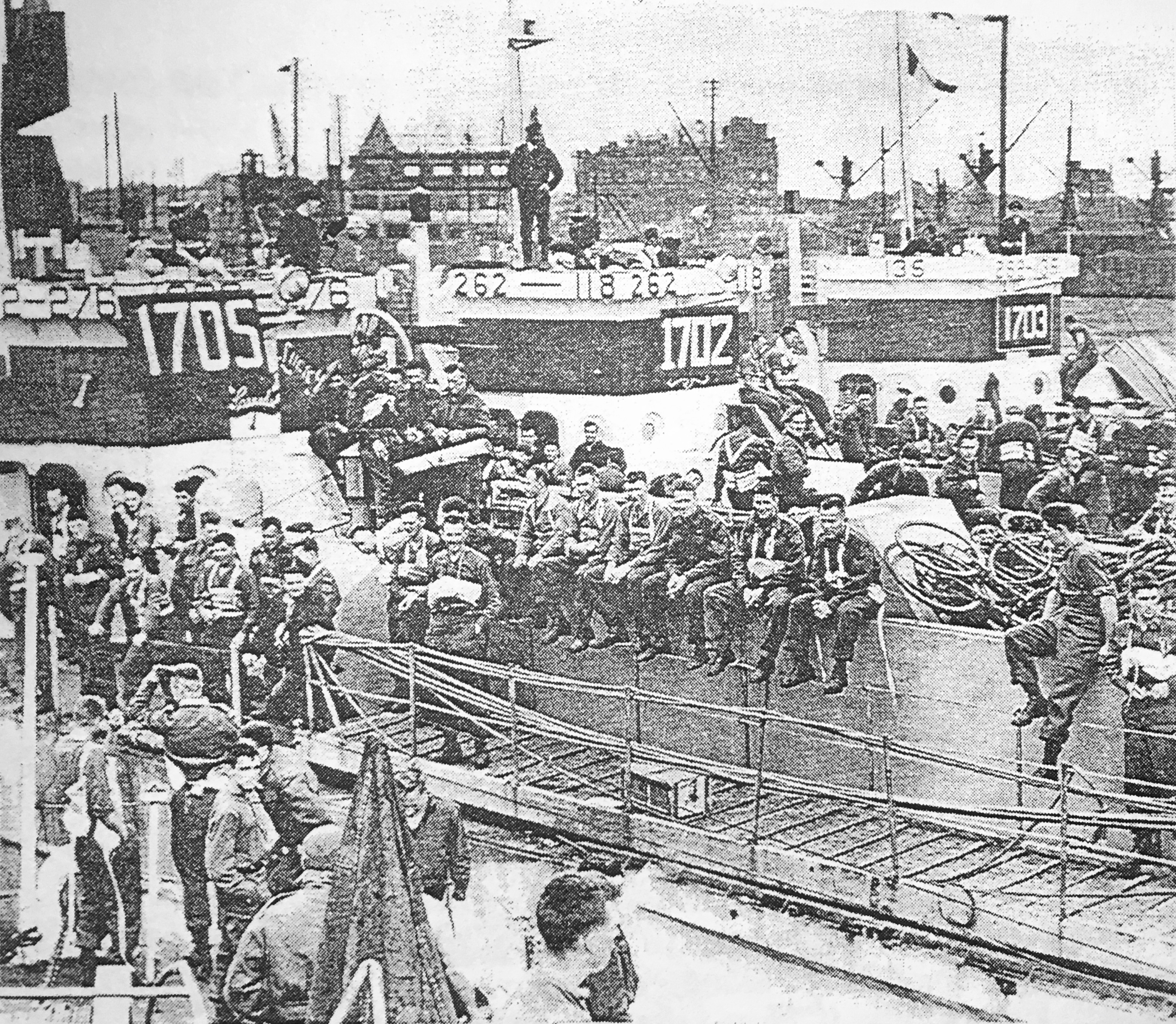
Troops waiting out departure aboard 262nd Flotilla, LCI(L)s,
for D-Day Normandy. Tied up alongside in Southampton
during a day of bad weather. Canadian Press Photo as
found in St. Nazaire to Singapore, Vol. 2, pg 231

During Fabius, the largest of the exercises, a huge assault force sailed out from the Solent in broad daylight and continued on for twenty-five miles south of the Isle of Wight under a bright moon. It was a dress rehearsal, very probably observed by the enemy; and had he chosen to add realism by attacking the convoys, it would have been a welcome gesture. No hostile movement was observed, either from the air, from the seas about, or from the coast of France. The great force, nearly in mid channel, turned back before dawn and poured its troops ashore under the thunder of supporting guns on the beaches of Bracklesham Bay, some ten miles east of Portsmouth.

Fabius was the final rehearsal. On May 24th the King inspected all the assault ships and craft, now assembled in Southampton Water and the Solent. The Commanding Officers of the Prince Henry and Prince David, as well as Officers of the landing Flotillas, were presented; after which the small ships sailed past while His Majesty took the salute. There remained after that only anxious, last-minute preparations and days of waiting.


Officers and Ratings awaiting the 'Royal Sail Past' alongside in
Southampton. Photo by Sub. Lt. David J. Lewis, RCNVR
Found in St. Nazaire to Singapore, Vol. 2, page 230

On land the assault divisions of the armies were moving into the sealed camps. Among the thousands of ships gathered along the west, south and east coasts from Bristol Channel to the Thames, some already held the bound masses of mimeographed papers which were their invasion orders. Others would receive them by special courier at set hours within the next few days. As soon as the orders came on board, the ships, too, were sealed. No man, except on an urgent official mission and with a signed order from his Captain, could set foot ashore.

By the first day of June many ships of Canada were a part of this host separated by barbed wire, bayonets or salt water from all other concerns of men. Others would join within the next day or so; to engage in feverish, last minute preparations or share the tense weary hours of waiting which still lay ahead. And there were yet other Canadian ships whose work, integrally associated with Operation Neptune, had begun weeks and months before and had still long to continue. On the right flank, where the Channel opened out into the North Sea above the Straits of Dover, and on the left flank, westward through the Channel to the shoulder of Ushant and southward into Biscay waters, much work had been done and much was still to do.

The forces of Overload were to strike the French coast in the region of the Seine estuary, directly across the Channel from Portsmouth, the Solent and Southampton Water. Here, enclosed by a shallow, bowl-shaped indentation known as Baie de la Seine, was the longest stretch of open shore lying within effective range of fighter aircraft based in England. It ran for some sixty miles from the mouth of the River Orne, westward along the southern face and northward up part of the western shoulder of the basin. The waters along this frontage and for a depth of twenty miles seaward to the mouth of the bay would provide anchorage for Neptune shipping. To the east the remaining fifth of the basin would be masked off from the assault area, first by a sector of heavily patrolled water, and then by a large minefield closing in Le Havre and the mouth of the Seine. At the approaches to the bay the great German mine belt, which formed an outer barrier along the coast from Cap de la Hague to Boulogne, would be slitted with lanes through which the assaulting ships could pass.

Three divisions of parachute troops were to be dropped well inland; one on the eastern flank and two on the western. The sea-borne landings were to be made on a five-divisional front; and five Naval forces, of which three were British and two American, were to deliver the troops to the beaches. The three British forces were grouped as the Eastern Task Force; the two American, as the Western Task Force. The divisional fronts along the shore - Sword, Juno and Gold in the eastern sector, Omaha and Utah in the western sector - were subdivided into brigade fronts or beaches. These, in turn, were divided into smaller beaches; on each of which Naval craft would have to set down the assigned troops and equipment at some exactly appointed day, hour and minute. This appointed time, to which every movement of the operation was related, had been tentatively set for June 5th. It remained, however, variable within narrow limits. Known only as H-Hour of D-Day, it could fall between June 5th and June 7th; or it could be postponed with immense difficulty to the period between June 19th and June 21st.

June of 1944 was the month prescribed by considerations to grand strategy. The necessary Allied forces would be assembled. Several months of good fighting weather would lie ahead. The time would coincide generally with the reopening of the Russian offensive in the east and with the breaking of the long stalemates in Italy. The entire strength of the United Nations, fully mobilized at last, would strike the enemy simultaneously on every front.

The selected periods in June were dictated by the tactics of the landing. No pre-dawn or moonlight attack against half-subdued defenses was to be risked. After a night-long smashing by aircraft, the German strong-points on shore were to be drenched by thirty minutes of Naval bombardment in daylight. Then landing craft would run in on a rising half-tide over the mines and beach obstacles which constituted the first line of German defense. Between the 5th and the 7th, or between the 19th and 21st of June, the tide along the beaches of Baie de la Seine would reach the necessary half-flood at the required time after daybreak.

The rocky, gently shelving shoreline of the assault beaches had been charted and studied inch by inch. Thousands of aerial photographs, thousands of intelligence reports, and the lives of many brave men had gone into the compilation of maps which showed every feature of the area, and every battery or minefield or cluster of beach obstacles which could be discovered up to the day of embarkation. Depths and gradients along each foot of the shore were known and planned for.

Landing craft were assigned in minute detail to exact beaching positions. By the time of the assault their crews had been so familiarized with the beaches that in some cases the fore-and-aft loading of the craft was arranged to make the slope of their bottoms correspond to the gradient over which they would ride up on the sand.

Pages 112 - 115

An outline of the full 23-page account can be found here. Story: Overlord - Operation Neptune, D-Day, Parts 1 - 6

The following photo was found in Combined Operations, page 108:

Landing Craft, Flak - near France on D - Day Normandy, June 6, 1944

Photo found in Combined Operations, pg. 109. Caption - D-Day Convoy
Photo Credit - not available

The following photograph is found in Combined Operations, pg. 110, and is labelled "D - DAY. World famous picture." 

The photograph was likely taken by the official RCN photographer Gilbert A. Milne. A very similar picture appears in his book entitled H.M.C.S. - One Photographer's Impressions of the Royal Canadian Navy in World War II

Milne's own caption reads "But nothing stopped the shoreward movement. While men fell, and while the morning air shook with the cacophony of exploding shells, the landing craft methodically went about the job of disgorging men on to the sands of Normandy.”


Another similar scene is depicted below from another source but I would give photo credit to Gilbert A. Milne once again:

Caption - Canadian soldiers from 9th Brigade land with their bicycles at
Juno Beach in Bernieres-sur-Mer during D-Day, while Allied forces were
storming the Normandy beaches. Photo found at The Atlantic Photo

Another photo similar to above - with the following caption - can be found at the link provided: "Normandy Landing, View looking east along 'Nan White' Beach, showing personnel of the 9th Canadian Infantry Brigade landing from LCI(L) 299 of the 2nd Canadian (262nd RN) Flotilla on D-Day." (Photo by G. Milne, courtesy Library and Archives Canada, PA-137013).

D - Day Landing with Life Line. Photo Credit - not available, but
I'm guessing readers are guessing it was taken by Gilbert Milne. 
As found in Combined Operations, page 111

Two other D-Day Normandy photos follow from different sources: 

Troops of the Canadian 3rd Division, leaving their ship with their bicycles, at
Juno beach along the coast of Normandy, France on D-Day, June 6, 1944.

A grand collection of WWII photos taken by Gilbert A. Milne are very well presented at a website entitled MAPLE LEAF UP (re the First Canadian Army). 

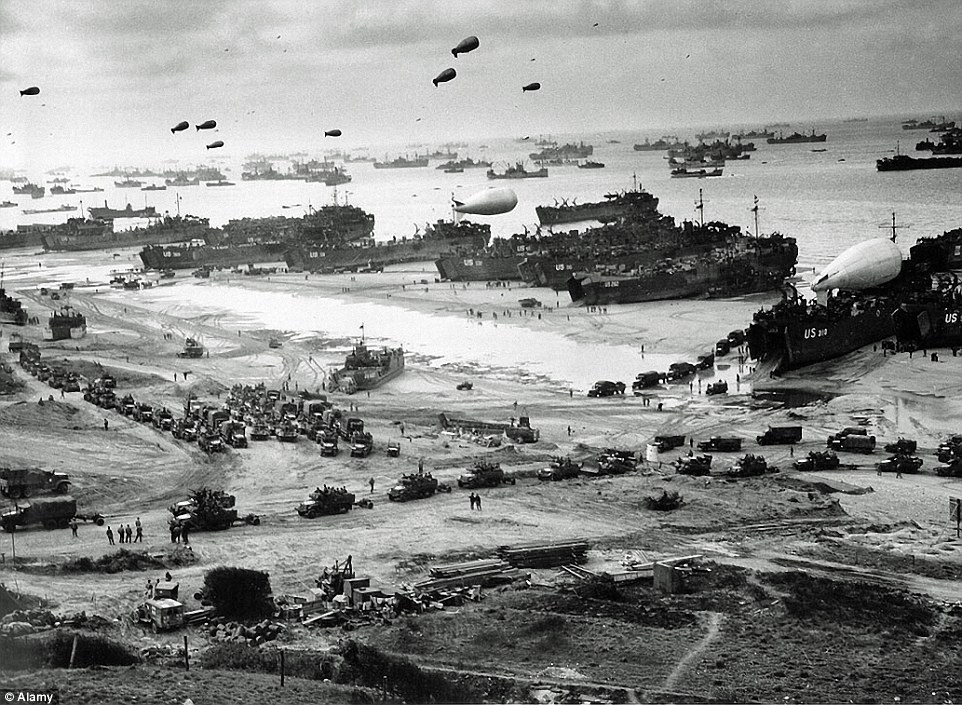
Historical photographs show the true scale of the D-Day landings, during which
some 156,000 Allied troops landed on five beaches along the Normandy coast
in a decisive blow against the Nazis in Europe. Photo - Imperial War Museum

The final post related to photographs and rare stories related to the Canadians mentioned in Combined Operations by Londoner C. Marks will follow.

For more information, including photographs, re Canadians in "Combined Operations", a book by Londoner Clayton Marks, please click here - Photographs: Canadians in "Combined Operations" (Part 7)

Unattributed Photos GH

Thursday, April 21, 2022

Photographs: Canadians in "Combined Operations" (Pt 7)

Canadian Sailors Serve in Sicily Until August 5, 1943

They Recuperate in Malta Before Returning to Italy 

Operation Baytown, the invasion of Italy, at Reggio, Sept. 3, 1943
Photo Credit - At Reggio di Calabria

Introduction:

This entry, though long on written details re the Canadians in Combined Ops as they served in Sicily (July) and Italy (September), is short on photographs from Combined Operations by Londoner Clayton Marks. His next collection relates to the invasion of Normandy beginning June, 1944.

That being said, photographs do appear below that touch on the activities of Canadians referred to in Mr. Marks' book. A third and lengthy excerpt from Combined Operations follows (re Sicily and Italy), along with maps, a rare news report that mentions a few sailors by name that have been referred to in earlier posts, and links to other pertinent material.

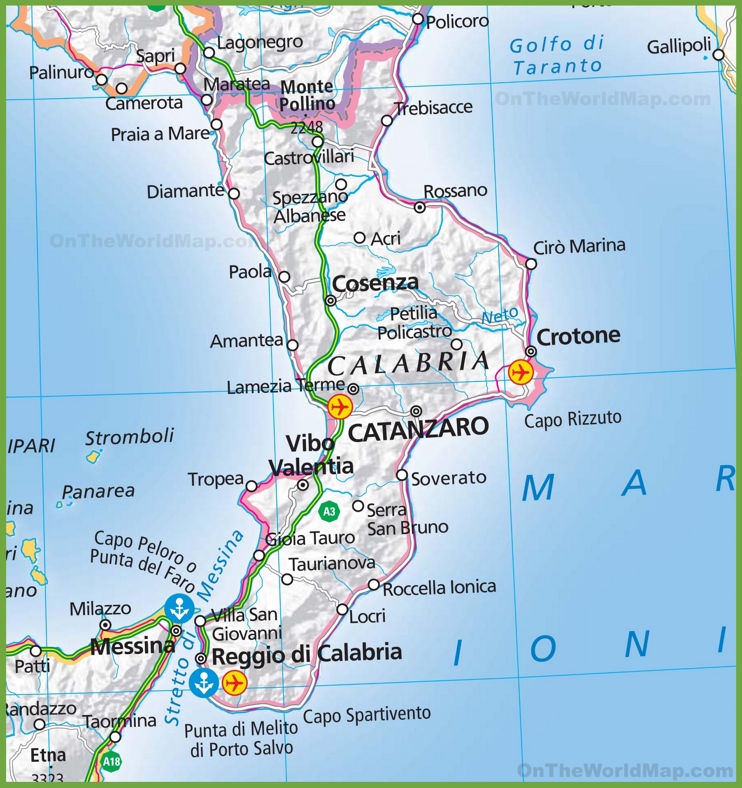
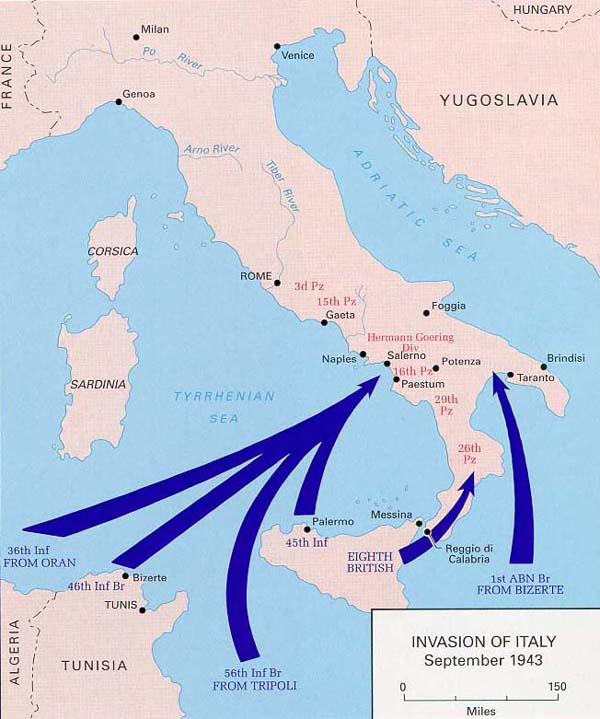
Operation Baytown, the invasion of Italy at the toe of the boot beginning September 3rd, 1943, involved members of the 80th Flotilla of Canadian Landing Crafts, and was described as much easier than the invasion of Sicily about two months earlier. Many sailors were involved in transporting troops from various Sicilian ports (e.g., Messina) to Reggio (a 7 mile round trip), then, once troops were ashore, they delivered all of the materials of war (for about 30 days). 


Landings of troops and all available supplies were made to other Italian beaches as well, as indicated by the blue arrows below. E.g., to Taranto, at the heel of the boot, beginning very shortly after an Allied beachhead was established at Reggio; to Salerno, south-east of Naples, a very difficult undertaking (Operation Avalanche) beginning September 8th.


Details about those days - continuing with Canadian sailors' war efforts in Sicily - are provided below from Combined Operations, pages 84 - 87. The excerpt is divided into two parts to make room for a rare news report by Canadian War Correspondent Dick Sanburn re Operation Baytown:

The Canadian Flotillas formed, of course, only a small part of all the Flotillas engaged, but wherever they operated the warmly admiring comments of British Officers seemed to indicate that they were pace-setters. The mechanical aptitude and the loving care which their maintenance parties lavished on the craft gave particular cause to marvel. During eighteen days of continuous work not one craft of the Flotilla was out of operation.

The demands of the armies proved higher and the demolitions in Sicilian harbours more inconvenient than had been expected, and landing craft had therefore to be kept longer on the ferry service. This meant a great deal of discomfort for the Canadians, as for all the landing craft Flotillas. The beaches of semi-tropical Sicily in late July and early August were far from being health resorts. Almost every man suffered at one time or another from a variety of disorders which included dysentery, septic scratches, jaundice, sandfly and malarial fever.

The small, amphibious craft were not equipped for life on the beaches. Moreover, their men were now everybody's children and no one's. Their parent landing ships had long since departed. They ferried cargo ashore from every ship that came, but their home was the hot beach, and there their companies had to make what living arrangements they could.

Some found accommodation of a sort in an old, disused Army camp and many more had to take shelter in a very dirty and uncomfortable cattle cave. Their food consisted of rations acquired from the Army, occasional largesse scrounged from the better-hearted merchant ships, and what they could acquire from an impoverished countryside. The cave-dwelling members of the Flotilla had improvised a stove of petrol tins in order to apply some heat to their unsavoury victuals; and one evening the stove blew up. Flames licked back into the cave, igniting another can of petrol and consuming most of the kit bags, hammocks and clothing of the men. About half the personnel of the 80th Flotilla had to get along for the next three months on borrowed gear.

[Doug Harrison, RCNVR, Combined Operations, and member of the 80th Flotilla writes about his time in a cave in Sicily at that time. Duffel bags and clothes were eventually replaced and I am in possession of his last duffel bag. Questions or comments can be addressed to me at gordh7700@gmail.com]

Photo Credit - K. Harrison, London ONT

On August 5th operations ceased on the Sicilian beaches, and the two Flotillas returned to Malta. After a month of hard work under exceedingly difficult conditions the men were looking forward to a fourteen-day leave which had been promised them, always subject to "exigencies of the service". The news which greeted them on arrival in Malta was, first, that civilian dockworkers were on strike, and secondly, that their craft must be put in condition at once for a landing on the Italian mainland. Twenty-four cranky LCMs, which had been overworked consistently for a month to land 40,959 men, 8,937 vehicles and 40,181 tons of stores, must at once be retuned to concert pitch by the equally over-worked men who had operated them. Complaints were loud, eloquent, sustained and unavailing, but once this routine gesture was over with the Canadians manifested, as always, a peculiar zest for anything mechanical. At the end of two weeks, during which all the fit men of both Flotillas worked day and night, they announced to amazed dockyard authorities at Malta that their craft were ready to sail again.

When the 81st Flotilla withdrew from Sicily in August, two LCM's were unable to make their way to Malta, so were left in Syracuse along with twelve ratings. They were joined by one other Canadian who was aboard a Royal Navy LCI.

The Canadians eventually had their landing craft welded and repaired by a Royal Navy LCM Flotilla under Canadian Command and were requested to accompany them on the landings at the Straits of Messina and the further invasion of Italy.

When these two landing craft were no longer usable, the Canadians left the British and joined up with the 80th Flotilla in Messina, and stayed with them on their trip back to North Africa and finally to the U.K. with some travelling on the "Queen Emma", which at that time was also under command of a Canadian Officer.

Just before the departure for northern Sicily in preparation for the jump across the Straits of Messina, it was decided that the 81st Flotilla would not be sent. Its craft were not of as recent a type as those of the 80th and would not be useful in the unfamiliar role of assault landing craft, which was to be the work allotted them. Moreover, a large number of men from the 81st were in hospital with sickness acquired in Sicily. The 80th Flotilla therefore sailed alone from the Great Harbour of Malta on August 27th.

On September 1st, at one of the assembly points near Messina, from which the expedition was to cross, the Officers of the Flotilla were briefed. Thirty-six hours later they began to embark the Canadians of the Royal 22nd Regiment, the West Nova Scotians, and the Carleton and Yorks. Canadian soldiers and Canadian sailors were operating together at last.

In the early morning darkness of September 3rd the loaded craft moved up the Strait, close inshore on the Sicilian side, making for their take-off point. Among many ships crowding the narrow waters, "Warspite" and "Valiant" swept by, looming hugely. The wash from the battleships' passing bounced the landing craft like water bugs and sent huge waves over the sides to soak the men. The big ships of the Royal Navy, at that tense, nerve-fraying moment, came in for a heartfelt cursing.

At dawn the armies for the invasion of Italy moved across the six mile Strait. "Warspite" and "Valiant" were forgiven their trespass by the men in the landing craft as the Navy added to a great barrage put up by artillery firing from Sicily across the Strait. Screaming through the half-light overhead, thousands of shells from the artillery of the Army and the big Naval guns passed above the Flotilla. Plumed explosions rose inland as the ramps of the craft went down and the conquerors of Sicily set foot on the Italian mainland. Great transit searchlights from the Sicilian side were cutting through the dim morning to assist navigation and directing smoke shells were providing some assistance mixed with a good deal of confusion.

The Editor interrupts Clayton's fine story to bring you this important announcement from The Ottawa Citizen, Sept. 5, 1943:


Photo as found in  Eclipse by A. Moorehead

Correction: L/S Norm Bowen, Ottawa

Please click here to learn more related to the observations of Lt. Koyl, mentioned in the article above - Memoirs re Combined Operations - Lt. Cdr. J. E. Koyl

More details and photographs concerning the invasion of Italy in September 1943 can be found here.

C. Marks' story concludes:

For a month after the lightly-opposed Italian landing the 80th Flotilla carried out its familiar routine of ferry work. The end came with the Italian armistice and a great celebration in which the population of the countryside joined, and after that the word "England" was on every man's lip. The men of the 55th and 61st assault Flotillas had long been in the United Kingdom. The 81st was also there. Last of the Combined Operations units to return to Britain, the men of the 80th Flotilla, arrived on October 27th.

A little more than two months remained of 1943. In England the men heard cheering news of conditions in the Atlantic and of the war around the world. Good tidings continued to arrive, right up to the destruction of Scharnhorst in the closing days of December. Already 1944 was being spoken of as the year of "the invasion", and perhaps the year of decision. The Allied world was girded at last and moving forward in the full tide of its strength and confidence.

Yet the bells of the new year ushered in a season of tense foreboding, for the men of Canada as for all men of the warring world. Before the armies now in Italy loomed icy hills fanged with the guns of a desperate and determined enemy. The divisions long trained and ready in England had yet to meet their great and costly test. Canadian Airmen knew that the fading Luftwaffe had not yet lost its power to sting. The men of the Atlantic escort forces looked forward to a continuance of a weary, four-year old task, from which the conquest of the U-boats - if it remained a conquest - meant the removal only of the greatest among many perils. For the powerful Tribal destroyers, and the still newer Fleet destroyers which were on the way, there was to be surface combat in the old tradition but with deadlier weapons. And before the men of the landing craft lay other hostile shores.

More information re the invasion of Italy can be found here.

More will follow related to the photographs and stories - related to the invasion of Normandy - as found in Combined Operations by Londoner Clayton Marks.

Tuesday, April 19, 2022

Passages: 'HERE IS YOUR WAR' (Parts 1 - 3)

One of the Finest WWII Writers Writes Fine Lines 

Drawing by Carol Johnson, from the book
"Here Is Your War", Page 184

Introduction:

Ernie Pyle, an iconic WWII U.S. war correspondent, is reputed to be 'America's eyewitness to World War II'. And I have occasionally written that the Canadians who volunteered to join Combined Operations (including my father) and eventually operated landing crafts during Operation Rutter/Jubilee (Dieppe raid), Operation Torch (invasion of N. Africa beginning November 8, 1942), and other significant operations up to the end of WWII (e.g., Operations Husky (invasion of Sicily), Baytown, Avalanche (invasions of Italy) and Neptune (invasion of France)), were another reliable version of 'eyewitnesses to WWII'.

A collection of quotable quotes and significant passages - related to men of all branches of the Allied armed forces - are presented in three posts:

'HERE IS YOUR WAR' (1) by Ernie Pyle

'HERE IS YOUR WAR' (2) by Ernie Pyle


'HERE IS YOUR WAR' (3) by Ernie Pyle

For more posts re 'poignant passages' related to WWII, please link to Passages: Writers on World War II

Unattributed Photos GH
Wednesday, April 13, 2022

Books re Combined Operations: THE CANADIANS IN SICILY and ITALY 1943-1945 (Parts 1 - 3)

OFFICIAL HISTORY, OF THE CANADIAN ARMY IN THE 2ND WORLD WAR

THE CANADIANS IN (SICILY and) ITALY 1943-1945 Volume II

By LT.-COL. G. W. L. NICHOLSON,
Deputy Director, Historical Section, General Staff

Personnel of No. 3232 Servicing Commando relax by their vehicles in Sicily,
while awaiting the order to proceed across the Straits of Messina for the invasion
of Southern Italy (Operation BAYTOWN). Photo Credit - WW2Today

Introduction:

In the 876 page, comprehensive history of the Canadian Army one will find mention of the Canadian landing craft flotillas that were on hand - for a month or more at a time - during the 1943 invasions of Sicily (beginning in early July) and Italy (September).

In Part 3 I have listed some pertinent passages from pages 202 - 204 that relate to Canadians in Combined Operations during Operation BAYTOWN - ferrying troops and materials of war from Messina Sicily to Reggio in Italy.

Many will find that the first 2 parts are interesting as well. And have fun reading all 876 pages!

Please link to the following three posts:

THE CANADIANS IN SICILY and ITALY 1943-1945 (Part 1)

Canadians in Combined Ops on their way to Sicily, July 1943

Photo Credit - St. Nazaire to Singapore by D. Lewis., C. Lewis, L. Birkenes

THE CANADIANS IN SICILY and ITALY 1943-1945 (Part 2)

THE CANADIANS IN SICILY and ITALY 1943-1945 (Part 3)

Questions and comments re the above passages can be addressed to G. Harrison at gordh7700@gmail.com

For more information about other books in which the Canadians in Combined Operations are mentioned, please link to Books re Combined Operations: DIEPPE DIEPPE

Unattributed Photos GH
Tuesday, April 5, 2022

Video: "Faint Footsteps, WWII" (Part 9)

Baptism of Fire on the Ennerdale

Rare WWII Photos Included

RFA Ennerdale carried Canadian sailors to their first 'action stations'

Introduction:

My father was given a baptism of water in May, 1942. His landing craft ran aground and Lt. Jake Koyl - an officer my father much admired - ordered Dad to jump off in order to help find deeper water and get the landing craft moving again. Dad obeyed the order, found deeper water, helped get the landing craft on its way, but was left behind on a sandbar (off the coast of Irvine and Troon, Scotland). 

A link to the story, in video form, is provided at the bottom of this post.

A few weeks after that incident my father and many other Canadian sailors were transported to the southern coast of England, perhaps to participate in an exercise (Exercise Yukon I and/or II), but at least to take part in Operation Rutter (the raid on Dieppe that was cancelled on July 7, 1942), and later, take part in Operation Jubilee (Dieppe Raid) on August 19. 

On the way to southern England the Canadian sailors were given a baptism of fire.

Please view the video re the trip on the Ennerdale provided below:


Questions or comments can be addressed to me at gordh7700@gmail.com

FYI - The video series can be viewed on YouTube as well, e.g.,  "FAINT FOOTSTEPS, WWII (Part 9) 

More videos to follow.

Please click here to view "Faint Footsteps, WWII" (Part 8)

Photos GH