Operation Torch: N. Africa Invaded Beginning November 8, 1942
Canadian Sailors Landed U.K. and U.S. Troops in Landing Crafts

American troops landing on the beach at Arzeu, near Oran, from a landing
craft assault (LCA 426), some of them are carrying boxes of supplies.
RN Photographer Lt. F.A. Hudson, A12649 Imperial War Museum (IWM)
Introduction:
Remembrance Day 2022 approaches quickly. And during WWII, also in the month of November, Allied forces combined to land thousands of troops in three general areas along the shores of North Africa, beginning November 8, 1942, eighty years ago from this date.

Canadian sailors (RCNVR) were members of the Center and Eastern Task Forces
More information, incl. above map, re Operation Torch, link to Wikipedia here
Under the command of Combined Ops they accepted "dangerous duties overseas" and helped fill the need to man small, swift landing craft, to transport troops and all the materials of war to foreign beaches, from Dieppe (Operation JUBILEE, August 19, 1942) to Normandy, France (Operation NEPTUNE, beginning June 6, 1944).
Below I will share a few details related to Operation TORCH, my father's first serious action. He was one of the 50 - 60 members of the Effingham Division - RCNVR, HMCS Stadacona, Halifax - and amongst the first draft of Canadian sailors to join Combined Operations in November, 1941. Though they all trained for the Dieppe raid a few months after arriving in the U.K. in January, 1942, some were put on leave on that fateful day, my father included.

The Effingham Division, "almost to the man", volunteered for Combined Ops
The sailors left for the U.K. for training aboard landing crafts in Jan. 1942
Photo - from the collection of Doug Harrison, taken December, 1941
That being said, over the course of the remainder of WWII, a total of about 950 - 1,000 other members of RCNVR (about one per cent of the 95 - 100,000 Canadians who joined the Canadian Navy during WWII), were eye witnesses (front row seats!) to most of the major Allied operations, including Operation TORCH (beginning Nov. 8, 1942), HUSKY (the invasion of Sicily beginning July 10, 1943; about which a sailor on my father's landing craft, after getting attacked by the German Luftwaffe every two hours during the first three days, proclaimed while hiding under a winch, "Dieppe was never like this!"), BAYTOWN (the invasion of Italy, on 'the toe of the boot', beginning Sept. 3, 1943), AVALANCHE (the invasion of Italy at Salerno, on the shin of the boot, beginning Sept. 9, 1943), and finally NEPTUNE (Neptune was the Navy's role in Operation OVERLORD, the invasion of France, beginning June 6, 1944).
I would say the 1,000 sailors who are the chief subject of '1,000 Men, 1,000 Stories' kept busy.
And now, about TORCH:
In the book Assault Landing Craft: Design, Construction and Operations by Brian Lavery, we read the following about the invasion of North Africa:
As the Vichy forces finally surrendered on Madagascar on 5 November, several huge convoys were approaching the coast of North Africa, for the Americans were about to land near Casablanca and at Safi, and the British inside the Mediterranean at Algiers and Oran. It was the largest operation mounted so far and the training camps had been emptied as partly trained crews were embarked in LSIs (Landing Ships, Infantry).
The Combined Operations Organisation was under considerable strain as the demands increased. Fifteen LSIs had been originally requested for the operation, twenty-five eventually sailed. The planners had asked for 91 LCAs (Landing Craft, Assault) with their crews, but now they needed 140. Page 102
My father, heading toward Arzeu in a troopship - with landing crafts hanging from davits - just east of Oran (one of the Central Task Force's destinations) writes the following in memoirs:

As found at Imperial War Museum FL 11110
We had American soldiers aboard and an Italian in our mess who had been a cook before the war. He drew our daily rations and prepared the meal (dinner) and had it cooked in the ship’s galley. He had the ability to make a little food go a long way and saved us from starvation. Supper I can’t remember, but I know the bread was moldy and if the ship’s crew hadn’t handed us out bread we would have been worse off.
We used to semaphore with flags to the Ennerdale to see how they were eating; they were eating steak. One of the crew cheered us up and said, “Never mind, boys. There will be more food going back. There won’t be as many of us left after the invasion.” Cheerful fellow. However, we returned aboard another ship to England, the Reina Del Pacifico, a passenger liner, and we nicknamed the Derwentdale the H.M.S. Starvation.
In the convoy close to us was a converted merchant ship which was now an air craft carrier. They had a relatively short deck for taking off, and one day when they were practicing taking off and landing a Swordfish aircraft failed to get up enough speed and rolled off the stern and, along with the pilot, disappeared immediately. No effort was made to search, we just kept on.
One November morning the huge convoy, perhaps 500 ships, entered the Mediterranean Sea through the Strait of Gibraltar. It was a nice sun-shiny day... what a sight to behold. "Dad, Well Done". Pages 23 - 24
Related Photos:


 American troops manning their landing craft assault from a doorway in the side
Our Coxswain was L/S Jack Dean of Toronto and our officer was Lt. McDonald, RNVR. After the 92 hours my officer said, “Well done. An excellent job, Harrison. Go to Reina Del Pacifico and rest.”

More information, in Part 2, will follow.
Please click here to view earlier posts about Operation TORCH.
Unattributed Photos GH
In the convoy close to us was a converted merchant ship which was now an air craft carrier. They had a relatively short deck for taking off, and one day when they were practicing taking off and landing a Swordfish aircraft failed to get up enough speed and rolled off the stern and, along with the pilot, disappeared immediately. No effort was made to search, we just kept on.
One November morning the huge convoy, perhaps 500 ships, entered the Mediterranean Sea through the Strait of Gibraltar. It was a nice sun-shiny day... what a sight to behold. "Dad, Well Done". Pages 23 - 24
Related Photos:

In the distance a destroyer is laying a smoke screen round one of the transports
off Oran. Two landing craft assault and one landing craft personnel (ramped) can
be seen in the foreground they are LCA 85, LCA 394 and LCP (R) 838.
Photo Credit - RN Photographer Lt. J.E. Russell. A12633 (IWM)

A destroyer laying a smoke screen round one of the transports off Oran.
Photo - RN Photogr. Lt. J.E. Russell. A12634 Imperial War Museum
North African Operations. Britain's Royal Navy had a major role in the world's greatest combined operation when the 500 ship convoy safely transported Allied troops to French North Africa, where simultaneous landings were made at strategic points. November 1942. Link to IWM Photos, approx. 11,000,000 : )

An Auxiliary aircraft carrier escorting the convoy.
RN Photographer Lt. L. Pelman A12711 (IWM)

HMS ARGUS operating off the North African coast during combined operations
for the 'Torch' landings. RN Photographer Lt. R.G.G. Coote. A12882 IWM
Excerpt from Brian Lavery's Assault Landing Craft continues:
The lack of training showed and several of the LCA flotillas got into difficulties. Off Algiers there was a westerly current that caused many landing ships and craft to arrive in the wrong place. Fortunately there was little resistance from the Vichy French. The three landings in the Oran area had similar difficulties. West of the town, Queen Emma's and Princess Beatrix's ten LCAs formed only a small part of the total of thirty-nine craft, which were mostly LCP and LCMs...
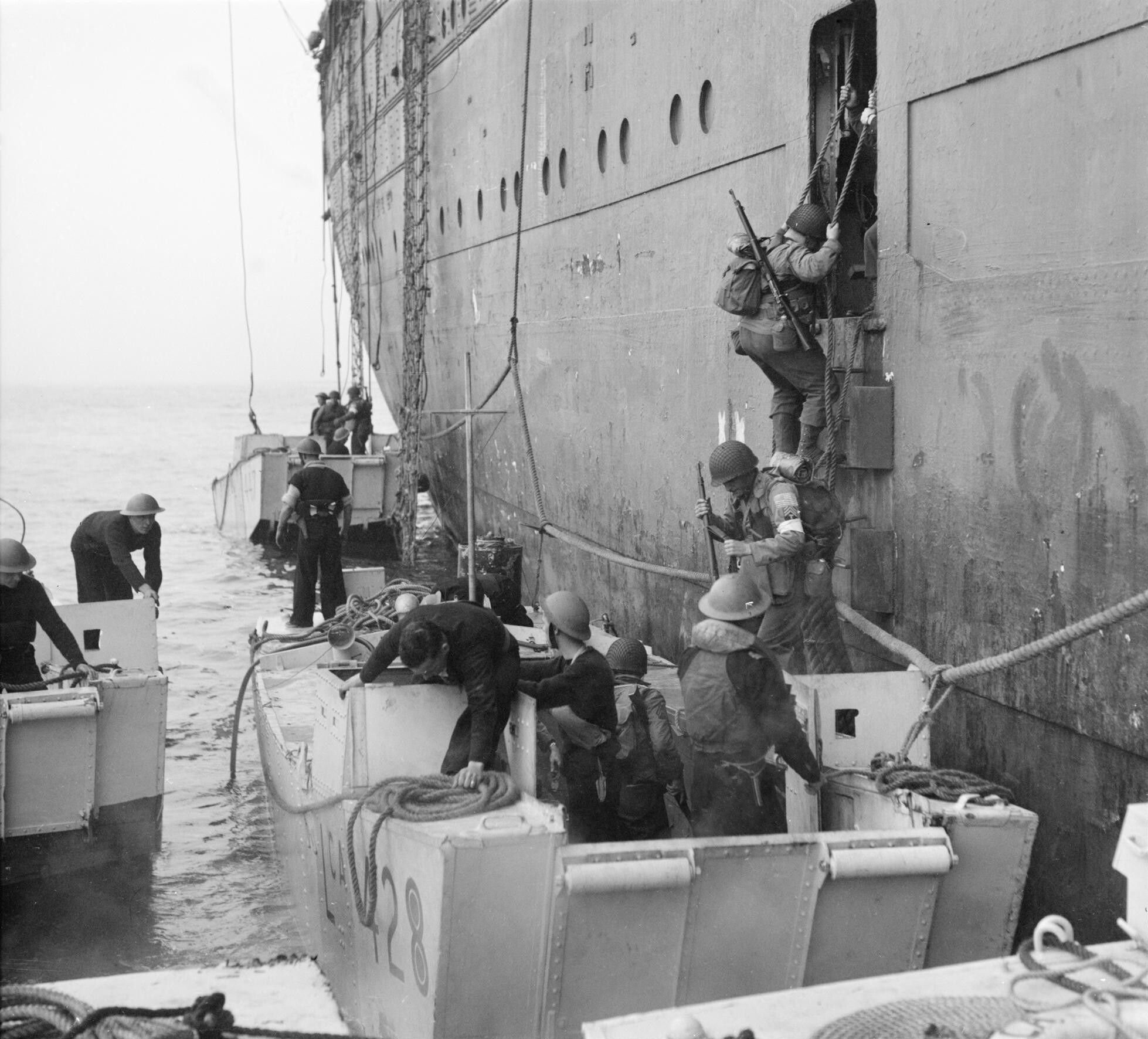
The troops from Monarch of Bermuda were embarked via ladders (Editor: see photograph below), the rungs of which turned out to be too far apart. This caused delay so that the LCAs from her and Glengyle landed sixteen minutes late*, and the LCMs grounded on undiscovered sandbars offshore**.

of the liner REINA DEL PACIFICO. Two of the landing craft are numbered LCA
428 and LCA 447. Photo - RN Lt. F.A. Hudson, A12647 Imperial War Museum
The third landing, east of Oran, was much larger and involved 29,000 troops, 2400 vehicles and eight LSIs plus the LCM carrier Derwentdale***. It deployed eighty-five landing craft, of which sixty-eight were LCAs and three were LCSs. The first flight of assault craft heading for Z Green beach lost cohesion despite being led in by a motor launch - the first of its craft landed twelve minutes before H-hour, the last landed ten minutes after...
Pages 102 - 104
*sixteen minutes late - that's not bad compared to my father's tale (below)
**undiscovered sandbars - my father actually discovered one!
***LCM carrier Derwentdale - my father came from England aboard this ship, but he liked Reina Del Pacifico better, I bet. Supporting details to follow.
About the landings east of the town of Oran, near Arzeu, and during the same time period, my father writes:
On November 11, 1942 the Derwentdale dropped anchor off Arzew (sic) in North Africa and different ships were distributed at different intervals along the vast coast. My LCM (landing craft, mechanised) had the leading officer aboard, another seaman besides me, along with a stoker and Coxswain.
At around midnight over the sides went the LCMs, ours with a bulldozer and heavy mesh wire, and about 500 feet from shore we ran aground. When morning came we were still there, as big as life and all alone, while everyone else was working like bees.
There was little or no resistance, only snipers, and I kept behind the bulldozer blade when they opened up at us. We were towed off eventually and landed in another spot, and once the bulldozer was unloaded the shuttle service began. For ‘ship to shore’ service we were loaded with five gallon jerry cans of gasoline. I worked 92 hours straight and I ate nothing except for some grapefruit juice I stole.

There was little or no resistance, only snipers, and I kept behind the bulldozer blade when they opened up at us. We were towed off eventually and landed in another spot, and once the bulldozer was unloaded the shuttle service began. For ‘ship to shore’ service we were loaded with five gallon jerry cans of gasoline. I worked 92 hours straight and I ate nothing except for some grapefruit juice I stole.

Doug Harrison (centre) watches as troops and ammunition come ashore
on LCAs at Arzeu in Algeria during Operation 'Torch', November 1942.
Photo credit - RN Photographer Lt. F. A. Hudson A12671 (IWM)
But first the Americans brought in a half track (they found out snipers were in a train station) and shelled the building to the ground level. No more snipers. "Dad, Well Done" Page 25
Brian Lavery's last line about North Africa in his book Assault Landing Craft reveals that two men in the same harbour (i.e., at Arzeu), perhaps on different days or a mile apart - can have radically different experiences:
Brian Lavery's last line about North Africa in his book Assault Landing Craft reveals that two men in the same harbour (i.e., at Arzeu), perhaps on different days or a mile apart - can have radically different experiences:
"Again there was no opposition (re three LCAs "making for Arzou (sic) harbour"), which was fortunate. Oran surrendered fifty-nine hours after the invasion began." Page 105
My father mentions snipers, and hiding behind a "bulldozer blade when they opened up at us."
My father mentions snipers, and hiding behind a "bulldozer blade when they opened up at us."
But 'all's well that ends well.' After about four straight days of 'ship to shore' - surviving on stolen grapefruit juice - he was given leave to visit the Reina Del:
I then had to climb hand over hand up a large hawser (braided rope) to reach the hand rail of Reina Del Pacifico and here my weakness showed itself.
I got to the hand rail completely exhausted and couldn’t let one hand go to grab the rail or I would have fallen forty feet into an LCM bobbing below. I managed to nod my head at a cook in a Petty Officer’s uniform and he hauled me in. My throat was so dry I only managed to say, “Thanks, you saved my life.”
The Reina was a ship purposely for fellows like me who were tired out, and I was fed everything good, given a big tot of rum and placed in a hammock. I slept the clock around twice - 24 hours - then went back to work.
In seven days I went back aboard the Reina Del and headed for Gibraltar to regroup for the trip back to England. During the trip I noticed the ship carried an unexploded three inch shell in her side all the way back to England. "Dad, Well Done" Pages 25 - 26
In memoirs, my father thanked his Maker for getting him home safely from operations, in this case Operation TORCH, November 1942, 80 years ago this week. And his time of service in North Africa ('ship to shore,' 11 days) was not the first or the last time he expressed his gratitude or sang a hymn of thankfulness that his mother Alice had taught him as a child.
In memoirs, my father thanked his Maker for getting him home safely from operations, in this case Operation TORCH, November 1942, 80 years ago this week. And his time of service in North Africa ('ship to shore,' 11 days) was not the first or the last time he expressed his gratitude or sang a hymn of thankfulness that his mother Alice had taught him as a child.

The damage to MV LLANGIBBY CASTLE from an 8" shell. North Africa
Photo Credit: Royal Navy Official Photographer - Russell, J E (Lt)
© Imperial War Museum (IWM) A12646
I think he and his 1,000 Canadian mates (approx.) in RCNVR and Combined Operations had good cause to be thankful many times over their four years of transporting troops and all the materials of war in small crafts, 'ship to shore' (from Dieppe, North Africa, Sicily, Italy and more, to D-Day Normandy), often under heavy, merciless fire.
Lest We Forget
More information, in Part 2, will follow.
Please click here to view earlier posts about Operation TORCH.
Unattributed Photos GH