Saturday, March 25, 2023

Photographs: Armada to Sicily, July 1943 (3)

Three Months in 'The Med' Means Many Photographs Were

Taken in Sicily. Royal Navy Official Photographers Kept Busy!

Every raid or invasion was preceded by training exercises, sometimes with new
equipment. "Valentine tanks storming the beach!" Photo - Lt. E. E. Allen, Royal
Navy Official Photographer. Imperial War Museum © IWM A 23098

Introduction:

It's likely true that a picture is often worth a thousand words. As I share news clippings from The Montreal Gazette,  issues published between July 1 - September 30, 1943, in order to build a series of posts/entries related to the time that many Canadian sailors manned landing crafts during two significant Allied invasions in the Mediterranean Sea (i.e., at Sicily and Italy). 

The 80th anniversaries of Operations Husky (Sicily; beginning July 10, 1943) and Baytown (at the toe of the boot of Italy; beginning September 3) and Avalanche (at the shin of the boot; beginning Sept. 9) are approaching and I hope to take part in some way. So, the news clippings and photographs will grow over the next few weeks.

Click here to view the most recent post re newspaper stories from 'the Med'.

Click here to view the first collection of photographs re the Armada to Sicily.

(A link to the second collection of photographs is provided at the bottom of this entry)

Please find below a small collection of photos re the armada to Sicily as found at the Imperial War Museum, home to (so they say) 11,000,000 very good quality images. The first six photographs are found in the Lt. E. E. Allen collection, Imperial War Museum (IWM)

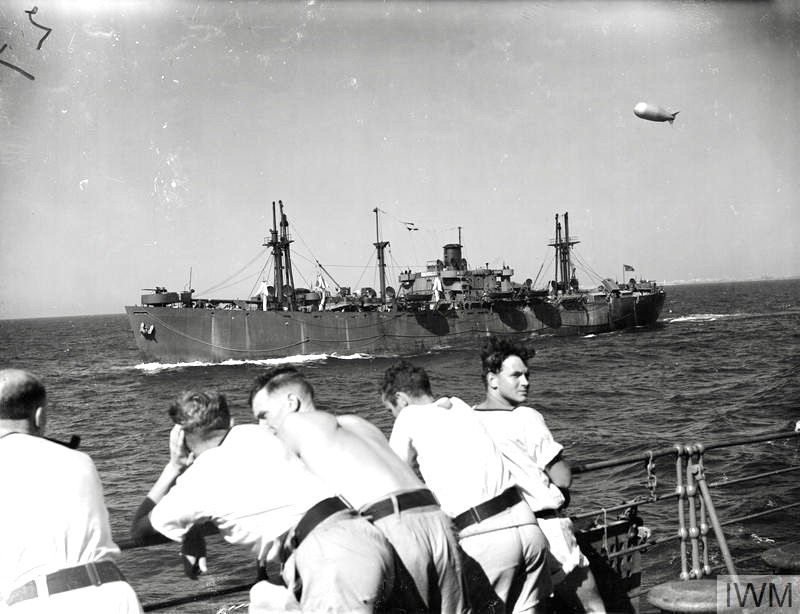
Armada to Sicily: Allied invasion ships set out July 3 - 10, 1943. On board the
sloop HMS Alynbank, in convoy. An American freighter on her way to Sicily
with troops, landing craft and other equipment. © IWM A 17902

Readers are encouraged to use the IWM search engine for subjects (e.g., armada to sicily) and photographs (e.g., A 17902, above). Once a photo is located, one can change the number up or down by one digit to (possibly) find other photos taken at the same time by the same photographer. Extensive searches are indeed possible. 

Armada to Sicily: Part of the huge Allied convoy on their way to Sicily.
© IWM A 17903

Armada to Sicily: A view from the bridge of HMS Alynbank of the huge
Allied convoy on their way to Sicily. © IWM A 17904

Lt. E. E. Allen took many photographs of pre-invasion exercises in preparation for D-Day Normandy, and I include some here to show the extent of the IWM collections, and because these exercises would have been similar in many ways to preparations for the invasions of Sicily and Italy

The Royal Navy during the Second World War: General view of troops and
Valentine tanks storming the beach during pre invasion fleet exercises in the
English Channel in the Portsmouth and Isle of Wight area. © IWM A 23098

The Royal Navy during the Second World War: Troops landing on the beach from
from an assault craft during pre invasion fleet exercises in the English Channel in the
Portsmouth and Isle of Wight area. A Duplex Drive Valentine tank is driving up the
beach whilst in the foreground troops leave a landing craft assault. © IWM A 23097

Pre-invasion fleet exercises in the English Channel, May 3 - 4, 1944. On board
LSI (landing ship, infantry) Empire Mace,  EMPIRE MACE, Portsmouth and Isle
of Wight area: Tanks on the beach with troops disembarking from an Assault craft.
Credit to Lt. E. E. Allen, RN Official Photographer © IWM A 23099

More information about the Duplex Drive Valentine tank (aka 'Ducky') at a dedicated Facebook site. 


Big British ships in the Ionian Sea as invasion of Sicily began. July 10 - 16, 1943.
On board HMS Formidable. Big ships of Force "H" were in the Ionian Sea at the
start of the Sicily invasion. Above, the destroyer HMS Tumult. © IWM A 18316

Study in British Sea power, March and April, 1943, at sea in the Mediterranean.
Grumman Martlets on the flight deck of the British aircraft carrier HMS Formidable 
frame a new study of the 39,000 ton British Battleship HMS Rodney. © IWM A 15837

Big British ships in the Ionian Sea as invasion of Sicily began. Left to
right: HMS Rodney, Warspite, a Cruiser, HMS Nelson and destroyers.
© IWM A 18324

Big British ships in the Ionian Sea as invasion of Sicily began. Left to right:
HM Battleships Valiant, Nelson, Rodney and Warspite. © IWM A 18313

Big British ships in the Ionian Sea as invasion of Sicily began.
Depth charge exploding near HMS Valiant. © IWM A 18322

Big British ships in the Ionian Sea as invasion of Sicily began.
HMS Nelson and Valiant (centre) with Rodney. © IWM A 18325

Big British ships in the Ionian Sea as invasion of Sicily began.
HMS Valiant refuelling during patrol of Ionian sea. © IWM A 18323

The next three items are paintings by Edward J. I. Ardizzone (others were shared in an earlier post and a link to his collection is here). Not all deal with Sicily and Italy, of course, but several do: 

With the Invasion Fleet: Troops Manning their Assault Landing Craft before
the Landings in Sicily, Dawn, July 10th, 1943. Image: The deck of a ship at night.
A line of fully kitted out troops prepare to board a landing craft, each soldier with his
right hand on the shoulder of the man in front to help guide each other in the dark.
© IWM Art.IWM ART LD 3452

In a South African Whaler on Corvette Duties: Seamen beside their bunks.
Image: A scene below deck. A partially-clothed man sits on the upper bunk
with his legs hanging over the side. On the bunk below another man leans on
his elbow smoking a pipe. Standing next to the bunk is another bearded man
wearing a cap. © IWM Art.IWM ART LD 2936

Troops Resting and Cleaning Up after Battle. Image: Groups of British
soldiers stand around on a hill undressing and washing.
© IWM Art.IWM ART LD 2928


More to follow

Unattributed Photos GH

Thursday, March 23, 2023

Research: Three Months in the Mediterranean, 1943 (4)

Extra! Read all About! Clippings from The (Montreal) Gazette, 1943

D-Day Sicily Will Arrive in the Shape of a Huge Allied Armada

Armada to Sicily: Allied invasion ships set out July 3-10, 1943, on board the sloop
HMS Alynbank, in convoy. "Part of the huge Allied convoy on their way to Sicily."
Photo - Lt. E. E. Allen, Royal Navy Official Photographer © IWM A 17903

Introduction:

The largest armada in history (up to that date) will soon make landings at several locations upon Sicily's eastern and southern shores. The armada will be accompanied by airborne forces as well, in the form of heavily loaded gliders and regular bombardments. Most of the inhabitants of the island will not be happy to withstand the rigours of war upon their land, but will have to endure losses of all kinds and magnitudes, to their families, friends, homes, properties and more. 

Below please find several timely news clippings from The Montreal Gazette, issues from July 8 - 9, 1943. Useful links will be provided to other newspaper clippings, information from Canadian memoirs, and good quality photographs:


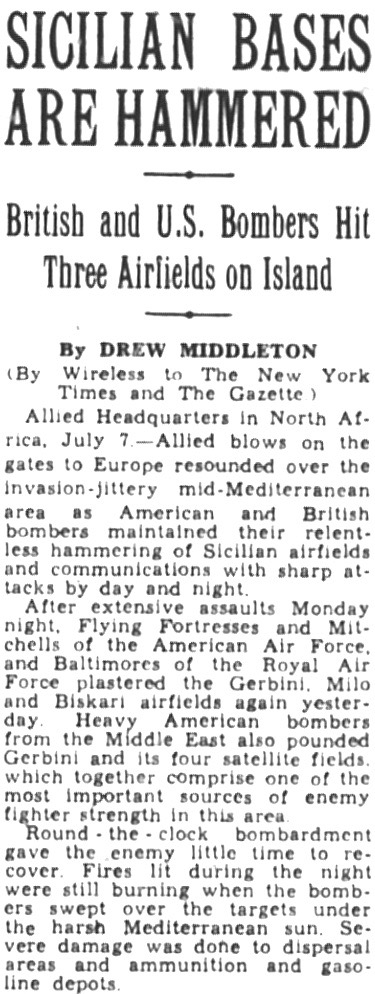
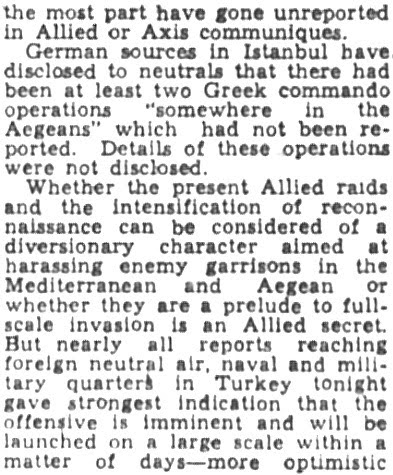
Sicilian airfields were obvious targets, leaving Italian and German forces to wonder when and where the Allied armies would land. They would not have to wait long. 

Got plans for this coming Saturday? You might want to reschedule.


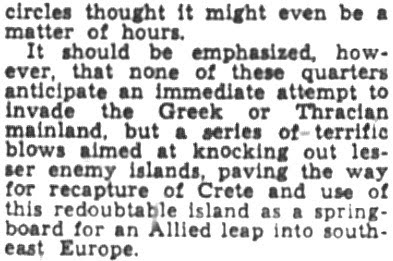
And where, in fact, were Allied forces to attack "the soft under-belly of Europe" (Churchill's words)?

"In 1943, two brilliant intelligence officers conceived a plan that was dubbed Operation Mincemeat. They would trick the Nazis into thinking that Allied forces were planning to attack southern Europe by way of Greece rather than Sicily." (From back cover of the book below.)

"The plan - get a corpse, equip it with misleading papers concerning the invasion,
then drop it off the coast of Spain where German spies would take the bait."

Operation Mincemeat is reported to have had some success, and was depicted in a movie that premiered in 2021:

Operation Mincemeat is a 2021 British war drama film directed by John Madden. It is based upon Ben Macintyre's book on the British Operation Mincemeat during the Second World War. The film stars Colin Firth, Kelly Macdonald, Matthew Macfadyen, Penelope Wilton, Johnny Flynn and Jason Isaacs. This was Paul Ritter's final film appearance, and was dedicated to his memory.

The film had its world premiere at the 2021 British Film Festival in Australia, and was released in the United Kingdom on 15 April 2022 by Warner Bros. Pictures. It was released on Netflix in North American and South American countries on 11 May 2022. 

See Wikipedia for more details.

Speaking of movies that have a connection to World War II and (indirectly) to Canadians in Combined Operations....


950 - 1,000 Canadian sailors (RCNVR) volunteered for Combined Operations (C.Ops.) during WWII and took part (most, like my father, by manning landing crafts) in Operation Jubilee (Dieppe raid), and Operations Torch, Husky, Baytown, Avalanche, Neptune, etc. (invasions of N. Africa, Sicily, Italy - at Reggio and Salerno - Normandy France, and more) from 1941 - 1945. Most returned from the war in one piece, partly related to the fact that landing crafts, though often first to the beach, make small targets. 

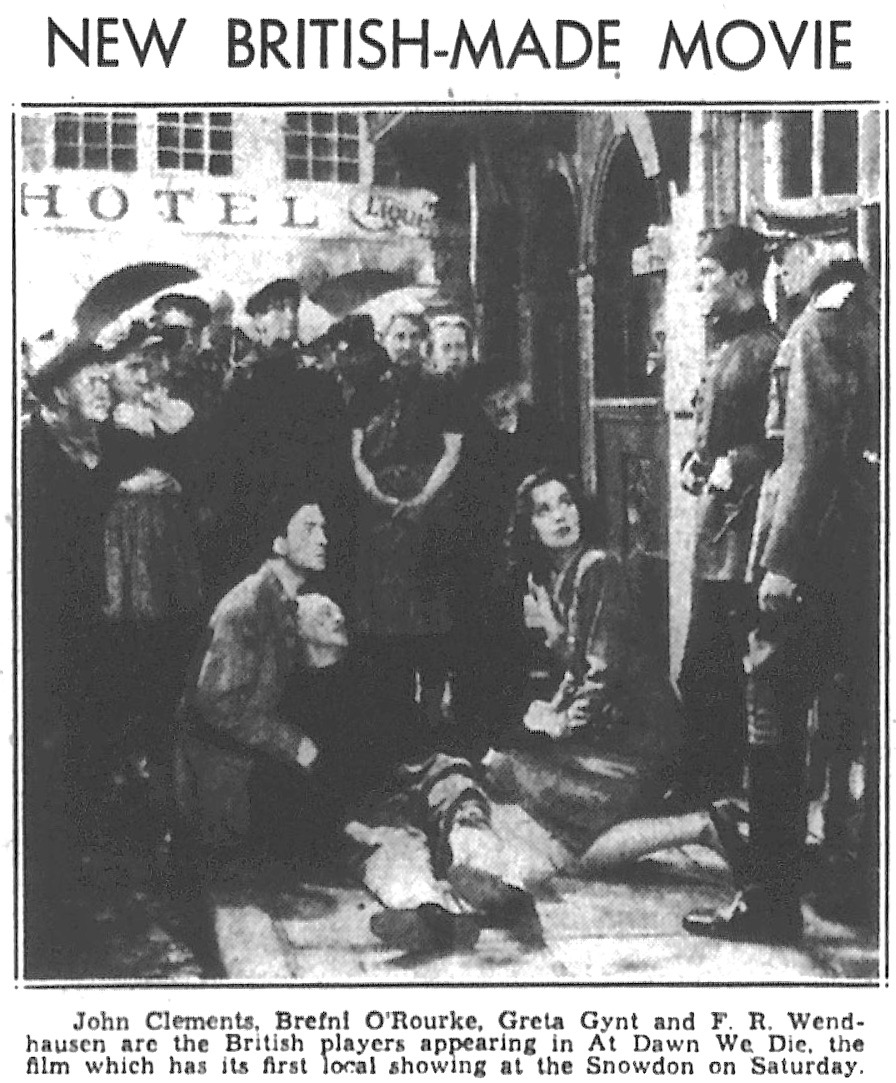
A small handful of the sailors must have arrived in Europe a short time ahead of other early volunteers to C.Ops. because they somehow snagged (or were snagged for) a role in "the greatest raid of all time" (so says a book by that name, re Operation Chariot), i.e., a raid on a significant dry dock, the largest in Western Europe close to the Atlantic, at St. Nazaire, France, in March, 1942. One sailor's name was John O'Rourke (Lt., RCNVR), and by a pleasant coincidence someone with the same last name appeared in "At Dawn We Die", as mentioned in the caption to the movie's photo above.

In St. Nazaire to Singapore: The Canadian Amphibious War 1941 - 1945 (a two-volume compilation of stories by WWII RCNVR/C.Ops. veterans) John O'Rourke writes the following:


As found in St. Nazaire to Singapore (Vol. 1), page 37

Published in 1995, approx. Collection of Doug Harrison (RCNVR, C.Ops.)

Please link to St. Nazaire to Singapore (Vol. 1), shared by the University of Calgary (Alberta, Canada), to read more about John O'Rourke's experiences at St. Nazaire. Click here, then go to pages 35 - 39. 


Below are two items from The Gazette's editorial page:


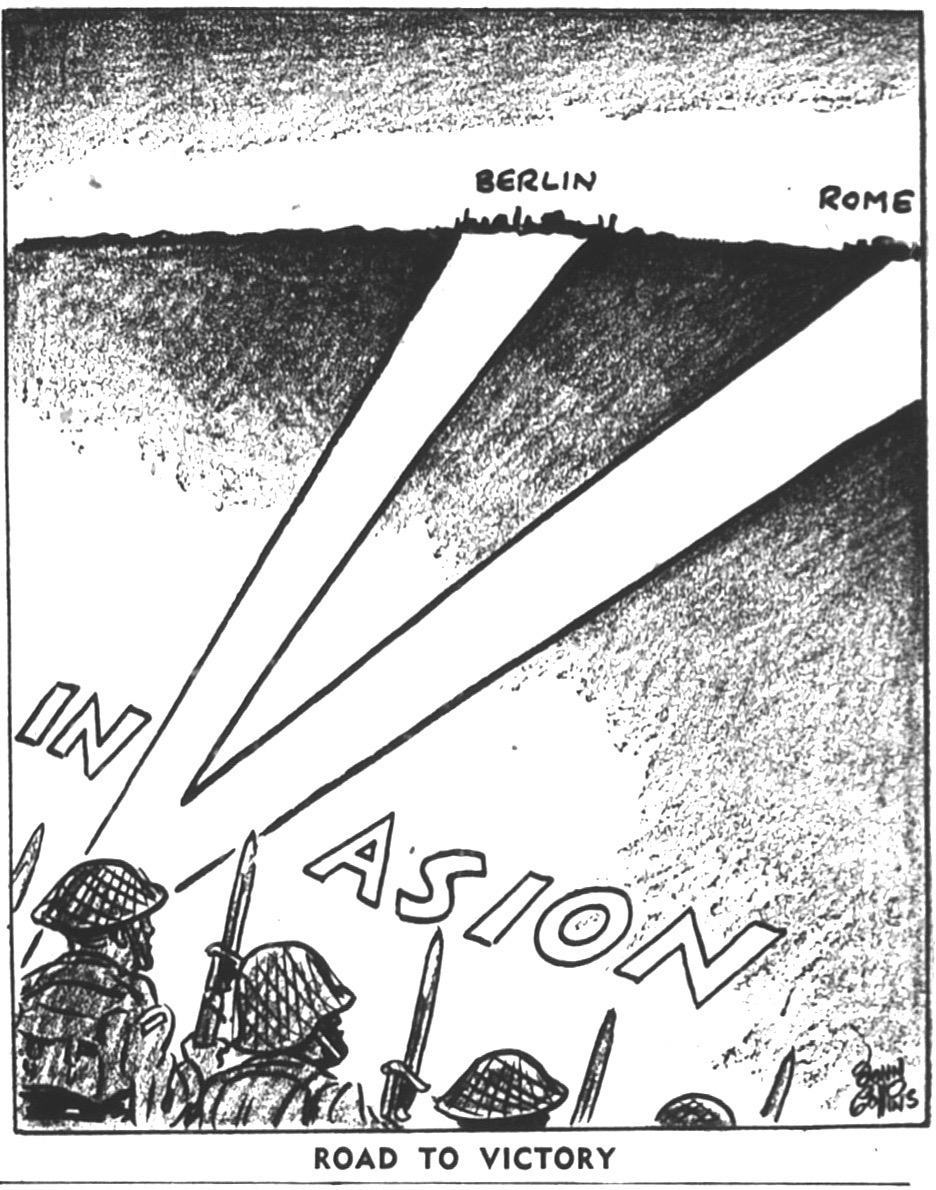
More than a few articles in various newspapers (Allied countries) expressed the belief that Berlin and Rome would fall... shortly. The positive momentum that many felt based on victories, for example, in North Africa, lead to the belief in ultimate victory. And when did the Allies enter Rome? June 1944, almost on the same day as D-Day Normandy. And when did they enter Berlin? Almost a year later. 'Positive momentum' is a force to be reckoned with, is it not?


More eyes are on Rome:


Faithful readers - by now, after over 8 years of posts - might come to expect that I will share almost any article that relates to the Canadian Navy. I admit, they'd be right. Especially if there is some connection to 'Canadians in Combined Ops', 1941 - 1945:


The first two groups (drafts) of Canadian sailors to volunteer for Combined Operations came from HMCS Stadacona in late December, 1941. More followed after that, making a group of up to 950 - 1,000 sailors, likely from various Navy bases across Canada. The early groups to volunteer would have been surprised at how large HMCS Cornwallis was compared to Stadacona, that is, if they ever saw the site, or ever knew about it.

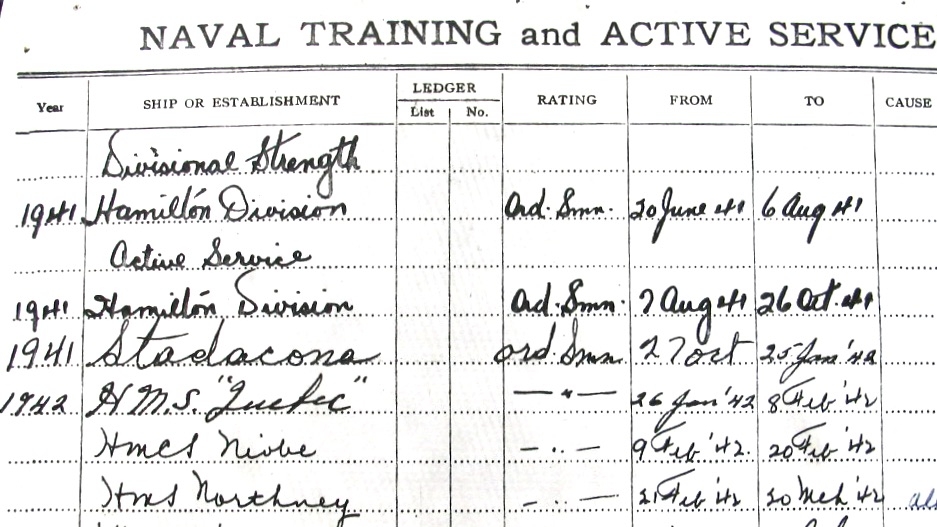
From the Navy records of my father Doug Harrison, Norwich, Ontario.

My father moved from Hamilton Division 1 (later know as HMCS Star), to HMCS Stadacona, Halifax, then to HMS Quebec, near Inveraray, Scotland (No. 1 Combined Ops Training Camp), in early 1942. Like the rest of his division, he made his way to Inveraray after a short stint of being introduced to landing crafts at HMS Northney (camps 1 - 4) on Hayling Island, off the southern coast of England, east of Southampton.
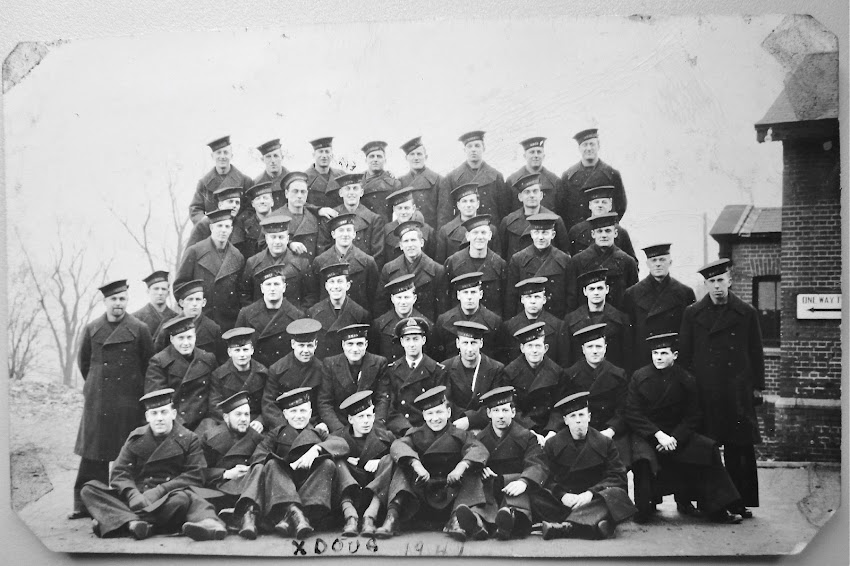
The Effingham Division, first draft to Combined Ops, HMCS Stadacona, 1941

Eight Canadian sailors, RCNVR and Comb. Ops., at HMS Northney, Feb. 1942
L - R: Al Addlington (London), Joe Spencer (Toronto), Chuck Rose (Chippawa),
Doug Harrison (Norwich), Art Bradfield (Simcoe), Don Linder (Kitchener), Joe
Watson (Simcoe), Jack Jacobs (town unknown). Brick barracks were formerly for
vacationers. "The toilets froze but the dining room was warm. We survived."
Photo is from the collection of Joe Spencer, 2nd from left. Used w permission

More details about early training on landing crafts can be found here. Questions or comments about the training undertaken at HMCS Stadacona and then at Northney and Quebec can be sent to Gord Harrison @ gordh7700@gmail.com

Now, back to news from The Gazette:

My feeling is that merchant seamen often had a thankless role to play

More news about D-Day -2 (July 8, 1943), from another newspaper, can be found here.

Below please find a few items fromJuly, 1943, aka D-Day -1, Sicily:


Observers could not be blamed for thinking that "a tremendous weight of bombs" dropped upon Sicily's airfields would give the Allied game away. And they'd be right. But the Allies could attack in many places, and a few diversions and deceits (e.g., Operation Mincemeat) had been thrown into the mix, as well as bombings in other areas as a lead up to D-Day Sicily:


Though the Dieppe Raid took place 11 months earlier (approx.), it remained in the news for many years after:


More news from 'the Med', including D-Day Sicily and D-Day Italy (three locations in September!) to follow shortly.

Please click here to view Three Months in the Mediterranean, 1943 (3)

Unattributed Photos GH

Tuesday, March 21, 2023

Photographs: Armada to Sicily, July 1943 (2)

"Three Months in the Mediterranean" Series Develops

With Significant News Stories and Sharp Photographs...

...And the occasional informative, though perhaps unsettling, painting.
Learn more about artist Edward Ardizzone at Imperial War Museum

Introduction:

As a way of drawing attention - in the year 2023 - to the upcoming 80th anniversary of (and events related to) the Allied invasions of Sicily and Italy in July and September respectively in 1943, during which four Flotillas of Canadian Landing Crafts were significant participants (i.e., the 55th, 61st, 80th, 81st Flotillas of LCAs and LCMs), I will share many related news clippings and photographs on this site. My main sources will continue to be The Montreal Gazette for 'news of the day' and the Imperial War Museum for photos... and the occasional painting.

Please click here to get a taste of news articles re Allied advances:


Research: Three Months in the Mediterranean, 1943 (3)

Below please find 12 related photographs by Lt. H. A. Mason, Royal Navy Official Photographer, as found at the Imperial War Museum:

© IWM A 17958. Description - Operation Husky: The Sicily Landings 9-10 July 1943:
Scene in the early morning as the invasion fleet closed in to land troops, tanks and
guns during the start of the invasion of Sicily. Lt. H. A. Mason, Royal Navy, IWM

© IWM A 17948. Description - Operation Husky: The Sicily Landings 9-10 July 1943:
An army anti-aircraft officer pointing to a map with a stick whilst three other soldiers
look on whilst they are at sea on board HMS HILARY at dawn of the first day
of the invasion of Sicily.

© IWM A 17969. Description - Rear Admiral Sir P. Vian with his Chief of Staff,
Captain Everett, RN, during the Sicily landing operation.

© IWM A 17945. Description - Operation Husky: The Sicily Landings 9-10 July 1943:
A small section of the vast armada of ships which took part in the invasion of Sicily
as photographed from landing ship headquarters HILARY at dawn
of the first day of the invasion of the island.

© IWM A 17952. Description - Canadian troops who were among the first to land.

© IWM A 17947. Description - Operation Husky: The Sicily Landings 9-10 July 1943:
Staff Officers of Combined Operations having an informal talk during leisure
moments at sea on board HMS HILARY at dawn of
the first day of the invasion of Sicily.

© IWM A 17966. Description - Operation Husky: The Sicily Landings 9-10 July 1943:
Out of the war, a group of prisoners waiting to leave Sicily during
the start of the invasion of the island.

© IWM A 17951. Description - Canadian troops who were among the first to land.

© IWM A 17954. Description - Operation Husky: The Sicily Landings 9-10 July 1943:
Landing craft going ashore in early morning during the start of the invasion of Sicily.

© IWM A 17967. Description - Warships of the Royal Navy
shelling gun emplacements (HMS ORION).

© IWM A 17950. Description - Over the sea in a Bosun's Chair, just before the
Canadian troops started their landing on the beaches of Sicily, it became necessary
to transfer Major J M Robinson, Canadian Staff Officer, from HMS HILARY,
to the destroyer HMS WHEATLAND, seen underway.

© IWM A 17953. Description - Captain A. T. Sesia, Historical Officer, and
Major C. W. Gilchrist, PRO, of the 1st Canadian Division,
discussing the attack.

© IWM Art.IWM ART LD 3385. Description - Image: a track running through
an orchard with a stationary tank on the right. Two bodies lie at the side of the
track and the ground is covered in debris. In the centre of the image is
a group of injured or exhausted soldiers sitting under a tree.

On 21 July 1943, Brigadier-General Rennie's 154th Brigade attack Gerbini airfield, spearheaded by 7th Argyll and Sutherland Highlanders. The defences they attack include deep wire, machine guns and tanks. After three hours the objective is taken, but casualties are heavy. Meanwhile, on 1st Canadian Division's front throughout the day, the men of Tweedsmuir's force at Assoro beat off German counter-attacks. Ardizzone was present and recorded the events in his diary: 'Go forward and get involved in not too pleasant a battle. The approach to the ridge,'ware mines. Tanks on the road, many dead, wounded under cactus hedge, the burning corpse. Tanks burning and blowing up in an almond orchard.' Several sketches used to produce this work accompany the diary entry (IWM ART LD 7580 [A]).

Extended caption: "The orchard and the surrounding country were the scene of very bitter fighting on the morning of 21st July. Our objective had been taken only to be lost again to a German counter-attack. Casualties were heavy."

In 1943 Ardizzone understood that an invasion of Europe was imminent and, with the help of his friends in the 50th division, landed at Sicily in July of that year. His experience there was very different to that of Egypt, as this drawing demonstrates. He witnessed close-quarter fighting and the bleak aftermath of war. Battle in an Orchard of Almond Trees in Sicily is a rare example of his wartime work which shows corpses. Ardizzone acknowledged that his style was not so suited to scenes of violence and even less so to places that had been deserted of people entirely. He tended to focus on the gentle and more humorous aspects of the subjects in his drawings.

Please click here to view Photographs: Armada to Sicily, July 1943 (1)

More photographs soon to follow.

Unattributed Photos GH