Tuesday, April 7, 2015

Books re Combined Operations

Visit the Best Combined Ops Website


In the next few years I am certain I will direct you to the best website concerning Combined Operations many times. It is entitled 'Combined Operations Command' and is carefully maintained by its creator Geoff Slee, a tireless Scotsman who lives within easy reach of Edinburgh.

We have much to learn: Photo Credit - Imperial War Museum

On the site's Homepage, Mr. Slee provides a link to a section devoted to Books related to CO (approx. 300 titles to date).

Bon Voyage!

Please link to Books at Combined Operations Command

Also, link to another book about Combined Operations, "DAD, WELL DONE"

Monday, April 6, 2015

Origins of Combined Operations (4)

Information and Resources

A map of some CO raids: Photo Credit to A Watery Maze

Several fine books and websites provide information about how the Combined Operations organization began in the UK and how Canadian involvement in it originated. The book A Watery Maze by Bernard Fergusson, copyright 1961, is one such fine resource.

In it one finds the following:

Churchill's verbal briefing (to Lord Louis Mountbatten, in October, 1941) ran something like this:

I want you to succeed Roger Keyes in charge of Combined Operations. Up to now there have hardly been any Commando Raids. I want you to start a programme of raids of ever-increasing intensity, so as to keep the whole of the enemy coastline on the alert from the North Cape to the Bay of Biscay. But your main object must be the re-invasion of France.

Mountbatten: Photo Credit to A Watery Maze

You must create the machine which will make it possible for us to beat Hitler on land. You must devise the appurtenances and appliances which will make the invasion possible. You must select and build up the bases from which the assault will be launched. Before that you must create the various Training Centres at which the soldiers can be trained in the amphibious assault. I want you to bring in the Air Force as well, and create a proper inter-Service organisation to produce the technique of the modern assault. I want you to consider the great problem of the follow-up, and finally, I want you to select the area in which you feel the assault should take place and start bending all your energies towards getting ready for this great day...

All other headquarters in the United Kingdom are at present on the defensive. Your headquarters are being created to be on the offensive. You are to give no thought to the defensive. Your whole attention is to be concentrated on the offensive. (Pages 87 - 88)

Just a few pages later we read:

Obviously two of the most urgent problems were the provision of landing ships and craft, and the crews to man them... As an illustration of the magnitude of the crew problem, the Joint Planners, in the very month of Mountbatten's appointment, had persuaded the Chiefs of Staff that our requirements in LCTs alone (i.e. landing craft for tanks) for the eventual invasion would be 2,250 - a figure to daunt almost anybody. And where were the crews to come from? Canada made an offer, which was gratefully accepted, of 50 officers and 300 ratings, but this was a drop in the bucket. (Page 93)


The author's father, Doug Harrison (left) and Buryl McIntyre,
among the first members of Canada's 300 Comb. Ops ratings

The Effingham Division, in Halifax, Canada, 1941

Raid on St. Nazaire occurred in March, 1942: Pg. 133, A Watery Maze

Dieppe Raid occurred in August, 1942: Photo Credit - Imperial War Museum 

Link to Origins of Combined Operations 3

Unattributed Photos by GH

Quotes re Combined Ops

'Trite but sound'

 Some of the raids and invasions involving Combined Ops*

The following three quotes concerning Combined Operations are taken from The Watery Maze by Bernard Fergusson, page 15, copyright 1961, and the first two are described as 'bromides, trite but sound': 

      Combined Operations are not a Black Art.

      The object of Combined Operations is to put the army ashore
      at the right place at the right time.

The third is described as 'more ribald and less justified' and attributed to Lord Louis Mountbatten, Chief of Combined Operations:

      C.O.H.Q. is the only lunatic asylum in the world run by its own inmates.

Mountbatten*


*Photo Credits to A Watery Maze

Memoirs re Combined Operations

"DAD, WELL DONE" Navy Memoirs 13
by L/S Coxswain Doug Harrison


A bronze sailor holds a copy of the V-E Day news, Victoria BC*

Chapter ELEVEN. HAMILTON, DISCHARGE, THE CO-OP 

After being shipped to H.M.C.S. Naden from Givenchy to Esquimalt B.C., I entrained for the new H.M.C. Star built in my absence in Hamilton, Ontario.


I wasn’t home a day before they were after me to go to the Co-op and work again, they were short of men.

I said, “No Sir. I have leave coming to me and I’m taking it.”

In fact, my records weren’t in after the first thirty days so I got another thirty days of leave. But the third time I went back I got my discharge having signed up for Hostilities only. I was discharged one day before my twenty-fifth birthday, September 5, 1945.

I resumed work at the Co-op, worked my way up from truck driver to production manager and was pensioned off in October, 1975 after being there nearly forty years counting my time in the Royal Canadian Volunteer Reserve Navy. I had fulfilled my ambition to be a sailor like my Dad and Lord Admiral Nelson and I am very proud.

Doug's 25-year watch was presented to him in the mid-1960s

It would cost a small fortune today to retrace the places I had been to and seen under the White Ensign. At D-Day (Normandy) I was at H.M.S. Givenchy III but many of our boys took part in that too.

 The ship HMCS Givenchy: Photo credit - The Maritime Museum of BC, 2012

Details re HMCS Givenchy - Photo credit, as above 

      Roll along, Wavy Navy, roll along
      Roll along, Wavy Navy, roll along
      If they ask you who you are
      We’re the R.C.N.V.R.
      Royal along, Canadian Navy, roll along

* * * * *

The main body of Doug Harrison's memoirs were written in 1975, perhaps after he retired from the Norwich Co-op.

*Doug was stationed at Givenchy III, on The Spit, when V-E Day was celebrated.

In 2012, at Courtenay BC, this blog's author met Dorothy Levett, widow of Chuck Levett, a former member of RCNVR and Combined Operations (one who served with Doug Harrison at Givenchy III between 1944 - 45). Dorothy is seen with a copy of Combined Operations, a book by Londoner Clayton Marks, open at the page in which a photo of her husband appears.

Dorothy Levett, 2012

The author at Esquimalt (Naden) Navy base, 2012

More of Doug's RCNVR and Combined Operations memoirs to follow.

Please link to more Memoirs re CO at "DAD, WELL DONE" Navy Memoirs 12

Unattributed Photos by GH

Sunday, April 5, 2015

Memoirs re Combined Operations

"DAD, WELL DONE" Navy Memoirs 12
by L/S Coxswain Doug Harrison

Old Ship Pub, first building on the left, next to the River Thames, UK

Chapter TEN. MY LEAVES 

I said I would write about leaves I had during my time in the navy. I cannot in my mind remember now when the dates were I had them. But I had three or four leaves in England and Scotland and they were mostly wine, women and song.

A few pubs in London were the Long Bar Metre Club, The Old Ship, Bunch of Grapes, and Brunswick House.

The Old Ship, Hammersmith, London 

I always slept at my relations or a Westminster Y. However, I enjoyed darts and a pint with Uncle Wally Fenner, my mother’s sister’s husband. I am sorry to write about my mother’s brother George. He was a heavy gambler and drinker, but this was well hidden from me when I was there. I slept with Uncle George and after his work at Woolwich Arsenal he would take me on walks. He took me to a soccer game once and when I went to visit Uncle George and Aunt Nellie I gave them equal time.

Quite a few times a lone German attack bomber would come over, the sirens went and my Aunt Nellie and other relations would run for the bomb shelter. I wasn’t that brave, though I did not run, I just figured the odds of ever hitting me were pretty slim.

The Bunch of Grapes, London  

One night I was waiting for a girl in London whom I had a date with. I was waiting by the Bunch of Grapes Pub, when a soldier walked up to me and said, “Have you a light for a cigarette, sailor?” I did, lit a match and cupped my hands, and when I lit his cigarette I saw his face but he didn’t see mine. A little later I said, “Where are you from, soldier?” He said Norwich, Ontario. “Do you remember Doug Harrison?” I asked. “Oh sure, sure I remember him. He worked at the Co-op.” “Well, you’re talking to him,” I said. Good gosh. Amongst all these millions of people here in London I should meet a guy from my own town in the black out. It’s unbelievable.

“I’ll buy you a drink. I’ll buy you a dozen drinks,” he said. “No, thanks anyway,” I said. “I’m waiting for a girl and don’t want her to think I stood her up. Next time maybe, Okay?” We gossiped for awhile and along came the provost corp shining their torches (flashlights) on boots. They knew air force boots and navy boots from army boots. “Gotta pass, soldier?”

“Sure.” He reached into his front pants pocket and then burst into a run, and they after him. I saw sparks fly from a cigarette, saw a bus at about the same time and thought, oh my gosh, he’s been hit. But no, the provost boys came by a little while later with him in tow. I said, “So long Art,” and he said, “So long sailor. I’ll be seeing you back home.” It was Arthur Wright from off a farm near Norwich and we have met many times and have laughed many times about the episode.

One time while in Glasgow I had the opportunity to go by water around the English ship Queen Elizabeth. Her bows were stove in terribly from a collision with H.M.S. Curaco which was cut in two. Despite her stove in bows she was a majestic piece of workmanship. No wonder matelots (sailors) like to call ships “ships” and boats “boats” because ships are a majestic thing.

A ship with severe torpedo damage: Photo Credit - H.M.C.S. by G.A. Milne

I used to go to the Beaver Club to eat in London sometimes and there was a staircase on each side as you walked in the door, then a landing at the top. My chums or buddies always called me a hayseed coming from a small town, but I spotted several I knew from Norwich.

One day Bouchard and I went in drunk, got our food which contained some radishes. Everytime we tried to spear one with our forks they would squirt out onto the floor. There was a very pretty girl working there and she never smiled, but that day, with Bouchard and I down on the floor on on our hands and knees with our forks trying to spear those damn radishes she laughed really hard.

D. Harrison takes a break with a member of CWAC, circa 1943
"Leaves... they were mostly wine, women and song"

Trying to spear those radishes under tables, against the wall - and missing - was just the tonic she needed. Bouchard and I were not laughing and the end result was to pick them up with our fingers and place them in the garbage. In fact, we entertained everyone who was eating there and there were plenty. We looked stupid but we sure had fun.

When I went to Ye Old Ship pub to drink while on leave, I used to tell the bartender that when he thought I’d had enough to drink he should kick me out the door, and on one occasion that I remember, he obliged me.

All in all the twenty-three months were quite an experience now I look back on it. I long to see my relatives and London and possibly, most of all, that deep blue water of the Mediterranean Sea. It’s in my plans to go back before too long, God willing.

Doug's son, Gord (right), turns down 'volunteer kitchen duty' aboard
HMS Belfast when visiting London, England (October, 2014)

Chapter ELEVEN to follow.

Please link to more Memoirs re Combined Operations at "DAD, WELL DONE" Navy Memoirs 11

Unattributed Photos by GH

Monday, March 30, 2015

Growing List - Canadian Members of Combined Operations

A Growing List

Shoulder patch for Canadians in Combined Operations

As books, passages from texts and newspapers, and photographs are displayed, more names of Canadian members of Combined Operations are gradually revealed and will be recorded here whenever possible in alphabetical order:

Fred Alston (Stoker)

Don Arney

Art (Gash) Bailey

R. W. Brown (Stoker), first left. Art Bailey is far right.
A 1989 reunion of two shipmates at Dieppe

Sub-Lieut. Ian Barclay, Montreal [link to news article]

Barclay was one of two Navy men from Combined Ops to help
the Navy win the Grey Cup in 1944

Photo and quote found in St. Nazaire to Singapore Volume 2

AB Sam Belisle, Ottawa [link to news article]

A/B H. Billington, Winnipeg, Manitoba

LS (Leading Seaman) Norm Bowen, Ottawa. [link to news article]

R. W. Brown (Stoker) [appears in photo above with Gash Bailey]

Roy Burt

AB Lloyd Campbell, 17138, London, Ontario

Richard Cavanaugh, V6678, Ottawa, Ontario

Earl Chambers

Lt. Walter (Wally) Charron

D. Chisholm

Ed. J. Corbett (Stoker), Fort William, Ontario

F. Coverdale

A. Daley

W. Dayton

K. Downey

A. Drew

Tom Enright

Thomas Fawdry (Stoker), Harrow, Ontario

AB Lloyd Evans, Ottawa [link to news article]

Photo as found in Ottawa Citizen, Feb. 1944

A. Fraser

W. 'Bill' Grycan

S/Lt. George Hampson, Montreal, Quebec

Doug Harrison, Norwich, Ontario V8809

D. Harrison, 2nd left, served at CO camp in Comox, BC, 1944 - 45

George Hobson

C.E. Howard

James 'Jim' Ivison

A/B M.W. Key, Winnipeg, Manitoba

S/Lt. John Keys, Montreal, Quebec

Budd Kidd

A. G. Kirby

Lieut. Jack Koyl, Saskatoon [link to news article]

AB Jean Kroon, Standard, Alberta [in above photo with Lloyd Evans]

Chuck Levett

Chuck Levett, centre row, left, is beside Bill Grycan

David Lewis, Alberta

Comb. Ops veterans put heads and stories together in the 1990s

Don Linder, Kitchener, Ontario

AB (Able Bodied) Cy Little, Ottawa [link to news article]

James 'Jim' Malone

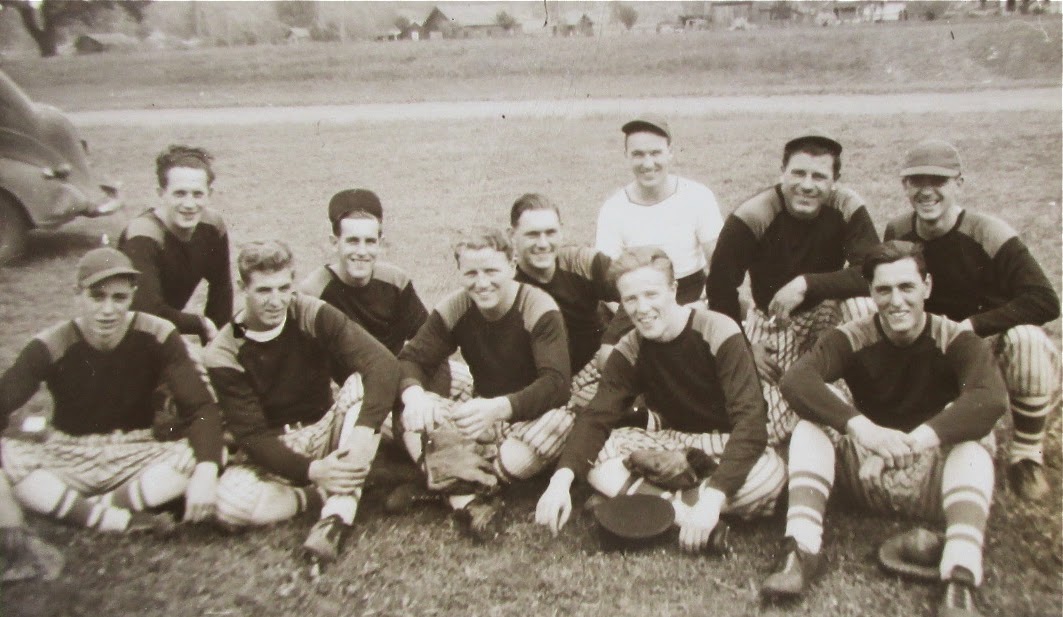
Jim Ivison and Jim Malone, back row, first and second from left,
were members of the No. 1 Navy ball team, Comox, 1944-45

L/Seaman Mair, Victoria, B.C.

Clayton 'Red' Marks

Photo from Combined Operations by Clayton Marks

Vic Mauro

A/B W.C.R. MacDonald, Abbotsford, British Columbia

J. McFarland

Buryl McIntyre, Norwich, Ontario

AB Joseph McKenna, V1540, PEI

Lt. Robert McRae, Toronto, Ontario

Lt. McRae became a POW at Dieppe, 1942
Sketch from St. Nazaire to Singapore, Vol. 1

A/B J.R. McTavish, Regina, Saskatchewan

C. Michael

Norm Mitchison, Niagara Falls

Waldo Mullins, FO 81st Flotilla

A/B Jerry Mulvey, Winnipeg, Manitoba

W. Parkes

Bruce Rendell

Jack Rimmer, Montreal

F. Robinson

Charles 'Chuck' Rose, Chippawa, Ontario, V-8927

Ted Sales

Jim Salisbury

Edward Scaysbrook, V-46818

Tom Scott

Lt. W. R. Sinclair

John Singleton, V-17334

Donald Slauenwhite, V-25787

Joe Spencer, V-8929

Gerald Spero, V-40874

F. L. Stapley, A-1399

L/Seaman Coxswain Lysle Sweeting, Gull Lake, Saskatchewan

Harold Tomlinson

A/B John Tomlinson, Galt, Ontario

S/Lt. Harry Trenholme, Montreal, Quebec

John Vandersluys, V-31672

Douglas Walker, V-34153

E. Walker, A-4081

Fred Walkley, V-59342

S/Lt. Clifford D. Wallace, Montreal, Quebec

Harold Wallace, V-44571

Joe Watson, Simcoe, Ontario V-8821

 Canadians in Combined Ops aboard H.M.S. Keren, Atlantic 1943

Names of Canadians aboard H.M.S. Keren, Atlantic 1943

Lt. Andy Wedd

Don Westbrook, Hamilton, Ontario

Lieut. Jud Whittall, Vancouver [link to news article]

Richard Wilson, V-43414

Douglas 'Doug' Zink

*  *  *  *  *

More to follow.

Link to A Work in Progress 3

Memoirs re Combined Operations

"DAD, WELL DONE" Navy Memoirs 11
by L/S Coxswain Doug Harrison

Comox is near top-centre on a painted map found in Victoria, BC

Chapter NINE. VANCOUVER ISLAND AND V-E DAY

Then I went to Givenchy III, known as Cowards Cove, at Comox on Vancouver Island. It was absolute heaven there. Just normal routine; I trained a few zombies on cutters, and played ball five or six times a week under a good coach.

At Comox, in "absolute heaven": "I played ball five or six times a week"
D. H., front far left; George 'Hobie' Hobson, coach, top far left

I also looked after Captain Windyers sailboat and prepared it when he wished to go for a sail. One day quite a wind was blowing and I was called by the captain to prepare the boat for sailing.

First thing I did was drop the drop keel and it sheered its bolt stoppers and plummeted into twenty feet of ocean. Diving would not raise it because we could not dive low enough, but by means of a wire we hooked a hole and retrieved it and soon the sailboat was ready to sail. “Isn’t it a bit windy today, sir, for sailing such a small craft?” I said. “I’ll be the judge of that,” he remarked. He hadn’t gone a hundred fathoms when the sailboat tipped over and he was bottoms up. We rescued him with an LCM barge, and when he came ashore - hair flattened and really soaked - he never even glanced my way. I wouldn’t have either.

At Givenchy III I passed professionally for my Leading Seaman rating and Acting Coxswain, classed very good. 

Riverside Hotel* is at top of the hill, trees shading its porch

We used to go to the Riverside Hotel in Courtenay and rent room number 14 because it had a window that opened into an alley just about hip high. Then we proceeded to drink Riverside dry, go to a dance and return to the room and find another dozen sailors who had come in the alley window. The room was crammed, and when we left on Sunday morning the manager’s head turned to and fro, like someone watching a ping pong game. He was utterly astounded but never called a halt because we were such nice guys.

I had a fight with an OPP Constable named Carson. I was drunk and he asked me for my I.D. card. I took a punch at him, missed him by a pole length and he assisted me to the cruiser, he was very kind. He had a hammer lock on me so didn’t open the door, he just put me through the open back window. You know, that shoulder is still sore. He took me to jail, but the cell was already packed with sailors and cleaning equipment, i.e., mops, brooms, etc. They lit the equipment on fire and smoke forced us all out. He didn’t like me because our team used to beat his team at ball. Big sissy. Poor loser.

Doug Harrison (left) with Chuck ‘Rosie’ Rose 

At Givenchy L/Sea Rose and I took a job washing dishes, but we gave everyone to understand that we had to be at the beach at 1300 hours (1:00 p.m.). There were 150 ratings to start but many were shipped out. If we were going to be late we grabbed dishes half full and said, “you’re done”, because we couldn’t keep the girls waiting.

Wm. Fischer, a stoker (not of combined ops but of R.C.N.V.R.), was stationed there. He had, I believe, an unequalled experience. He was on an Atlantic convoy run, on H.M.C.S. St. Croix, and one night in rough seas the St. Croix was sunk and he was the lone survivor. His life jacket had lights on and later he was picked up by the English ship H.M.S. Itchen. It in turn was torpedoed and Fischer was one of three survivors. They took him and his wife on saving bond tours, etc., but when he was asked to go to sea again, he said he would go to cells first. With an experience like that I would have too. He was lucky to be alive.

Gordon Bell, a YMCA director, came to ‘the spit’ as it was called nearly everyday and provided piano music, sewed on crests and buttons, repaired uniforms and showed movies. One night my oppo, Frank Herring, slightly drunk, was laughing his booming laugh at a hilarious movie when he took a sudden urge and jumped right out the window, frame and all, and he didn’t even get out.

The Spit**, a piece of land thinly linked to Comox, w oyster beds

There was a government oyster breeding ground [seen in photo above] at Givenchy and at low tide we would get bags full of the largest ones and put them in the water near the barracks, so, when the tide came in no one saw them and when tide went out we had a feast. We cooked a lot, but some of the large ones we ate raw. They were hard to swallow, i.e., the large ones, and we often needed a slap on the back to be able to move it down our throat. 

It was beautiful to see the snow-capped mountains and the contours - which had various names.

Then one day, the day we had been waiting for came - V.E. day - and what a celebration. They poured beer in my hair, there was no routine, but nothing untoward happened.

“...there was no routine, everything went mad and uncontrolled...” 

The fellows were just so glad, that it gave us time to think back and count our blessings. No, I cannot recall anything unusual happening to write about. It had a sobering effect on most of us who had been in Combined Operations under the White Ensign.

Of course, I said we were very very happy, but we were also very very lucky and knew it. Soon we went to H.M.C.S. Naden, with none of us volunteering for the Japanese theatre of war, although we were all asked by a recruiting officer.

A naval photographer took a picture of six of us: L/Sea Watson, L/Sea Warrick, L/Sea Rose, L/Sea Westbrook, L/Sea Spencer and myself, L/Sea Harrison, because we all joined the same day, went through twenty-three months overseas together and were going to be discharged all on the same day too.

Back row: Donald Westbrook, Charlie Rose, Joe Spencer 
Front row: Joe Watson, Doug Harrison, Arthur Warrick

Chapter TEN to follow.

*Photo Credit - Comox Valley Record Heritage calendar, 2012

**Photo Credit - Comox Museum

Please link to more Memoirs at "DAD, WELL DONE" Navy Memoirs 10