Thursday, March 15, 2018

Articles: Italy, Sept. 28-Oct.1, 1943 - Pt 10.

Allied Troops Italy, Supplied by 80th Canadian Flotilla of Landing Crafts

A19320. Taranto, 9 September 1943 (Operation Slapstick): View from
a landing craft, loaded with soldiers, as it approaches Taranto harbour, 
bringing reinforcements for the operation. 

Full Caption: British airborne troops approaching Taranto in a landing craft, during the invasion of Italy, 14 September 1943. Photo Credit - Lt. L.C. Priest, RN Official Photographer. Imperial War Museum (IWM).

Introduction:

Several Allied operations were in play during the invasion of Italy beginning in early September, 1943. Operation Baytown occurred at Reggio di Calabria on the toe of the boot; Operation Avalanche took place at Salerno northwest from the toe; Operation Slapstick (above photo) took place at Taranto near the heel of the boot; and another landing took place at Anzio, on Salerno's left. 

 Canadians in Combined Operations, members of the 80th Flotilla of Landing Crafts were in action at Reggio, landing Canadian troops and supplies for the first time, and - as mentioned earlier - lived where possible in Messina, Sicily and completed transporting duties for about 30 days in September and early October. On days off they water-skied, did a bit of sight-seeing, purchased or acquired the odd souvenir and scrounged for food and clothing as best they could.

As many readers already know, the war in Italy, e.g., even to reach and gain control of Rome, went on for many more months, well into 1944. To my knowledge, Canadians and their landing crafts left the scene in Messina during the first week of October 1943 before returning to England.

Some details concerning the second landings have already been provided in earlier posts, and more information is listed below as found in articles presented in The Winnipeg Tribune and other sources.

As well, along with actual veterans' stories and memoirs from the Mediterranean, several other news clippings and ads are displayed from The Tribune that provide "a sense of the times" in 1943.

*   *   *   *   *

An editorial cartoon related to neutral countries appeared in the Sept. 28 issue of The Tribune:


A map shown in the same newspaper shows Allied advance, some near Salerno on the lower coast of italy. German troops dug in, defended yardage fiercely and a long and winter lay ahead:


According to the map below, the "soft underbelly of Europe" was slowly falling under Allied control.:


"Monty" was clever not to raise expectations about an early end to the war. Axis capitulation is many months away:


Though the photo below of an LST (Landing Ship, Tank) was taken during a training exercise, it reveals that crafts that could haul and disembark tanks onto a beach were growing in size.

Early in the war, PM Winston Churchill was aware of the need to build large crafts to carry tanks in support of troops once they were delivered to hostile shores. This from The Watery Maze:

Page 68, from a well-used book by Bernard Fergusson


I include the following light-hearted story because it has a connection to a Canadian story (offered below the clipping):


In late 1941 the first Canadians (already members of RCNVR) volunteered for the unknown after reading and hearing about a 'Volunteers Needed' bulletin found at HMCS Dockyard (near HMCS Stadacona and Wellington Barracks). Al Kirby of Woodstock, Ontario writes the following:

I was finishing my Seaman Torpedo Course in Halifax Dockyard, when I saw a notice asking for volunteers to go to England to train with the Royal Navy for hazardous duties on small craft. I immediately thought Motorized Torpedo Boats. Now that sounded very exciting to a 17 year old, so I reported to the Petty Officer and applied. Yes, I was qualified. I was single and warm. (From The Yardarm, an RCNA newsletter)

My father recalls that same notice in his memoirs:

One day we heard a mess deck buzz or rumour that the navy was looking for volunteers for special duties overseas, with nine days leave thrown in. Many from the Effingham Division, including myself, once again volunteered. The buzz was true and we went home on leave....

Dad also wrote that the Canadians volunteered for “the unknown.” They knew little more than “special duties overseas, hazardous duties on small craft, nine days leave thrown in.”

After the fall of the German Sixth Army at Stalingrad in early
1943, the Russian Army was making more gains westward.

The Allies were making more gains in Italy, northward


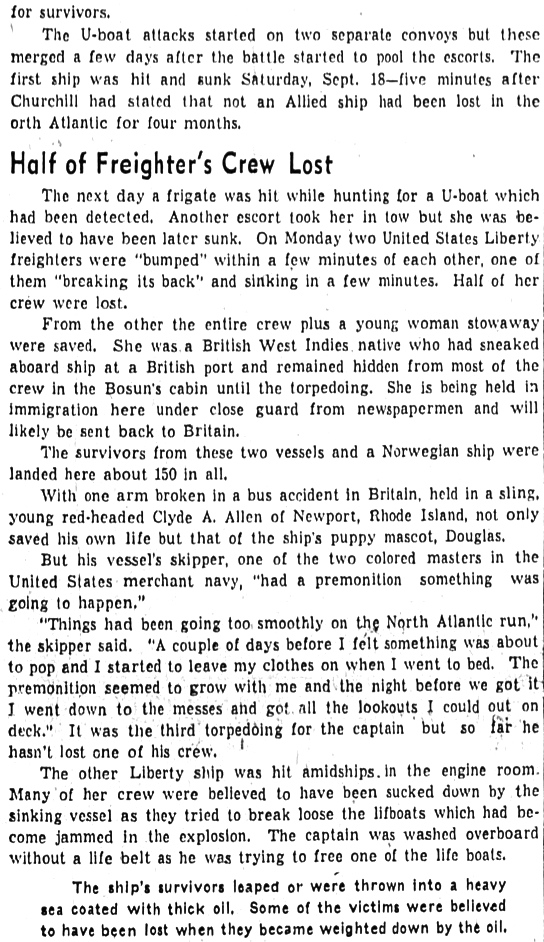
The following is a lengthy story that has an unusual (and direct) connection to the Canadians in Combined Operations who are working - at this time - in Italy, shuttling supplies from Messina to Reggio. Within a few months my father and his mates would come in contact with "the sole survivor" W. A. Fisher, seen and mentioned below:


W. A. Fisher is mentioned again in these digital newspaper offerings (in the next collection, October 2 - 6, 1943), as well as in my father's memoirs. He writes the following:

Wm. Fisher, a stoker (not of Combined Ops but of R.C.N.V.R.), was stationed there. He had, I believe, an unequalled experience. He was on an Atlantic convoy run, on H.M.C.S. St. Croix, and one night in rough seas the St. Croix was sunk and he was the lone survivor. His life jacket had lights on and later he was picked up by the English ship H.M.S. Itchen. (Page 41, "DAD, WELL DONE")

My father's notes about Fisher do not end there. More will be added in connection to the next entry about Fisher's unusual story.

Link to an account of the story at The Naval Museum of Manitoba.


"E N O, ENO, when you're feeling low, ENO"

Lord Louis Mountbatten, formerly the Commander of Combined Operations, is now moving eastward as Supreme Commander of East Asian forces:


Canadian Women were serving on different fronts during WWII as were women in other Allied nations. Invaluable service was provided by WRNS, CWACs and more organizations. Below is a CRAF, I believe, similar perhaps to the British WRAFs. 


Doug Harrison, Canadian in Combined Ops at a Canadian canteen?

Germany's new battle line was drawing away from an earlier battle front near the Volga River and Stalingrad and moving west, toward Germany itself.


More news clippings from The Winnipeg Tribune to follow.

Please link to Articles: Italy, September 24-27, 1943 - Pt 9.

Unattributed Photos GH.

Wednesday, March 7, 2018

Articles: Italy, September 24-27, 1943 - Pt 9.

Canadian Troops Push North; Navy Boys Sight See.

Jack Trevor* (RCNVR, Combined Operations). In Sicily and Italy, 1943.
Photo Credit - From the collection of Joe Spencer, Brighton ONT.

Introduction:

Canadians in Combined Operations lived where possible in Messina, Sicily and delivered troops and their supplies (the materials of war) to the toe of Italy's boot for about 30 days in September and early October in 1943.

On days off they water-skied, did a bit of sight-seeing, purchased or acquired the odd souvenir and scrounged for food and clothing as best they could.

(*Jack Trevor, above photo) certainly appears to require meat on his bones and fresh clothes. Canadians in Combined Ops transported war supplies but were short on most goods for their own day-to-day needs).

As already mentioned, about one week after the initial landings in Italy (Sept. 3, 1943 - Operation Baytown) another Allied landing took place at Salerno (Operation Avalanche), farther north along the Italian coast. It was fiercely opposed by German forces. Success was eventually achieved in establishing a solid beachhead but only after great cost to Allied forces.

As many readers already know, the war in Italy, e.g., even to reach and gain control of Rome, went on for many more months, well into 1944. To my knowledge, Canadians in Combined Ops (members of the 80th Flotilla of Landing Crafts) left the scene in Messina during the first week of October 1943 and returned to England, but not one second before their important role was finished.

Some details concerning the second landings have already been provided in earlier posts, and more information is listed below as found in articles presented in The Winnipeg Tribune and other sources.

As well, along with actual veterans' stories and memoirs from that front, several other news clippings and ads are displayed from The Tribune that provide "a sense of the times" in 1943.

*   *   *   *   *


My father, a member of RCNVR and Combined Operations, was surely reminded of home between shifts on Landing Crafts, Mechanised (LCMs), when - somewhere near his Messina accommodations - he spotted some chickens. With the thought of chicken on the menu he recalls this tale from 1943:

We weren’t too busy and the officers (who ate separately but had the same food as us) were growing tired of the diet, the same as we were, even though they had a Sicilian cook and we didn’t. An officer by the name of Wedd asked me if I knew where there were some chickens or something. I said, “Chickens, yes.”

When he said, “How be we put on some sneakers and gaffle them,” I said right then, “Okay by me. Tonight at dark we’ll go, but I get a portion for my part of the deal.”

He agreed and later we got every chicken in the coop, rung their necks, and then took them to the house and had the Sicilian cook prepare them. I got a couple of drum sticks out the window.

Next morning, the Sicilian cook came in as mad as hell. Someone had stolen his chickens. Little did he know at the time he cooked them that they were his own because his wife looked after them. 
(Page 36, "DAD, WELL DONE")


Dad at home in Norwich. He loved his chickens. Circa 1990.


Al 'Addy' Adlington of London, Ontario (RCNVR, Combined Operations) met and married a lovely Scottish bride while overseas. Al was injured during Operation Husky (invasion of Sicily). Mary travelled to Canada aboard the Ile de France.

Chuck Rose (left) with Al and Mary Adlington (w Mary's sister), Glasgow.
Photo from the collection of the Adlingtons, London Ontario.


The photo below is significant in that Canadian troops are being transported by members of the Canadian Navy.


One reads about the process of rationing by citizens on many fronts, so that Allied troops could be as fully supplied as possible:


On days off the Canadians in Combined Ops only travelled short distances compared to the above adventure. For example, the trip from Messina in Sicily to Reggio in Italy is about 7 miles.

Doug Harrison recalls the following in memoirs:

We had some days off and we travelled, did some sight seeing, e.g., visiting German graves. We met Sicilian prisoners walking home disconsolately, stopped them, and took sidearms from any officer. We saw oxen still being used as draft animals when we were there.

Sometimes we went to Italy and to Allied Military Government of Occupied Territory depot (AMGOT). (They later changed that name because in Italian it meant shi-!)

While a couple of ratings kept the man in charge of all the revolvers busy, we picked out a lot of dandies. If he caught us we were ready. We had chits made out, i.e., “Please supply this rating with sidearms,” signed Captain P.T. Gear or Captain B.M. Lever, after the Breech Mechanism Lever on a large gun. 
(Page 36, "DAD, WELL DONE")

Another member of Combined Ops recalls a similar if not the same incident re the guns:

Three of us decided to do a little sightseeing when the other crew were on duty on our craft. We visited Reggia di Calabria and called in on a police station with a letter requisitioning any guns we wanted.

Under the occupation rules and regulations locals had to turn in any weapons they held. To make the letter look authentic we stamped it with an official looking mark...the stamp having been made out of a potato. As we suspected the local police couldn’t read English and they fell for it.

Most of the weapons looked like antiques from the Boer war but I managed to get a lovely little Baretta ladies gun that I later sold to an American sailor in Gibraltar. (Page 33, My Naval Chronicle by Lloyd Evans)

FYI - Lloyd's memoirs appear at a Combined Operations website created and maintained by a hale, hearty and tireless Scotsman, Geoff Slee. I say readers should visit the site regularly to be truly informed about the extend of operations associated with Comb. Ops.

Please link to Combined Operations Command.


Charles Sellick and Jim Ivison, two other Canadian in Combined Ops, bear proof in the next photo that they may have done a bit of travelling in Italy to collect a souvenir or two... or six, as in six-shooters:

Charley Sellick (left) and Jim Ivison, Sicily 1943
From the collection of Joe Spencer.

Jim Ivison soon left the Mediterranean theatre of war with other members of the 80th Flotilla and, after arriving back in Canada in December, re-volunteered for service with Combined Operations and was sent to Givenchy III (Comb. Ops training camp at Comox on Vancouver Island, B.C.) with several other sailors, including my father in January 1944.

Jim had a talent for baseball and played on the No. 1 Navy team at Comox and appears in the following photographs:

Jim sits on fender (front right). My father sits behind him (far right).
Photo from the collection of Doug Harrison.

Jim sits back left. Joe Spencer, front right.


A few hundred members of Combined Operations were not too far behind the veterans mentioned above, as far as returning to Canada was concerned.

More Combined Ops. veterans' tales and clippings from The Winnipeg Tribune will follow.

Please link to Articles: Italy, September 22-23, 1943 - Pt 8.

Unattributed Photos GH