Monday, May 7, 2018

Articles: About Sicily, July - Aug. 1943 (18 Parts).

Canada is Heavily Involved in Operation HUSKY
In the Air, on Land, and on the Sea.

Operation Husky: The Sicily Landings 9-10 July 1943: Landing craft (a Landing
Craft Mechanised - a Mark 3) going ashore in the early morning during the start
of the invasion of Sicily. Photo Credit - A17955. Lt. H.A. Mason,
RN Photographer, Imperial War Museum

Introduction:

Canadian pilots, among many things, flew Hurricanes and helped keep the skies somewhat safe and clear as Allied troops and all the materials of war were delivered to various shores from troop and supply ships in July 1943. 

The Canadian Army landed near the south-east corner of Sicily and helped Allied forces under the command of General "Monty" Montgomery (of British 8th Army) push Italian and German troops to the point of surrender or off the island by way of Messina on Sicily's north-east corner.

Members of the Canadian Navy worked aboard British troop and supply ships in the largest armada in history, i.e., up to the date of Operation Husky. As well, about 250 members of RCNVR and Combined Operations manned four distinctly Canadian Flotillas of Landing Crafts during this significant invasion.

The 55th and 61st flotillas of assault landing craft (LCAs) took troops ashore before retiring to North African ports; The 80th and 81st flotillas of mechanised landing crafts (LCMs - see top photo) transported the materials of war (fuel, food, guns, ammunition, lorries, etc.) from July 3 - Aug. 7 (approx.) while scrambling to escape bombings, strafings, anti-personnel mines, etc. and find accommodation, meals, uniforms, etc. at the same time.

In the 18 entries (with links) that appear below, one will find photographs and news clippings from The Montreal Daily Star (digitized),  The San Bernardino Sun (California, digitized), The Madera Tribune (California, digitized) and The Winnipeg Tribune (also digitized), along with related - and rare - passages from Navy memoirs (e.g., from Canadians in Combined Operations who manned the barges) and excellent photographs from several sources (e.g., the Imperial War Museum, and Joe Spencer of RCNVR and Comb. Ops.).

I have searched many newspaper files related to the invasion of Sicily and have provided links to only a portion of the available material. Briefly, I provide details about the invasion of Sicily and subsequent Allied actions up to late August, 1943 (75 years ago as of this year, 2018).

Some items relate closely to Canadians in Comb. Ops., others do not. However, hopefully all items will provide some context for what was happening in Sicily for about eight weeks during WW2.

Readers will notice that the quality of digitization varies from one newspaper to another.

Please use the Links provided below -

1. Wartime Coverage by The Montreal Daily Star.

2. More Wartime Coverage by The Montreal Daily Star.

3. Wartime Coverage in The San Bernardino Sun.

Caption: One of the most-bombed ports in Sicily is Messina, the city just across
the straits from the Southern tip of Italy, whose hills are seen in the background.
Photo Credit - The San Bernardino Sun, issued July 11, 1943

4. More Wartime Coverage by The San Bernardino Sun.

5. Wartime News Coverage from The Madera Tribune.

6. Winnipeg Tribune - News from Operation HUSKY.

Canadian troops land west of Pachino, above; Canadian sailors manned
landing crafts at Avola and Noto, just north of Pachino.
Photo Credit - The Winnipeg Tribune

7. More Coverage from The Winnipeg Tribune.

8. Local Tars and Canadians in Combined Operations in Sicily.

9. Navy Boys Get a Word In Edgewise!

10. Focus is On The Troops Now.

Photo Credit - @ histomil.com

11. Focus Still On The CanadianTroops.

12. And The Work Goes On.

13. One More Week for Canadian LCMs.

14. Near the End of Canada's Days in Sicily.

Photo - The Winnipeg Tribune, August 13, 1943

15. Gearing Down in Sicily. Gearing Up for Italy.

16. Canadian Army and Navy Win Praise in Sicily.

17. Sicily Falls, Italy is Next.

18. Italy Bombarded: D-Day But One Week Away.

Canadians in Combined Ops were heavily involved
in the subsequent invasion of Italy as well.
Photo Credit - The Winnipeg Tribune

Please link to a compilation of articles related to the subsequent invasion of Italy - Articles: About Italy, Sept.-Oct. 1943 (13 Parts).

Unattributed Photos GH

Wednesday, May 2, 2018

Articles: About Italy, Sept. - Oct. 1943 (Parts 1 - 14)

News from The Winnipeg Tribune, and Memoirs

Photo - As found in an Oct. 1943 issue of The Winnipeg Tribune

During Operation Baytown and Avalanche, related to the invasion of Italy beginning in early September 1943, a group of Canadians in Combined Operations fulfilled a unique and significant role.

The group, as a separate Canadian entity - the 80th Flotilla of Landing Crafts - delivered Canadian troops to a foreign shore. 

By about mid-October the 80th Flotilla was gone from the Italian theatre of war and was heading back to England, where they received news they would be returning to Canada in the near future.

In the 14 entries that appear below, one will find photographs and news clippings from The Winnipeg Tribune, related passages from Navy memoirs (e.g., from Canadians in Combined Operations who manned the barges) and rare photographs from several sources (e.g., the Imperial War Museum, and Joe Spencer of RCNVR and Comb. Ops.).

I have searched many newspaper files related to the invasion of Italy and have provided links to only a portion of the available material. Briefly, I provide details about the invasion of Italy and subsequent actions up to mid-October, 1943, even though our troops were active until early June 1944 (occupation of Rome) and more.

Some items relate closely to Canadians in Comb. Ops., "men of the barges", others do not. However, hopefully all items will provide some context for what was happening in Italy for six weeks during WW2.

Please use the Links provided below -

1. A New Chapter for Canadians on Landing Crafts.

2. D-Day Italy: Operation Baytown at Reggio Calabria


3. Canadians on Landing Crafts Get Top Billing!!

4. Canadians on Landing Crafts - No More Top Billing.

5. Operation Avalanche, at Salerno, Was a Close Call!


6. Strong Stories about Salerno and One Great Lead.

7. Allies Advance in Italy, But Chickens Go Missing

8. Hard Work Continues on Italian Mainland... and Beaches
       (And the Navy Boys Find Time to Go Waterskiing!)


[Photo: NA6220. Personalities: The Commander of the Eighth Army, Lieutenant
General Sir Bernard Montgomery, watches troops as they pass through the streets
of Reggio. Photo Credit - Major Geoffrey Keating, No. 2 Army Film and
Photographic Unit, Imperial War Museum (IWM)]

9. Canadian Troops Push North; Navy Boys Sight See.

10. Allied Troops Italy, Supplied by 80th Canadian Flotilla of Landing Crafts

11. Final Days for Canadian Sailors in Italy

12. Allies Gain Ground in Italy, But...

13. Allies Advance in Italy, and Tirpitz is Hit.

14. Navy Boys on Their Way Home

Readers are encouraged to visit The Digitized Winnipeg Tribune found at the University of Manitoba and search their extensive collection of complete newspapers that span not just WW2 but several decades.


For information about the invasion of Sicily (Operation Husky), please link to About Sicily, July - August 1943, (Parts 1 - 18)

Unattributed Photos GH

Tuesday, May 1, 2018

Photographs: Camps, Landing Crafts (15 Parts).

A Compilation of Photos re Training Camps, Landing Crafts.

[Art Work - Herbert Hastings McWilliams, HMS Saunders, Kabret, Egypt, 1945.]
Credit - As found at Combined Operations Command 

Introduction: 

Canadians in Combined Operations trained aboard landing crafts at various camps in the United Kingdom prior to calls to action at Dieppe, N. Africa, Sicily, Italy and more. The camps and types of landing craft varied, as did their surroundings, nearby towns, townspeople, customs and pubs.

In my search for more information related to camps the Canadians were soon to know well, e.g., HMS Northney, HMS Quebec, Camp Auchengate (between Irvine and Troon, Scotland) and HMS Saunders - to name a few - I found scores of photographs with informative captions and created 15 entries on this website. Links to each are provided below.

1. HELP WANTED: 1000s of Landing Crafts and Crews.

2. Gradual Growth of Combined Ops Crafts and Crews

3. Gradual Growth of Combined Ops Crafts and Crews

Eight Canadians at their first training camp, HMS Northney on Hayling Island.
L - R: Al Adlington, London; Joe Spencer, Toronto; Chuck Rose, Chippawa;
Doug Harrison, Norwich; Art Bradfield, Simcoe; Don Linder, Kitchener;
Joe Watson, Simcoe; Jake Jacobs, address unknown. February, 1942
From the collection of Joe Spencer, RCNVR, Combined Operations

4. Combined Operations Camps, Landing Crafts and Crews

5. Combined Operations Camps, Landing Crafts and Crews.

6. Combined Operations Camps, Landing Crafts and Crews.

7. Combined Operations Camps, Landing Crafts and Crews.

Night scene showing searchlights from two boats circling just off a beach.
Creator - Henry Carr. Photo Credit - The Imperial War Museum (IWM)] 

8. Invasion Craft During a Training Exercise.

9. Types of Landing Craft Grow in Number

10. Various Crafts and Camps: Isle of Wight to Irvine.

11. Major Camps Near Irvine and Inveraray, Scotland

Buryl McIntyre (left) and Doug Harrison, from Norwich, Ontario.
Veterans of Dieppe, N. Africa, Sicily, Italy and more.

12. H.M.S. Quebec at Inveraray and More

13. Various Crafts and Camps in the U.K.

14. Training on Crafts in Inveraray, and More

15. Salutes, Saunders Camp and Sundaes in Canada

Unattributed Photos GH

Articles: Italy, Oct. 12-13, 1943 - Pt. 13

Allies Advance in Italy, and Tirpitz is Hit.


Photo: Germany's largest battleship Tirpitz is hit while hiding in Norway.
Photo Credit - The Canadian Press, as found in the Winnipeg Tribune

Introduction -

The following news clippings and photographs are credited to the October 12 - 13, 1943 issues of The Winnipeg Tribune unless attributed otherwise.

As far as I know, the Canadian members of Combined Ops who manned landing craft for several weeks (Sept. - Oct.) during the invasion of Italy, are now on their way back to England. Next stop for many - Canada.

Please link to the digitized Winnipeg Tribune for more information about World War activities and Canadian news.


The location of the strike upon the Tirpitz - Alten Fjord - is seen in the small map below:


Canadians in Combined Operations (C.O.) manned landing crafts during training exercises (prior to the invasions of Sicily and Italy) at various sites in the U.K. In the photograph below, three such Canadians are seen aboard a landing craft while transporting a machine gun or two and beach traction mats.

Left to right: Chuck Rose (from Chippawa, ONT), Al Kirby (Woodstock, ONT)
Don Westbrook (Hamilton, ONT). Photo Credit - Lloyd Evans, RCNVR, C.O.


Canadians in Combined Ops, when in Italy, visited an AMGOT depot and tried to tip the scales in their favour. Says my father:

We had some days off and we travelled, did some sight seeing, e.g., visiting German graves. We met Sicilian prisoners walking home disconsolately, stopped them, and took sidearms from any officer. We saw oxen still being used as draft animals when we were there.

Sometimes we went to Italy and to Allied Military Government of Occupied Territory depot (AMGOT). (They later changed that name because in Italian it meant shi-!) While a couple of ratings kept the man in charge of all the revolvers busy, we picked out a lot of dandies. If he caught us we were ready. We had chits made out, i.e., “Please supply this rating with sidearms,” signed Captain P.T. Gear or Captain B.M. Lever, after the Breech Mechanism Lever on a large gun. (Page 36, "Dad Well Done")


Combatants from both sides of the armed conflict (WW2) that spanned six years suffered in many ways, one of which was homesickness. Big tough boys would speak of their mothers, girlfriends, hometowns and humble homes - and would at times cry unashamedly for any and all things 'home'.

My father mentions the following while on his way to The Solent, the channel separating Isle of Wight from the UK mainland, on his way to take part in his first call to action (Operation Rutter, a cancelled raid on Dieppe):

On June 22, 1942, my mother’s birthday, O/D Seaman Jack Rimmer of Montreal and I were reminiscing on deck. We must remember there was daylight saving time and war time, and to go by the sun setting one never knew what time it was. Jack and I were feeling just a little homesick - not like at first - and it was a terribly hard feeling to describe then. (Navy memoirs)

One year later he and his mates spent a long time travelling aboard SS Silver Walnut as they circled Africa on their way to Operation Husky, the invasion of Sicily. My father mentions the following in memoirs:

The conversation among the Canadian sailors would invariably be of home. We spoke most often of our mothers, rather than our girlfriends. Some of us, including a young, apple-cheeked Mr. Rodgers, shed unhidden and un-ashamed tears as we talked of our mothers and the mutual concerns we shared for one another.

Usually when we sang navy ditties on decks, with our backs against the bulwark, Mr. Rodgers would emerge from his cabin and say, “Keep it down to a dull roar, boys.” He thought, possibly, that we might attract a U-boat. After a while, with my tutoring, we learned to sing a song about our mothers. Although the officer didn’t join in, he was nearby with his foot on the lower rail, looking off into the distance with his arms folded across his chest. He appeared to be deep in thought; after all, officers have mothers too.

This is the song that my mother had taught me a few years before - a poignant reminder of happier times:

M is for the million things she gave me
O is that she now is growing old
T is for the tears she shed to save me
H is for the heart of purest gold
E is for her eyes with love light shining
R is right and right she’ll always be.

Put them all together they all spell MOTHER
A word that means the world to me.


Page 98, "Dad, Well Done"


An excerpt from another separate article follows:


"William, wait until you're a little older!"

"No way, Ma!"


Any photograph or drawing with landing crafts catches my eye : )


"Hey, Quinn. Play us a song from Winnipeg, eh."


Some Canadians in Combined Ops who returned to Canada in December, 1943 were very soon on their way to Canada's Combined Operations training camp (Givenchy III) on Vancouver Island. They remained there - as trainers, not trainees - until discharge in September, 1945. Bill Fisher, mentioned below, stayed at the same camp for awhile, and went on a tour for a period of time to promote war bonds. When asked if he'd like to return to sea he said he would rather "go to cells (jail)."


More information about the hit on Tirpitz, Germany's largest battleship:


What's a bo'sun? What's a rating?


A boatswain, bo's'n, bos'n, or bosun, also known as a Petty Officer or a qualified member of the deck department, is the senior-most rate of the deck department and is responsible for the components of a ship's hull. The boatswain supervises the other members of the ship's deck department, and typically is not a watch-stander, except on vessels with small crews. Additional duties vary depending upon ship, crew, and circumstances. (Wikipedia)

A naval rating is an enlisted member of a country's navy, subordinate to warrant officers and officers, and hence not conferred by commission or warrant. The naval term comes from the general nautical usage of rating – a seaman's class or grade as recorded in the ship's books,[1] whilst in the United States it is currently used to denote a sailor's occupational specialty.[2]

The system of conferring authority on sailors in the Royal Navy and elsewhere evolved through the recognition of competence; Landsman, Ordinary seaman or Able seaman and through the appointment of authority as a petty officer.

Historically the term rate also applied to ships, denoting their combat strength by the number, and type, of guns.
(Wikipedia)


Please link to Articles: Italy, Oct. 7-11, 1943 - Pt 12.

Unattributed Photos GH

Thursday, April 26, 2018

Editor's Column: As Published in Norwich Gazette (8).

FAINT FOOTSTEPS, World War II.

Canadians (RCNVR, Combined Ops) with landing crafts at Portsmouth
Doug Harrison (centre) peeks out from behind his mates. circa 1942

Baptism of Fire on the Ennerdale.

In May, 1942 my father received a baptism of water. He was stranded offshore Irvine, Scotland - in cold, black waters - while his landing craft (British troops, Dad’s mates and Lieutenant Koyl aboard) participated in assault exercises under King George’s watchful eye. 

A few weeks later, the Canadians received a baptism of fire. En route to their first official action - Operation Rutter, a raid on Dieppe set for July 7 - they were attacked by German bombers hiding in the sky.

Rutter may be a relatively unknown entity today. The name was not even known to Canadian officers or sailors at the time. Lt. Koyl writes, “The first operational call received was in early June when we sailed away from our base to take part in some operation.” (As found in Combined Operations)

Though cancelled, and over-shadowed five weeks later by Operation Jubilee (the ‘battle of Dieppe’), events related to Operation Rutter - especially the bombings, sudden and frightening - were well-remembered.

The Canadians and well-worn landing barges left Scotland aboard the oil tanker Ennerdale in early June and sailed past Wales and Land’s End on their way to the Isle of Wight. Though one of the ship’s crew warned my father of what might come - “We got a bloody basinful last time!” - Dad recalls that early on “all was serene.”

The Ennerdale headed toward The Solent, the strait near Isle of Wight

Then on June 22, 1942 (“my mother’s birthday,” says Dad), after a bit of “reminiscing on deck... feeling a little homesick,” and after two Spitfires “waggled their wings and headed home,” my father and mates hit their hammocks.

They were barely settled in when chaos erupted - in a mad rush. 

“Eight German Junker JU 88s came from the east, took position in the sun and attacked us from the stern,” says my father.

The Ennerdale’s klaxon horn quickly blared out ‘action stations.’

“Everybody tried to dress and hit the deck,” Doug adds. “Being the largest ship, we knew we were in for it. I got my socks on, put my sweater on backwards and got suspenders on my pants caught on the oil valves. I was hurrying like hell and nearly strangled myself - scared to death. The bombs came, and close. They really bounced us around.”

Extra gunners were needed and Lloyd Campbell of London, Ontario was heard to say, “Let me at ‘em.” The gun crew on the Ennerdale’s forecastle was knocked clear off the gun by the concussion. The men fell hard but were only bruised. 

“The attack was short and sweet but it seemed an eternity,” says Doug. “A near miss had buckled our plates and we lost all our drinking water. I ventured out on deck (when skies were clear) and picked up bomb shrapnel as big as your fist for a souvenir.” 

The sturdy Ennerdale, its plates buckled and decks covered with mud from the sea bottom, arrived at Isle of Wight the next day “with everyone happy to be alive and still shaking.”

Though Lt. Koyl later reported that Operation Rutter “was cancelled and all were ordered to return to base,” sailors saw some details related to the operation before leaving England’s southern coast.

Lloyd Evans recalls a confusing scene. “A large flotilla of Landing Craft, loaded with soldiers and Commandos, set sail one evening - and we remained in port. The mystery deepened,” he says, “they returned a few hours later... they found out the Germans were waiting for them.” (My Naval Chronicles)

Perhaps that same evening my father saw “terrific activity. Motor launches by the dozen went to see what was going on, and it turned out to be the aborted attempt on Dieppe.” 

In his opinion, “The next one should have been aborted too.”

More columns to follow.

Please link to Editor's Column: As Published in Norwich Gazette (7).

Unattributed Photos GH

Saturday, April 21, 2018

Photographs: Training on Landing Crafts (15).

Salutes, Saunders Camp and Sundaes in Canada

[Photo: A13216. Lord Louis Mountbatten taking the salute at the march
past by men of the Royal Navy, the Army and the Royal Air Force.
Photo - RN Photographer S.J. Beadell. Imperial War Museum]

Introduction:

The first draft of Canadian members of RCNVR - who also volunteered for Combined Operations - trained on landing crafts at some of the camps mentioned in this entry. For example, in the top photo, Lord Mountbatten is 'taking the salute' at Camp RAF Dundonald, south of Irvine, Scotland, which was adjacent to Camp Auchengate, home to the Canadian Navy boys while they practised landing assault crafts on the broad beaches between Irvine and Troon (farther south by only a few miles).

Several photographs at the bottom of the entry deal with (camp) H.M.S. Saunders at Bitter lakes, Kabret, Egypt. Much Combined Operations training took place there and the Canadians, after circling Africa in the summer of 1943 with their landing crafts aboard troop transport ships, stayed at Saunders - as a stopover - on their way to Operation Husky, the invasion of Sicily (July, 1943).

Most photos below and their informative captions are attributed to the Imperial War Museum (IWM). Explore their rich stock of photographs (11 million and rising) at Search Our Collection.

The following Heading appears with many of these photos at IWM:

LORD LOUIS MOUNTBATTEN AT A COMBINED OPERATION CENTRE. DUNDONALD CAMP, 9 DECEMBER 1942.

By December 9, 1942 the first draft of Canadians in Combined Ops had gained experience in training at H.M.S. Northney on Hayling Island, H.M.S Quebec south of Inveraray and at Irvine. They wold also have participated in Operation Rutter (the cancelled raid on Dieppe), Operation Jubilee (the Dieppe raid) and Operation Torch, invasion of North Africa in November, 1942.

In December the Canadians were very likely on leave. (My father recalls spending Christmas with an aunt and uncle in London).

A13217. Lord Louis Mountbatten inspecting the WRNS personnel.
RN Photographer S.J. Beadell, Imperial War Museum

A13218. Lord Louis Mountbatten inspecting Naval Ratings.
RN Photographer S.J. Beadell, IWM.

A13219. Lord Louis Mountbatten inspecting Canadian soldiers.
RN Photographer S.J. Beadell, IWM.

A13220. Lord Louis Mountbatten chatting to a signal Rating.
RN Photographer S.J. Beadell, IWM.

A13221 Lord Louis Mountbatten inspecting Canadian soldiers.
RN Photographer S.J. Beadell, IWM.

Heading - LORD LOUIS MOUNTBATTEN AT A COMBINED OPERATION CENTRE. DUNDONALD CAMP, 9 DECEMBER 1942.

A13226. Lord Louis Mountbatten shaking hands with Army officers.
Photo Credit - S.J. Beadell, Imperial War Museum.

Readers will notice that the Army officer third from the right is shorter than all others nearby, maybe about 5 ft. 2 in. That being said, he might be a tough one to deal with when returning to camp after enjoying a few pints at the Harbour Lights in Irvine.

My father recalls the following (while at H.M.S. Quebec near Inveraray) in memoirs:

Nearby was the H.M.S. Chamois camp (adjacent to Quebec). We moved there for a time and still used the same wet canteen.

O/D Kirby of Woodstock, a very young man (possibly 17 or 18 years old), got quite drunk and on his way back to camp was challenged to show his ID card. After he did so he went on to his barracks but then started to brood.

“No 5 ft. 2 in. English guard is going to challenge me for my ID card,” he said.

So, back he goes to pick a quarrel. Quite soon came an order: “You, you, and you. Take a stretcher down to the gate.”

Who should come back but young Kirby, quite unconscious. The guard just slammed him over the head with the butt of his rifle. Page 15, "Dad, Well Done"

D. Harrison (left), Al Kirby. Guard duty! circa 1942

A13344. On the range a seaman fires with live ammunition at a moving target.
Lt. L. Pelman, RN Official Photographer, IWM.

Heading as found at IWM. - Mobile DEMS Gunnery School. 7 to 11 December, 1942 Devonport.

A13346. The Officer instructor explains the principles of sighting on the blackboard.
Photo Credit - RN Photographer Lt. L. Pelman, Imperial War Museum

Heading - MOBILE D E M S GUNNERY SCHOOL. 7 TO 11 DECEMBER 1942, DEVONPORT. IN ADDITION TO THE REGULAR TRAINING ESTABLISHMENTS WHERE OFFICERS AND MEN OF THE MERCHANT NAVY ARE TAUGHT HOW TO USE THEIR GUNS, THERE ARE NOW A NUMBER OF MOBILE SCHOOLS WHICH TOUR THE VARIOUS PORTS GIVING THREE DAY GUNNERY COURSES TO ANY MERCHANT NAVY PERSONNEL WHO WISH TO TAKE PART.

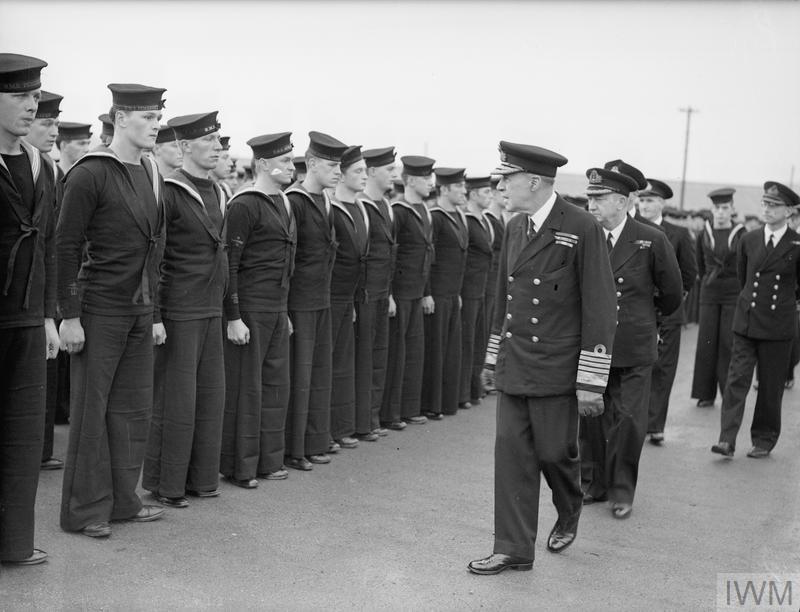
A13349. Admiral of the Fleet Sir Charles Forbes, GCB, DSO, inspects divisions
at HMS FOLIOT I AND HMS FOLIOT III of Naval officers and ratings lately
returned from operations in North Africa. Photo - Lt. L. Pelman, IWM.

Heading - COMMANDER-IN-CHIEF OF EASTERN APPROACHES, MEETS NAVAL OFFICERS AND RATINGS WHO TOOK PART IN THE NORTH AFRICA OPERATIONS. 13 DECEMBER 1942, IN THE PLYMOUTH AREA.

Here are a few lines from one of my father's lengthy newspaper columns written for his hometown paper, the Norwich Gazette (Ontario). It was published in the 1990s and recounts a Christmas dinner in London England while on leave after the invasion of N. Africa.

Down Memory Lane

Upon returning to England from the invasion of North Africa by Allied Forces in November, 1942, I was stationed in barracks at H.M.S. Foliot near Portsmouth.

As a boy, I had read and re-read history books about Admiral Horatio Nelson, my hero, and while waiting for a leave over Christmas I journeyed to Portsmouth to see Nelson's ship, H.M.S. Victory, which to me was a bonus. I never dreamed I would one day actually lay hands on those famous last words: "England expects every man will do his duty."

Christmas came ever nearer and parcels began arriving from family and friends in Canada. I hadn't received mail for some time and along with Christmas parcels came cartons of Sweet Caporal cigarettes from the Women's War League in Norwich.

There were perhaps 250 Canadian sailors at H.M.S. Foliot and everyone got Christmas and New year's leave. I don't remember exactly how many parcels I received but I piled all my earthly belongings neatly in my locker, and when all the necessities for a great Christmas for myself and relatives in London were stowed away in my kit bag, I just managed to tie it and put on a padlock.

The padlock was such that it acted as a hand grip and I lugged Christmas goodies on buses, trains and tube trains all over London. I had arranged the Christmas cakes in my metal hat box, and it was right on top....

A13350. Admiral of the Fleet Sir Charles Forbes, GCB, DSO, inspects divisions
at HMS FOLIOT I AND HMS FOLIOT III of Naval officers and ratings lately
returned from operations in North Africa. Photo Credit - Lt. L. Pelman, IWM.

*  *  *  *  *

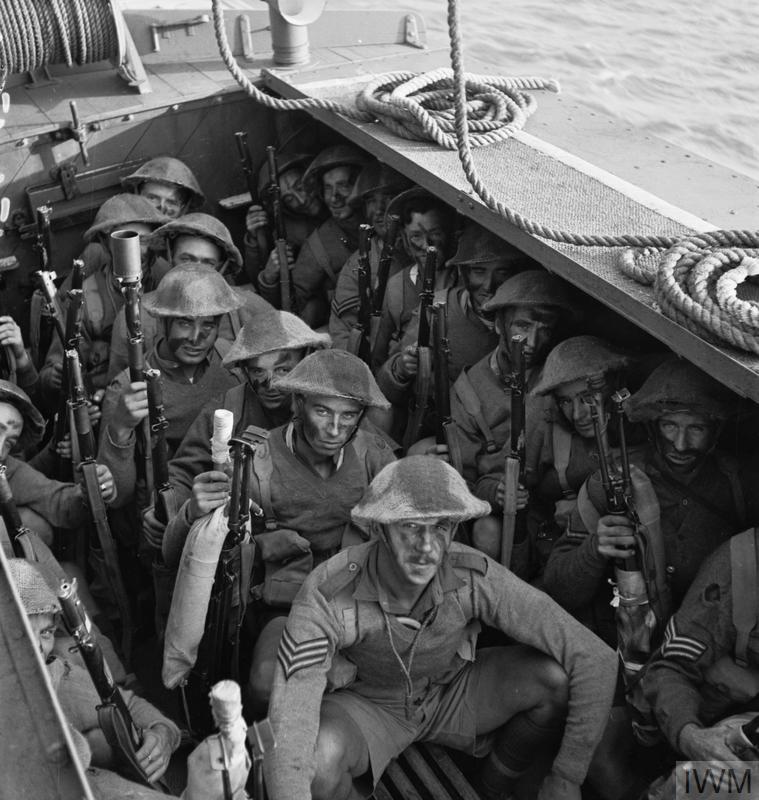
E4594. Camouflaged troops in an assault landing craft during combined
operations training in the canal zone, Egypt, 2 August 1941.
Major Geoffrey Keating, No. 1 Army F and P Unit, IWM.

E8172. A Matilda tank comes ashore from a landing craft during combined
operations training involving 5th New Zealand Infantry Brigade at Ras Sudr
in Egypt, 9 February 1942. Photo - No. 1 Army Film and Photo Unit, IWM.


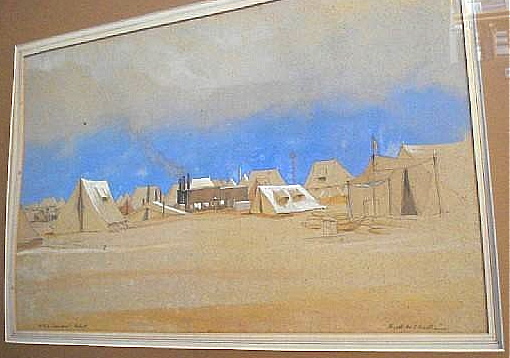
Two Art Works - Herbert Hastings McWilliams, HMS Saunders, Kabret, Egypt, 1945

For more details about HMS Saunders, please link to Combined Operations Command.

Canadians members of RCNVR in Combined Operations, aboard H.M.S. Keren,
on their way around Africa to Port Said, Egypt and Operation Torch, 1943

"H.M.S. Keren/43. Atlantic." With names of Canadians in Combined Ops.
Note: D. Westbrook, Hamilton. Dad was his best man in December, 1943

Canadians in Combined Ops at H.M.S. Saunders. Tents barely seen in background.
Note - Don Westbrook, back row, 4th from left. Likely has dysentery!

Canadians in Combined Ops, aboard Aquitania bound for Canada, Dec. 1943
Note: Don Westbrook in 'Group of Seven', centre. Father in group, far right.

My father enjoys a sundae back in Canada with a member of CWAC. Dec. '43
In January, Canadians journeyed to a Comb. Ops camp on Vancouver Island. 

Please link to Photographs: Training on Landing Crafts (14).

Unattributed Photos GH