Monday, March 7, 2022

Photographs: Canadians in "Combined Operations" (Pt 5)

Invasions of Sicily and Italy - A Big Deal (Three Deals, in Fact)

Operations Husky, Baytown and Avalanche, July - Sept. '43

Four Canadian Flotillas of Landing Craft (see 80th, 81st, 55th and 61st)
were active on beaches of SE coast of Sicily, beginning July 10, 1943
Map found in Combined Operations by London's C. Marks, pg. 76

Introduction:

After duties related to Operation Torch (the invasion of N. Africa, beginning early November, 1942), Canadians in Combined Ops returned to the United Kingdom for more training aboard landing crafts. My father, for example, trained for a time at HMS Westcliff at Southend-On-Sea, east of London, on the north shore of the Thames River.

And in the spring of 1943 they embarked, flotilla by flotilla, aboard troop and cargo liners to destinations touching on or near the Mediterranean in order to prepare the launch of the world's largest armada (up to that point) for (firstly) Operation Husky, the invasion of Sicily. Some, like my father, aboard the Silver Walnut,  travelled the long-way-'round to get to Port Said and Alexandria - all the way around Africa - in order to arrive at HMS Saunders, a Combined Operations training camp next to an inland lake, south of Port Said. 

The first group of old photographs found in Combined Operations (page 75) after stories re the Dieppe Raid reveal a little bit about the arrival of Canadian sailors (RCNVR, Combined Operations) at HMS Saunders, and a couple of other locations in Egypt. These are followed by the map of Sicily as seen at the top of this entry. It is also shared in a larger size below.

Along with Mr. Marks' photos - most only have the shortest of labels, i.e., location - I have included a few other items:

Approaching Port Said, perhaps; or Alexandria?

Help Wanted: If anyone looks familiar, let me know!
Comments to gordh7700@gmail.com

Help Wanted again: If anyone looks familiar, let me know!
Comments to gordh7700@gmail.com

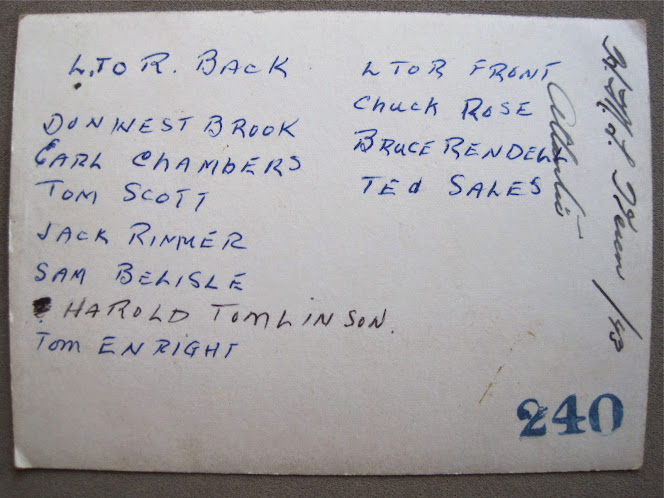
In my father's collection I found the following. Tents can be seen, faintly, in the background and I recognize one good friend of Dad's, i.e., Don Westbrook (Hamilton) in back row, 4th from left. He may be wearing borrowed (huge!) shorts because of the dysentery problem that some sailors recalled in memoirs.

Wouldn't a list of names be lovely? I can only say the site is HMS Saunders.
Wait! I recognize the second from left, up front. Harold Tomlinson!*
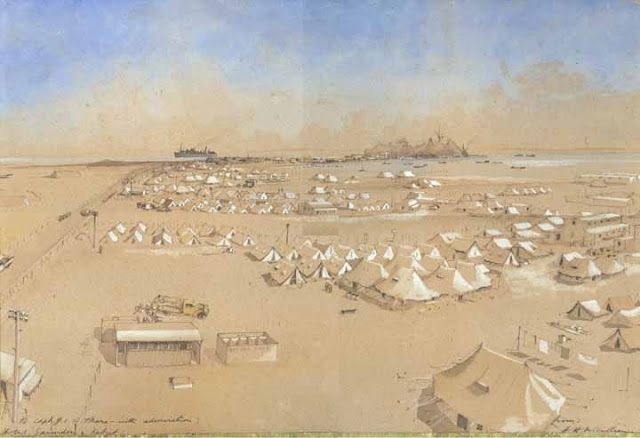
Art Work - Herbert Hastings McWilliams, HMS Saunders, Kabret, Egypt, 1945
Credit - As found at Combined Operations Command

*Harold Tomlinson and Don Westbrook appear together below in a photo taken while they and other Canadian sailors in Combined Ops were aboard HMS Keren - in the Atlantic - and travelling around Africa to get to Port Said, Summer, 1943:

Chuck Rose, front left, was another fine friend of my father's*,
and came from Chippawa, ONT (near Niagara Falls)

*My father and Chuck played a lot of baseball together when back in Canada, but still during the war:

Doug Harrison and Chuck Rose at an RCNVR or Combined
Operations reunion, during their middle age. 1975-ish?

Canadian sailors took in sights and sounds of places during the war that would have cost them a small fortune to revisit later in life. Cairo, Alexandria, the Pyramids, etc.


The night sky over Alexandria is lit up like a Christmas tree!

Again, wouldn't a list of names be lovely? Combined Operations, page 75

The following photograph is from the collection of Joe Spencer and from the same time period:

"Ismalia, Egypt. (L-R) P. Martel, E. Chambers*, S. Ingram, Norm Mitchinson"
*E. Chambers also appears with the group of ten (above) aboard HMS Keren

A few sailors mention visiting the Pyramids aboard camels during leave

Before the Canadians in Combined Ops and their flotillas of landing craft (aboard troop ships*) made their way to the invasion of Sicily ("Husky"), they faced the perils of German subs in the Atlantic Ocean and a lengthy trip around Africa to arrive in Egypt.

"LCM 81-7 hoisted off E. Charmain in Sicily, July 10, 1943.
MacGregor's boat." Photo - Joe Spencer, RCNVR, C. Ops

Below are excerpts from Combined Operations that help tell the tale:

SICILY AND ITALY July 10, 1943 - and - September 3, 1943

The armies for the invasion were gathering in England. Many of their divisions were already hardened, trained and ready. Weapons, stores and supplies were accumulating in enormous volume, in incredible variety.

Great fleets of Allied bombers were now battering at German industries, cities and strategic centres; at the country's brain, nerve centres and heart. The war seemed to be moving toward its climax, as indeed it was. Yet the grand diversion, the round-about closing in from the south which had begun with Operation Torch on November 8, 1942, was still in progress; had still to reach the point where it could mesh and move forward as an integral part of the final assault. It had advanced through several phases during the mid-months of 1943, and in some of those phases the Landing Craft Flotillas of the Canadian Navy had again played a part.

About the middle of March, 1943, several large convoys left British ports for Suez. The end of the North African campaign was coming in sight, and the next step would be the forcing of a passage to the Italian mainland. Sicily lay between North Africa and Italy, separated from the toe of the boot only by the narrow Straits of Messina; and Sicily was chosen by Allied planners as the next step toward Rome.

The convoys, which were to round Africa and come up through the Red Sea to Suez and Port Said at the eastern entrance to the Mediterranean, carried the Combined Operations Flotillas and a portion of the troops for the landings on Sicily; and among them were the 55th and 61st Canadian Flotillas of LCAs (assault landing craft). Later convoys were to carry the 80th and 81st Canadian Flotillas of larger landing craft (LCMs) for the ferrying of vehicles and heavier stores.

Together, the Canadian personnel manning these Flotillas totalled about 400 men, while another 250 Canadians served in British Landing Craft Flotillas or in the support ships. They were a microscopic proportion of a force which consisted in all of 2755 transports, escorts and landing craft of many kinds; yet they were to be an important part of the ferrying forces at the beaches where they were used, and their performance was to be of a high order.

Far from Sicily, as the battle for Tunisia swept on to its conclusion, the men of the Landing Craft Flotillas trained under the broiling sun of Suez. Large-scale amphibious exercises*, as tough and realistic as possible, ironed out difficulties remembered from the Torch landings, tested the men and the craft to their limits, gave rise to excited speculation as to what actual coast resembled the "dummy" beaches against which the exercises were directed.

*Below are photos re Combined Operations training (i.e., "large-scale amphibious exercises") at HMS Saunders:

A17724. Army assault troops landing from invasion craft as naval beach parties and
commandos train at HMS SAUNDERS, Kabrit, Bitter Lakes near the Mediterranean.
Photo Credit - Lt. L.C. Priest, RN Photographer, Imperial War Museum (IWM)

8A17725. Army assault troops landing from a landing craft assault (LCA 57)
as naval beach parties and commandos train at HMS SAUNDERS.
Lt. L.C. Priest, RN Official Photographer, IWM.

Please click here for more details and photos re to Combined Ops training at HMS Saunders.

Clayton Marks continues:

On July 4th all Combined Operations Officers were called together for final instructions, and on July 5th the assault convoys sailed from Port Said for a rendezvous position south of Malta. On the 9th the rendezvous was reached, and to the men of the 55th and 61st assault Landing Craft Flotillas, watching from the decks of the Landing Ships Strathnaver and Otranto*, it seemed that every horizon was crowded with arriving convoys.

Certificate re crossing the equator aboard 'ye Goode Shippe Otranto'
Collection of Charles "Comox" Levett, RCNVR, C. Ops. Photo GH

At sea in the western Mediterranean and gathering at the rendezvous, were sixteen escorted convoys and two large Naval covering forces of battleships, cruisers, aircraft carriers and destroyers.

At the rendezvous position the convoys assembling from the eastern and western Mediterranean divided into two great forces which passed up on either side of Malta. The Western Task Force carried the American Seventh Army which was to land along the southwest coast on a front extending southward from Licata.

The Eastern Task Force carried the British Eighth Army, which included the First Canadian Division and the First Canadian Army Tank Brigade. It was to land along a two-corps front extending from the western side of the Pachino Peninsula around northeastward as far as Syracuse. Canadian soldiers and sailors, for this operation, were not to have the satisfaction of working together*.

The Royal 22 Regiment lands on the beaches at Reggio, September 3, 1943
"Canadian soldiers and Canadian sailors were operating together at last."
Photo - Alexander M. Stirton. Department of National Defence,
National Archives of Canada, PA-177114.

[* The 'satisfaction of working together' was realized on September 3, 1943, during Operation Baytown, the invasion of (the toe of the boot of) Italy at Reggio di Calabria.]

C. Marks' story continues: 

The Canadian Division was to drive in on the western side of the Pachino Peninsula, carried in British Landing Craft. The Canadian Landing Craft Flotillas were a part of the subdivision of the Eastern Task Force which was to land British troops on the eastern side of the Peninsula, a little to the north of Pachino itself.

Toward evening on the 9th of July, the Eastern Task Force approached the shores of Sicily, and the summit of Mount Etna loomed through the haze.

Two things went wrong in the early stages. The odds against bad weather in those waters at that time of year were long, but a gale blew up. D-minus one (i.e., D-Day minus one day) started as a hot day without a ripple on the water. By noon there was a seasonable breeze from the northwest. By 1500 it was blowing force 4 and three hours later it was more like force 7. 

Almost all the troops in the landing craft were sick. As the British came under the lee of the land, conditions for them improved, but the Canadians and the Americans had no such shelter, and had to disembark soaked to the skin and in full misery of seasickness. Yet the bad weather had one good effect; the enemy, certain that we could not make a landing, tucked up and went to sleep.

For a time it was thought that the whole operation would have to be postponed, but after darkness it was decided to continue in the hope of better weather at dawn.

The second misfortune concerned the airborne troops... [To be continued]

Combined Operations, C. Marks, pages 79 - 81

Details concerning Operation Husky is upcoming. Below is a very significant map re where Canadians in Combined Ops were serving.... Acid North (or Centre), at Green Beach, near Avola.


Map as found in Combined Operations, page 76

More photographs and stories will follow from Combined Operations by Londoner C. Marks (RCNVR, Combined Ops), along with other related materials and links.

Please link to Photographs: Canadians in "Combined Operations" (Pt 4)

Photos GH

Friday, February 18, 2022

Video: "FAINT FOOTSTEPS, World War II, Part 8"

An Important Combined Ops Exercise Goes Awry

The WWII Training Exercise Schuyt 1, May 1942

WWII landing crafts penetrated 'hostile shore defences' under the
watchful eye of King George VI from waters off Irvine, Scotland

Introduction:

The Canadian sailors and officers who volunteered for the Combined Operations (C.O.) organization in December, 1941 were soon involved in training exercises - handling landing crafts filled with British soldiers - at C.O. training camps near Irvine, Scotland (and initially, Hayling Island, England, and Inveraray, Scotland) in the spring of 1942. Raw recruits, sea-sick soldiers under the thoughtful observation of C.O. Commander Louis Mountbatten, PM Winston Churchill and King George VI - not everything went off as planned. 

My father helped nudge a stranded landing craft off a sandbar, but was left
behind in the waters near Irvine. An Aldis lamp spotted him. Photo - IWM

FAINT FOOTSTEPS WWII, Part 8 follows:


The video incorporates many details from a story (below) written by my father, Doug Harrison (RCNVR, Combined Operations), and photographs from my trip to Scotland in 2014.

Exercise Schuyt 1: Marooned On a Submerged Sand Bar

by Doug Harrison, L/Sea, RCNVR.

(As found in St. Nazaire to Singapore: The Canadian Amphibious War Volume 1, page 46)

It was so damn dark. "Keep closed up!"
I can still hear Andy Wedd's voice to this day
(I am glad I saw him shortly before his death).

At the night exercise the time of arrival was midnight. The crew was Koyl, Art Bailey, Stoker Lank (and his pail — Stoker Willard Lank was always chewing kelp) and myself, with a full complement of English soldiers.

Believe me, these fellows were sick soldiers. Bailey and I lashed ourselves down as best as we could (onto canvas toppers) and emptied the helmets as the soldiers handed them up.

The assault landing craft (ALC) has an open channel up the middle, so
troops can hurry off; the benches for sitting are under 'canvas toppers'.
Caption w original photo: A23097. Troops landing on the beach from
an assault craft, Isle of Wight area...Lt. E.E. Allen, IWM.

Destination or landing, I don't remember. Troon? I can remember two perimeter lights vaguely in the distance. We were perhaps headed south and it was rough.

The following or all of this is true.

Our craft ran aground on a sand bar. Koyl ordered Bailey and I overboard to look or tread for deeper water. And he soon followed. First we tried rocking the craft in conjunction with the motors. No luck.

Wandering in sea boots, underwear, my duffel coat, I fell into deeper water (which wasn't too cold fortunately) and hollered, "Over here, sir!" So we worked our asses off to free the ALC and we were successful. The soldiers helped to rock the craft.

Koyl's fuming, ''We are going to be late!" And he is flotilla commander.

Bailey and Koyl were able to get aboard. I wasn't and they drove off and left me out in the water. I was scared, but I felt I knew Mr. Koyl.

I discarded all my clothing but uniform pants and underwear, found a sand bar and waited it out. They made their landing eventually but.... how is he going to find me (this is unbelievable)?

I thrashed my arms, swam on my back for short stints to maintain circulation and after an eternity I saw an Aldis Lamp blinking. Motors were cut, then revved up, and cut. Koyl had a fair idea perhaps but I don't know how he knew where to locate me.

Eventually our voices came reasonably close together. I was caught in the light of the Aldis lamp and picked up after one and a half or two hours waiting. My hands were all wrinkled. I felt all in.

When we returned to Irvine, Koyl, Bailey and I hurried to a local pub (now known as the Harbour Light).* We were given hot porridge, rum and our clothes were taken to be dried and we were wrapped in blankets. All of this help came from ladies.

It was late afternoon before we left the pub - Royal Sovereign or King George?

I was a very lucky fellow. In the darkness Koyl and Bailey took awhile before they missed me. I didn't really know what went amiss but the fact that the landing had to be made on time was uppermost in Koyl's mind.

[*The Harbour Light was mentioned by the creator of St. Nazaire to Singapore as well, but I believe the pub was the King's Arms Hotel, formerly owned by the Skinner family (as I was told by the current owner's son). The Harbour Light was formerly owned by the Burns family and known as the Queen Victoria. Editor GH]

All's well that ends well, I say.

Dad likely enjoyed the King's rum; I enjoyed the Guinness 72 years later

To view the previous video in this series, please link to "FAINT FOOTSTEPS, World War II, Part 7"

A series of "Faint Footsteps" videos can be found also on YouTube, e.g., Faint Footsteps WWII, Part 1

Questions or comments can be addressed to GH at gordh7700@gmail.com

Video and Unattributed Photos GH

Wednesday, February 9, 2022

Training for Combined Ops: Shortly Before the Dieppe Raid (Parts 1 - 3)

Schuyt 1 and 2, Lady Helen and a Silent Pact

And Where is the Top Hat Pub Again, Dad?

RFA Ennerdale, Landing Ship Gantry. Photo Credit - Wikipedia

Introduction:

Exercise Schuyt I, an important training venture with important observers (PM Churchill, C.O. Cmdr. Louis Mountbatten, and King George VI!) took place near Irvine and Troon, Scotland prior to the Dieppe raid. My father recalls his experience aboard - and then not on board! - a landing craft that became stuck on sandbars during the exercise. Officers recall other events, and in-between, my father discovers a lovely pub and a lovely lady.

1. Shortly Before the Dieppe Raid - Part 1

A13228. Lord Louis Mountbatten (on right) watching a landing exercise
on the beach at the combined operations centre at Dundonald Camp.
Here the men making their way out of sandbagged emplacements.
Photo - Lt. S.J. Beadell, RN Official Photographer, IWM.

2. Shortly Before the Dieppe Raid - Part 2

Doug Harrison and Frank Herring (RCNVR and Combined Ops) find a
happy pub in Southend-On-Sea while training at HMS Westcliff, 1942

3. Shortly Before the Dieppe Raid - Part 3

War 1941 - 1945, Volume 1, Page 50. NB Photo by Len Birkenes*

Please click here for more information about training experiences of Canadians who volunteered for Combined Operations - Photographs: Camps, Landing Crafts (Parts 1 - 15)

Questions and comments can be sent to gordh7700@gmail.com

Unattributed Photos GH

Training for Combined Ops: Shortly Before the Dieppe Raid (Part 3)

Schuyt Exercises 1 and 2, Lady Helen (LCA 17) and a Silent Pact

And Two Canadian Flotillas of Landing Craft at Work

War 1941 - 1945, Volume 1, Page 50. NB Photo by Len Birkenes*

Introduction:

About the title of these posts: The story of 'LCA 17, Lady Helen' by David J. Lewis (RCNVR, Combined Ops) can be found in Part 1 of this short series of WWII reports; the story about a 'Silent Pact' by Doug Harrison (RCNVR, Combined Ops) can be found in Part 2. Other details and links to related stories are sprinkled throughout the first two posts as well. 

Has the best been saved 'til last? Quite possibly, though I am biased, of course, and lean toward Part 2 since it is a story by my father, and I have found a contact number for The Old Hat Pub in Southend-On-Sea in which - I believe - part of Dad's story could actually haven taken place (and not the Top-Hat Pub). Unfortunately, the pub is closed because of the pandemic. 

So, onto Part 3, a story by Canadian Navy Officer William Sinclair concerning important details about the early training of Canadian officers and ratings in the use and deployment of landing crafts, and more. His story continues into the time of the Dieppe Raid and may provide a springboard into more stories re that tragic event.

[*I have found the obituary of Len Birkenes and will try to make contact with surviving family members. Perhaps some sharing of RCNVR, Combined Ops information can be one positive result.]

Early Engagements of the First Two Canadian Flotillas

by W. R. Sinclair

Intro by David Lewis, editor of St. Nazaire to Singapore, Volumes 1 and 2 (with the able assistance of his wife Catherine and Len Birkenes):

Following his description of initial training at HMS Northney, Combined Ops based on Hayling Island, Hampshire, and HMS Quebec on Loch Fyne, Bill Sinclair writes of his participation in exercises "Schuyt I and II."

Sinclair's story begins:


*David Lewis adds the following as a footnote: Mountbatten had just taken over as "Representative" of Combined Operations, not yet Chief.

Editor's Note - Adjacent to HMS Dundonald as mentioned above, Camp Auchengate (Navy) was located. Canadian sailors recall living in bell tents, sneaking off property to hike into Irvine for pints at Harbour Lights pub, adjacent to the channel. Towns mentioned above, e.g., Ayr, Prestwick, etc., may have been the officers' choices. Related photos below:

St. Nazaire to Singapore, Volume 1, page 53 (David J. Lewis)

"Bell Tent at Irvine: Don Westbrook (Hamilton) and Butler emerging"

My father's Navy records reveal movement from Halifax (Stadacona) to 
Combined Operations in Jan. 1942. Early training was at Northney and 
a change in location beginning in April, 1942. Inveraray, Irvine, etc.
Questions, comments can be sent to GH at gordh7700@gmail.com

Officers outside their Nissen Hut, HMS Dundonald, Irvine.
L-R: David Lewis, Johnny Boak, Davy Rogers, Charlie
Pennyfather, Jake Koyl before Schuyts I and II
Photo - St. Nazaire to Singapore, page 44

Len Birkenes returning on Board through a makeshift gangway

Finding relatives of Len Birkenes may result in better photos!
Joe 'Spenny' Spencer is far left. RCNVR, Combined Ops

Bill Sinclair's story continues:


RFA Ennerdale, at Greenock, Scotland. From the collection of Joe Spencer

Sinclair writes:

RFA Ennerdale

This ship, a 10,000 ton Admiralty tanker, was fitted with gantries and carried 14 LCM (landing craft, mechanised) as deck cargo. In company with the Daffodil we sailed for the Solent, and what looked like a forthcoming operation**. Our coastal convoy left the Clyde about the 10th of June, 1942. Our first port was Belfast Loch, following which we put in at Milford haven on the Welsh coast.
 

We then proceeded across the Bristol Channel and along the coast of Deven, past Lundy Island and round land's End. Bishop's Rock and the Scilly Isles were visible to the south and west. About 10pm, just as it was getting dark, and when were a few miles off Portland Bill, our convoy was attacked by some eight JU 88s. After a few close ones, two of the Gerries were shot down and we proceeded to Portsmouth where the Ennerdale went into dry dock for two weeks as some of her plates had sprung due to near misses. (St. Nazaire to Singapore, page 50)

David Lewis added the following footnote to paragraph 1 above:


From what I have read, Operation Rutter (raid on Dieppe, France ) was scheduled for July 7, 1942. Operation Jubilee (Dieppe) took place approx. 5 weeks later. As well, I suppose this would be a good time to say that my father was aboard the Ennerdale when it was attacked by JU 88s, saw who tried to shoot down one of them, and later wrote a pretty good description of what happened from a rating's POV. His account compares nicely, in part, to Sinclair's own.

Part of my father's story - written in the mid-1970s - follows here, with a link to the conclusion:

Navy Memoirs - Chapter 4: A Taste of Dieppe, 1942

It is very difficult to put a finger on where I was and when I was there because I have only my service sheet and memory to go by and neither seem to be up-to-date. However, I believe we went from Irvine to H.M.S. Quebec (Inveraray, Scotland), then to H.M.C.S. Niobe (a Canadian transit centre near Greenock, Scotland) and then aboard the oil tanker Ennerdale at Greenock in late April, 1942. Our barges were loaded on the ship too, by use of booms and winches. I do recall that before leaving Greenock one of the ship’s crew said to me, “I wish we weren’t going on this trip, matey.” When I asked why he said, “‘Cause we got a bloody basinful last time!” We got our basinful this time too.

During the trip down the west coast of England it seems we pulled into an Irish seaport one night; however, farther down the coast of England we headed south past Milford Haven, Wales, and all was serene.

We usually had a single or maybe two Spitfires for company. There were eight ships in the convoy; we were the largest, the rest were trawlers. Of course, the Spitfires only stayed until early dusk, then waggled their wings and headed home.

On June 22, 1942, my mother’s birthday, O/D Seaman Jack Rimmer of Montreal and I were reminiscing on deck. We must remember there was daylight saving time and war time, and to go by the sun setting one never knew what time it was. Jack and I were feeling just a little homesick - not like at first - and it was a terribly hard feeling to describe then.

Our Spitfire waggled his wings and kissed us goodnight though it was still quite light, and no sooner had he left when ‘action stations’ was blared out on the Klaxon horn.

Eight German JU 88s came from the east, took position in the sun and attacked us from the stern. It was perhaps between eight and nine o’clock because I had undressed and climbed into my hammock next to Stoker Fred Alston. When the Klaxon went everybody hit the deck and tried to dress, and being the largest ship, we knew we were in for it.

(From "Dad, Well Done", page 19)

Please click here to read the conclusion of the story.

Bill Sinclair's account continues:

HMS Calshot

Our Flotilla proceeded under its own power to Calshot, located at the eastern tip of the New Forest. Here we did nothing much for two weeks except for marches into the New Forest and some interesting bus trips to Southampton, Winchester, Andover and Salisbury. We then sailed in the Daffodil back down the English Channel to Milford Haven (Wales), then to the Clyde.

See Comb. Ops establishment # 33. As found in Combined Operations
by Londoner Clayton Marks, page 7

HMS Roseneath is a Comb. Ops establishment on above map; see no. 9
Paragraphs above are from St. Nazaire to Singapore, Vol. 1, pg. 51

Unfortunately, very few words are recorded about the type(s) of training the Canadians in Combined Ops experienced. More words are shared about the location of some trips. Such is life, as my father would say. Hopefully, more information is out there re Comb. Ops training and I'll find it.

Sinclair's account now goes on to include details related to the role of Canadians in Combined Ops during the Dieppe raid. (My father missed the raid by one day, he writes. He was on leave at Calshot Castle and knew something big was happening as he watched ships and landing craft leave The Solent from Southampton).

Bill Sinclair's account continues with the photo and paragraphs below, from the same source:


[Editor's Note: Just a few pages later in the text St. Nazaire to Singapore, David Lewis shares many relevant details re the loss of Cliff Wallace. Below is a photo and opening paragraph of his account as found on page 60 of Volume 1.]


Sinclair's account continues:

We arrived at the shore about 5:30 A.M. Our beach was at Pourville, under its code name Green beach, and there we landed them in good order although firing was heavy.

Thence we left for "Pool" and floated there for some time, with other craft. We were supposed to enter the harbour, to the "Basin de Paris", to tow out German landing craft and E-Boats. Our Flotilla and the 7th were to follow the gunboat HMS Locust and some Free French Chasseurs. Unable to see them we headed east for the harbour entrance but were forced to turn back.

A little later, after the Locust and the Chasseurs appeared, we again tried it but were unsuccessful in forcing an entrance. 

[Editor's Note - more information re the Dieppe raid, including aspects of HMS Locust's mission and goals, can be read in the book One Day in August by David O'Keefe. Details about the book can be found here. A recommended read. ]

Bill Sinclair's account concludes below:


After Bill Sinclair mentions a few words about seeing "dog-fights" over Dieppe first hand, he says he returned to Inveraray, i.e., HMS Quebec, Combined Operations No. 1 Training Camp. 

He was there "most of September, 1942 in the "Ettrick" as the Canadian officers and sailors in Combined Operations prepared for Operation Torch, i.e., the invasion of North Africa, beginning in early November.

The accounts of David Lewis, Doug Harrison and Bill Sinclair give us important information about some of the training and experiences of Canadians in Combined Ops in their first year overseas. We have here their memoirs and collected stories to inform us.

However, one more paragraph remains, as found at the end of Sinclair's account. A final footnote by David Lewis: 

Photo of footnote as found in St. Nazaire to Singapore, Vol. 1, page 52

Readers can read more information about "Dieppe, Dieppe"Brereton Greenhous's book here.

ALC 269 leaving Newhaven on August 21, 1942 with Charlie
Sheeler (front) and Len Birkenes aboard. Photo - Joe Spencer

ALC 269 returning to Southampton from Newhaven with C. Sheeler
(left) and Joe Spencer under White Ensign. Photo - Joe Spencer

Readers can also read Al Kirby's 25-page account of his experience at Dieppe here.

For more information about this time in the lives of Canadians in Combined Operations, i.e., spring - summer, 1942, please link to Training for Combined Operations: Shortly Before the Dieppe Raid (Part 2)

Questions and comments can be addressed to Gord Harrison at gordh7700@gmail.com

Unattributed Photos GH