Sunday, January 8, 2017

Article: Canadian War Correspondents on the Move

Remember Their Names

 Photo - The Montreal Star (microfiche at University of Western Ontario, London)

The photograph above appeared in The Montreal Star on Monday, July 5, 1943, just a few days before Operation HUSKY commenced, i.e., the Allied invasion of Sicily. It depicts Canadian war correspondents living out-of-doors, perhaps as they accompany Canadian troops during manoeuvres or prepare to find an assigned troop ship, very likely in or near Algiers, North Africa.

The caption above the photo ('Sampler: No Savoy Suites Available Now!') is interesting, in my opinion, because many of the Canadians in Combined Operations - who participated gallantly in the task of transporting troops and all material of war ashore on landing craft during the upcoming invasion - lived in caves near Avola for 3 - 4 weeks and called their accommodation 'The Savoy'.

A caption accompanying the above photo in the Star reads as follows:

London's Savoy is headquarters for the foreign press corps in the United Kingdom. But for Canadian reporters assigned to accompany invasion forces, days of hotel service may be just about over. Digging into his kit for a toothbrush - or a morning seltzer - in the centre of the picture is Sholto Watt, The Star's war correspondent, during extensive manoeuvres with Gen. McNaughton's men. At left, in stocking hat, is Ross Munro. Still abed, right foreground, is a sleepy fourth-estater identified as Francis H. Fisher, formerly of Montreal, now head of British United Press in Britain. Seated, right rear, are Fred Griffin, Toronto Star; Capt. Kim Beattie, and Bill Stewart, of the Canadian Press.

For those who are attempting to locate more information about Canadians in Combined Ops or other details about the role of Canadians during WW2, I would recommend they remember the names of the Canadian war correspondents and try to locate their news releases. Many newspapers of the era are still available today, often as microfiche, and can be found in libraries, archives, universities, etc.

(Editor: For example, the above photo was found in microfiche copies of The Star in my home city, London, Ontario. I became interested in that newspaper after reading, in a Canadian veteran's memoirs, that someone from The Montreal Star accompanied him on a landing craft from Sicily to Italy in 1943).

The following story, which features the names of many correspondents linked to Canadian WW2 stories, appeared in The Toronto Globe and Mail on July 15, 1943:

Photo is of a PDF file displayed on a computer screen. GH

The articles states:

Algiers, July 14 (CP). - Seventeen war correspondents accredited to the Canadian forces are reporting the invasion of Sicily for the Canadian people. Four of them accompanied the original assault force. The rest came to North Africa with reinforcements which arrived just as the invasion started.

The four at the front are Ross Munro of the Canadian Press, Peter Stursberg of the CBC, Bill Wilson of the British United Press, and Lionel Shapiro of the Montreal Gazette. Shapiro was chosen by lot from among Canadian independent war correspondents in Britain.

Of the 13 other correspondents, one is accredited to Allied headquarters, five are accredited to air force headquarters and seven others are awaiting their chance to move up toward the front. All but two are from Canada. Bill Stewart of Riviere-du-Loup, Que., is at Allied headquarters for the Canadian Press.

Others on the Scene

Accredited to air force headquarters are Andrew Cowan of the CBC, formerly of Calgary; Bob Vermillion, recently attached to the B.U.P. by the United Press of America; Ralph Allen of the Toronto Globe and Mail; J.A.M. Cook of Sifton newspapers, and Louis V. Hunter, Canadian Press.

Maurice Desjardins of Montreal, fourth Canadian Press man in the area, covers French-language newspapers on events of special interest to them.

The other Canadian war correspondents on the scene are Jim Chambers, recently attached to the B.U.P. of Canada by B.U.P. of Britain; Sholto Watt, Montreal Star; Fred Griffin, Toronto Star; Major Bert Wemp, Toronto Telegram; Dick Sanburn, Southam newspapers, and Wallace Reyburn, Montreal Standard.

Technicians Assist.

The CBC has two technicians assisting Cowan - Alex McDonald of Kingston, Ont., and Paul Johnston of Edmonton.

A number of Canadian Army public relations officers now are in the Mediterranean theatre to assist the war correspondents in their work. Lt.-Col. C.S. Wallace of Toronto is in charge of all arrangements at this end. Major Royd Beamish, formerly of the Globe and Mail, commands No. 1 Canadian Public Relations Detachment. 

Please link to Article: News Clips Linked to the 'Dieppe Report'.

Unaccredited Photos GH

Friday, January 6, 2017

Article: News Clips Linked to the 'Dieppe Report'.

Many Officers Reported Missing at Dieppe Are Alive.

25-year old clipping from The Hamilton Spectator, Sept. 18, 1942 issue.

War stories undoubtedly appeared on a regular basis in The Hamilton Spectator, and all other Canadian newspapers, from 1914 - 1918. Such was the case as well 25 years later, during World War II. Three recent entries on this website shared the official report related to the Dieppe Raid that appeared on Sept. 18 and 19, 1942 in The Spectator and Toronto Globe and Mail respectively. (Link to the report appears at page bottom).

Along with the official statement there also appeared related pieces of news, e.g., some about men who had been involved in the Dieppe operation. Several of those clippings appear below:

From The Hamilton Spectator, 1942

The newspaper reports the following concerning the Essex Scottish leader:

Windsor, Ont., Sept. 18. - (CP) - Lieut.-Col. F.K. Jasperson, of Windsor, officer commanding the Essex Scottish Regiment at Dieppe, previously reported missing, believed killed, is alive and a prisoner of war in Germany, relatives said today following word received from the International Red Cross.

Twelve Windsor officers of the regiment previously reported missing now are believed prisoners of war, word received by relatives from the International Red Cross said. Others were: Capt. W.L. McGregor, Lieut. A.D. Mothersill, Lieut. P.D. Ambery, Lieut. Jack Prince, Capt. Bryan S. Wilson, Lieut. J.M. Brick, Lieut. W.H. Scott, Major J.M. Green, Major E.H. Williams, Major Edward Henry and Capt. R. Turnbull.

Five More Safe

Calgary, Sept. 18 - (CP) - Five officers of the Calgary Tank Regiment, reported missing after Canadian forces led an attack on Dieppe last month, are prisoners of war in Germany, their relatives in Calgary were informed by cable last night. They are: Major Charles H. Page, Capt. George Valentine, Capt. Allan H. Turney, Lieut. T.L. Taylor and Capt. C.R. Eldred.

The cables were all similar, stating the information that the men were prisoners had been received through the International Red Cross society. They said further information would follow later.

Three Torontonians

Toronto, Sept. 18 - (CP) - Three Toronto officers of the Royal Regiment of Canada, previously reported missing, or missing believed killed at Dieppe, were reported last night prisoners of war in Germany.

Major Brian McCool, reported missing, believed killed, was officially said by the International Red Cross a prisoner of war.

Lieut. John Graham Housser is also said in the hands of the Germans. He was reported missing.

Lieut. John Darsavel is a prisoner of war, after being reported missing in the Dieppe action.

From The Hamilton Spectator, 1942

The Spectator recorded the following:

Ottawa, Sept. 18. -(CP)- The defence department to-day singled out in its 5,000 word statement statement on Dieppe the bravery of two Canadian soldiers - Lieut.Col. C.C.I. Merritt, officer commanding the South Saskatchewan Regiment, and Lance-Sgt. G.E. Hickson, of the Seventh Field Company, Royal Canadian Engineers.

Colonel Merritt, a Vancouver man whose wife is listed by the army as living at Belleville, Ont., is missing. Sergeant Hickson got back to England safely.

"Where all were brave, it is difficult and perhaps invidious to quote individual cases of gallantry," said the department, "but two such instances are mentioned here merely as examples of the manner in which Canadian officers and men maintained the traditions of the Canadian army and the honour of their country."

Shows Way to Men

When Colonel Merritt's battalion was held up by fire at a bridge on which many men had fallen, he walked back and forth across the structure, waving his helmet and calling, "See, there is no danger here." Then he led his men across and cleared enemy positions on the other side.

He led detachments against strong road blocks, personally disposing of a sniper and led parties against machine-gun posts. When last seen he was gathering weapons and organizing a defensive position to cover the withdrawal of the last parties of his unit.

On Demolition Job

Sergeant Hickson was assigned to a demolition task in the town and, unable to go to it directly, attached himself to an infantry platoon. When the platoon's officer and senior non-commissioned officer were put out of action, he took command and led them to the casino, which he entered by blasting a hole through a wall.

With another charge he blew in the steel door of a concrete gun emplacement inside the casino and killed the gun crew. He destroyed a six-inch naval gun and two machine-guns, then reorganized the rest of the platoon and led them against heavy opposition into the town. He was one of the last men evacuated from the beach.

Photo Caption: Dead Canadians still litter the beach in this photograph, looking across Red Beach to the harbour entrance. In the foreground, a largely-undamaged Landing Craft Assault; behind it a burning Landing Craft Tank. Photo Credit - ECP Armees, as found in Dieppe, Dieppe by B. Greenhous

From The (Toronto) Globe and Mail, 1942

The Globe and Mail reports the following:

Belleville, Sept. 18 (CP). Lieutenant-Colonel Cecil C.I. Merritt, singled out by Defence Minister Ralston for his exploits in the Battle of Dieppe*, is a great grandson of Sir Charles Tupper, one of the fathers of Confederation. Previously reported missing, it was only today his wife was informed that he is now a prisoner in Germany. He was officer commanding the South Saskatchewan Regiment.

A graduate of the Royal Military College, Kingston, Colonel Merritt is a partner in the law firm of Walsh, Bull, Tupper & Company of Vancouver. Mrs. Merritt, eldest daughter of Jamieson Bone, former mayor of Belleville, is now living here with her two children.

(*Editor's Note - the first time I have seen the raid described as the Battle; italics mine).

Photo Caption: Standing among a number of bodies, a German officer wearing the ribbon of the Iron Cross speaks to two men who may be Canadian prisoners while a German soldier, hands on hips, surveys the damage. Photo Credit - ECP Armees, as found in Dieppe, Dieppe by B. Greenhous

From The (Toronto) Globe and Mail, 1942

About 'two airmen at Dieppe' The Globe reports the following:

London, Sept. 18 (CP). Canada's ever-growing honor's list was increased today with announcement of awards to four Canadian airmen, two of them for heroism during the Dieppe raid.

The Distinguished Flying Cross went to Flight-Lieutenant James Whitham of Edmonton; Pilot Officer George Allen Casey, Mitchell, Ont., and Pilot Officer George Pepper, native of Belleville, now living in England. Sergeant Clarence Scott of Tisdale, Sask., was awarded the Distinguished Flying Medal.

Scott's award resulted from a thrilling episode over Dieppe. He was wireless operator-air gunner, in an aircraft detailed to attack a selected target prior to the troop landings. The bombing was accomplished, but on the return flight his aircraft was attacked by a Focke-Wulf 190 and set afire.

As the plane plunged into the sea near the French coast, Scott gave the enemy a final burst from his guns. He was thrown clear when the plane struck the water and soon became aware his two flying companions were in the wreckage.

The gunner inflated his "Mae West" jacket and swam to the spot where his crewmates had come up unconscious. Scott held the pilot's head above water while he inflated his jacket, then he inflated the crashed plane's dinghy and pushed the pilot into it. Next he swam to the observer's side, blew up his jacket and got him into the dinghy. He was spotted by a British aircraft which sent a rescue launch. Scott suffered a sprained ankle and a deep cut over the eye.

Casey was wireless operator-air gunner in the leading aircraft of a formation of bombers detailed to carry out a smoke-bomb attack in support of the Dieppe operations. He met considerable fire and his plane was hit repeatedly. One engine was put out of action and casey was wounded in both thighs while his R.A.F. co-gunner was injured critically.

The bombs were released from low level and Casey, disregarding his injuries, engaged enemy defenses whenever they came within reach of his guns.

Whitham, member of a famed Canadian fighter squadron, received his decoration for bravery and initiative in a large number of sorties over enemy territory, while the award to Pepper was for consistent and skilful flying in the face of danger.

From The Hamilton Spectator, 1942

The Hamilton Spectator goes on to report the following:

Ottawa, Sept. 18. - (CP) - A spokesman for national defence headquarters said last night he understood that some relatives of men who participated in the large-scale raid on Dieppe August 19 had received notification that soldiers previously listed as missing were prisoners. 

Such notification would be based on information received through the International Red Cross.

Defence Minister Ralston said Tuesday that 2,547 officers and men were missing as a result of the Dieppe attack. He said total casualties were 3,350.

It has been assumed, however, that at least some of those posted as missing have been captured. In the case of those taken prisoner, word as to their fate would take some time to reach national headquarters.

One Ottawa couple received word last night that their son, Lieut. T. McDonald Saunders, is a prisoner. He was listed as missing in a defence headquarters casualty list of Dieppe missing issued Tuesday.

An outstanding oarsman, Lieutenant Saunders was with the Royal Canadian Artillery. He is a son of Mr. and Mrs. Allan J. Saunders.

Word that another well-known officer is a prisoner was received by relatives here. He is Lieut. Frank Lafortune, who also had been listed as missing.

  From The Hamilton Spectator, 1942

The report mentioned the following:

Ottawa, Sept. 18 - (CP) - Spotted through to-day's defence department statement on the Dieppe battle are brief bits of unqualified praise for the Canadian soldiers, sailors and airmen who took part.

These are the ones that stand out, aside from those referring to individual acts of gallantry:

"Throughout this operation the conduct of all ranks of the Canadian military forces engaged, and their determination to capture their objectives at any cost, were beyond all praise."

"Although they came under the heaviest forms of artillery, mortar and machine-gun fire, and confronted situations comparable to the most dangerous tasks assigned to troops in the last war, there was not the slightest hesitation, and all ranks evinced the keenest desire to come to grips with the enemy."

*****

"In not one of these (documents on the operation) is there the slightest suggestion that so much as one man of the Canadian army failed in his duty."

*****

"The Royal Hamilton Light Infantry - attacking with great dash - had succeeded in capturing the Casino, which was.... most heavily fortified."

*****

The article goes on to mention other descriptions of gallantry and sacrifice found in the lengthy report. The full report can be read in three parts in an earlier post on this website. A link to the official Canadian statement is provided below:

Please link to Article: The Official Statement on the Dieppe Operation.

Unattributed Photos GH

Article: The Official Statement on the Dieppe Operation.

Many Details of the Combined Operation Against Enemy Forces.

Photo Caption: Perhaps the most famous of all Dieppe photographs....
Photo Credit - ECP Armees, as in Dieppe, Dieppe by B. Greenhous

On August 19, 2017 the 75th anniversary of the Dieppe Raid will undoubtedly be recalled in many ways. A good deal of material about the raid can be found on this website - and in many many books and reports.

A few weeks after the Dieppe Raid occurred, lengthy reports appeared in newspapers, at home and abroad. An official statement was released by Canadian Defence Minister Ralston on September 18, 1942. It appears below in three parts, as found in The Hamilton Spectator and Toronto's The Globe and Mail:


Please link to Article: Dad Had Sailed These Same Waters

Article: Only "Highest Standard" Troops at Dieppe (3).

"Conduct of the Troops Beyond All Praise."

Photo Caption: Brig. W.W. Southam. Who led his men at Dieppe and also
helped plan the raid. Now is a prisoner of war. Photo - The Globe and Mail

August 19 of this year (2017) will mark the 75th anniversary of the Dieppe Raid. A good deal of material about that significant raid has already been shared on this website - and in many many books and reports - and I am certain a good deal more will be shared this year and in the future, here and by several other sources.

A few weeks after the long-remembered raid took place, lengthy reports appeared in newspapers, at home and abroad.

An article published in the September 18, 1942 issue of The Hamilton Spectator, as well as Toronto's The Globe and Mail the following day, continues:

Withdrawal Dangerous Under Terrific Fire

Withdrawal following a raid of this sort is always a most difficult and dangerous operation; and in this instance it was especially so as the enemy had succeeded in bringing into action a number of mobile batteries, mortars and additional infantry.

Although this enabled him to organize very heavy fire on both the beaches and the sea approaches, and the ships and craft lying off Dieppe, in spite of excellent fighter cover, suffered sporadic attacks by dive bombers, the navy most gallantly went into the beaches again and again to take off the troops, and officers and other ranks of the military force ashore performed many acts of gallantry in carrying wounded men to the landing craft.

During this phase, destroyers closed the beaches almost to the point of grounding, in order to support the re-embarkation by fire and to pick up survivors.

The expedition returned to England under an umbrella of air force fighter cover which prevented any serious interference by enemy aircraft. In England, dispersal arrangements were most efficiently organized by the Canadian headquarters concerned, and all return ing officers and men were given hot food on arrival. The wounded were immediately dispatched to hospital and the remainder were returned to their unit areas.

Commandos returning to Newhaven in their landing craft (IWM)
Photo Credit - Normandy, Then and Now

Naval and Air Support and Protection

The splendid assistance given by the Royal Navy has already been referred to. No terms could be too warm to describe it. There are on file statements by many members of the Canadian military forces, from private soldiers upwards, which testify to their deep understanding and most grateful appreciation of the manner in which the naval forces ran all risks to assist the troops.

Air cover and bombing were likewise magnificent, and drew equally warm tributes from the troops and from the navy.

Throughout the operation, both the air force and the navy provided smoke screens at the times and places where they were required which greatly reduced casualties to ships and personnel.

The distinguished part played in these operations by both Canadian sailors and Canadian airmen excited the warmest appreciation on the part of the Canadian army. Considerable numbers of Canadian naval officers and ratings were engaged on board the naval vessels; one flotilla of landing craft was almost entirely manned by Canadian naval personnel.

Soldiers Are Rescued From Overturned Craft

Numerous cases of gallantry on the part of such personnel were recorded. At one point, light craft ventured into extremely heavy fire to rescue men of the Royal Regiment of Canada, who were clinging to the bottom of an overturned landing craft close to shore.

Of these rescue craft, one was commanded by a Canadian officer, and in another a Canadian rating and an English rating sacrificed their lives to save these soldiers. Two army co-operation squadrons of the R.C.A.F. attached to formations of the Canadian army overseas participated in the operation. Both did gallant work and suffered losses. Canadian fighter squadrons likewise played a brilliant part. Many Canadian airmen served in R.A.F. squadrons engaged in the operation.

Conduct of the Troops Beyond All Praise

Throughout this operation the conduct of all ranks of the Canadian military forces engaged, and their determination to capture their objectives at any cost, were beyond all praise.

Although they came under the heaviest forms of artillery, mortar and machine-gun fire, and confronted situations comparable to the most dangerous tasks assigned to troops in the last war, there was not the slightest hesitation, and all ranks evinced the keenest desire to come to grips with the enemy.

Literally hundreds of documents relating to this hazardous operation now have been examined. In not one of these is there the slightest suggestion that so much as one man of the Canadian army failed in his duty.

Where all were brave, it is difficult and perhaps invidious to quote individual cases of gallantry, but two such instances are mentioned here merely as examples of the manner in which Canadian officers and men maintained the traditions of the Canadian army and the honour of their country.

Lieut.-Col. C.C.I. Merritt, of the South Saskatchewan Regiment, acted with most distinguished gallantry throughout the operation. When his battalion was held up by very hot fire at a bridge on which many men had fallen, Colonel Merritt walked back and forth across the bridge, waving his helmet and calling, "See, there is no danger here," He then led his men across and cleared the commanding enemy positions on the other side.

After many acts of bravery during the day, including leading detachments against strongly defended road blocks, personally disposing of a sniper and organizing and leading parties for the destruction of enemy machine-gun posts which were harassing his men, this most gallant officer was last seen collecting automatic weapons and organizing a defensive position to cover the withdrawal of the last parties of his unit from the beach.

Hero of Engineers Lands With R.H.L.I.

Lance-Sgt. G.E. Hickson, of the 7th Field Company, Royal Canadian Engineers, was assigned to a demolition task in the town and landed with the Royal Hamilton Light Infantry. As fire was too heavy to move directly to his objective, he attached himself to an infantry platoon, and when this platoon's officer and senior N.C.O.'s were put out of action, took command and led them to the casino.

Here he used an explosive charge to enter through the walls, and reached a large concrete gun emplacement. He blew in the steel door of the emplacement with another charge, killing the gun crew, and subsequently destroyed the six-inch naval gun in the emplacement, as well as two machine-guns.

He then reorganized the remaining men of the platoon and, in the face of heavy enemy opposition, led them into the town as far as the Church of St. Remy. Only when he found his party alone and unsupported did he withdraw it to the Casino. Subsequently, he was among the last men to be evacuated from the beach.

Such deeds as these will be long remembered.

Results of the Operation Are Being Studied

It has already been made clear that comparatively little can be said at present concerning the results of the raid. The operation is still being most carefully studied with a view to extracting from it every possible lesson which may assist us in future operations and the value of the experience gained at Dieppe will appear only in the future course of the war.

At the present time, no public analysis of the lessons learned is possible without giving assistance to the enemy. Certain points of importance can, however, be made here.

A large naval force crossed the Channel and approached the French coast. Protected by powerful air support, it remained of that coast for many hours, with the loss of but one destroyer and a number of small landing craft. This was a significant achievement.

Although Dieppe was a very strong place, military forces were landed on the enemy-occupied beaches, and heavy tanks in large numbers were transported across the Channel and successfully landed. The importance of this has already been referred to.

British tanks stranded on shingle beaches. LCT (Landing Craft, Tank)
burning in background. Photo Credit - Normandy, Then and Now

It can be stated that the organization of combined command worked out in such detail in advance of the operation functioned most admirably. The three services worked together in perfect co-ordination, and in this respect the result of the operation has been to afford complete confidence in the effective co-ordination of the efforts of the services in large combined operations.*

A special point concerning the air aspect of the operations can be made. This extensive raid compelled the enemy to concentrate air squadrons from many distant points and to commit a large force to action. Even night fighters, night bombers and training squadrons were thrown into the fight. This gave the R.A.F. a valuable opportunity, and in the intense air fighting over Dieppe the german air force suffered losses in aircraft amounting to a very serious strategic reverse.

As for the more limited and local objectives of the raid, enemy batteries and a radio-location station were destroyed; heavy casualties were inflicted upon the enemy and prisoners of war were brought back; and one and possibly two armed vessels were sunk.

For the lessons learned and the advantages gained the forces engaged, and particularly the land forces, paid a very heavy price. The history of similar operations in the past serves to indicate that heavy losses are to be expected in amphibious operations of this type directed against a fortified coastline held by a determined and alert enemy.

At Dieppe the losses suffered were probably due in part to the misfortune of the chance encounter with the escorted German tanker. Such small circumstances are often important in operations of this kind.

The Canadian military units engaged in the Dieppe operation gained combat experience which will be of great value to them in future operations. The troops have returned from the enterprise with added confidence in themselves and, in particular, in the leadership of their officers and N.C.O.'s, which from start to finish was of the highest order.

British and Canadian prisoners at Dieppe, August 1942
Photo Credit - Normandy, Then and Now

All ranks of the units concerned, and especially those which have suffered most heavily, are anxious for another opportunity of contact with the enemy which will enable them to exact from him a further reckoning for the losses which they have suffered on this occasion.

The heroism both of those who fell and those who returned will be a source of future inspiration to all ranks of the Canadian Army.

* * * * * 

*Editor: This statement would be disputed - even to this day - by many veterans of Dieppe, and past and present writers and observers.

More will follow related to other articles presented on the same news pages as the report in The Hamilton Spectator and The Toronto Globe and Mail

Please link to Article: Only "Highest Standard" Troops at Dieppe (2).

Thursday, January 5, 2017

Article: Only "Highest Standard" Troops at Dieppe (2).

News Report Briefs Canadians on Dieppe Raid

Official Report re Dieppe, as it appeared in The Globe and Mail
Toronto, Saturday, September 19, 1942

August 19 of this year (2017) will mark the 75th anniversary of the Dieppe Raid. A good deal of material about that significant raid has already been shared on this website - and in many many books and reports - and I am certain a good deal more will be shared this year and in the future, here and by several other sources.

A few weeks after the long-remembered raid took place, lengthy reports appeared in newspapers, at home and abroad.

An article published in the September 18, 1942 issue of The Hamilton Spectator, as well as Toronto's The Globe and Mail the following day, continues:

Radio Appeal Made to French People

As the operation began, the French population were appraised by radio that it was definitely not an invasion but a raid, and were advised to remain quiet.

The course of the operation:

The successful crossing of the channel by the force of naval vessels employed in the operation, which were preceded by mine-sweepers clearing the way, was a remarkable achievement and was accomplished almost wholly without the knowledge of the enemy. 

The military and naval force commanders, Gen, Roberts and Capt. Hughes-Hallett, insisted on being aboard the first vessel to venture into these dangerous waters. Subsequently this same vessel, with the two force commanders aboard was the last to leave French waters.

The almost complete achievement of surprise during the channel crossing was marred by one mishap. At 3:30 in the morning the landing craft carrying No. 3 commando encountered five or six enemy armed vessels which were acting as escort to a tanker. The presence of this tanker is itself important evidence that the enemy was not expecting an operation on our part.

Armed Trawler Sunk and Probably Second

A minor naval engagement resulted and orders were given to the landing craft to scatter to avoid the fire of the enemy armed trawlers. Escorting Royal Navy gunboats succeeded in sinking one armed trawler and reports indicate that a second was probably destroyed.

The remaining enemy craft retreated rapidly up the coast and were not seen again during the operation.

Unit Carries Objective and Captures Prisoners

This unfortunate incident may have afforded the German troops holding the defences which were the objective on the left flank warning of the approach of our force. Whether this was the case or not, the encounter had the effect of preventing the larger part of No. 3 commando from landing in the Berneval area, which was its objective.

Map found in The Globe and Mail, Saturday, Sept. 19, 1942

A small detachment of this unit did, however, succeed in reaching the objective, and the officer in command employed his handful of men to such good advantage in mortar fire and sniping as to interfere with the fire of the battery.

At Varengeville on the opposite flank, the operation proceeded according to plan. Here No. 4 commando landed successfully, carried the enemy battery which was their objective, captured prisoners, destroyed the guns and their ammunition dumps and subsequently withdrew on schedule. A small group of United States Rangers accompanied this special service brigade unit.

The encounter with the tanker and her escort had an adverse effect upon the attack against the beach at Puits, delivered by the Royal Regiment of Canada, commanded by Lt.-Col. D.E. Catto (of Toronto). This unit had been scheduled to land at 4:50 a.m.; but, turning from this course to avoid the naval engagement, the craft carrying this unit landed about 20 minutes late.

As a result, instead of reaching shore in the twilight hour, considered most suitable for such an operation, they "touched down" in broad daylight. The enemy garrison at this point were manning formidable prepared defences, were well provided with machine guns and mortars, and were on the alert.

In consequence the Royal Regiment came under fire before landing and under very intense fire at the moment of touching the beach. Although the troops rushed to the attack through a deadly crossfire with the utmost gallantry, the regiment suffered extremely heavy casualties and only a temporary lodgement was obtained. The consequence was that the headland immediately east of Dieppe was not cleared, and this affected the success of the landings on the main beaches.

At Pourville, on the other flank, a much greater degree of surprise was obtained. Here the South Saskatchewan Regiment, commanded by Lt.-Col. C.C.I. Merritt (of Belleville, Ont.), landed with comparatively little initial opposition and captured their first objectives, taking a number of prisoners and clearing enemy positions.

Commanding Officer Killed Early in Fight

Subsequently, the Queen's Own Cameron Highlanders of Canada, commanded by Lt.-Col. A.C. Gostling of Winnipeg), who was killed immediately he stepped ashore, passed through the bridgehead established by the South Saskatchewan regiment. and, under the command of Major A.T. Law, penetrated about two miles inland on the west side of the River Scie.

During this advance they inflicted considerable losses on the enemy.

Caption: Smoke is shown enveloping Dieppe as the Canadians move in
to the attack. Photo Credit - The Globe and Mail, Sept. 19, 1942

R. H. L. I. Delivers Blow on Main Dieppe Front

On the beaches fronting Dieppe itself the attack was delivered on the right by the Royal Hamilton Light Infantry, commanded by Lieut.-Col. R.R. Labatt (of Hamilton), and on the left by the Essex Scottish, commanded by Lieut.-Col. F.K. Jasperson (of Windsor, Ont.). These units were closely followed by the first wave of Churchill tanks of the 14th Canadian Army Tank Battalion (Calgary regiment), commanded by Lieut.-Col. J.G. Andrews (of Barrie, Ont.).

Although the Dieppe defences had been heavily engaged before the assault by naval bombardment and waves of Hurricane bombers, the troops came under heavy fire from concealed posts in the two headlands to the west and east of the beaches, and also from artillery sited under cover of the first line of buildings.

The first wave of tanks was landed successfully, and most valuable knowledge was gained as a result; but they came under direct fire as soon as they came off the landing craft, and while some immediately got on to the boulevard in front of the town and penetrated further, others did not get off the beach.

The engineers, charged with the particularly perilous and difficult task of carrying on assault demolitions in the face of heavy fire, did their work most gallantly. They were, however, unable fully to breach the sea-wall, and some of the tanks were unable to cross it.

Hamiltonians Succeed in Capturing Casino

Although a number of these were soon immobilized by damage, their crews continued to fire their guns with the most intrepid courage, engaging the batteries which were firing on the beaches and on the craft offshore.

About one hour after the first landing at this point, information received indicated that the beach was sufficiently cleared to permit the landing of the floating reserve. In consequence the Fusiliers Mont-Royal, commanded by Lieut. Col. D. Menard (of Montreal), were ordered to land and to establish themselves on the beach and on the edge of the town of Dieppe.

The Royal Hamilton Light Infantry, attacking with great dash, had succeeded in capturing the casino, which was a prominent feature on the front of the town and was most heavily fortified. Strong road blocks across the heads of the streets leading into the town, and the heavy fire brought to bear from the houses facing the esplanade and beach, were obstacles to further progress. Nevertheless, small parties of various units fought their way into the town and penetrated for some distance at a number of points.

On the eastern section of the beach in front of the town the advance of the Essex Scottish was hindered by the enemy's heavy wire obstacles which were covered by extremely heavy fire. The men of this unit, advancing with great courage to close with the enemy, were exposed to heavy fire from enemy mortars and suffered very numerous casualties.

Withdrawal Dangerous Under Terrific Fire....

More to follow.

Please link to Article: Only "Highest Standard" Troops at Dieppe (1).

Unattributed photos GH

Wednesday, January 4, 2017

Article: Only "Highest Standard" Troops at Dieppe (1).

News Report Follows 30 Days After Dieppe Raid.


Headline in Hamilton Spectator, Sept 18. 1942.

Second Sub-Heading raises a serious question (?).
Had Germany's forces at Dieppe been warned?

August 19 of this year (2017) will mark the 75th anniversary of the Dieppe Raid. A good deal of material about that significant raid has already been shared on this website - and in many many books and reports - and I am certain a good deal more will be shared this year and in the future, here and by several other sources.

A few weeks after the long-remembered raid took place, lengthy reports appeared in newspapers, at home and abroad. 

An article published in the September 18, 1942 issue of The Hamilton Spectator follows:

Ottawa, Sept. 18. - (CP) - Following is the text of the official statement on the Dieppe operation last month, released today by Defence Minister Ralston:

It is now possible to give somewhat fuller details of the combined operation against the enemy forces in the Dieppe area carried out August 19 by forces which included a large body of the Canadian army overseas. This account is based upon the preliminary report made by the military force commander (Major-Gen. J.H. Roberts, officer commanding the Second Canadian Division), and upon examination of personal reports made by many participants, including a large number of N.C.O.s and private soldiers, as well as information from other sources.

Impossible to Tell Full Story of Raid

It is obvious that many facts concerning operations of this particular nature cannot be revealed without affording the enemy information which he is very anxious to obtain. It is therefore impossible to tell the full story of the Dieppe operation at the present time; but it is the purpose of the present statement to describe the operation as fully as possible without giving assistance to the enemy.

Objectives of Operation To Seek Information

The united nations have an agreed offensive policy. In the preparation and development of such a policy the acquisition of the fullest possible information concerning the enemy's strength and dispositions, and every other element in the situation affecting the conduct of operations against him, is a matter of the most fundamental importance.

Such information is available from many sources, but it is frequently the case that facts essential to the successful prosecution of offensive operations can only be gained by fighting for them.

The Dieppe operation must be regarded in this light. It was, in fact, a reconnaissance in force conceived with the important object of obtaining information and experience vital to the general offensive program.

Practical Experience Necessary For Troops

It was considered most important that our forces should have an opportunity for practical experience in the landing on an enemy-occupied coast of a large military force, and in particular in the problems arising out of the employment in such a force of heavy armoured fighting vehicles.

The strategic objectives of the operation now have been outlined in very general terms. It also had what may be termed tactical or local objectives involving the destruction of enemy installations in the Dieppe area and the infliction of as much local damage as possible upon the enemy. It is impossible to discuss these objectives in detail.

The task of carrying out these operations against a well-fortified and strongly-held coast line was one that could be entrusted only to troops of a very high standard of training and general quality.

McNaughton Satisfied Objectives Vital

Preliminaries of the operation before the employment of Canadian military forces was approved by the G.O.C.-in-C. First Canadian army (Lieut.-Gen. A.G.L. McNaughton), he had satisfied himself that the objectives of the proposed operation were vital to the agreed offensive policy and that the means available were likely to be adequate for the task at hand.

The planning of the enterprise, so far as the Canadian military forces were concerned, was directed by General Roberts, the military force commander. Canadian plans were concerted with the chief of combined operations (Vice-Admiral Lord Louis Mountbatten) by Lieut.-Gen. H.D.G. Crerar, general officer commanding a Canadian corps.

In all combined operations, there is a force commander for each service element involved. At Dieppe while the military force commander, as already stated, was General Roberts, the naval force commander was Capt. J. Hughes-Hallett, R.N., and the air force commander was Air Marshal T. Leigh-Mallory.

Brigadiers Southam, Lett in Active Command

The Canadian military force involved was composed basically of large elements of two brigades of the Second Canadian Division, commanded by Brigadiers W.W. Southam of Toronto, and S. Lett of Vancouver, and a battalion of the First Canadian army tank brigade. The Canadian army troops engaged comprised about 5,000 all ranks. In addition, detachments of all arms and services played essential parts in the operation.

Units of the Second Canadian Division were chosen because, although these troops had been in the United Kingdom since 1940, they had had no opportunities for active employment such as had fallen to troops of the First Canadian Division in France in June of 1940 and in the expedition to Spitzbergen in 1941.

The First Canadian army tank brigade was the first Canadian armoured formation to arrive in the United Kingdom, which it reached in June, 1941. All the troops chosen for the enterprise were in a high state of general training, apart from the additional and special training which they received for this operation.

In addition to the Canadian forces, the military units employed included the third, fourth and Royal Marine "A" commandos (special service brigade troops), as well as small detachments of United States Rangers and Fighting French troops.

"Part of the assault fleet gathered for Operation Jubilee"

The naval force participating included no vessels larger than destroyers and was composed primarily of various types of landing craft and support craft. In addition to vessels of the Royal Navy, the force included a Polish destroyer and some Fighting French chasseurs.

Entire Operation Carefully Prepared

The air force consisted of units from all operational commands of the Royal Air Force, from the Royal Canadian Air Force, the United States Army Air Force, the Royal New Zealand Air Force, and Polish, Czech, Norwegian, Belgian and Fighting French squadrons.

The operation was most carefully prepared in advance in every detail. The officers charged with planning the operation had at their disposal a great mass of information related to the Dieppe area, collected from many sources. The proposed operation was checked on a large-scale model of the area to be raided, and when the plans were completed a most thorough understanding had been established between the three services.

The forces to be employed in the enterprise were subjected to an intensive special program of combined operations training. While details of this training cannot be given, it is possible to state that the Canadian military units chosen to participate were trained on suitable terrain within the United Kingdom where conditions could be considered to approximate those in which the operation was to be conducted.

Most careful precautions were taken for the maintenance of secrecy. Special means were used to conceal the movement of troops. Thanks to the precautions taken it is believed that the enemy, in spite of the size of the force involved and the necessary magnitude of the preparations, had no information that a specific operation against the Dieppe area was projected.

However, in consequence of our avowed aggressive policy, he had been strengthening his position on the French coast generally, and during the raid it became clear that the enemy had recently brought additional troops and guns into the Dieppe area. This appears to have been done as part of a general policy of reinforcement of coastal areas. The Germans on the French coast were therefore in what may be called a state of general alert.

Photo - As found in The Globe and Mail, Toronto, Sept. 19, 1942

Topography of Dieppe Area and Operation Plan

The town of Dieppe lies at the mouth of the River d'Arques, which provided a fairly spacious harbour lying to the south and east of the town. East of the river and harbour is a lofty headland overlooking the town and a similar headland lies immediately to the west.

On a great part of the coast in this vicinity cliffs make a landing from the sea virtually impossible, but there are areas of low ground providing avenues to the interior in the vicinity of Puits, a little more than a mile to the east of the river, and Pourville, situated at the mouth of the River Scie, about a mile and a half west of the town.

The beach immediately in front of Dieppe itself is suitable for landing operations, but the approach to the town is obstructed by a sea-wall which the Germans had turned into a more formidable obstacle by the use of heavy barbed wire, while the beach is also commanded by the headlands on either side.

Deliver Assaults at Coastal Batteries

The plan for the operation provided that assaults should be delivered by special service brigade troops against enemy coastal batteries at Varengeville, roughly five miles west of Dieppe, and Berneval, roughly six miles east of the town. The capture or disablement of the enemy guns at these points was considered necessary to the safety of our naval vessels offshore and the successful execution of the landing operations closer to the town.

Simultaneously with the special service brigade attacks at these places, Canadian forces were to land at Pourville and Puits. The troops landed at Puits were to secure the headland east of Dieppe, from which the enemy would otherwise be in a position to menace landings attempted on the beach in front of the town itself.

The main attack was to be delivered against the front of the town, following a naval and air bombardment. Heavy tanks were to be employed in this attack in support of the Canadian infantry.

The need for knowledge and experience concerning the transport and landing of tanks was fundamental to the operational plan. The tanks once ashore, it was, of course, hoped to re-embark if conditions were favourable. Orders were given, however, that tanks were to be disabled and left behind if it were a choice of re-embarking men or machines.

More to follow.

Please link to Article: Dad Had Sailed These Same Waters

Unattributed Photos GH

Monday, January 2, 2017

Research: In Comox and Courtenay, BC (10).

Canada's Landing Craft Burned, Tossed Out!

We Build 'Em. We Burn 'Em. (News clip below).

In the above WW2 ad (as found in Canada's War At Sea) we see a Canadian-built landing craft and U.S.-built Gray engine. The caption tells us "the Ramped Cargo Lighter, designed and built in Canada, is a good example of Canadian resourcefulness. Built of plywood to save critical metals, it is designed to carry ordnance and men, as well as to do general lighterage work where docks are available..."

The landing craft look very much like those seen in photos that come from The Spit or HMCS Givenchy III from 1943 - 45. In my opinion, such craft - used in training exercises, as in the advertisement - are worthy of display in modern-day museums, especially the Canadian War Museum in Ottawa. However, none likely exist to this day. A few more details about such landing craft are presented here, along with other items that relate in some small way to Canadians in Combined Operations.

Chuck Rose, member of RCNVR and Combined Ops, was a good fastballer and bowler during his days on The Spit:

 The Comox Argus, February 1, 1945

We learn the Canadian Red Cross sent millions of food parcels to POWs:


 The Comox Argus, March 1, 1945

The Comox Argus, March 8, 1945

 The above Argus story (Editor: Hinting at a love affair?) continued:

Carefully removing his overcoat and scarf, Ordinary Seaman Garfield Joh Strey, RCNVR, jumped from the deck of the West-Vancouver bound ferry, Hollyburn, into the waters of First Narrows at 12:20 a.m. and disappeared. He is still missing.

The ferry was 100 feet from the shore. Only a moment before he had been talking to Grace Wright, 1445 Bellevue, West Vancouver. She had known him about three months.

Capt. J. Brayshaw of the Hollyburn flashed a "man overboard" signal to Lions Gate signalman, Sid Carnell, and began to circle the spot. A navy patrol boat was despatched to the area. According to Capt. Bradshaw, Strey could have reached the shore, although a tide was running out at the time. The ferry was about 200 feet east of First narrows when he made the plunge.

Miss Wright told police she had no idea why Strey jumped overboard.

I snipped the clipping below because a 'tar' from London, Ontario is mentioned;


 The Comox Argus, March 29, 1945

Though victory in Europe had not yet been officially proclaimed, V-E Day was imminent, i.e., about 3 weeks away:

 Big Dance at Native Sons' Hall: The Comox Argus, April 19, 1945

 Big Dance at Native Sons' Hall (see interior below, 2016)


Victory Bond campaigns continued: The Comox Argus, April 19, 1945

Now. About those Canadian barges!

 The Comox Argus, April 26, 1945

The article continued:

It is explained that everything of any value is taken out of the barges before they are scuttled, the powerful engines and all other fittings that are of any value. The wood work is being burnt because it is laminated and would be of little or no value as firewood. After the barges have been looted and the wood work burnt they are taken out to sea and sunk.

These are the barges that were for so many months in the Slough at Courtenay. On them many thousands of men were trained for combined operations who used their training received here on 'D' day in Normandy, at the Leopold Canal, and now in the flooded lands of Holland. For years the school at Courtenay was the only one of its kind in Canada.

It is contended that these barges have served their purpose and are no longer of any value so they are being got rid of. They were in very hard use for 29 months.

About three months later, these same barges made the local news once again:

The Comox Argus, July 12, 1945

The article continued:

....At Courtenay he was told of the destruction of some of the landing barges at Comox Spit. He is taking this matter up with the department responsible at Ottawa as he is convinced that they would be useful in many ways if offered for sale.

It will be remembered that some time ago some of the landing craft were stripped and the woodwork burnt and the shell then taken out and sunk. Mr. Gibson is going to see why.

The new member is amazed at the amount of mail he is receiving. It began to come in a steady stream ever since the election was over and it has continued ever since until today, as Mr. Gibson laughingly says, "I have received more letters than there are people who voted for me."

Editor: Surely, some of the letters asked, "Why were some of the barges not saved for posterity's sake?" : (

The Comox Argus, April 19, 1945

The above article, which appeared adjacent to the first article about the burnt landing craft, continued:

Yesterday he got a letter from Mrs. Alexander, the mother of Mrs. Lapp, that a survivor had seen P.O. Lapp clinging to a raft and that he was then in the last stages of exhaustion.

Stoker Petty Officer Denis Walker.... who was in Courtenay yesterday, was one of the survivors of the Guysboro. He is now on leave in Victoria. He is one of six survivors of 42 who hung on a Carley raft, the remainder dropping off as they reached the stage of exhaustion before the royal navy vessel picked up the six. They were nineteen hours in the water before they were picked up.

The Comox Argus, May 10, 1945 - Two days after V-E Day

The above article continued:

Jack was on duty in the engine room when the torpedo struck at about twenty minutes past six in the morning. Something struck him, he did not know quite what but he believes now that it was some deck plates. When the torpedo struck Jack escaped through the hatch under the stack and went up to the boat deck. He found the starboard side under water. He got on a Carley float with two others and later they picked up ten more.

The water was smooth and the sun was just rising. Two of his buddies in the engine room got out but neither of them survived the ordeal on the float. They picked up a damaged Carley float and transferred four to it to lighten their own. They then started to paddle for the light ship but the cold of the water was so intense that there were only six survivors on the float when they were picked up.

The ship went down in two minutes after being struck on the starboard side and she went down stern first. The rapid list of the ship carried away the life boat before it could be released and all the survivors had to hold on to were Carley floats. Jack found himself clinging to one of these just as he was when he came out of the engine room. The water was intensely cold, 34 degrees. Jack says they had their first certain hope rescue was coming when a plane came over them and made signs that they would send a ship out for their rescue.

It came in the form of a sister sweeper, the Sarnia, commanded by Lieut. R.P. Douty of New York. Jack was the only one that was able to walk up the ladder when the ship came alongside, all the others had to be carried off. They were taken to Halifax, where they went to hospital for a few days.

Seven and Half Hours on Raft

They were seven and a half hours on the raft before they were rescued. Jack is now home on survivor's leave. Except for some bruises he received when the ship was torpedoed he is none the worse for his narrow escape from death....

Jack enlisted in the Canadian navy last May and after training on HMCS Discovery at Vancouver and HMCS Cornwallis in Nova Scotia, was posted to the Esquimalt on which he has been since. For reasons of security the news of the sinking of the Esquimalt was kept secret until hostilities ceased. HMCS Esquimalt was a Bangor class mine sweeper with a crew of 44 men.

The Argus reports that V-E Day was 'Soberly Observed':

The Comox Argus, May 10, 1945

The article says:

V-E Day - the first - was observed very soberly in Courtenay. There were no parades, no kissing on the streets, little noise. The first hint that citizens received was the shrilling of the air-raid siren with Constable Figueiredo pressing the button at twelve minutes past seven. He had heard the siren go at Comox and then asked for authority.

The Comox loggers had gone to work but came back later in the morning. Otherwise people heard the thrilling news in their bedrooms for the most part. The stores opened for two hours and then closed (or most of them) for three days. The first event of the days was the thanksgiving service in St. George's United Church hurriedly called at 9:30. In spite of the short notice the building was filled when the choir (and two Reverends and two pastors) filed in.

Meanwhile, back at the Navy base, i.e., HMCS Givenchy III..... My father's memoirs indicate celebrations did not necessarily proceed soberly out on The Spit. He tried to censor his response but didn't do a very good job:

"Nothing untoward happened" vs "everything went mad and uncontrolled"
(Editor: I'll let you decide) From "DAD, WELL DONE"

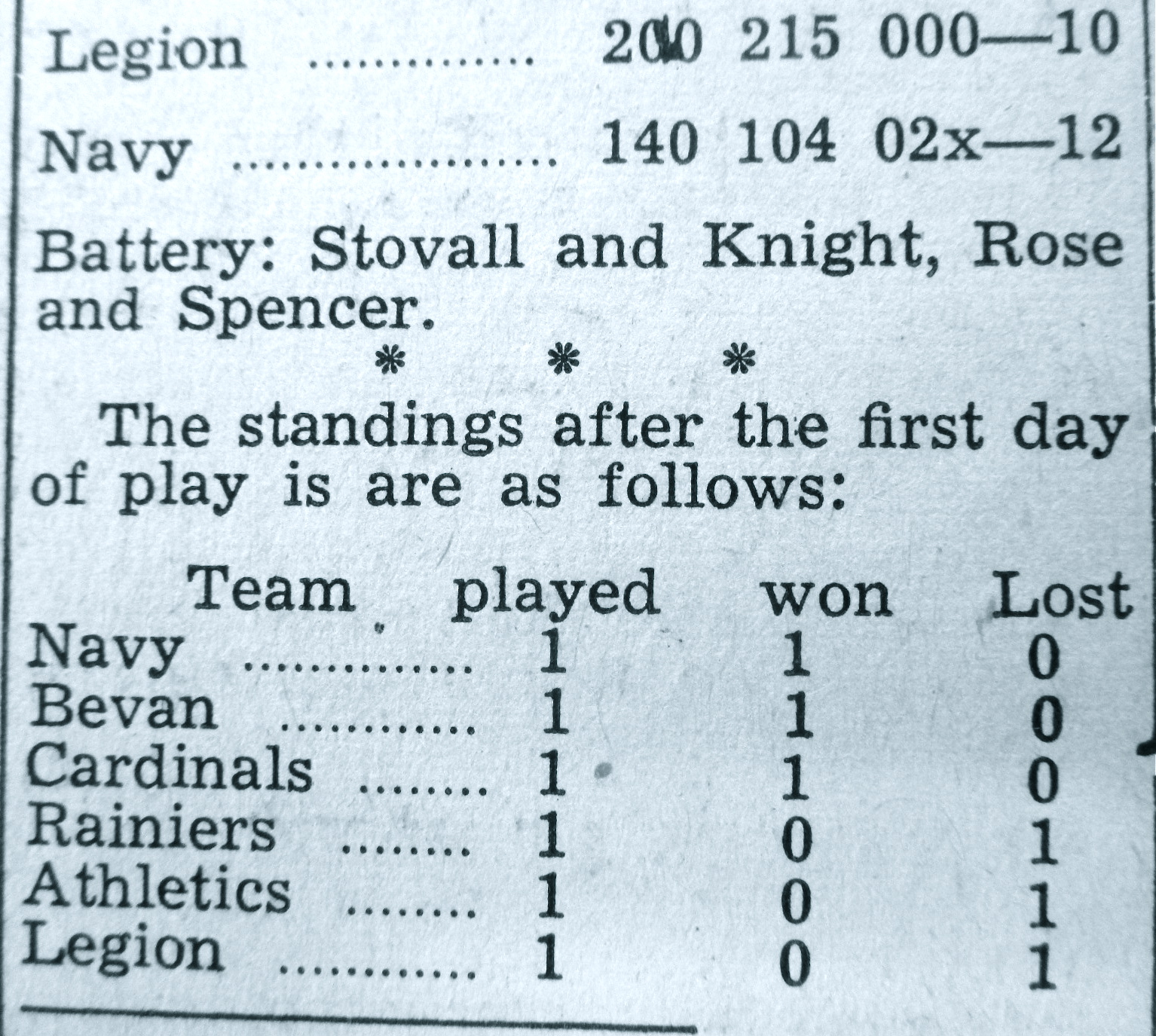
Some first-of-season fastball games continued as scheduled, and the classy Navy team from Givenchy III, anchored by Chuck Rose on the mound and Joe Spencer behind the plate, held their ground:


The Comox Argus, May 10, 1945

Some Canadians in Combined Ops may remember the day they heard - or read in the paper - that they were finally going to get to lock up the last of the landing crafts, hang up their ball gloves.... and start thinking about packing their bags for home.

The Comox Argus, May 17, 1945

 The article says:

The Combined Operations Army School at Sandwick has already been reduced to "care and maintenance" status, and Givenchy III will soon be in the same position.

After acting as O/C of Givenchy III for a year and a half, Commander Windeyer left for his home in Duncan on Tuesday turning over the care of the station to Lieut. J. Calland who is living at Comox with his wife and two children....

Though my father came home in one piece, from training, from two years of hostilities in Europe and about one and a half years of service at Givenchy III, memories of WW2 never left his mind.

My last entry of the feature 'With The Forces' ends with a poignant line:

The Comox Argus, June 14, 1945

"The soldiers have seen too much." We may be able to say the same for all who returned home in 1945.

More research discoveries will follow.


Photos GH