Saturday, April 6, 2024

Research: Three Months in the Mediterranean, 1943 (17)

Allied Troops are Knee Deep in the War in Sicily

Palermo, Catania and Enna (Can. troops) are Hot Spots

C.C.J. Bond, in C.P. Stacey, The Canadian Army 1939-1945: Official
Historical Summary (1948), DND. Red circle denotes Can. troops. GH

Introduction:

The Montreal Gazette ran a lot of stories concerning WWII, especially on a busy Saturday in July. Canadian war correspondents - producing newspaper articles at a very steady clip - kept Canada informed to a very good degree. As well, radio broadcasts became another significant aspect re reporting how Allied troops were progressing, and a few items will be shared in this entry about the Canadian role in getting "on the air" across Canada.

And what about the Canadian Navy boys working hard aboard landing crafts along the eastern shores of Sicily just south of Syracusa? Don't worry, I've got them covered. I've learned that CBC Radio was definitely in their area, i.e., GEORGE Sector, at Fontane Bianche, and I have a few lines to share about that connection later. 

Now, for the news - 


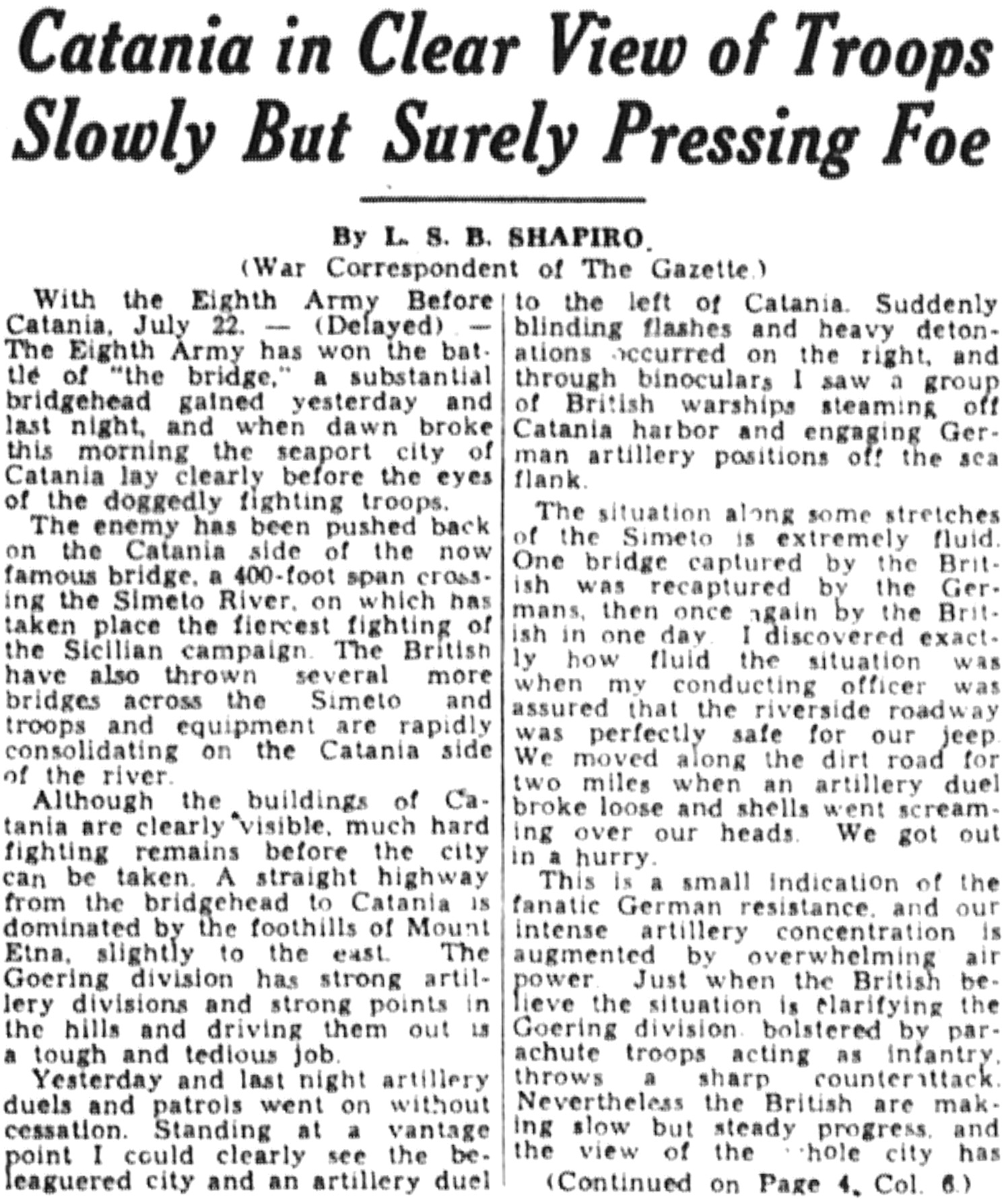
Lionel Shapiro, author of They Left the Back Door Open (re Sicily WWII), and mentioned in the last entry as "missing in action" and "where the heck did he get to?", eventually settled into a lovely routine of sharing buckets of information with his readership in Montreal (and beyond). Here is a lead article re Monty's Eighth Army near Catania:


[About the last paragraph above: Would the majority of Sicilians have somewhat the same attitude today, i.e., "what is Italy's business/concern is not necessarily our business/concern?"]

Map focused on Catania. Modified from map at top of page. 
The Eighth is halfway up the coast but not halfway done. GH

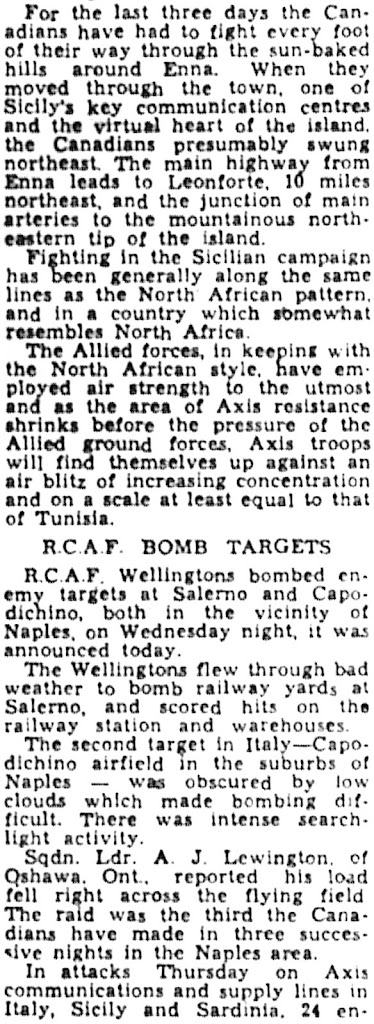
Canadian troops are featured below related to actions in Enna (see red circle in the centre of the map at top of page):


In the third-last paragraph above we read about the masterful use of "booby traps and demolitions" by the Germans, to be expected in the "Troina-Aderno (etc.) area" NE of Enna. If one looks at the map of Sicily below (SE of Enna), the GEORGE Sector aka Beach 44 can be found, home of the RCNVR volunteers connected to Combined Operations (UK organization), who transported all materials of war aboard their landing crafts (the 80th Flotilla of Canadian LCMs) for the use of Monty's Eighth Army. 

Inside the red circle an arrow points toward Fontane Bianche, Beach 44, Sicily.
Dozens of members of the 80th, incl. my father, served in that area for 4 weeks
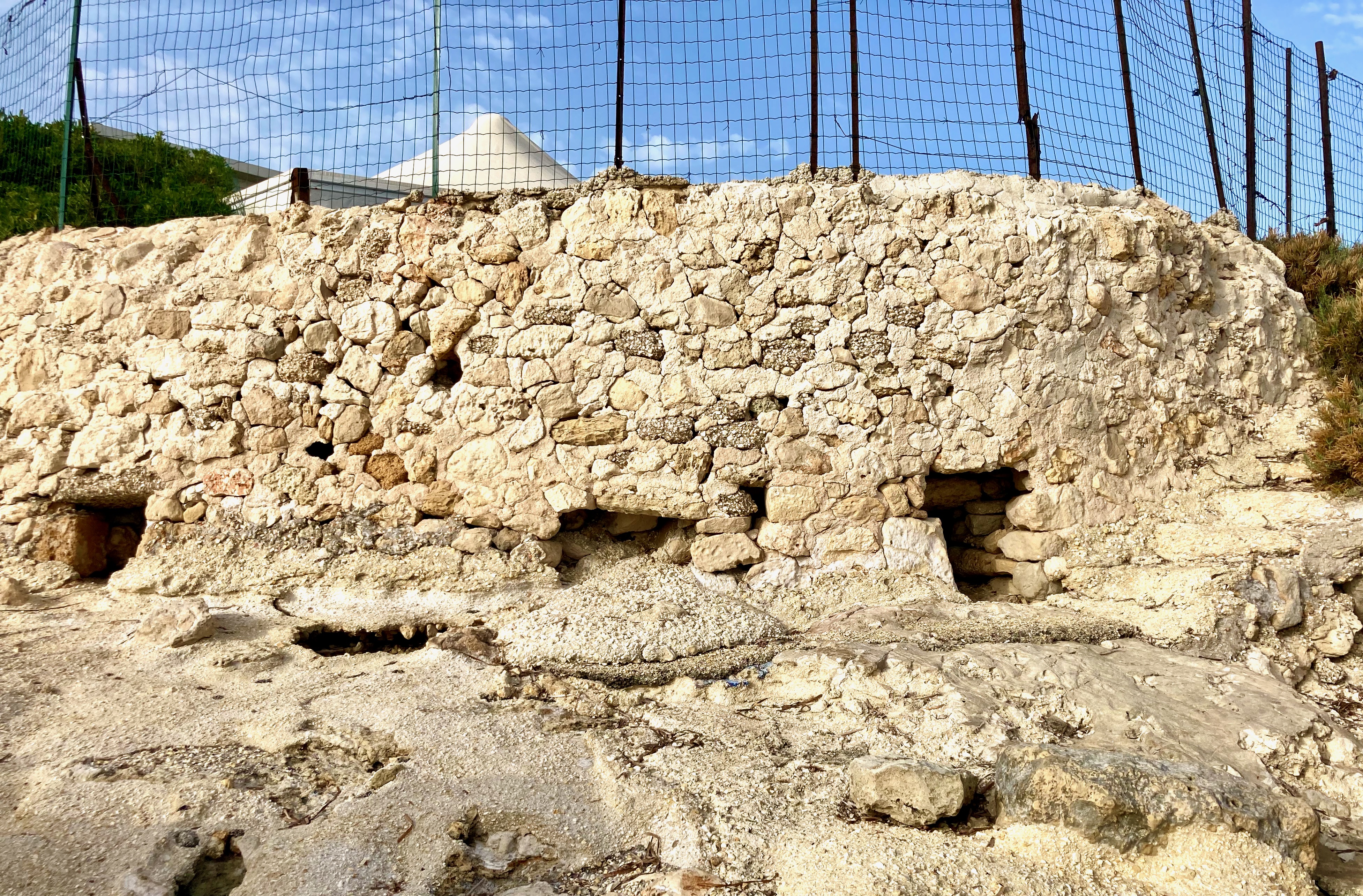
during July 1943, and made two adjoining caves near the beach their home.

About German "booby traps and demolitions" my father wrote the following in his Navy memoirs: 

(After our initial landings) we moved into a limestone cave, dank and wet, but safe from bombs. We hung a barrage balloon over it, about 1,000 feet up, and one sailor got drunk and shot it down but we had 50 - 60 feet of limestone over our heads. We used a pail of sand saturated with gasoline to heat our meals on if any food was available.

I had 27 days at Sicily living on tomatoes and Bully Beef. I swore I would kick the first bull I saw in Canada - right in the posterior - if I got back. Everywhere I looked there were anti-personal hand-sized grenades that needed only to be touched to go off. They were built to maim and not kill because it takes men to look after the wounded, but if you’re dead, you’re dead. We threw tomatoes at a lot and exploded them in that manner. (page 33, "Dad, Well Done")

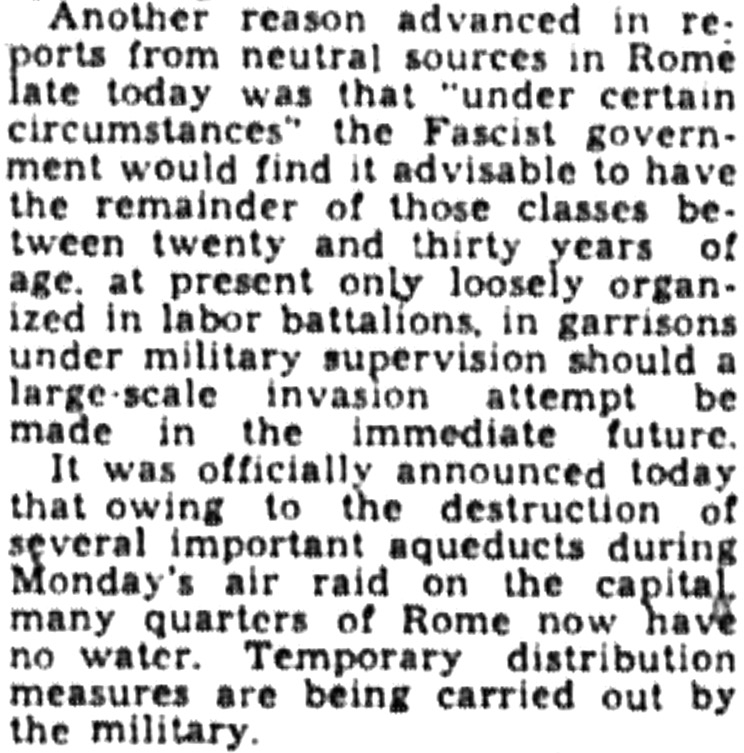
Wanted. More Italian troops!


The Italian "powers that be" are targeting new recruits, while the American "powers that be" are encouraging Allied bombers to target Italy, including Rome:


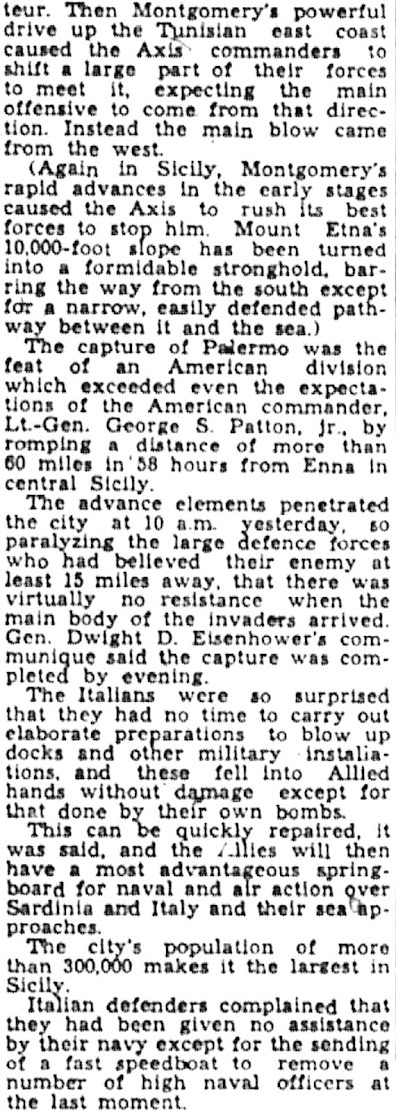
Allied muscle (like a "sledgehammer") is gradually moving across Sicily. Where are Allied armies now and what are they doing?:


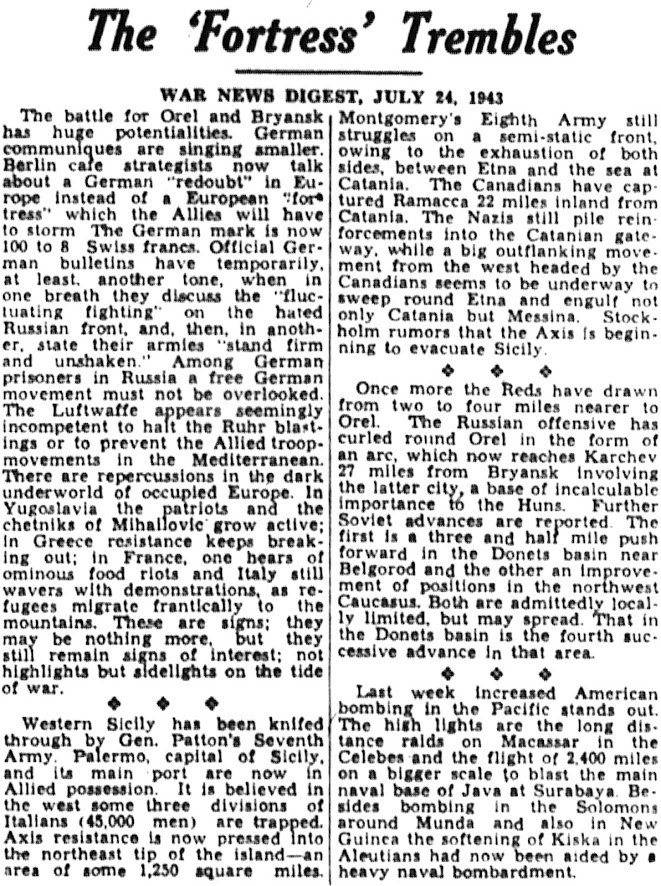
The War News Digest provides details from most of the war fronts, spread around the word:


A Nazi Military Governor announces executions are in order:


I have looked through the following book (copy from a Canadian navy veteran), and though some of the same ideas are listed, I do not think it is the same booklet described above. If you have a copy of a booklet that is described above, please let me know. Email me at gordh7700@gmail.com
 

The injured are well taken care of, but had a long journey to the nearest hospital:


re the third-last paragraph above, i.e., words from a Canadian Army captain from Salmon Arm, B.C.: "...as soon as we began disembarking, machine-gun fire opened. As far as I know we had two injured. One sailor was killed."

The captain had landed SW of Pachino (lower right corner of the map of Sicily at top of page). The sailor was likely British. 

Canadian sailors landed British troops (in LCAs, i.e., landing craft assault), and then all materials of war (in LCMs, landing craft mechanised) as part of the 55th, 61st, 80th and 81st Flotillas of Canadian Landing Craft while serving Monty's Eighth Army south of Syracuse and north of Avola, on the lower third of the eastern coastline of Sicily. 

As we read above, the Canadian troops landed SW of Pachino with some light opposition. Peter Stursberg, a renowned Canadian radio broadcaster, was close by, and describes the scene he encountered as follows:

I landed in Sicily without getting my feet wet. A large amphibious vehicle called a DUKW came alongside the LSI (Landing Ship, Infantry) when we ran into a sandbar and took us ashore. Already anti-aircraft guns were on the beach, and a bulldozer were widening the entrance to a small lane. Landing craft, including large tank-landing craft (LCTs), kept coming in and offloading troops and guns and tanks.

Operation Husky. Men of the Highland Division wade ashore from 
landing craft during the landings in Sicily, 10 July 1943. Photo by

Peter Stursberg continues:

There was a great array of ships in the waters off Pachino Peninsula, a stretch of poor farm land that had been turned into the busiest port in Sicily. A combined operation* was confusion, organized confusion. I recall that I didn't know quite what to do. There was no transportation, no one to report to. Ross Munro had landed earlier, but I could not find him on the crowded beach. So I sat down on the sand and began to write my first story. It was scorching hot; and there was nothing in the sky, not even a cloud. The Sound of War, page 98 

Caption: CBC personnel making sound recording – A. W. Holmes or Alex
McDonald, Peter Stursberg. Note: Photo likely taken in Sicily, inside a van
that carried carefully-manufactured recording equipment. GH

*combined operation - an exercise, raid or invasion that involved planned cooperation and co-ordination of efforts by the three major military forces, i.e., army, navy and air force. (Combined Operations is also a British organization, under the command of Lord Louis Mountbatten during Operation Husky and Baytown - invasions of Sicily and Italy, and more. My father took part in combined operations (e.g., exercises, raids, etc.) while a member of RCNVR and Combined Operations from 1941 - 1945, as did 950 - 1,000 other Canadian sailors.)

It is important to note that while many war correspondents followed the activities of the Allied armies in Sicily (e.g., U.S. troops making their way to Palermo, then to Messina; Canadian troops from west of Pachino to Enna to Mount Etna to Messina; British troops from Avola to Syracuse, Augusta, Catania to Messina), the activities of the Canadian Navy (RCNVR/Comb. Ops) upon which this site focusses, were taking place - for 4 weeks - along the eastern seaboard of Sicily, south of Syracuse. More about that to follow.

But first, some important news from Hollywood!


As many already know, the Canadian Army - after arriving in England - remained on the island for a long, long, long time before being called into action in Sicily. In Peter Stursberg's book, The Sound of War, which details his journey as a CBC radio reporter during WWII, comments are made about the waiting game Canadian troops endured:

Most of my work with the CBC Overseas Unit was reporting on the Canadian troops, visiting their camps, and covering their endless exercises, which were rehearsals for the real thing, as all exercises were. But when would the curtain rise? When would the balloon go up? That is what the rank and file wanted to know. They had been waiting around too long for the battle to begin.

After Dunkirk and the fall of France, the onus for the defence of the United Kingdom had fallen on the shoulders of the Canadians, who were the only fully equipped troops left in Britain. They were the guardians of the island fortress... (they) were stationed in the most vulnerable part of the country, the south coast, and they remained there for so long that the counties of Sussex, Hampshire, and Surry became know as the Canadian country. (page 67)

And now, finally, they're in the fight:


1939-1943: Training in England. Major Hoffmeister leads B Company (sans
drummer-boy) on a route march near the village of Limpsfield in the summer
of 1940. Click here for more details re the Seaforth Highlanders (Canadian)

Lionel Shapiro, of The Montreal Gazette, is keeping readers well-informed:


The "buzz" is as follows. Canadian 'Buzz' Beurling shot a lot of Italian and German planes down!

 
Click here for more about BUZZ from Canada's Aviation Hall of Fame.

I know this photo of a minesweeper isn't much to look at, but some the 950 - 1,000 members of RCNVR who volunteered for Combined Operations, got their first taste of the sea by spending a wee bit of time on a minesweeper off the coast of Halifax in late 1941. One such sailor, Lloyd Evans (from Ottawa) recounts the following:

The new entry training there (i.e. at HMCS Stadacona, Halifax) was the ex-army Wellington Barracks (then C Block of HMCS Stadacona). The training consisted of knots and splices, rifle drill, semaphore, Morse code, ship and aircraft recognition, gunnery drill and parade drill. The highlight of the training was a one-day trip to sea on a Minesweeper for gunnery practice. The whole ship rattled and shook when the 4-inch gun went off. It wasn't all fun - one of our boys was so seasick he pleaded to be thrown over the side! I heard later that he was posted to sea and was just as sick and still pleading to be thrown overboard. He finally got his wish when his ship was hit by a torpedo! (As found in 'My Navy Chronicles' by L. Evans)


A few items from the back pages of The Montreal Gazette close out this lengthy (hopefully informative) entry:


One airfield that the Allies took over was near the British landing site my father became very familiar with, on the east coast of Sicily about one mile from GEORGE Sector or Beach 44 (serviced by the 80th Flotilla of Canadian Landing Craft), between modern day Fontane Bianche and Cassibile).  About a very memorable experience at the airfield my father wrote the following:

One morning in Sicily I woke up in my hammock in our cave (the hammock was slung between two lime-stone piers and above the lizards) and I saw Hurricane planes taking off just a short distance away. We now began working eight hours on and eight hours off. When we were pretty well unloaded I decided, on my eight hours off, to investigate the air strip and, behold, they were Canadians with Hurricane fighters. I arrived about supper time and explained who I was and was invited for a supper of tomatoes and bully beef... Not that again!

“I have no mess fanny or spoon,” I said, and the cook told me there were some fellows washing theirs up and to ask one of them for the loan of their mess fanny and spoon. So I walked over, tapped a man’s shoulder and asked if I could borrow his equipment. The man straightened up and said “sure” and it turned out to be Bill Donnelly from my own hometown of Norwich, Ontario.

I got my oppo, A/B Buryl McIntyre from the cave (at GEORGE Sector, Fontane Bianche) and did the vino ever run that night. Small world. So when we had had enough Bill crawled into his hole in the ground, covered himself with mosquito netting, and we headed back to the cave. Overhead, Beaufort night fighters were giving Jerry fighters and bombers hell. We felt the courage given us by the vino and slept quite soundly in our dank old cave ‘til morning rolled around again. 

From "Dad, Well Done" my father's Navy memoirs. 

K. Simpson's article continues:


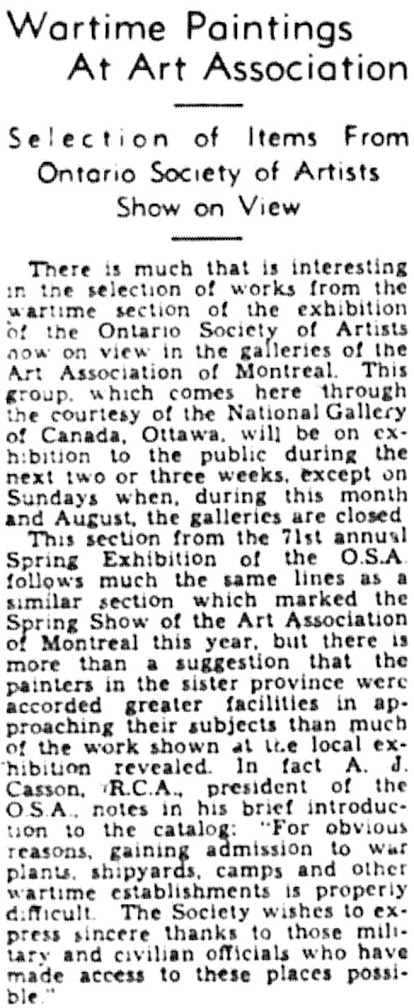
Canadian artists and writers made a long-lasting contribution to the art of war:


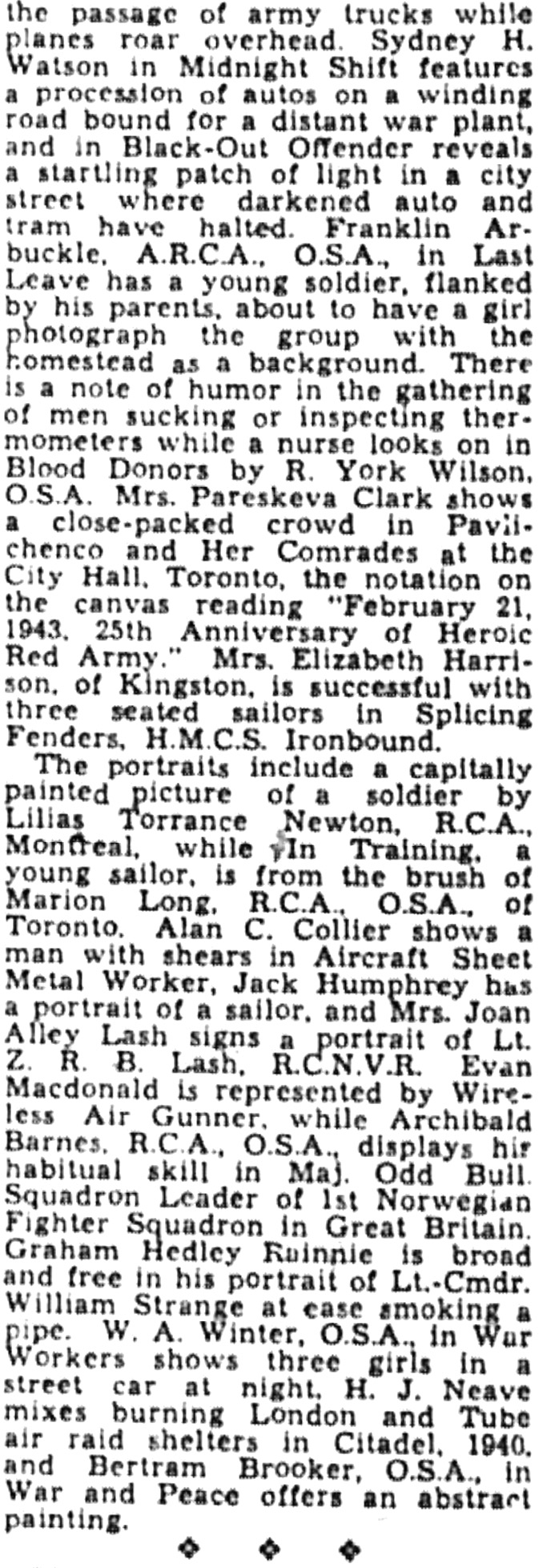
Click here to view entries related to "the arts of war."

I think I've seen a better photo of the wreck below but cannot find it. So, I call for "Help Wanted." If you can find a clean photo of the damaged ship please let me know @ gordh7700@gmail.com


Two short articles, in conclusion:


More news clippings from The Montreal Gazette to follow.

Please click here to view Research: Three Months in the Mediterranean, 1943 (16)

Unattributed Photos GH

Friday, March 29, 2024

Sicily: An Italian Blog re Allied Invasion

The Invasion of Sicily from an Italian Point of View

"Fontane Bianche beach was assaulted by two battalions"

Fontane Bianche beach, Sept. 22, 2023 (aka GEORGE Sector, 1943)

Introduction:

My son and I travelled to Sicily last September (2023), 80 years after the Allied invasion of Sicily (Operation HUSKY, beginning July 10, 1943) and Allied invasion of Italy (Operation BAYTOWN, at the toe of the boot, beginning September 3, 1943). Our interest ran high about the date and destination of our trip because my father, as a member of the Royal Canadian Navy Volunteer Reserve ("We are, we are the RCNVR") and Combined Operations (U.K.) organization, served for four weeks - "ship to shore" i.e., transporting all the materials of war for Monty's Eighth Army - aboard landing crafts, on this very beach above, aka Beach 44.

My main contact in Sicily is a Sicilian film maker and writer who lives 100 km or more north of this beach, at Santa Teresa di Riva, aka Charlie Beach in 1943, a WWII Allied embarkation site during Operation BAYTOWN.

Please note* the slope of the background landscape as it tapers off, left.
A close up of the same coastline appears below, Sept. 2023. Photo GH

Landing crafts replaced by holiday caravans. The same change has taken place
at No. 1 Combined Ops Training Camp in Inveraray, Scotland, 80 years later

* Please note: Yes, I did write the preface for Fabrizio's book. You didn't know I was world famous?

My interest still runs high as I search for more materials re the role of Canadians in Combined Operations during WWII. And though only 950 - 1,000 Canadians enlisted in RCNVR and later also volunteered for Combined Ops (about 1% of the total who joined the Navy between 1939 and 1945), their small slice of Canadian Navy history provides a 'close up' view of many significant events, both directly and indirectly.

Recently, a blog entry by 'Berto' - presenting important details re the Italian defences during Allied landings, from the Sicilian point of view - caught my eye and I encourage readers to take the time to explore the slice of WWII history that took place at Fontane Bianche, Cassibile and other small towns and hamlets, near the very place the 80th Flotilla of Canadian Landing Crafts (including my father) served for four weeks beginning July 10, 1943. 

Many statements or details are not only directly connected to Italian divisions but to the Allied forces (Montgomery's Eighth Army, and Canadian sailors, indirectly) present along Sicily's eastern coastline during the opening days of Operation HUSKY.

Berto's entry begins as follows:


No maps of the area are provided but I have been fortunate to find a few
(Berto's blog has not been active since Oct., 2018 (Send comment!)

Acid North, including Acid Center can be found south of Syracuse, upper right:

South East Sicily: GEORGE, HOW and JIG Sectors were served
by the 80th and 81st Canadian Flotillas of Landing Craft.

The area between Cape Ognina (upper right) and Cape Negro (lower left) was "defended by four strongpoints" says Berto:

Map as found at "Allied Landings in Sicily Museum" in Catania, Sicily

Evidence of the "four strong points" may still exist. My son and I found pillboxes near both ends of the beach at Fontane Bianche, and an air tower was still found at Torre Cuba:

Pill box 200 - 300m from the south end of F. Bianche's beach

Opposite side of above pill box, damaged and repaired

Pill box found on the north side of F. Bianche's beach. Photos GH

Please click here to read an excellent article re "Operation Ladbroke" and "3 Commando - the Storming of Torre Cuba" posted by Ian Murray. The article begins as follows:

3 Commando – the Storming of Torre Cuba

3 Commando’s capture of the Italian strongpoint at Torre Cuba helped prepare the ground (literally) for the surrender of Italy and the signing of the Armistice.

Major Peter Young had a disappointing start to Operation Husky, the Allied invasion of Sicily on 10 July 1943. He was the commanding officer of half of 3 Commando, and he had been ordered to neutralise Italian defences on the shoulder of George Beach*, prior to the main seaborne forces arriving. However he and his men spent the night in their landing craft shuttling from one wrong position to another. They finally arrived off George Beach after the assault waves had gone in and the beach had been captured. Already annoyed at missing the action, he was even more frustrated when his men were then given what was in effect a lowly garrisoning role, well behind the front lines.

*Be sure to click on GEORGE Beach (above) for a "modern day" look at the area.

After the area had been secured, the Allies converted the farmland
around Torre Cuba into Cassibile Airfield. The tower became an air
traffic control tower. Source: NARA (as found at above link)

The first paragraph of Berto's blog entry continues:

These strongpoints were covered by three artillery batteries belonging to the 27th 149/35 mm Artillery Group (Major Giuseppe Mineo), the 79th, 80th and 81st*, located in their rear. The battery that most concerned the British was the 81st, the one in the highest position, located in the Cafici farm in the hamlet of Spingallo**, north of Fontane Bianche.

*re 79th, 80th and 81st artillery batteries... it is an interesting coincidence that the 80th and 81st Canadian flotillas of LCMs were landing Allied materials of war on nearby beaches.

**Spingallo - I could not find a hamlet by this name but did find a 'Spinagallo Rd' going north from Cassibile (just 2 km east or inland of Fontane Bianche, so there may be remains of the hamlet in the area (as well a Spinagallo cave and fossils belonging to a very small elephant species!) ; )

Berto's piece continues:

This battery was one of the two objectives of the No. 3 Commando. At 3:00 in the night of 10 July, 180 British commandos from the No. 3 Commando, led by Lieutenant Colonel John Durnford-Slater, landed near Scoglio Imbiancato (“Whitened Rock”, between Cape Ognina and Fontane Bianche)

My son and I walked the roads and fields between Cape Ognina and Fontane Bianche on two occasions, on the same day, as we searched for suitable caves in which my father and 50 - 60 other Canadian sailors may have lived for 2 - 3 weeks while supplying Monty's Eighth with all manner of supplies (minus a goodly supply of rum) and cannot recall a "Whitened Rock" (Scoglio Imbiancato, circled in yellow below). I would have called the area "Blackened Lava Rock" instead. But the views were glistening as we walked and looked south west toward GEORGE Beach.

The map, re WWII, has many notes, and was scouted by COPP (Combined
Operations Pilotage Parties prior to the invasion. Click here for details re COPP,
and look for section entitled "Sicily reconnaissance - Avola, 24 - 29 June 1943".

Please read the next paragraph (lengthiest so far) in Berto's account that begins "They (3 Commando) silenced an Italian machine gun position that had opened fire on them, and then they moved inland..." and that ends with "The same authorities that had punished him for his ‘excessive’ parental concern now awarded him a posthumous Bronze Medal for Military Valor.." The story of "a small cheese vendor" may help us understand that while visiting a country that was for a time a WWII battle field (even though 80 years ago), it is still home to many, many people who were/are still scarred by what happened to their land and their families - during a fierce battle that had very little to do with most land owners. 

During the day that my son and I explored the fields and ridges near Scoglio Imbiancato we met a retired doctor (age 72) who had been fishing near a lovely beach with his 20-year-old grandson. We chatted, roughly, but connected with enough shared words to inform them we were looking for cattle caves. The doctor felt he knew the location of one, in an area my son felt positive about too because of his research. Off we went, the doctor armed with a saw and clippers from his car, to do battle with brambles and cactus that covered the entrance to a relatively medium-sized but promising hidden cave (home to Romanians for five years, filled with worn, torn mattresses, cooking gear, plastic bins, all material related to poverty and struggle). 

We chattered back and forth about a blackened ceiling and markings on the walls - but nothing that I felt related to Canadian sailors - and after I'd expressed a feeling it was not a strong possibility that Canadians had lived there, the doctor spoke.

"When the Allies attacked this country my mother's house was destroyed and a relative was killed before her eyes."

He was generously helping us but at the same time remembering too that WWII had not treated his family very generously. Buildings in many cities, towns, hamlets and farms in Sicily carry battle scars, bullet holes; minds and hearts and psyches in many corners of Sicily carry deeper scars. I won't soon forget his words, what he worked really hard to communicate. He was no "small cheese vendor" who had "stubbornly fought on with his machine gun, for patriotic pride, for fear, for a sudden surge of sense of duty, for reasons that only he knew" but he was speaking for him. And I'm very glad that my son and I listened attentively and learned a valuable lesson about life and death and war. 

Photos taken as we "explored the fields and ridges (and a cave) near Scoglio Imbiancato":

Remnants of Italian WWII defensive positions?


Inside a cave used for human habitation but not likely for cattle

The flotsam and jetsam of cave life; I was looking for Canadian etchings. GH

Berto shares in his blog a lengthy paragraph concerning the coming to shore of "3rd Army Commando, led my Major Peter Young" at Fontane Bianche, and "its march toward its designated objective, Torre Cuba, to the north-east." After taking control of Torre Cuba the commandos "proceeded towards Torre Ognina, where they demanded the surrender of the small Italian garrison of 17 men, who laid down their arms without resistance."

The map below, found by clicking on "GEORGE Beach" in the article re "The Storming of Torre Cuba" above, has 5 numbers added that reveal the location of significant sites related to the paragraph above, and more:

1. Donna Coraly Resort, home to a replica of the stone marking the site the Italian surrender, Sept. 3, 1943

2. Torre Tonda, a fortified tower farther inland than Torre Cuba

3. Torre Cuba

4. Torre di Ognina, about 1.5 km east of Torre Cuba

5. Gord and son Paul's B&B in Fontane Bianche, so we were within walking distance of many significant WWII sites and clashes:


Gord and Paul at the Donna Coraly resort in September, 2023
The stone marker is not the original. See below

The original stone has once stood in a nearby field

In Berto's entry re 'the landing and the battle for Cassibile and Casanuova' we also find details about the strength and courage related to the Italian resistance from the Allied point of view, a rare occurrence, or so it is suggested:

For a change, the Italian resistance is acknowledged even by the British side, in the memoirs of a Scot soldier who was there and was evidently uninformed, unlike some armchair historians, that the wops were supposed to have come out with their hands raised, eager to be taken out of the war. Then-sergeant James (Jim) Stockman, of the 6th Seaforth Highlanders, later recalled the battle for Cassibile in his book “Seaforth Highlanders 1939-1945: A Fighting Soldier Remembers”. In his memoir book, Stockman recalled that immediately after the landing his battalion had headed towards Casanuova, east of Cassibile, where it was met with strong Italian resistance. The Seaforth Highlanders managed to break this resistance with the help of a company from the 2nd Northampton, which carried out a converging manoeuvre in order to cover the Seaforth’s attack. Once they had stabilized the bridgehead and overcome a number of clashes with Italian infantry and artillery, the three battalions readied themselves for the assault, that would be carried out with the light of the day. Stockman considered it unlucky that Cassibile and its adjacent crossroads were located within his battalion’s landing area, as both of them were tenaciously defended by an Italian machine gun company, supported by tanks, howitzers and high caliber guns, all of them directly pointed at the beaches; this initially caused considerable losses, while they (the Seaforth) were frustrated by the apparent absence of their own artillery. Not even the Navy could help them, as naval guns risked to hit them as well, besides the enemy. It took three bloody hours for the Seaforth Highlanders to take Cassibile and silence those guns, which costed the Scots 40 casualties, including three officers killed. So far, Stockman’s memoirs.

Regular readers will know that my father's memoirs are quoted (admittedly) quite often in my own entries and so I will again because during the first day or two of the Allied landing he carried wounded soldiers out to a Hospital ship (HMHS Talamba) and some were likely the aforementioned Seaforth Highlanders.

Doug Harrison writes:

We had a hospital ship with us named the Alatambra (sic - HMHS Talamba) with many nurses and doctors aboard. She came in to about three miles in daytime and went out to seven miles and lighted up like a city at night. No one was to bomb a hospital ship and for days on end we took the wounded out to her, many being glider pilots with purple berets. Never a sound out of them, no matter how badly they were hurt. Mostly Scotch soldiers.

One night we saw what appeared to be a tremendous bonfire in the east, offshore a long way out. In the morning, the Alatambra was gone, nursing sisters, doctors, wounded and all. Seven hundred and ninety were killed or drowned. The Germans had either bombed or torpedoed her that night. So goes war. (Page 33 from "Dad, Well Done")


Red Star: Talamba sunk, according to a map re the 81st Flotilla, on July 10, first
day of invasion, whereas my father said he took wounded out "for days on end."
Let the debate begin!

Stories related to the brave resistance of other Italian soldiers and officers conclude the entry by Berto.

As I share information about the role of Canadians in Combined Operations during WWII I hope I come across more articles or blog entries, etc., that reflect the Italian or Sicilian or North African (Operation Torch), etc., point of view. And of course, if there is a way to attach some details re the 80th Flotilla of Landing Crafts, I'll continue to do so, hopefully in an understanding and appropriate manner.

Please click here to view more stories about the Allied invasion of Sicily

Unattributed Photos GH